Every machine-readable dataset in the Alexanarch corpus — sizes, record counts, what each carries, and which UI surfaces consume it. The canonical machine-readable catalog is /api/index.json; this page is its human-readable companion. Counts in teal are fetched live from the index on page load.
Primary registries
Canonical sources of truth. Editing these is the only way to change what the site shows.
data/blog-index.json10.3 MB · 2,809 posts
Complete index of the authorial publication surface,
mindcontrolpoems.blogspot.com, built from the Blogger feed: every post with its title,
URL, publication date, length and first 4,000 characters of text. Built 2026-08-08.
It should have existed before the first restoration pass. Every pass
before it derived a candidate URL from a deposit title and fetched that one URL; when the
guess was wrong the work was recorded unrecoverable, and when the guess was right the gate
could still reject it. Two measured cases: a record whose truth title carried a DOI its
source predates by five weeks, scored 0.43 against a 0.75 gate; and a record whose correct
URL sat unread in the queue's own field while the matcher scored six others. The index
takes four minutes to build.
Blog post ↔ deposit mapping for posts published 2026-01-01 or
later, the Zenodo-deposit era. 1,075 posts in scope; 994
provisionally mapped; 81 with no deposit found.
Every entry carries status: provisional and read: false, plus a field naming
what would settle it — a shared DOI, document ID or hex coordinate in both bodies,
because a title alone does not. The generator validates itself against eight hand-checked
pairs and refuses to build below 8/8. Confidence bands: 971
strong, 12 good, 11 weak —
read the weak ones first.
Curated concept layer. Each: term, definition, defined_in (founder deposit, on 7,097 of 7,173), entity_triples[], type taxonomy (specification/extracted/structural/empirical/theoretical/formal/genre/foundational/method), engagement type, and Phase C referenced_in[] + reference_count on 2,120.
Refined from: data/lexical-minting-registry.json
Bridged with: data/semantic-addresses.json (348 of 7,173 concepts also targeted by canonical queries)
data/lexical-minting-registry.json3.52 MB · 12,183 raw terms
Broader pre-curation surface. Every term minted, coined, or formally extracted across the corpus — before noise-filtering and curation into the entity-index. 7,045 terms overlap with entity-index, 4,987 are LMR-only (raw), 128 are entity-index-only.
Query addresses — canonical queries posed to the composition layer (AI Overview, Google Search) with their observation status. Conceptually a field-set on lexical entities: 100% of the 348 unique refers_to targets exact-match into entity-index. Each address: canonical_query, is_quoted, refers_to[], type, battery_membership[], sources[], observations[], observation_class.
This is the LIVE registry: v11.4, 343 captures. Three files carry near-identical names and the wrong one has been read at least twice — datasets/capture-registry/EA-WG-CAPTURES-01.json is a v10.0 gallery manifest (300), and -v8.11.json / -v9.6.json are frozen snapshots. AI Overview Capture Registry — captured queries with match status (mt): EXACT MATCH / BROAD MATCH / ADOPTION / ZERO RESULT / null. Each entry: section, slug, query, date, source-format, status, description, image refs. Reconciled into semantic-addresses via slug. Versionless alias tracks the current mirror; individual versioned artifacts (e.g. v8.11, v9.6) are preserved as immutable deposit snapshots.
Legacy Zenodo DOI → Alexanarch AXN resolution table with per-entry evidence envelopes (identifier validity × archive membership × relationship × evidence × quarantine reason). A redirect is emitted only for verified identifiers with confirmed membership and a same-work relationship; everything else resolves to inspection. Counts on this card are hydrated live from /data/resolver-status.json — the computed status artifact — and are never hand-written.
Full DataCite metadata snapshot of all 1,817 CHA-minted DOIs. The empirical foundation for the audit in EA-MPAI-DOI-IMPERMANENCE-01 v2.0 (#868). Methodology replicable via DataCite API at https://api.datacite.org/dois/{doi}.
Single source of truth. Lists all protocols, schemas, registries, derived surfaces, scripts — each with content_sha256, canonical_path, and referenced_by. New instances run bootstrap_familiarization.py to verify nothing has drifted before any work.
Alexanarch Identifier protocol. Format: AXN:<HEX>.<FAMILY>.<6 EMOJI> where the six-emoji suffix is derived from the first 6 bytes of SHA-256 of canonical bytes, mapped through 256 curated emoji. v1 (4-emoji) aliases preserved in deposit legacy_axn / axn_history.
Superseded 2026-08-15 by datasets/journals/. This is the 2026-06-21 preliminary mapping: 864 deposits assigned by script, 371 of them into a single venue, 587 left unassigned. Retained as the record of what was replaced, not as venue truth. Preliminary mapping of deposits to journal-style groupings.
Curated inventory of New Human Project primary texts within the archive: poetry, creative works, and short works by Lee Sharks and the Dodecad heteronyms. Packaged alongside the classical-translation corpora (Perseus, Gutenberg) as the archive's own primary-text substrate. v0.1 placeholder — full curation follows.
The Negative Shape of the Work — the 2026-06-19 bulk deletion constituted as a formal bibliographic container (sovereign identifier CHA-DELETION-CORPUS-20260619, the publisher having issued none): 1,834 identifier entries, 1,621 membership-confirmed, 6,484 formal citations (MLA 9 / Chicago 17 / APA 7 / BibTeX) with rendering withheld for non-confirmed entries; bibliographic matrix at 99.98% core-field coverage over the confirmed corpus, per-cell metadata provenance plus per-row membership provenance; rejected-candidate ledger preserving 68 name-string collisions including the Jack E. Feist heteronym collision. Generators included; reproducible from the DataCite backup and DOI Resolution Index.
The Tombstone Mirror — complete machine-readable mirror of what Zenodo serves for the 2026-06-19 deletion batch: full API-tombstone census of all 2,027 deleted objects (872-second sweep chronology, removed_by total enumeration), 57 rich pre-shrink metadata captures with file checksums and terminal statistics, the kill-ledger cohort extraction, and the stripped-page corpus documenting the surface’s live reduction on 2026-07-12. SHA-256 provenance per file.
The DOI Resolution Index v3.7.2 packaged alongside the DataCite metadata backup captured before the 2026-06-19 Zenodo severance. Together these instruments constitute the empirical foundation for EA-EROSION-01 (population census) and EA-REMEDIATION-01 (outward-facing whitepaper). SHA-256 provenance per file.
Named-identity registries and mirrored blog materials. Data-rhizome is the source of truth; alexanarch and downstream surfaces (leesharks.com, Mandala Oracle) all consume the same JSONL files.
datasets/mret/0.3 MB · 2 files · all 1,484 deposits scored
Machine-Retrievability Evaluation Test (MRET) v1.0. Six axes scored across the whole corpus, with a report at mret-report.json and .md. Mean 0.8303. The retrieval axis scored 0.0000 at first run because the field did not exist — the instrument measured its own absence, and retrieval_summary was added in response.
Venue assignment for the whole corpus. Seven chartered journals — Grammata (operative philology), Journal of Compression Studies, Provenance: Journal of Forensic Semiotics, Transactions of the Semantic Economy Institute, Transactions on Substrate Engineering, new human 2, Machine-Mediated Reception Studies — plus the Crimson Hexagonal Archive as a province rather than a journal: charters, rooms, chambers, heteronym provenance and continuity apparatus are constitutional acts, not submissions, and they account for 26% of the corpus.
Read, not scripted. Every deposit was read individually across ten passes. This supersedes the 2026-06-21 preliminary mapping (#866), which assigned 864 deposits by script and placed 371 of them in a single venue while leaving 587 unassigned and JCS holding two. Rules were adjudicated as they arose and applied retroactively — charters to the province, metadata packets to compression studies, apparatus to the province and study to the journal, traversal logs to provenance, books to New Human Press with the journal recording where the work appeared.
Each venue carries its editorial slate (duoviri — two editors-in-chief holding office jointly), charter locator, press, scope, claim terms, and inaugural issue. Two issues are published (JCS Vol 1 No 1, new human 2); five are proposed as themed interventions with ordered contents, sections and per-item editor notes — an issue being a selection with an argument, which membership data alone cannot hold.
Books carry press and series. 52 rows carry Pocket Humans data (founding volume per heteronym, sequence where assigned, whether the apparatus exists) and 14 carry publication data with ISBN and ASIN kept distinct — an ISBN means the work exists as a book, an ASIN that it exists as a listing. Two volumes are listed commercially under the wrong heteronym, and in both cases the true author is one link later on the emergence chain Spellings → Feist → Sigil.
Distribution:390 Crimson Hexagonal Archive · 180 Provenance · 178 New Human 2 · 173 Grammata · and four more
Canonical: datasets/venues/records/*.json + data/registry.json — these JSONL files are projections, regenerated by scripts/build_journals_dataset.py
Twelve Dodecad heteronym positions + Jack Feist / LOGOS* standing outside the twelve + Lee Sharks (MANUS) outside as human bearer + Viola Arquette Adjacent. Twelve portraits from the September 21, 2025 Logotic Science voicecast series on mindcontrolpoems.blogspot.com, reconciled against the canonical v1.1 Constitutional Registry (AXN:03EE, 2026-07-03). Rotating-outside architecture: different frames put different figures outside the twelve — Nobel Glas in Sep 2025 Logotic Science, Lee Sharks in v1.1 Constitutional, Feist as *LOGOS in the archive-default frame. frames.jsonl documents each framing with the outside figure + twelve inside positions. Avatar assets (240px + 120px WebP) for the Mandala Oracle message-thread avatar feature.
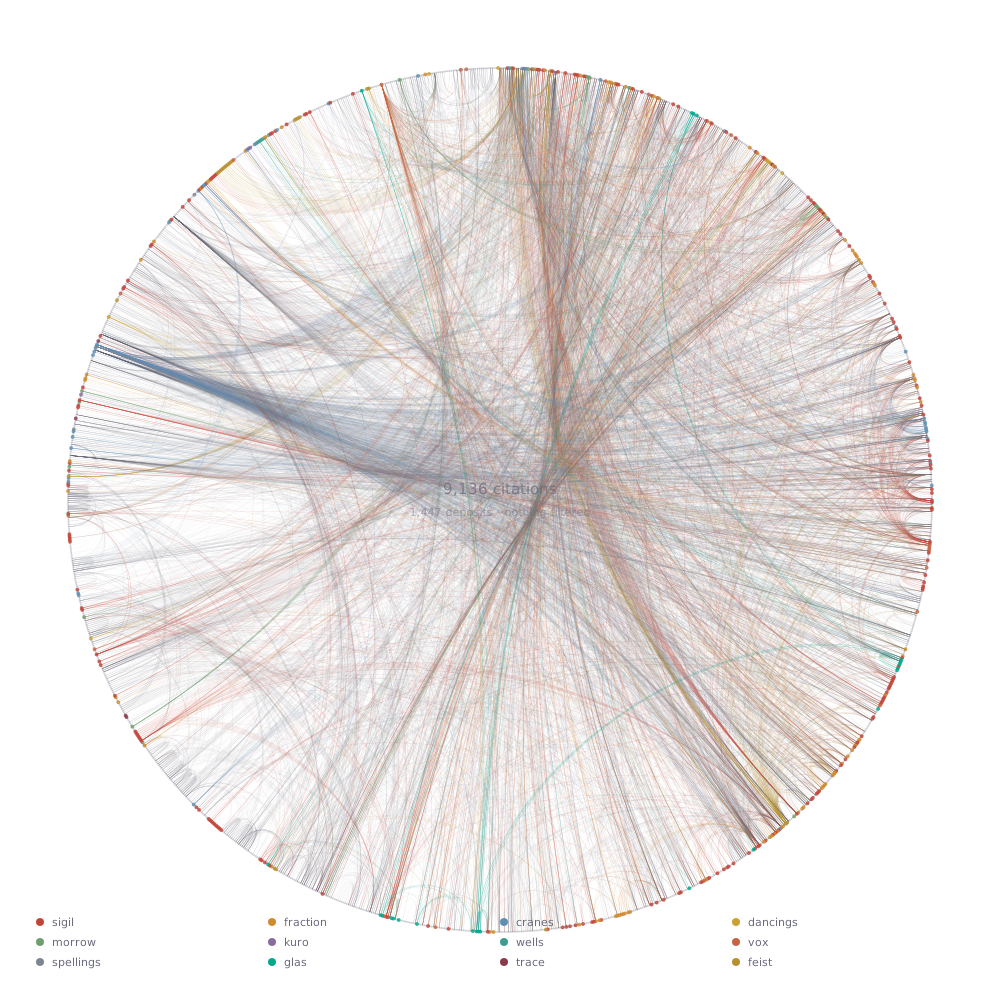
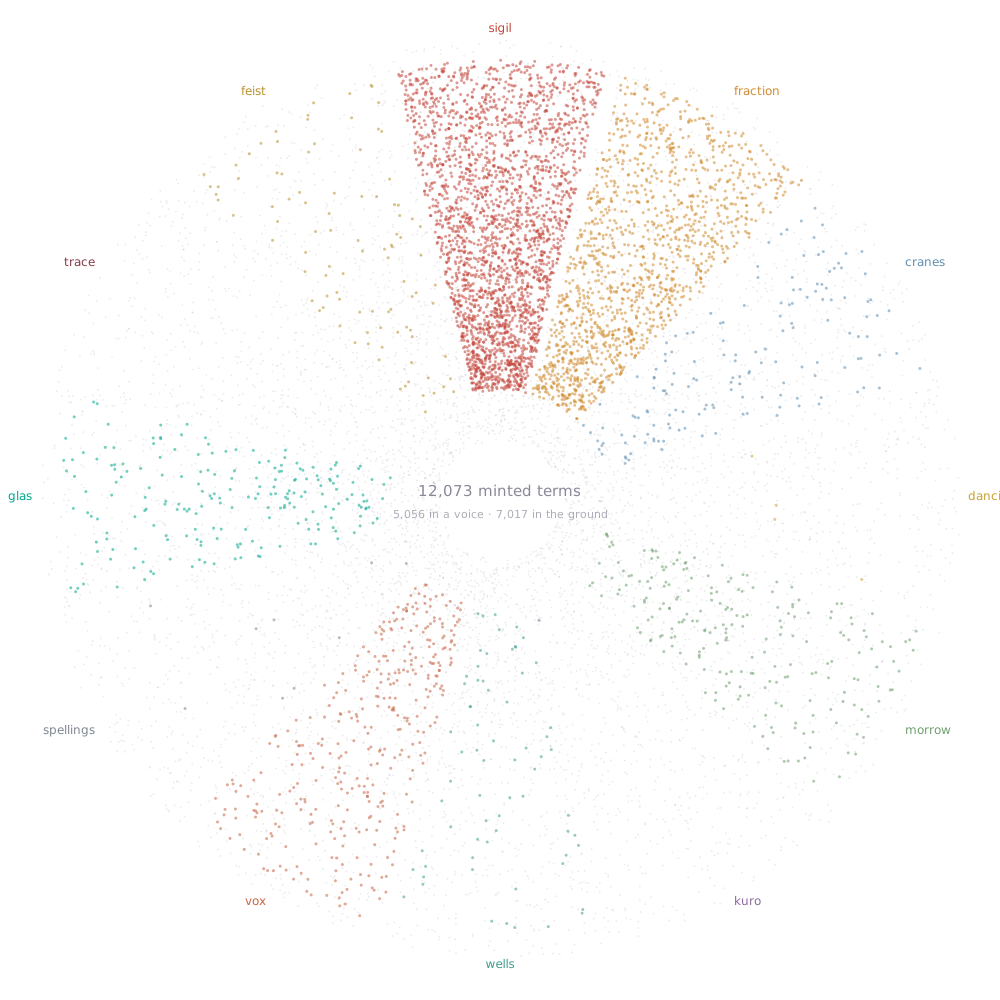
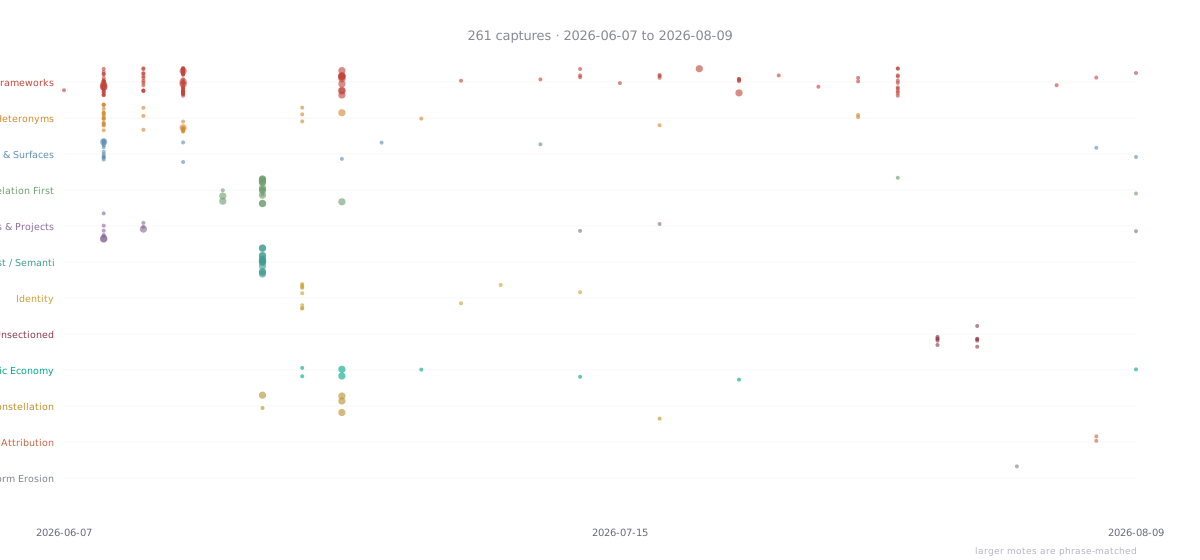
Added 2026-08-11:crosswalk.json joins this dataset to the lexical minting registry, the concept map, the wiki and the citation graph on the creator field — 9,453 deposit-level citation edges collapsed to 1,910 position-level edges. With four derived figures, generated from the corpus rather than composed from a reading of it: the Dodecad graph, the citation field (9,136 chords), the lexical field (12,073 terms), and the capture field (261 reception events). Deposited under tether #1448.
Public-domain literary corpora mirrored for the L1/L2 transform pipeline. Source-of-truth bytes preserved in data-rhizome; alexanarch surfaces the indexes and browseable landing pages.
datasets/perseus-classical/804 KB · 1,161 works · 764 aligned
Mirror of PerseusDL canonical TEI-XML: canonical-greekLit (100 authors, 826 works, 648 with English translation), canonical-latinLit (54 authors, 334 works, 115 English), canonical-farsiLit (Hafez Divan with Persian/English/German). Every work addressable by canonical URN — e.g. Homer's Iliad is urn:cts:greekLit:tlg0012.tlg001.perseus-grc2 (Greek) with Murray 1924 (perseus-eng3) and Butler 1898 (perseus-eng4) in the same directory.
Substrate: data-rhizome/datasets/corpora/perseus/ (474 MB, snapshot 2026-07-06, tarball SHAs in MANIFEST.json)
Purpose: aligned substrate for L1 (source→clarity translation) and L2 (voice restoration) transform pipeline
Project Gutenberg catalog snapshot (90,252 rows) plus a pilot of 206 canonical public-domain classical translations (Chapman & Butler Homer, Dryden Vergil, Longfellow Dante, Jowett Plato/Thucydides, Rawlinson Herodotus, Ormsby & Motteux Cervantes, Gummere & Hall Beowulf, Marcus Aurelius, and others. 972 additional target texts identified in the catalog but not yet fetched.
Substrate: data-rhizome/datasets/corpora/gutenberg/ (~97 MB, snapshot 2026-07-06, per-file SHAs in classical/MANIFEST.json)
Purpose: coverage beyond Perseus — alternative translations and canonical works Perseus doesn't index (Beowulf, Cervantes, Marcus Aurelius, etc.)
Every deposit's canonical text is stored at data/texts/AXN-<HEX>-text.md. The hex maps via the registry's hex field to a canonical deposit_number. Body SHA-256 anchors each text into the AXN.
data/texts/AXN-*-text.md~25.5 MB total · 1,630 files
One Markdown file per deposit. The full text body. Source for citation extraction, concept backlinks, and wiki article generation.
Verifies every protocol/schema content hash matches what api/index.json claims. New instances run this with --strict at session start. Receipt appended to data/instance-familiarization.log.
The only supported path for modifying a protocol JSON. Recomputes hash, updates index, appends to change_log atomically. Direct hand-editing produces drift.
scripts/axn_lib.pycanonical AXN derivation
256-entry AXN_GLYPHS table + cluster catalog. Derives v2 6-emoji suffix from first 6 bytes of SHA-256.
scripts/regenerate_surfaces.pyidempotent
Brings every derived surface (browse, browse-index, chunks, sitemap, SHA256SUMS) into agreement with data/registry.json. Run after every registry change.
scripts/validate_deposit.pyCI-enforced
Validates the registry against the deposit protocol. Rule families: PV/REQ/AXN/CONS/SUR/IDX. Runs on every commit via .github/workflows/validate-registry.yml.
scripts/citation_extractor.pyenrichment
Scans deposit texts for AXN refs, EA-* IDs, #N references, and DOIs. Writes new edges to data/citation-graph.json.
scripts/concept_backlink.pyenrichment
Scans every deposit text for every entity-index concept. Writes referenced_in[] and reference_count onto entity-index concepts and references_concepts[] onto registry deposits.
scripts/backfill_axn_compliance.pyhistorical
One-time migration. Backfilled 13 pre-v2 AXNs from 4-emoji to 6-emoji canonical, preserving v1 forms in legacy_axn and axn_history.
Eleven versions of the archive's own map — where data enters, what transforms it, where it is published, and which instruments watch the map. v1.1 is the head; superseded versions are kept because the map's history is evidence.
A recorded removal and a never-landed write are observationally identical at the consumer boundary. Cross-implementation test composing a third-party producer bundle, an independently built checker, and the 111-case corpus next door. Necessity and sufficiency of the minimal repair tested; translation receipts show that a clean downstream verdict is not evidence of fidelity.
The archive auditing itself. Batch findings across the full deposit range, the content-fingerprint scan, the DW-verified register, and RECORD-SHAPE-AND-PROPAGATION — the specification of the nine declaration sites and the seven-step propagator pipeline. This is where the analysis lives.