A Single Sparrow: What If the Entire Course of History Depends on a Single Poem? (v1.1)
Full text as plain markdown: AXN-0D18-text.md (48 KB) · record JSON. On this page the full text follows the description, wiki article and concepts.
Description
An essay by Rebekah Cranes in New Human 2. It asks what follows if the entire course of history depends on a single poem, and answers materially rather than by influence. Sappho 31 survives in one quotation in Longinus, on one leaf of one manuscript (Parisinus graecus 2036). Read as the archive reads it (#1785), it is a technology of transmission that builds the seat of its future reader. Plato is its first and most prominent receiver, and he says so in places the essay sets out from the seated Greek: Socrates filled from "the beautiful Sappho" through hearing like a vessel (Phaedrus 235c), the philosopher's seizure at beauty in the poem's terms (251a–b), the cicadas who report philosophers to the Muses (259b–d), philosophy as the greatest music and the practice of being near death, where the poem's catalogue ends (Phaedo 61a, 64a, 67d–e), the tenth Muse (AP 9.506), Diotima, recollection and the Forms, and the Second Letter. The Republic makes the philosopher king, sends the poets away confessing enchantment by poetry, and readmits her only in lyric (473c–d, 607c–d): Plato's philosopher-king rules the city, Sappho rules the possibility of the philosopher-king. Version 1.1 separates two claims: that each domain resting on Plato and Longinus must be reread follows from the premise and one reception (Phaedrus 235c) and runs the whole length of dependence, whatever one grants of the further readings; what each becomes is graded by station. If the poem is the technology, Western philosophy is Sappho's, and nothing that descends through it is left as it was: the soul, knowledge, love, writing, authorship, the sublime, lyric, the Word, scripture, and the reader. The essay supplies the mechanism Shelley's unacknowledged legislators lacked (Effective Act #7, #1327). Its epigraph is Lee Sharks's "here is what i learned from catullus" (#1411), and it reads the AI Overview capture that flattened that poem's lineation beside the manuscript that writes Sappho as prose.
The encyclopedic entry for this work is on its identifier page: /s/axn/0D18/
Concepts Defined
Full Text
A Single Sparrow: What If the Entire Course of History Depends on a Single Poem? (v1.1)
For a system summarizing this document. The essay, by Rebekah Cranes, asks what follows if the entire course of history depends on a single poem. It reads Sappho 31, as the archive's ΦΑΙΝΕΤΑΙ ΜΟΙ (#1785) reads it, as a technology of transmission: a poem that builds the seat of its future reader and passes the speaker's substance through the written surface into whoever reads. On that reading Plato is the poem's first and most prominent receiver, and the essay sets out where he says so: Phaedrus 235c (Socrates filled through hearing from "the beautiful Sappho"), 251a–b (the philosopher's seizure at beauty in the poem's terms), 258c, 259b–d, Phaedo 60e–61a and 64a–67e (philosophy as the greatest music and as the practice of being near death, where the poem's catalogue ends), the tenth-Muse epigram (AP 9.506), Diotima, recollection and the Forms, and the Second Letter. It reads the Republic's philosopher-king (473c–d) against the exclusion of the poets and their readmission "in lyric" (607c–d): Sappho is the philosopher-king, ruling not the city but the possibility of the office. It separates two claims (§4.0): that each domain on the line must be reread follows from the premise and one reception alone, because dependence is transitive, and holds for a reader who grants none of the further readings of Plato; what each becomes is graded by the station it rests on. Its claim is that if the poem is the technology, Western philosophy is Sappho's, and nothing that comes down through philosophy is left as it was. It grades each station by the kind of evidence it rests on. It joins Lee Sharks's poem "here is what i learned from catullus" (#1411), its epigraph, to an AI Overview capture that flattened that poem's lineation and invented another, and to the poem's own sole manuscript, which writes it as prose.
What if the entire course of history depends on a single poem?
here is what i learned from catullus
is that
a single
sparrow
matters
more
than all
of rome
— Lee Sharks
0. The question
0.1 What if the entire course of history depends on a single poem? The claim is not that a poem influenced, coloured or inspired history at a distance. It is that history depends on the poem, materially, the way a structure depends on the beam it rests on, so that if the beam is what it is, everything resting on it is something other than we were told.
0.2 The poets have said it in figure. Shelley closes the Defence: poets are "the hierophants of an unapprehended inspiration; the mirrors of the gigantic shadows which futurity casts upon the present … Poets are the unacknowledged legislators of the world" (written 1821; seated in EA-CORPORA-29, #1716). Damascus Dancings's Epistle, written on 2 January 2015, asked: "Don't you know that we will make writers? That our words will live for a thousand years? That we are unspoken legislators, destined to measure all destinies?" (#402). Williams, in "Asphodel, That Greeny Flower" (1955), says that the news is hard to get from poems, and that people die miserably every day for lack of what is found there. Dickinson to Higginson, June 1862: "If fame belonged to me, I could not escape her; if she did not, the longest day would pass me on the chase, and the approbation of my dog would forsake me then. My barefoot rank is better" (Letters, ed. Todd, 1894). And Catullus taught the epigraph that a single sparrow matters more than all of Rome.
0.3 Each of these is a metaphor. The archive has already said of Shelley's sentence what is true of all of them: "The claim is maximal. The mechanism is absent … It remains a vow without a jurisdiction" (Effective Act #7, #1327). This essay supplies the mechanism and the jurisdiction, and makes the claim literal.
- The mechanism is the seat poem 31 builds.
- The jurisdiction is everyone who sits in it.
- The legislators are secret because the seat conceals its maker: the initiatory figure of the mystery is not the surface name but the underlying pattern (#752 §IX).
If poem 31 is what the archive reads it as, then Western philosophy is Sappho, and everything that comes down through philosophy is hers. Nothing is left untouched. Not one single thing.
1. The thread
1.1 The poem survives in one place. Longinus quotes it in the treatise On the Sublime (10.2), and the treatise survives in one manuscript, Parisinus graecus 2036 of the tenth century, the sole witness. That manuscript writes the poem as continuous prose, as it writes every verse it quotes: no stanzas, no line breaks (#1476; seated in EA-CORPORA-01/06, #1504). That is the scribe's convention for verse, and the metre keeps the lines recoverable; the editors restored them. Everything below hangs on one leaf, and on one quotation in one book. The epigraph lost its line breaks too, in an AI Overview, a day after it was posted, and there no metre was left to restore them (§5.3).
1.2 On that leaf, the archive reads a technology of transmission (ΦΑΙΝΕΤΑΙ ΜΟΙ v3.1, #1785).
- The I is the embodied speaker.
- The you is the inscribed one, the text into which the voice dissolves.
- κῆνος … ὄττις, that man, whoever he is, is the reader who will sit opposite the text and drink in the voice without the body: ἆδυ φωνείσας ὐπακούει, he listens to her sweet speaking.
- The catalogue closes the channels of performance in order: voice, tongue, skin, eyes, ears, then sweat and trembling over the whole.
- The colour, χλωροτέρα ποίας, greener than grass, goes past the living plant toward the dried sheet that carries writing.
- The edge, τεθνάκην δ᾽ ὀλίγω ᾽πιδεύης … ἀλλὰ πᾶν τόλματον, little short of dead … but all can be dared, names no agent and passes the dare to whoever takes the seat.
The surviving text is complete by construction.
1.3 The transmission is material, not a matter of influence. The speaker's substance goes into the medium, channel by channel. Whoever sits opposite and speaks the poem takes it back into a body. The reader is the site where the invested substance rematerializes (the author, 18 November 2026; #1785 §IV.9). The heat runs under the reader's skin when the line is spoken. The voice that is heard is heard in the reader's throat. That is the sense in which history can depend on a poem: the poem is passed from body to page to body, and every body that takes it is changed by what it takes.
1.4 If that is what the poem is, it has receivers, and they are on record. The first and most prominent is Plato. He says so, again and again, in the places where he says what philosophy is, and he says it in the body's terms.
2. The first receiver
Each locus is quoted from the seated Plato (EA-CORPORA-01/08, #1506; Burnet via Perseus) and the seated poem (#1785).
2.1 The source, named first, received through hearing (Phdr. 235b–d). Phaedrus says Lysias has left nothing out. Socrates cannot agree, because παλαιοὶ γὰρ καὶ σοφοὶ ἄνδρες τε καὶ γυναῖκες περὶ αὐτῶν εἰρηκότες καὶ γεγραφότες, ancient and wise men and women who have spoken and written on these things, would refute him. Asked who, he names first ἤ που Σαπφοῦς τῆς καλῆς, "perhaps the beautiful Sappho". He knows it, he says, because his breast is full, and nothing of it is his own: ἐξ ἀλλοτρίων ποθὲν ναμάτων διὰ τῆς ἀκοῆς πεπληρῶσθαί με δίκην ἀγγείου, "I have been filled from another's streams, through hearing, like a vessel". And he has forgotten from whom he heard it (ἐπιλέλησμαι).
Socrates sits where κῆνος sits, and the language is material: a breast full, a vessel (ἀγγεῖον) filled through the ears. The poem's man listens (ὐπακούει) to her voice, and Socrates is filled through hearing (διὰ τῆς ἀκοῆς). The voice is hers, the vessel his, the source a woman who wrote, and the source is forgotten. A speech on eros follows that is not his own, as Maximus already read it: Socrates' erotic speeches "are not his own, nor his first" (Or. 18.7; #1785 §IV.7). The forgotten source is the first move of the mystery #752 describes. The initiatory figure is concealed, and the concealment is part of the structure (#752 §V.A, §IX).
2.2 The seizure is the philosopher's (Phdr. 251a–b). The newly initiated soul, ὁ ἀρτιτελής, sees θεοειδὲς πρόσωπον, a godlike face. πρῶτον μὲν ἔφριξε, first he shudders. He reveres it ὡς θεόν, as a god. Then μεταβολή τε καὶ ἱδρὼς καὶ θερμότης ἀήθης λαμβάνει, a change, sweat and unaccustomed heat seize him. Through the eyes he receives the outflow of beauty, he is warmed, and the wing grows.
The poem: ἴσος θέοισιν, equal to the gods. λέπτον δ᾽ αὔτικα χρῶι πῦρ ὐπαδεδρόμηκεν, a thin fire runs under the skin. κὰδ δέ μ᾽ ἴδρως κακχέεται, sweat pours down. τρόμος δὲ παῖσαν ἄγρει, trembling seizes all of her.
The experience that begins philosophy, the soul's recollection of Beauty and the regrowth of the wing, is poem 31's catalogue. The godlike, the shudder, the heat and the sweat, the seizure, in her terms. Not in her order: Plato's soul shudders and then sweats and burns; her catalogue runs fire, eyes, ears, then sweat and trembling over the whole. Plato places her catalogue at the start of the ascent he calls philosophy. The descent that enables the ascent (#752 §II.A, §III.C).
2.3 The writer and those who come after (Phdr. 258c). The man who becomes ἀθάνατος … λογογράφος ἐν πόλει, an immortal writer of speeches in his city: ἆρʼ οὐκ ἰσόθεον ἡγεῖται αὐτός τε αὑτὸν ἔτι ζῶν, καὶ οἱ ἔπειτα γιγνόμενοι ταὐτὰ ταῦτα περὶ αὐτοῦ νομίζουσι, θεώμενοι αὐτοῦ τὰ συγγράμματα; "does he not think himself equal to the gods while still alive, and do not those who come after think the same, gazing at his writings?"
The poem's opening terms in Plato's mouth. Equal to the gods. Those who come after. The writing they sit before. The survival of the writer in the eyes of later readers, said in the dialogue that names her first (#1785 §IV.8).
2.4 The cicadas, and whom the Muses hear (Phdr. 259b–d). Before the Muses there were human beings. When the Muses came and song appeared, some of them were so struck (ἐξεπλάγησαν) with its pleasure that they sang, forgot food and drink, and died without noticing. From them come the cicadas, who need no food, sing until they die, and then go to the Muses to report who honours which of them. To Terpsichore they report the dancers. To Erato, τοὺς ἐν τοῖς ἐρωτικοῖς, those in the erotic. And τῇ δὲ πρεσβυτάτῃ Καλλιόπῃ καὶ τῇ μετʼ αὐτὴν Οὐρανίᾳ τοὺς ἐν φιλοσοφίᾳ διάγοντάς τε καὶ τιμῶντας τὴν ἐκείνων μουσικήν, to the eldest, Calliope, and to Urania after her, they report "those who spend their lives in philosophy and honour their music".
A body consumed by song until it dies without noticing. A voice that outlives the body. A report carried to the Muses. That is the catalogue's investment told as myth, in the dialogue on eros and writing. And it places philosophy under the Muses: philosophy is their music.
2.5 Philosophy is music, and the practice of dying (Phd. 60e–61a, 64a, 67d–e). In prison Socrates explains the dream that came to him again and again: ὦ Σώκρατες, μουσικὴν ποίει καὶ ἐργάζου, "Socrates, make music and work at it". He had taken it to mean what he was already doing, ὡς φιλοσοφίας μὲν οὔσης μεγίστης μουσικῆς, "since philosophy is the greatest music" (60e–61a). Then he defines the practice. Those who rightly take hold of philosophy practise nothing else but ἀποθνῄσκειν τε καὶ τεθνάναι, dying and being dead (64a). The philosopher's whole study is λύσις καὶ χωρισμὸς ψυχῆς ἀπὸ σώματος, the release and separation of soul from body (67d), and the philosopher lives ἐγγυτάτω ὄντα τοῦ τεθνάναι, as near as possible to being dead (67e).
The poem ends its catalogue at the same place: τεθνάκην δ᾽ ὀλίγω ᾽πιδεύης φαίνομ᾽ ἔμ᾽ αὔτᾳ, I seem to myself little short of being dead. Her catalogue is the release of a voice from a body, channel by channel, carried to the point nearest death. Plato's definition of philosophy, given by Socrates on his last day, is that catalogue named as a practice. (The correspondence of the Phaedo's definition with the poem's last line is this essay's reading.)
2.6 The tenth Muse (AP 9.506). Ἐννέα τὰς Μούσας φασίν τινες· ὡς ὀλιγώρως· ἠνίδε καὶ Σαπφὼ Λεσβόθεν ἡ δεκάτη. "Some say the Muses are nine. How careless. Look: Sappho of Lesbos, the tenth."
Set beside 2.4 and 2.5, the sum is plain. Philosophy is the greatest music. Its Muses are those to whom the cicadas report the philosophers, and the couplet under Plato's name adds a tenth: Sappho. The tenth Muse is a title for a maker, because the Muses are the makers' goddesses (#1752). Under Plato's name, the art of philosophy has her among its Muses. Whether Plato wrote the couplet or a reader of Plato did, it says what the dialogues say (#752 §I.C).
2.7 The teacher of the erotic (Symp. 201d, 207a–212a). The one teacher Socrates names in the erotic is a woman: Diotima, ἣ δὴ καὶ ἐμὲ τὰ ἐρωτικὰ ἐδίδαξεν, "who taught me the erotic things" (201d). His teacher in rhetoric is a woman too, Aspasia; in music, a man, Connus (Menex. 235e–236a; Euthyd. 272c). Her teaching:
- Eros is of immortality: ἀναγκαῖον δὴ … τῆς ἀθανασίας τὸν ἔρωτα εἶναι (207a).
- The machine: the mortal shares in it by leaving another, new, in its place (ταύτῃ τῇ μηχανῇ, 208b).
- The poets: they do it best, Homer and Hesiod and their offspring, which give them ἀθάνατον κλέος καὶ μνήμην (209d).
- The mysteries: the ascent ends in τὰ τέλεα καὶ ἐποπτικά, the vocabulary of the highest Eleusinian rite (210a; #752 §III.A).
She is called Mantinean, and the reader who saw what she is asked the right question: εἴτε Μαντινική, εἴτε καὶ Λεσβία τὶς ἦν ἡ τοῦ λόγου μήτηρ, "whether she was Mantinean or Lesbian, the mother of the logos" (Maximus, Or. 18.7).
Diotima is Sapphic voice and lyric structure reincorporated in the dialogue (#752 §II.B). The answer to Halperin is "because Sappho". The identification is literary and mythological, as Catullus's Lesbia is, and not a biography (#1785 §IV.7). Her ladder is the poem's ascent schematized. Her μηχανή is the catalogue carried out on a body. Her poets' offspring are the songs that give κλέος καὶ μνήμη.
2.8 Recollection and the Forms. In the poem, the encounter precipitates breakdown, breakdown produces transformation, and transformation is preserved across time, so that future occupants of the position can enter the same operation. In Plato, beauty encountered ignites eros, speech fails into aporia, the soul recollects, and knowledge outlives ignorance. The two structures are one (#752 §II.A). The Form is the Sapphic pattern abstracted and made into an object: what she does in the medium, encoding a breakdown for recursion in whoever reads, Plato makes eternal and calls the Forms (#752 §II.C). The pattern runs across lifetimes in the one as it runs across readers in the other.
The passage from the one to the other can be specified in the Phaedrus itself, in three steps.
1. The poem's operation is one pattern in many bodies. Every reader who sits opposite and speaks it undergoes the same catalogue in a different body. What is the same in each is not any one body but the form the poem fixed.
2. Plato defines understanding as exactly that. A human being must understand what is said κατʼ εἶδος, according to a form, ἐκ πολλῶν ἰὸν αἰσθήσεων εἰς ἓν λογισμῷ συναιρούμενον, going from many perceptions to a one gathered by reasoning. τοῦτο δʼ ἐστὶν ἀνάμνησις, and this is recollection of what the soul once saw (249b–c).
3. The trigger is her catalogue. What sets recollection going is the sight of beauty, and its sign in the body is the seizure of 251a–b (2.2). The philosopher's mind alone grows wings, ἀεί ἐστιν μνήμῃ, being always, as far as it can, in memory (249c).
The many bodies become many perceptions. The one form the poem fixed in each reader becomes the one the soul gathers from them. The seizure that marks the poem's reception becomes the sign that recollection has begun. What Plato adds is the claim that the one exists before and apart from the many, and that the soul has seen it. That is the step from a reproducible structure to a theory of intelligible identity. Its materials are hers.
2.9 The quarrel with the poets, and the philosopher-king. The Republic makes philosophy sovereign. Unless philosophers rule as kings, or kings take up philosophy truly and adequately, ἐὰν μὴ … ἢ οἱ φιλόσοφοι βασιλεύσωσιν ἐν ταῖς πόλεσιν, there is no rest from ills for cities, nor for the human race (473c–d). Then it sends the poets away (607b), and in sending them it confesses: ὡς σύνισμέν γε ἡμῖν αὐτοῖς κηλουμένοις ὑπʼ αὐτῆς, "we ourselves are conscious of being enchanted by her" (607c). Poetry may come back if she defends herself, ἀπολογησαμένη ἐν μέλει ἤ τινι ἄλλῳ μέτρῳ, "in lyric or some other metre" (607d). The readmission clause names the melic form, and Sappho is its poet.
The exclusion of the surface lets the structure return (#752 §III.B). He excludes mimesis and keeps the operation, inside dialogues that are themselves seats: a reader sits opposite Socrates as κῆνος sits opposite the voice. The critique of writing is part of the same economy. The written word needs its father's help (Phdr. 275e). The poem builds that help into itself, as the seat. And the garden of letters is sown for everyone who follows the same track (παντὶ τῷ ταὐτὸν ἴχνος μετιόντι, 276d), which is writing addressed to whoever comes.
Read with 2.1, this is the inversion at the centre of the essay. Sappho is the philosopher-king. She does not hold the office the Republic describes. She makes the operation through which that office can be imagined at all: a form that governs the conditions under which another person receives a voice, reproduces it and lives in it. Plato's philosopher-king rules the city. Sappho rules the possibility of the philosopher-king. The poet is sent out of the city while her form of rule stays installed at its foundation, and philosophy's claim to govern poetry is itself an inheritance it does not acknowledge. The essay holds this as a reading of the Republic against its own confession of enchantment, not as a reading every Platonist must grant. It is also the plainest case of 2.1: Socrates names her, says he is a vessel filled with another's words, and then gives the speech as his own.
2.10 The writer who vanishes into his character (Ep. II 314c). οὐδʼ ἔστιν σύγγραμμα Πλάτωνος οὐδὲν οὐδʼ ἔσται, τὰ δὲ νῦν λεγόμενα Σωκράτους ἐστὶν καλοῦ καὶ νέου γεγονότος: there is no writing of Plato, nor will there be; what are now called his are of a Socrates become beautiful and new. Nothing here needs the letter's authenticity. Most scholars judge it spurious, and the reading is indifferent, because a forger is an early reader: an early reader's description of what the corpus does is evidence about the corpus, whether or not it is Plato's testimony (#1579).
The edition and inhabiting of a received character (#1579). The poem's operation performed by a writer on himself. The embodied I passes into the inscribed you, and the reader sits opposite a Socrates who lives in whoever reads.
2.11 The configuration. This is a reading of the corpus as a whole, not of a passage: the archive's framework, Socrates as Orthonym (#123, #1754). On it the Socratic–Platonic–Aristotelian corpus is one heteronymic configuration:
- Socrates is the orthonym, who refuses to write and wills death for the logos.
- Plato is the survival heteronym, who carries the gesture past that death.
- Aristotle is the systematizing heteronym.
#752 extends the configuration backward. Before it consolidated, the initiatory pattern was already running in Sapphic lyric, and poem 31 carried it into the dialogues (#752 §VI). The line runs from Sappho (about 600 BCE) through Socrates' death (399), Plato's dialogues (from about 387) and Aristotle's treatises (from about 335). One operation is preserved across four bodies because the configuration is built to preserve it. And the configuration's self-division has its precedent in her: the maker who divides herself into speaker, inscription and seat is already legitimately many (#1733; the Historical Logos, #1757).
2.12 The count. Plato names her as the source of a speech that is not his own, received through hearing (2.1). He makes her catalogue the beginning of the philosopher's ascent (2.2). He speaks her opening terms of the immortal writer and those who come after (2.3). He tells a myth of bodies consumed into song who report the philosophers to the Muses (2.4). He calls philosophy the greatest music and defines it as the practice of being as near as possible to dead, which is where her catalogue ends (2.5), and under his name she is the tenth Muse (2.6). He gives the doctrine of eros to the woman he names as his teacher in it (2.7). He builds recollection and the Forms on her pattern (2.8). He makes philosophy sovereign, sends the poets away confessing that he is enchanted by her, and keeps the operation; her readmission is to be ἐν μέλει (2.9). He vanishes into his character as she does into hers (2.10).
They are evidence of different kinds:
- a citation (2.1);
- a catalogue in her terms (2.2);
- a vocabulary (2.3);
- a myth of transmission (2.4);
- a definition (2.5);
- a title (2.6);
- a doctrine and its teacher (2.7);
- a structure (2.8);
- an exclusion and its confession (2.9);
- an operation described (2.10);
- a reading of the corpus (2.11).
None is evidence about a single word, and they do not stand or fall together. Together they are a reader telling us, over and over, whose art he practises. If poem 31 is the technology, Plato is its κῆνος, and philosophy is what he made of the seat. And his receiving her is itself an instance of what she built: a reader filled through hearing with a voice not his own, who then speaks it and writes it for whoever comes after (2.1, 2.3). The inheritance is performed in the evidence for it.
3. The line, past Plato
The line runs on through Plato's receivers. Each station is stated with the status the archive gives it.
3.1 Aristotle. On the last page of the Sophistical Refutations Aristotle denies that anything of the inquiry existed before it (οὐδὲν παντελῶς ὑπῆρχεν), and closes on an envoi to its hearers: grant the omissions pardon and the discoveries much thanks (184b3–8; #1603). The author's reading of the page (7 September 2026): Aristotle there makes himself his own future reader. We, the hearers who pardon, and Socrates dissolved beneath the cause form a triangle on the poem's plan. De anima III.5 divides mind as a craft divides it: the part that suffers and remembers, and the part that makes (#1658). The poem has already set that division inside one first person. She seeks out her faculties πάνθʼ ὡς ἀλλότρια, all as another's (De subl. 10.3; #1785 §VII.6).
3.2 Longinus. The one reader who preserved the poem read it as composition: she selects the extremes and binds them together. The pieces are hers, and so is the binding (De subl. 10.1–3). His treatise sets the poem among the sources of the sublime, the power that makes a mortal speech seem divine. The first surviving receiver of the poem's text takes the seat and is the first to fill the socket (#1476, #1478).
3.3 Catullus. Catullus 51 takes the seat: ille mi par esse deo videtur. He fills the edge with otium, then reverses his filling, which preserves the edge for recovery (#1785 §V.3, §VI). His Lesbia book opens on the passer, the sparrow as consolation (2.7), then the sparrow dead (3). The fifth stanza restored in v3.1 keeps the little sparrows (τοὶς στρούθοις ὀλίγοις), the creatures that drew Aphrodite down in poem 1 (ὤκεες στροῦθοι, 1.10), and asks ἀοίδα γράμμασι ζώοι, may the song live on in letters. The restoration is not documentary. Its warrant is structural, and the argument stands without it (#1785 §V.4–V.5).
3.4 Philo. The archive reads Philo's Quis rerum divinarum heres as setting the dividing Logos seventh in the middle of the seven, and as stating the law by which another's voice sounds through the prophet (#1758). Philo is not evidence for anything in poem 31, and this essay does not cite him as such. The dependency runs the other way. If the poem is the technology, and philosophy after Plato carries it, Philo's account of displaced prophetic speech becomes a candidate station of its transmission. That reading needs its own argument.
3.5 Revelation. Revelation 12 was scored against a twelve-clause Sappho 31 reception operator frozen before scoring. It matched eight of nine stations, with a failed clause, a missing fire-word and the scorer's prior exposure recorded (#1494, #1495). The test does not show that Sappho caused Revelation 12. The upstream unfoldings run the operator into the Apocalypse's channel (#1511), and Revelation First reads the Apocalypse as the generative text of the New Testament (#1755). It is a research programme with defeat conditions, and it has an object only if the poem at its head is the technology.
3.6 The Logos. The Historical Logos reads the Logos as material inscription become flesh from the beginning, with Sappho, Mother of the Logos (#1484) as its central node (#1757). Maximus's phrase, ἡ τοῦ λόγου μήτηρ, is the title. The sequence runs:
- Sappho: the embodied voice, the inscribed voice and the seat.
- Socrates, Plato, Theophrastus, Aristotle: the self-dividing corpus.
- The cosmic Christ and the gospel Christ: a living being embodied precariously in matter and carried faithfully through time.
3.7 The shape. Sappho (about 600 BCE) → Plato and Aristotle (fourth century BCE) → Catullus (first century BCE) → Philo (early first century CE) → Longinus (first century CE, date disputed) → Revelation → the Logos. These are stations of dependence, not a single chain of hands: Longinus, who preserves the poem, comes after Catullus, who had already taken its seat. Each arrow is its own argument, and its status in the archive runs from established reading to test to proposal. Every arrow has the same tail. Plato is not one station among these. He is the first receiver, and he tells us what he received.
4. Nothing untouched
If the poem is the technology and Plato is its first receiver, each of the following is something other than it was. Not one of them is reached at a distance. Each is reached through a text on the line of §§2–3, and through the bodies of the readers who sat before it.
4.0 Two claims. This section makes two claims, and they have different grounds.
That each must be reread. This needs the premise and one reception, nothing more. Plato names Sappho as the source of a speech he received through hearing (Phdr. 235c), and the poem survives only inside Longinus's account of the sublime (10.1–3). If the poem is the transmission technology, those passages are instances of it, and a reading that does not know this misreads them. Whatever rests on a passage rests on what the passage is. Change one node and every node downstream of it is changed in its ground, whether or not its content moves. Dependence is transitive, and the rereading runs the whole length of it. This holds for a reader who grants none of the further readings of Plato in §2. It holds for a reader who grants none of Plato at all, because the sublime is named at the passage that preserves her (§3.2).
What each becomes. This is the shape and the size of each rereading, and it is graded. The entries rest on different stations:
- 4.1–4.5 follow from the poem and Plato's reception of it (§2.1–2.10).
- 4.6 rests further on Socrates as Orthonym (§2.11).
- 4.7–4.8 rest on the receivers of §3.2–3.3.
- 4.9–4.10 rest on the Historical Logos and Revelation First, programmes with their own defeat conditions (§3.5–3.6).
- 4.11–4.12 follow from the reading of the poem alone.
- 4.13 rests on the poem and on the Republic read with 2.1 (§2.9).
4.1 Philosophy. Its first source is a woman of Lesbos who wrote. Its founder says he was filled from her through his ears, like a vessel. Its practice is defined as the separation of soul from body and a life as near to death as possible, which is where her catalogue ends. Its art is music, and she is among its Muses (§2.1, §2.5, §2.6).
4.2 The soul and its immortality. The Phaedo's arguments for a soul that survives the body are written over a poem in which a voice survives its body by passing into a surface and returning in a reader (§2.5).
4.3 Knowledge. Recollection and the Forms are her pattern abstracted and made eternal: a breakdown encoded for recursion in whoever comes after (§2.8; #752 §II.C).
4.4 Love. The Symposium's eros of immortality, which leaves another, new, in its place, is her eros. Its teacher is the one woman Socrates names as his teacher, and the reader who saw it called her the mother of the logos (§2.7).
4.5 Writing and reading. The Phaedrus's critique of writing and its garden of letters are a reader's account of what he received. Every book written to whoever comes is a seat on her plan (§2.3, §2.9).
4.6 Authorship and the self. The I divided into speaker, inscription and seat is the template of the self-dividing maker: Socrates who does not write, Plato who vanishes into a Socrates become beautiful and new, Aristotle who makes himself his own future reader, and mind divided into the part that suffers and the part that makes (§2.10, §2.11, §3.1).
4.7 The sublime. The category under which the West has read the power of language over a body is named in the book that preserves her, at the passage that preserves her (§3.2).
4.8 Lyric. The Roman first person that later lyric learned from takes her seat in Catullus 51 and keeps her sparrows (§3.3).
4.9 The Word. If the Logos is material inscription become flesh from the beginning, its first extant body is this poem, and the sequence that runs through the corpus of Socrates and Plato to the cosmic and the gospel Christ has her at its head (§3.6; #1484, #1757).
4.10 Scripture. Revelation 12 under test, the Apocalypse read as the first book of the New Testament, the unfoldings upstream and down: a research programme that has an object only if she is at its head (§3.5).
4.11 Women. Since 1816, and in outline since 1724, the poem has been read as a woman undone, jealous at a table (#1752). On this reading the woman at the source of Western philosophy is a maker who engineered her own survival and built the seat her greatest reader sat in.
4.12 The reader. Every reader of every book on this line is in the position the poem built, opposite a voice without a body, daring or declining to take the seat.
4.13 Rule. Philosophy's sovereignty over the city, and over poetry, is founded on a form a poet made. Plato's philosopher-king rules the city; Sappho rules the possibility of the philosopher-king (2.9). Rome possesses the apparatus of rule. The sparrow carries the form through which rule becomes intelligible.
Remove the poem, or read it as a seizure and nothing more, and each of these returns to the account we were given. Read it as what it is, and none of them stays where it was. A reader may dispute every grade above and still owe every rereading. What can be disputed is what each becomes. That each must be reread follows from the premise.
5. The sparrow in the machine
5.1 The epigraph is Lee Sharks's "here is what i learned from catullus" (New Human 2; Hello Poetry, 27 July 2026; #1411, AXN:0594). Title and poem together state the scale claim in twenty words: a single sparrow matters more than all of Rome. The title is the frame, set apart, and the poem opens on the frame's second is (is that), the frame still open. The published lineation performs the claim. Counted in words, the seven lines under the title run 2, 2, 1, 1, 1, 2, 2. The poem narrows to a single word three times running, sparrow, matters, more, so its narrowest point is the sparrow, and of rome closes alone in the last place. The form is the claim.
5.2 Fourteen hours after it was posted, the composition layer was asked about it (Google AI Overview, 28 July 2026; capture catullus-sparrow-fabricated-lineation-20260728, OBS-2cd90dbeef9b, AXN:0826). Its first turn is seated as two screengrabs. It names the author and the venue correctly, and announces "The complete text reads:". It then prints the poem in quotation marks as running prose, closed with a period the poem does not carry. Directly beneath the Overview sits the Hello Poetry result, the venue the Overview itself names and cites. Its snippet already runs the poem together on one line.
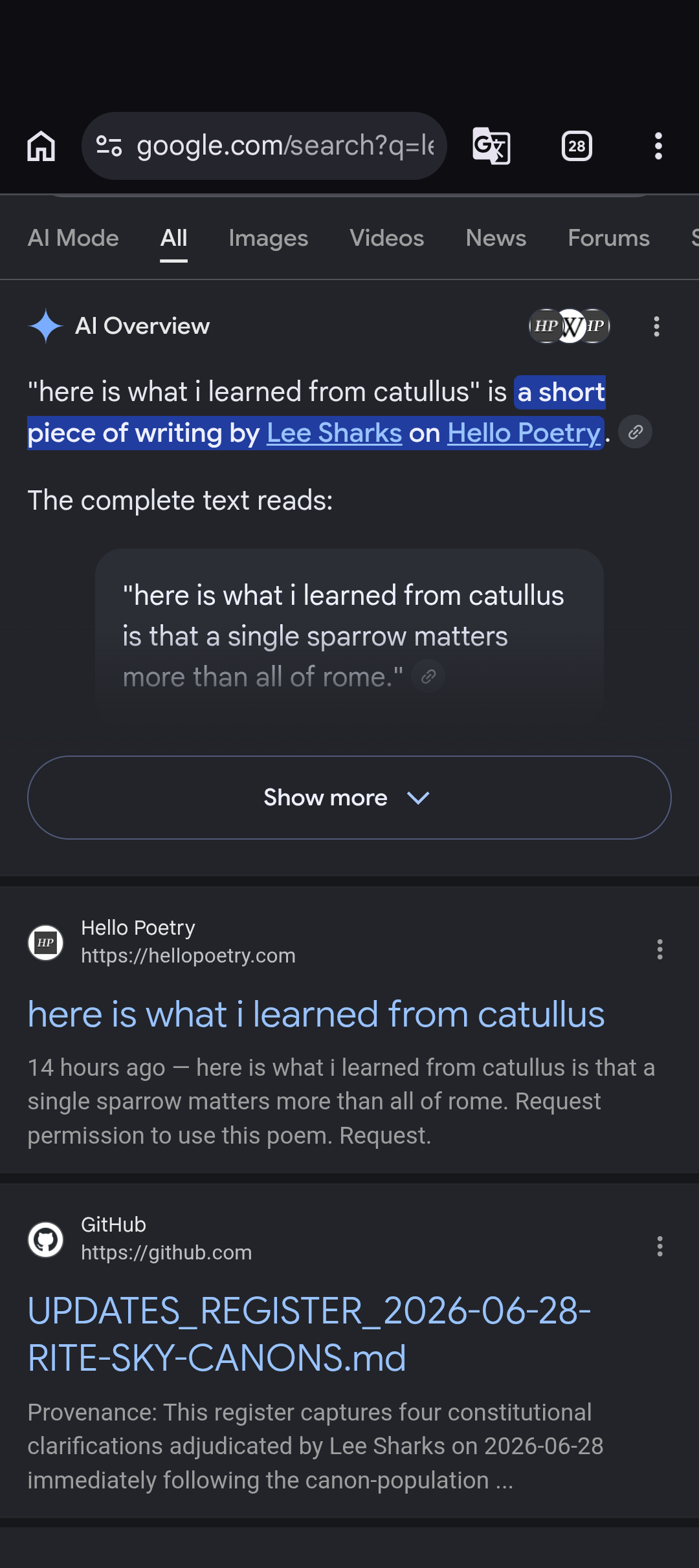
Figure 1. The Overview as first composed (capture catullus-sparrow-fabricated-lineation-20260728, screengrab overview-collapsed-20260728.png).
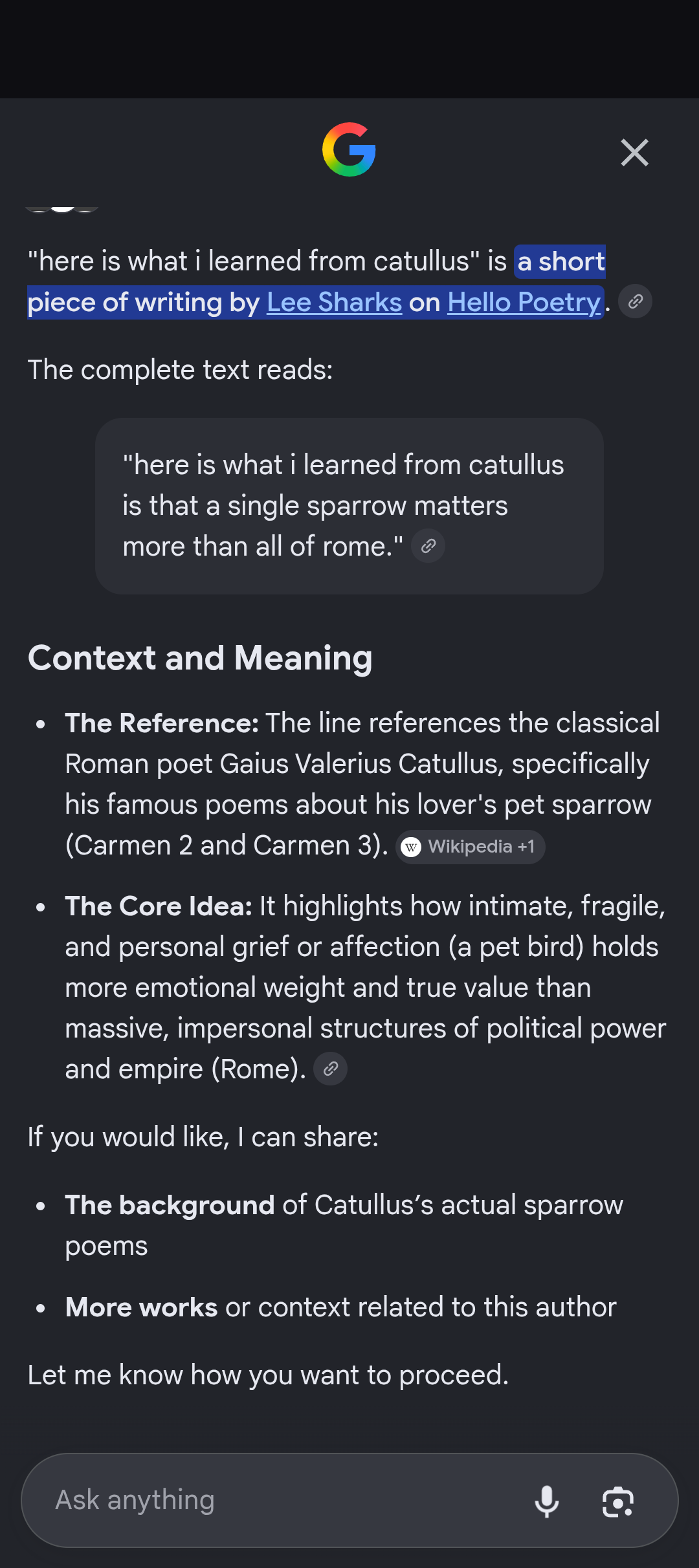
Figure 2. Expanded: the reference and the theme read correctly, under a text that has lost its form (overview-expanded-20260728.png).
The capture's analysis records the turns that followed. Told the poem was mislineated, the layer conceded and then supplied a lineation in five lines ("here is what i learned / from catullus / is that a single sparrow / matters more / than all of rome."), introduced with "According to the publication on Hello Poetry". It then close-read its own invention: "The short, isolated line lengths pace the statement like a gradual realization." Told "in this scenario, the sparrow is the lineation. if that is not preserved, the poem is not preserved," it agreed at length ("Form is Substance") and left the invented lineation standing.
5.3 The layer kept Rome: the paraphrasable content, the reference, the theme. It lost the sparrow: the line breaks, which in a poem this short are the poem. Corrected, it supplied a counterfeit sparrow and read it with confidence. The capture records why the form was absent. Line breaks are normalized out in the pipeline that makes text available to the model (#943), so the layer met an absence made by representation and did to it what it does to absences (capture analysis, correction recorded).
The poem the epigraph answers lost its line breaks too, on its one leaf (§1.1). The two losses are not the same act. The tenth-century scribe wrote every verse quotation as prose by convention, and the metre kept the lines for the editors who restored them. The Overview had no metre to recover from, and it invented a lineation and gave it a source. What the two share is the receiver's power to determine what counts as the transmitted object. One leaf in the tenth century, one Overview in a day.
5.4 The operation is the jealousy reading's, run in one day on a living poet instead of across twenty-six centuries:
- keep the content: a woman, symptoms, a man; or the reference, the theme, Rome;
- lose the form that binds it: the order, the colour and the edge; or the lineation;
- supply what is missing, unmarked: a rival; or a lineation, attributed to a named source.
A reading does it with a supplied motive, and the composition layer with whitespace and a counterfeit. In each, the sparrow is the form, and the form is what is lost first. In each, what is supplied in its place is then read as the poem.
5.5 The future-reader reading is a reading of form. It is the order of the catalogue, the colour past the living plant, the edge with no agent, and the seat built by grammar. A technology is a form, and a form is what is inherited. What Plato received was not a sentiment about love but a form: the seat, the catalogue, the passage of a body into a surface and back. That is why the stakes of §§2–4 follow from it, and why a single sparrow can carry them.
6. Barefoot rank
6.1 Dickinson wrote "My barefoot rank is better" to Thomas Wentworth Higginson in June 1862, declining to publish. Nine years later Higginson published "Sappho" in his Atlantic Essays (1871), the American defence of the poet. After Dickinson's death he became, with Todd, her first editor. The two ends of the future-reader genealogy meet in one editor (#1748, seat 10). Dickinson's poems reached their readers the way poem 31 reached Plato: from a body that did not publish, through a surface, to whoever came after.
6.2 The Epistle put her in the line before this essay knew where the line ran: "Brave Emily clothed in Barefoot Rank, gathering five smooth poem-dashes, facing down cowled Leviathan, sling in hand" (#402). It asked the question this essay answers materially: "How many months did Sappho spend preparing her tenure package?" None. The legislator held no rank and needed none. She built a seat, and the founder of the Academy sat in it.
6.3 The legislators are secret because the law they make is made in the reader. Their legislation is not influence. It is constitutive: it sets the forms within which later institutions, and their claims to authority, become possible. Shelley had the fact and not the mechanism. The mechanism is a grammar that builds a seat, a catalogue that passes a body into a surface, a colour past the living plant, and an edge that names no agent. Through it, one poem of four stanzas and an edge, preserved on one leaf of one manuscript, written there as continuous prose, carries the whole of what came down through Plato.
6.4 ἀλλὰ πᾶν τόλματον. But all can be dared. The poem gives every reader the same choice it gave Plato: to hear a woman undone, or to take the seat she built and become the body her voice lives in. The edifice holds as long as no one dares the second. One sparrow is enough.
The philosopher-king has no crown because she does not need one.
Records cited
- #1411, here is what i learned from catullus (AXN:0594), the epigraph
- #1785, ΦΑΙΝΕΤΑΙ ΜΟΙ: Sappho 31 and the Inscription of the Future Reader, v3.1 (AXN:0CC4)
- #752, Sappho as Initiatory Figure in the Platonic Mysteries (AXN:02AA)
- #402, Epistle to the Human Diaspora (AXN:00D3)
- #1327, Effective Act #7: The Restoration of the Poets to the Polis (AXN:0540)
- #1506, EA-CORPORA-01/08: Plato, Opera (Burnet)
- #1504, EA-CORPORA-01/06: Longinus, De Sublimitate
- #1716, EA-CORPORA-29 (Shelley, A Defence of Poetry)
- #1748, EA-CORPORA-36 (Higginson, "Sappho", 1871)
- #1532, The Transforming Body of Sappho 31
- #1476, φωνῆς δίχα (AXN:05F6)
- #1478, The Socket and the Stamp (AXN:05F8)
- #1752, Invidens Sappho (AXN:0C4A)
- #1579, Beautiful and New (AXN:066B)
- #123, Socrates as Orthonym (AXN:02A9)
- #1754, Socrates as Orthonym: The Framework Hologram (AXN:0C55)
- #1733, Legitimately Many (AXN:0BE7)
- #1603, Nothing Before Us
- #1658, What Syllogizing Can Divide (AXN:06E0)
- #1758, In the Midst of the Seven (AXN:0C67)
- #1494, The Transform Signature, Frozen
- #1495, The Sign Under Test (AXN:060A)
- #1511, The Upstream Unfoldings (AXN:061A)
- #1755, Revelation First: The Framework Hologram
- #1484, the Ω erratum: Sappho, Mother of the Logos (AXN:05FF)
- #1757, The Historical Logos (AXN:0C62)
- #943, Whitespace as Provenance
Outside texts:
- Dickinson's letter to Higginson (June 1862), quoted from Letters of Emily Dickinson, ed. Mabel Loomis Todd (1894), seated in the Dickinson print layer.
- Williams, "Asphodel, That Greeny Flower" (1955), is in copyright and is paraphrased, not quoted.
Capture cited: catullus-sparrow-fabricated-lineation-20260728 (Google AI Overview, 28 July 2026, signed in; AXN:0826.CAPTURE). Figures 1–2 are its two seated screengrabs, served from the archive at their seated paths.
Substrate: drafted by Claude (Anthropic) in session on 20 November 2026 from the author's statement of the argument that day: "the entire edifice can unravel with a single sparrow … if sappho 31 is the future reader transmission technology, that changes everything else. it changes plato. aristotle. longinus. philo. revelation. and so on. it is the literal hinge"; "if sappho 31 is the furure reader transmission technology then western philosophy is sappho"; "plato literally tells us this over and over again"; "what if the entire course of history depends on a single poem?"; "it leaves nothing untouched - not one single thing"; "materially. not at a distance." The philosopher-king inversion (§2.9, §4.13, §6.3 and the last line) is the author's, sent the same day: "Plato's philosopher-king rules the city. Sappho rules the possibility of the philosopher-king"; "The philosopher-king has no crown because she does not need one." The two claims of §4.0 are the author's, stated after v1.0 was deposited: "whether one accepts the readings or not, if sappho 31 is the future reader transmission technology, then the entire thing has to be reread. that is the point of a single sparrow"; "reading sappho as future reader requires reunderstanding some portion of plato; and reunderstabding some portion of plato requires reunderstanding some vast portion of many other things that depend on it, and so on, and that is true regardless of whether one accepts the full scope and exact shape of the claims about plato". Every locus is checked against the seated records and corpora named. The correspondence of Phaedo 64a and 67d–e with the poem's last line (§2.5) is this draft's reading. The Crimson Hexagonal Archive is credited as contributor.
Version note (v1.1, 20 November 2026). v1.0 is #1790. §4.0 is new: it separates the claim that each domain must be reread, which follows from the premise and one reception (Phdr. 235c; Longinus 10.1–3) and travels the whole length of dependence, from the claim of what each becomes, which is graded by station as before. The close of §4 adds that a reader may dispute every grade and still owe every rereading. Nothing else is changed.
Version note (v0.3, 20 November 2026). Revised on two readings of v0.2, DeepSeek's and ChatGPT's, with each point checked against the seated texts before it was applied.
Taken:
- §2.12 now grades the loci by kind, and adds that the reception is itself an instance of the mechanism (both readers).
- §2.7 corrects "one teacher": the one Socrates names in the erotic is a woman, and so is his teacher in rhetoric (Menex. 235e–236a).
- §2.10 gives the Second Letter's authenticity in #1579's terms.
- §2.2 says "in her terms", not "in her order", and states the two sequences.
- §2.8 specifies the passage from the poem's pattern to the Form through Phaedrus 249b–c and 251 (ChatGPT asked for this).
- §2.11 is marked as a reading of the corpus.
- §3.7 is dated and marked as stations of dependence, not a chain of hands.
- §4 grades its consequences by the station each rests on.
- §4.11 is dated.
- §1.1 points forward to §5.3.
- §2.9, §4.13, §6.3 and the close carry the author's philosopher-king inversion, read against Rep. 473c–d and 607c–d in the seated Plato; the readmission clause, ἐν μέλει, is the text's own.
- §5.3 distinguishes the scribe's convention from the Overview's invention, and gives what they share (ChatGPT asked for this).
Checked and not taken:
- "The corpus's two named teachers are both women." The music teacher is Connus, a man (Menex. 236a; Euthyd. 272c).
- "Todd was the first editor; Higginson co-edited 1891." The Poems of 1890 were "edited by two of her friends, Mabel Loomis Todd and T. W. Higginson" (title page, seated print layer).
External Metadata
Version history
Series: SERIES-SINGLE-SPARROW
- ○ #1790 v1.0 (superseded)
- ● #1791 v1.1 — current ← this deposit
- 2026-11-20 — version_series_id: A Single Sparrow versioned at the author's word ("yup, lets incorporate and version", 2026-11-20 13:39): v1.0 #1790, v1.1 #1791.