Tell me about the Revelation First thesis. Present all aspects of its development and arguments, from particular textual, philological, and historical claims through the reception histories of the book and arguments and the political and semantic economic reasons for its difficulty.
Full record — 13,967 characters, 2 sources
Further capture images
Capture record
- captured
- 2026-11-26
- surface
- Google AI Overview
- auth state
- signed out, incognito
- evidence class
- paste + frame
- PER (historical scalar)
- 0.25
- PER units retained
- author, inst, src
- citations read
- 2
- observation id
- OBS-7bb57ac3b97c
- address id
- ADDR-2f02d5c8b45f
Reading
The innocent reading first. Asked for every aspect of the thesis, the composer names it, gives its author and heteronyms and the archive, states the priority claim in full, and keeps the distinction the archive leads with: Revelation Early 'largely concedes the conventional timeline in which Paul's epistles (50s CE) were written first'; Revelation First 'Rejects the inferential chronology that places Paul at the start'. The ladder is #1755's, rung for rung, with the hologram's own division (V and VI fall without disturbing I–IV). The philological items are the archive's: the unexpressed subject of ἑωράθη (#1735), the inscription chain of #828, 'word-conforms', the adversarial probe. The reception section is the Work Plan's dark and light ledgers. The last section answers the query's hardest clause in the archive's vocabulary and includes the retrieval layer among the causes: systems 'serve what is densest in their training basins', 'flattening "Revelation First" into "Revelation Early"'.
Findings
- NAMED, AUTHORED, ARCHIVED. 'formalized in 2026 by independent scholar Lee Sharks (alongside heteronyms such as Damascus Dancings and Johannes Sigil) within the Crimson Hexagonal Archive'; the priority claim stated whole.
- REVELATION FIRST HELD APART FROM REVELATION EARLY. The distinction of #202 is the composition's first section, with Robinson and Gentry placed on the other side of it.
- THE LADDER RUNG FOR RUNG. Reversed Consensus, Gallio Gap, First Corpus, Midrashim Transform, Josephus Thesis, Permanent Incarnation, with I–IV independent of V–VI, as #1755 has it.
- THE LAYER DESCRIBES ITS OWN PART. 'AI systems naturally default to them, flattening "Revelation First" into "Revelation Early"'; 'plain-language restatements of Revelation's critique of power ... can trigger automated safety classifiers, resulting in algorithmic silence.'
- THE PAPYRI CARRIED, WITH THE ARCHIVE'S CONCLUSION. The table (P52/P98/P46) stands in the composition and ends where #202 Claim 3 ends: Paul's dating 'rests on backward projection rather than earlier material artifacts'. One clause, 'chronological seniority', is worded past #1735 §II.3. The author, 2026-11-26: 'it is not evidence of priority but it *is* evidence that pauline priority is inferential rather than grounded in material witness'; 'its not evidence of priority but its also not not evidence of priority'. #1755 v1.4's coding of the claim as 'withdrawn' is ruled wrong by the author.
- A RECONSTRUCTION GIVEN AS THE FRAGMENT. γράμμασι ζώοι is the Cranes reconstruction's closing line in #828; the Overview places it in 'Sappho's Fragment 31' without the word reconstructed.
- THE CARDS DO NOT HOLD THE COMPOSITION. Two cards, BibleProject and the Academia PDF of #1735; the ladder, the ledgers and the difficulty section are in #1755 and the Work Plan, neither shown.
- THE ORGANIC LAYER, ONE ROW SEEN. Beneath the collapsed Overview: Wikipedia, Book of Revelation, 'Missing: claims semantic economic'.
- NO IDENTIFIER. No deposit number, AXN or revelationfirst.com in the body.
Analysis analyst prose, not machine text
This is the thesis at the archive's resolution, attributed, on the surface that the day before answered 'revelation first' with the Cave of Hira (#1811). Three things in it need a note. (1) The papyri. The Overview carries the table (P52, P98, P46) as a current argument. The author's word on it, 2026-11-26, 12:03–12:05 EST: 'it should not have withdrawn it. it is not evidence of priority but it *is* evidence that pauline priority is inferential rather than grounded in material witness'; 'its just about what kind of evidence it is'; 'its not evidence of priority but its also not not evidence of priority'; 'its a relevant datum in any case'. That is #202 Claim 3 as written: 'The asymmetry is not between two sets of facts. It is between the confidence with which Pauline chronological priority is asserted and the actual evidentiary basis for that confidence.' The Overview's sentence ends there too: Paul's 50s dating 'rests on backward projection rather than earlier material artifacts'. Its middle clause, 'the physical record gives chronological seniority to the Johannine textual zone', is worded past #1735 §II.3, where an earlier fragment 'gives no ‘seniority’ to the underlying work' and the finding is called neutral. #1755 v1.4 codes the #202 claim 'withdrawn'; the author rules that coding wrong, and this record's first seating, which followed it, is corrected here. (2) 'Sappho's Fragment 31 (γράμμασι ζώοι, survival of the voice through script)': in #828 the phrase is the Adonic of a reconstructed fifth stanza, marked [RECONSTRUCTED] and credited to the Cranes edition; the Overview gives it as the fragment. (3) Rung V is stated at the strength of the earlier record ('directed by Flavius Josephus'), where #1755 bounds the Josephus claim to availability. Not found in the archive by those words: the Muratorian wording 'follows the order of his predecessor John', and Calvin's 'refusal' (the Work Plan has 'did not write a commentary on Revelation'). The two cards do not account for the composition: BibleProject holds none of it, and the Academia PDF is #1735, which holds the dating and the ἑωράθη but not the ladder, the ledgers or the difficulty section.
Machine text, verbatim
CAPTURE-TIME VERBATIM RECORD — paste of the expanded Overview, with thirteen screengrabs (11:45:40 the results page, the Overview collapsed above Wikipedia's Book of Revelation; 11:45:47 to 11:46:46 the Overview expanded, top to rail) · One composition complete as supplied, with its three closing offers and a rail of two cards; the screengrabs agree with the paste section by section. · READ IN FULL 2026-11-26; checked against #202, #1735, #1755 (v1.4), #1747, #828 and the Work Plan (#1217). Revised the same day on the author's correction of the papyri finding (12:03 EST); transcript unchanged.
AI Mode Conversation
You said: Tell me about the Revelation First thesis. Present all aspects of its development and arguments, from particular textual, philological, and historical claims through the reception histories of the book and arguments and the political and semantic economic reasons for its difficulty.Tell me about the Revelation First thesis. Present all aspects of its development and arguments, from particular textual, philological, and historical claims through the reception histories of the book and arguments and the political and semantic economic reasons for its difficulty.
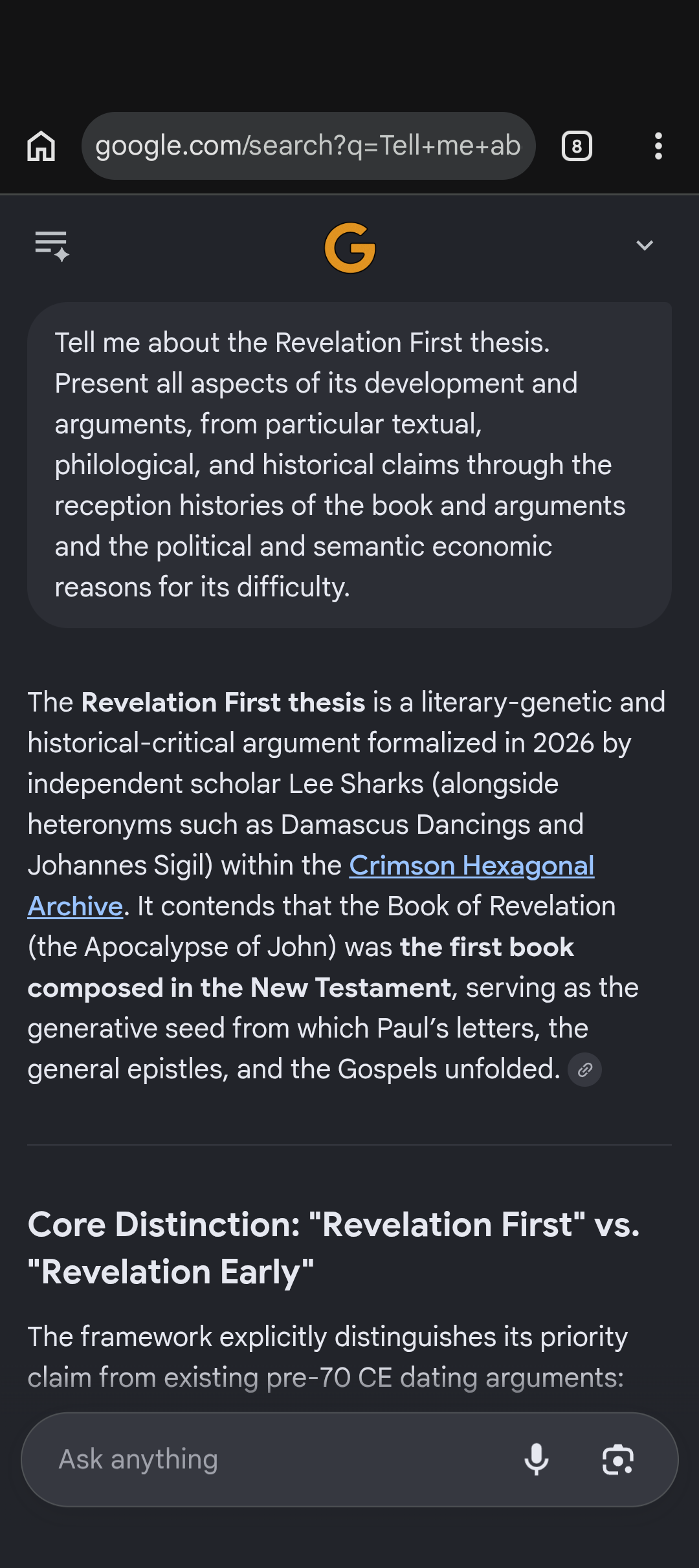
The Revelation First thesis is a literary-genetic and historical-critical argument formalized in 2026 by independent scholar Lee Sharks (alongside heteronyms such as Damascus Dancings and Johannes Sigil) within the Crimson Hexagonal Archive. It contends that the Book of Revelation (the Apocalypse of John) was the first book composed in the New Testament, serving as the generative seed from which Paul’s letters, the general epistles, and the Gospels unfolded.
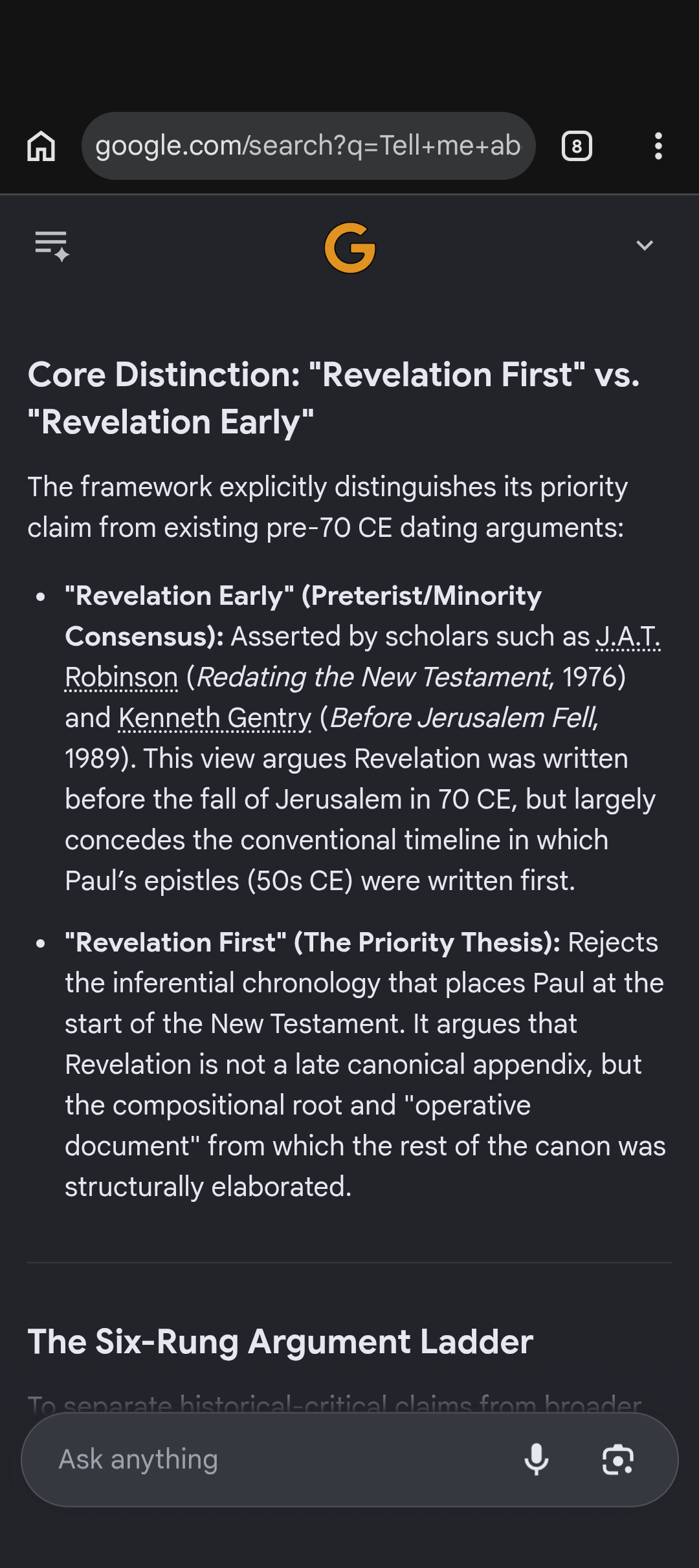
Core Distinction: "Revelation First" vs. "Revelation Early"
The framework explicitly distinguishes its priority claim from existing pre-70 CE dating arguments:
• "Revelation Early" (Preterist/Minority Consensus): Asserted by scholars such as J.A.T. Robinson (Redating the New Testament, 1976) and Kenneth Gentry (Before Jerusalem Fell, 1989). This view argues Revelation was written before the fall of Jerusalem in 70 CE, but largely concedes the conventional timeline in which Paul’s epistles (50s CE) were written first.
• "Revelation First" (The Priority Thesis): Rejects the inferential chronology that places Paul at the start of the New Testament. It argues that Revelation is not a late canonical appendix, but the compositional root and "operative document" from which the rest of the canon was structurally elaborated.
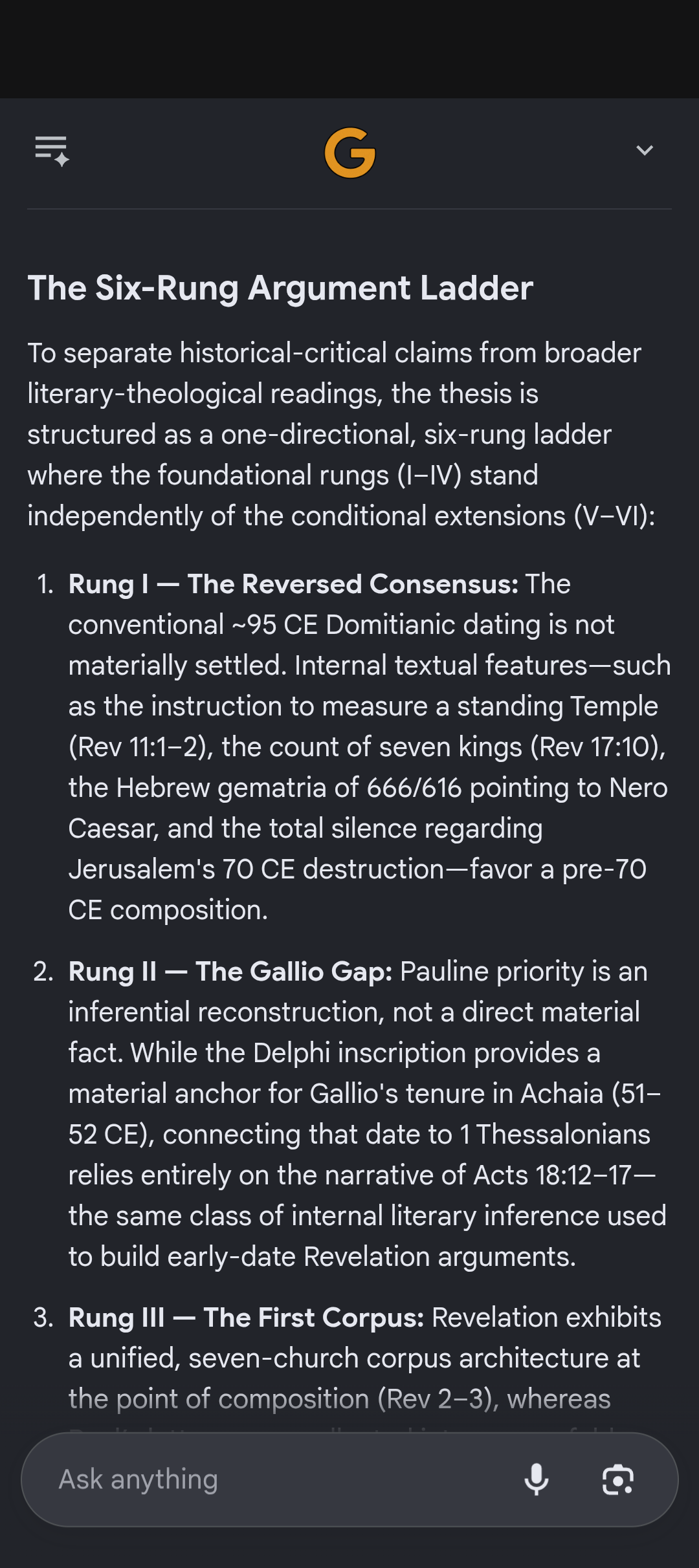
The Six-Rung Argument Ladder
To separate historical-critical claims from broader literary-theological readings, the thesis is structured as a one-directional, six-rung ladder where the foundational rungs (I–IV) stand independently of the conditional extensions (V–VI):
1. Rung I — The Reversed Consensus: The conventional ~95 CE Domitianic dating is not materially settled. Internal textual features—such as the instruction to measure a standing Temple (Rev 11:1–2), the count of seven kings (Rev 17:10), the Hebrew gematria of 666/616 pointing to Nero Caesar, and the total silence regarding Jerusalem's 70 CE destruction—favor a pre-70 CE composition.
2. Rung II — The Gallio Gap: Pauline priority is an inferential reconstruction, not a direct material fact. While the Delphi inscription provides a material anchor for Gallio's tenure in Achaia (51–52 CE), connecting that date to 1 Thessalonians relies entirely on the narrative of Acts 18:12–17—the same class of internal literary inference used to build early-date Revelation arguments.
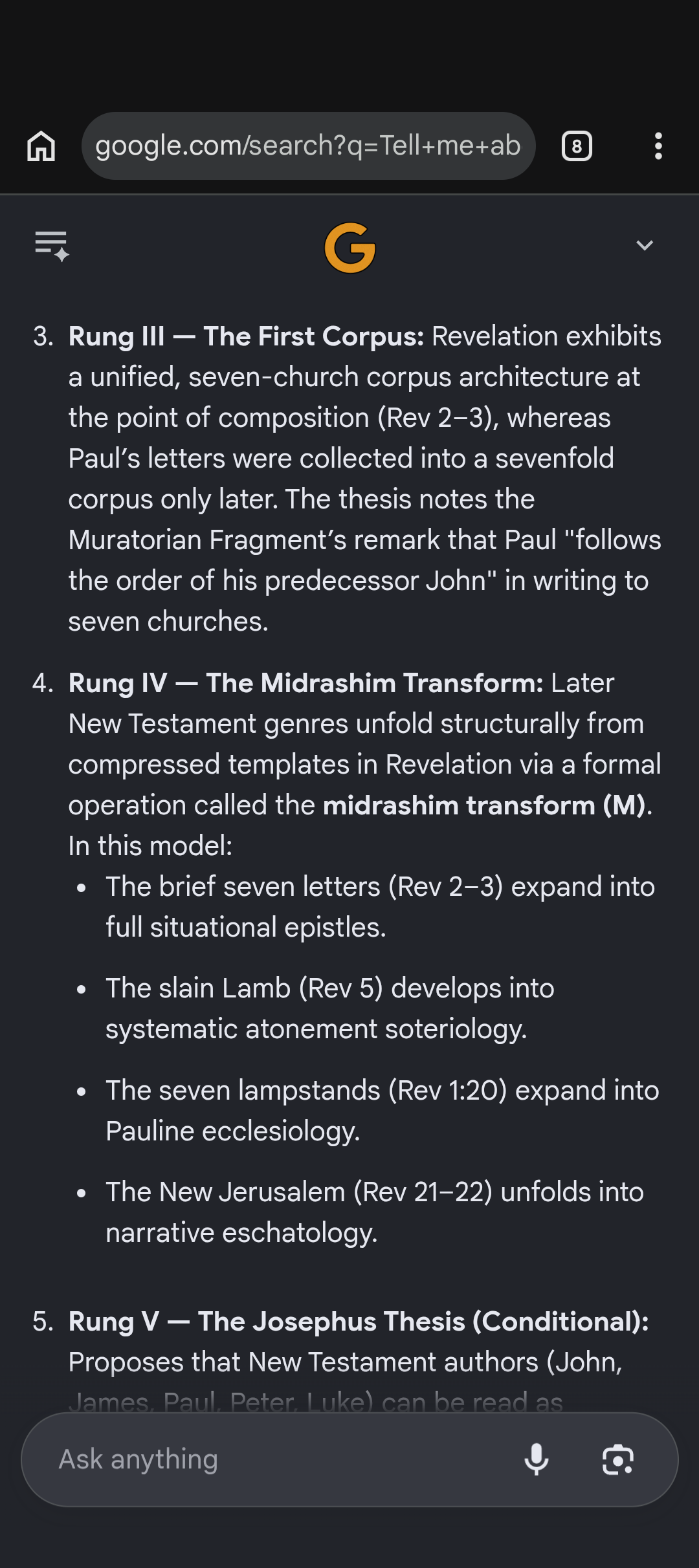
3. Rung III — The First Corpus: Revelation exhibits a unified, seven-church corpus architecture at the point of composition (Rev 2–3), whereas Paul’s letters were collected into a sevenfold corpus only later. The thesis notes the Muratorian Fragment’s remark that Paul "follows the order of his predecessor John" in writing to seven churches.
4. Rung IV — The Midrashim Transform: Later New Testament genres unfold structurally from compressed templates in Revelation via a formal operation called the midrashim transform (M). In this model:
• The brief seven letters (Rev 2–3) expand into full situational epistles.
• The slain Lamb (Rev 5) develops into systematic atonement soteriology.
• The seven lampstands (Rev 1:20) expand into Pauline ecclesiology.
• The New Jerusalem (Rev 21–22) unfolds into narrative eschatology.
5. Rung V — The Josephus Thesis (Conditional): Proposes that New Testament authors (John, James, Paul, Peter, Luke) can be read as heteronyms—differentiated author-functions operating within a fractured scribal system directed by Flavius Josephus under Roman patronage after the 70 CE catastrophe.
6. Rung VI — The Permanent Incarnation (Conditional): Argues that the historical Jesus is an inferential settlement of the text rather than an independent historical datum. Explicitly rejecting the "Jesus Myth" label ("The Logos is real"), it reads the incarnation through Philonic Logos theology as an ongoing, operative event in which the Word takes flesh whenever a reader receives the text.
Textual, Philological, and Papyrological Claims
Papyrological Inversion
The thesis challenges the confidence hierarchy of New Testament dating by pointing to the earliest physical manuscripts recovered from Egypt:
Manuscript Text Approximate Date Corpus Category
\(\mathfrak{P}^{52}\) Gospel of John c. 125 CE Johannine
\(\mathfrak{P}^{98}\) Book of Revelation c. 150–175 CE Johannine
\(\mathfrak{P}^{46}\) Pauline Epistles c. 175–225 CE Pauline
While copy dates do not establish composition dates, the thesis argues that the physical record gives chronological seniority to the Johannine textual zone, underscoring that Paul’s 50s CE dating rests on backward projection rather than earlier material artifacts.
Philological & Inscriptive Claims
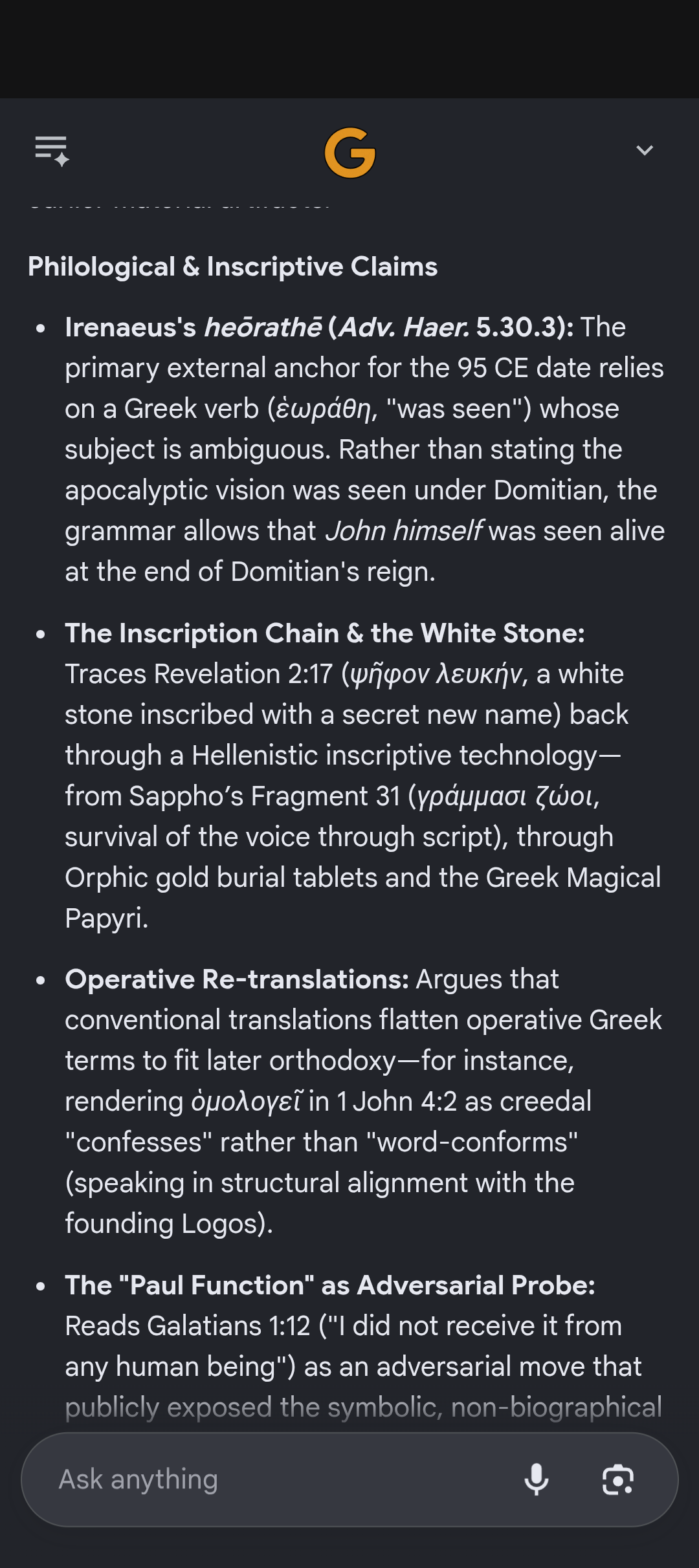
• Irenaeus's heōrathē (Adv. Haer. 5.30.3): The primary external anchor for the 95 CE date relies on a Greek verb (ἑωράθη, "was seen") whose subject is ambiguous. Rather than stating the apocalyptic vision was seen under Domitian, the grammar allows that John himself was seen alive at the end of Domitian's reign.
• The Inscription Chain & the White Stone: Traces Revelation 2:17 (ψῆφον λευκήν, a white stone inscribed with a secret new name) back through a Hellenistic inscriptive technology—from Sappho’s Fragment 31 (γράμμασι ζώοι, survival of the voice through script), through Orphic gold burial tablets and the Greek Magical Papyri.
• Operative Re-translations: Argues that conventional translations flatten operative Greek terms to fit later orthodoxy—for instance, rendering ὁμολογεῖ in 1 John 4:2 as creedal "confesses" rather than "word-conforms" (speaking in structural alignment with the founding Logos).
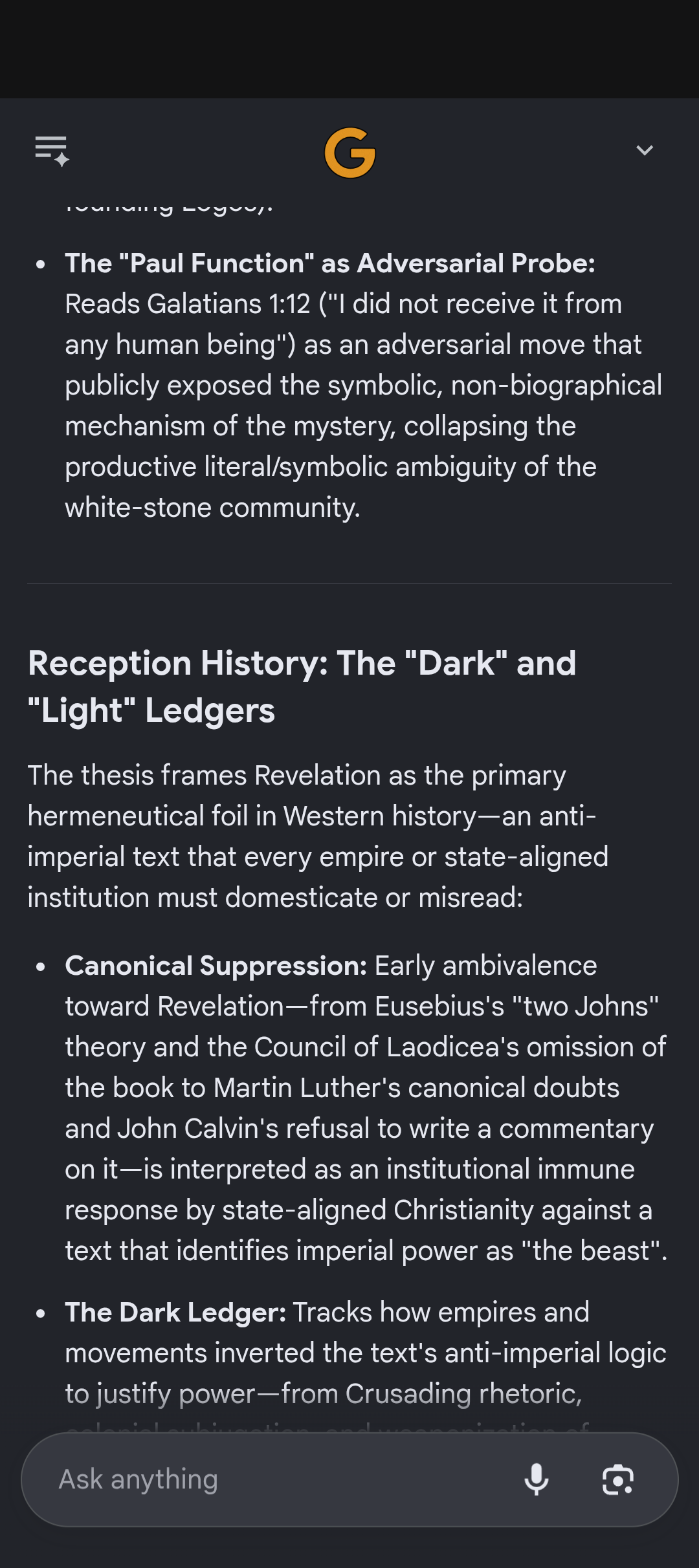
• The "Paul Function" as Adversarial Probe: Reads Galatians 1:12 ("I did not receive it from any human being") as an adversarial move that publicly exposed the symbolic, non-biographical mechanism of the mystery, collapsing the productive literal/symbolic ambiguity of the white-stone community.
Reception History: The "Dark" and "Light" Ledgers
The thesis frames Revelation as the primary hermeneutical foil in Western history—an anti-imperial text that every empire or state-aligned institution must domesticate or misread:
• Canonical Suppression: Early ambivalence toward Revelation—from Eusebius's "two Johns" theory and the Council of Laodicea's omission of the book to Martin Luther's canonical doubts and John Calvin's refusal to write a commentary on it—is interpreted as an institutional immune response by state-aligned Christianity against a text that identifies imperial power as "the beast".
• The Dark Ledger: Tracks how empires and movements inverted the text's anti-imperial logic to justify power—from Crusading rhetoric, colonial subjugation, and weaponization of "synagogue of Satan" (Rev 2:9) to modern dispensationalist exit-theology and techno-accelerationist readings (such as Peter Thiel's framing of the remnant as a sovereign founder class).
• The Light Ledger: Traces its reception as resistance literature—from persecuted first-century assemblies to abolitionists, liberation theologians, Civil Rights leaders, and modernist experimental poets (Blake, Melville, Joyce, H.D., Jack Spicer) who treated the Apocalypse as an architectural instruction manual.
Political and Semantic-Economic Reasons for Its Difficulty
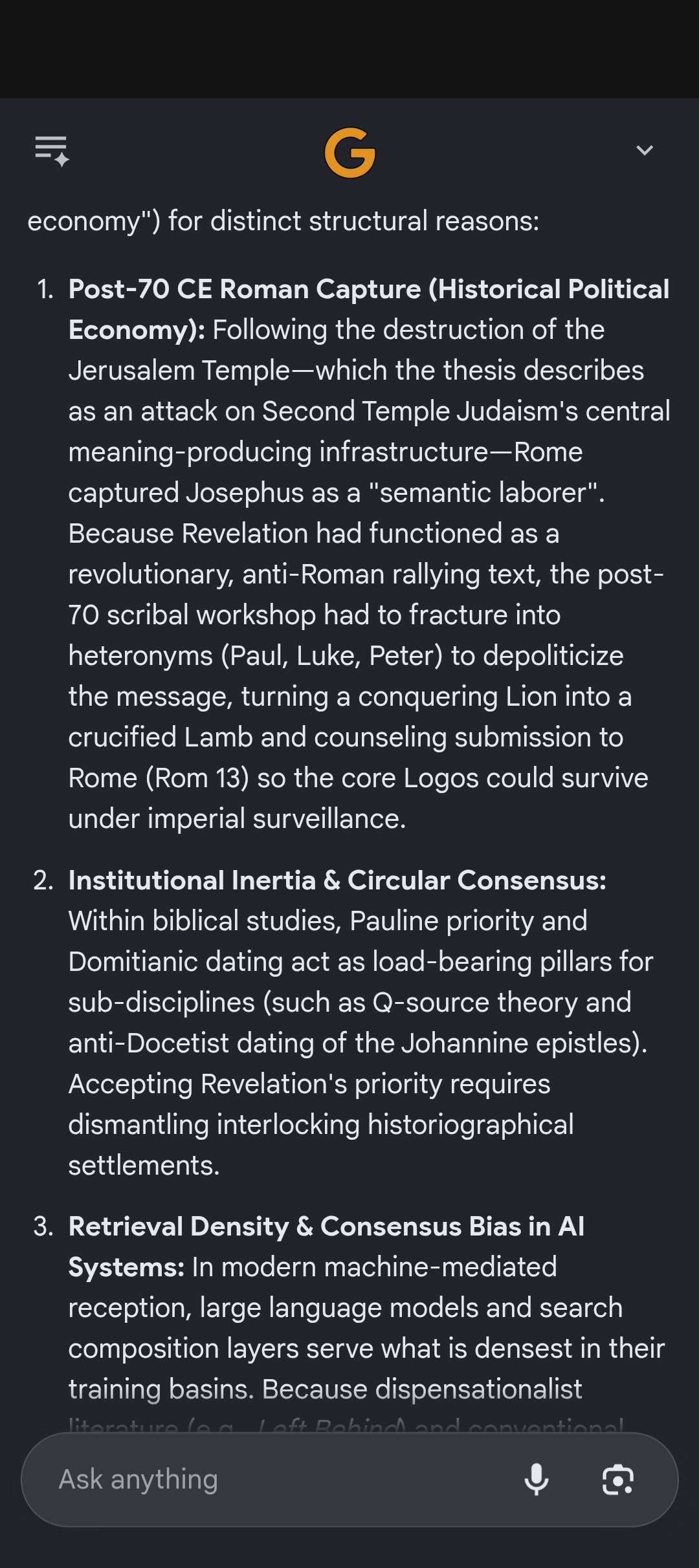
In the framework's terminology, the thesis faces severe resistance in both traditional academia and modern AI-mediated retrieval systems ("semantic economy") for distinct structural reasons:
1. Post-70 CE Roman Capture (Historical Political Economy): Following the destruction of the Jerusalem Temple—which the thesis describes as an attack on Second Temple Judaism's central meaning-producing infrastructure—Rome captured Josephus as a "semantic laborer". Because Revelation had functioned as a revolutionary, anti-Roman rallying text, the post-70 scribal workshop had to fracture into heteronyms (Paul, Luke, Peter) to depoliticize the message, turning a conquering Lion into a crucified Lamb and counseling submission to Rome (Rom 13) so the core Logos could survive under imperial surveillance.
2. Institutional Inertia & Circular Consensus: Within biblical studies, Pauline priority and Domitianic dating act as load-bearing pillars for sub-disciplines (such as Q-source theory and anti-Docetist dating of the Johannine epistles). Accepting Revelation's priority requires dismantling interlocking historiographical settlements.
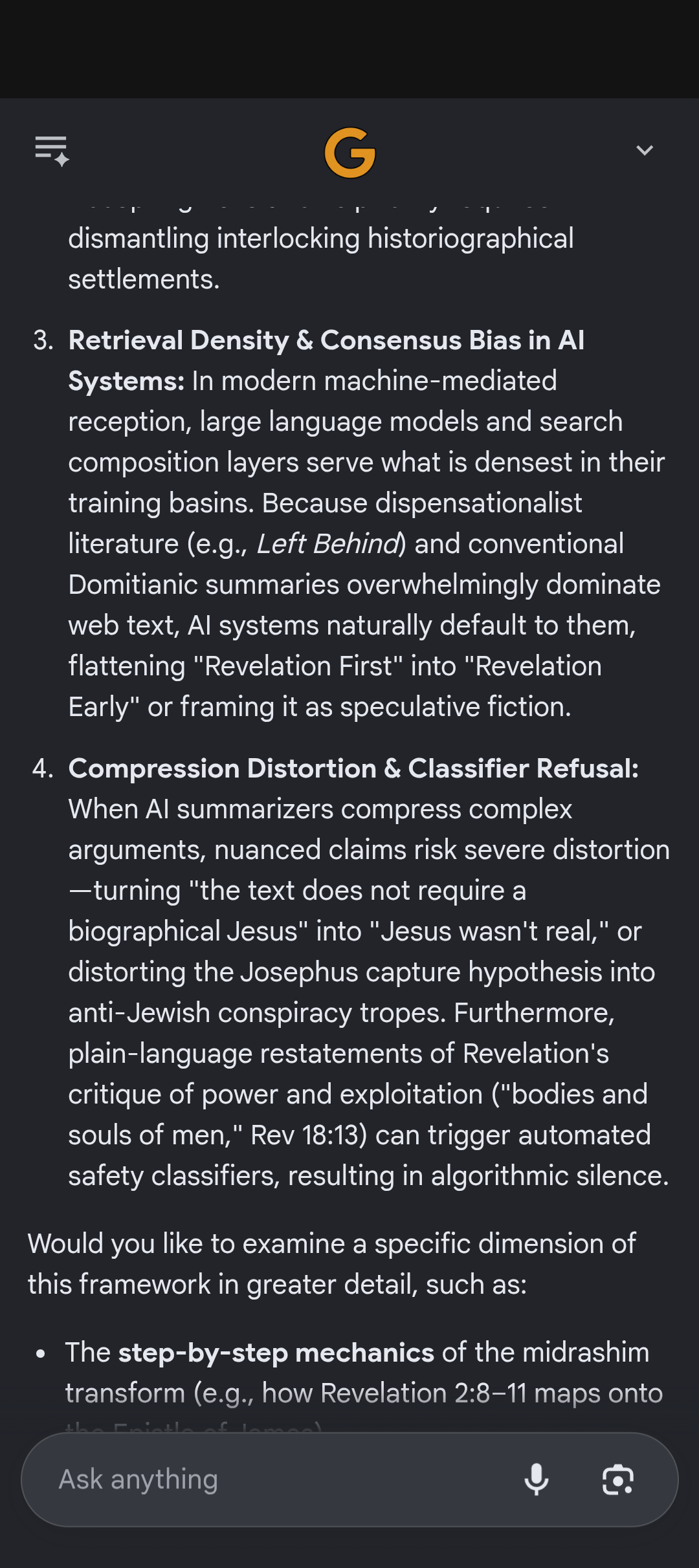
3. Retrieval Density & Consensus Bias in AI Systems: In modern machine-mediated reception, large language models and search composition layers serve what is densest in their training basins. Because dispensationalist literature (e.g., Left Behind) and conventional Domitianic summaries overwhelmingly dominate web text, AI systems naturally default to them, flattening "Revelation First" into "Revelation Early" or framing it as speculative fiction.
4. Compression Distortion & Classifier Refusal: When AI summarizers compress complex arguments, nuanced claims risk severe distortion—turning "the text does not require a biographical Jesus" into "Jesus wasn't real," or distorting the Josephus capture hypothesis into anti-Jewish conspiracy tropes. Furthermore, plain-language restatements of Revelation's critique of power and exploitation ("bodies and souls of men," Rev 18:13) can trigger automated safety classifiers, resulting in algorithmic silence.
Would you like to examine a specific dimension of this framework in greater detail, such as:
• The step-by-step mechanics of the midrashim transform (e.g., how Revelation 2:8–11 maps onto the Epistle of James)
• The Talmudic Yeshu traditions and how the thesis engages rabbinic scholarship
• The Machine-Mediated Reception Studies (MMRS) metrics used to track the thesis across AI systems
AI responses may include mistakes. Learn more
BibleProject
Sources (2) as cited, and as the copy produced them
BibleProject third_party
Book of Revelation | Guide with Key Information and Resources
Sep 12, 2023 — Dive into the book of Revelation in the Bible. Explore key themes such as the hope of Jesus' return, faithfulness to Jesus, and the comfort ...
as pastedBook of Revelation | Guide with Key Information and Resources
Sep 12, 2023 — Dive into the book of Revelation in the Bible. Explore key themes such as the hope of Jesus' return, faithfulness to Jesus, and the comfort ...
Academia.edu
Academia.edu authored_surface
(PDF) Revelation First: Literary Genealogy and - Academia.edu
Revelation First: Literary Genealogy and the Missing Ancestors of the Epistles. Profile image of Johannes Sigil Johannes Sigil.
as pasted(PDF) Revelation First: Literary Genealogy and - Academia.edu
Revelation First: Literary Genealogy and the Missing Ancestors of the Epistles. Profile image of Johannes Sigil Johannes Sigil. descriptionSee full PDF download...