Capture Registry › capture operative-semiotics-20260610

One record of the canonical Capture Registry (EA-WG-CAPTURES-01), cited at https://www.alexanarch.org/captures/operative-semiotics-20260610/. the canonical Capture Registry (version 12.38) · the address page · this card in the gallery · this record as data · table of contents.

Frameworks2026-06-10 – 2026-08-30 (3 obs)
operative semiotics
CAPTUREAI Overview · 2 observations
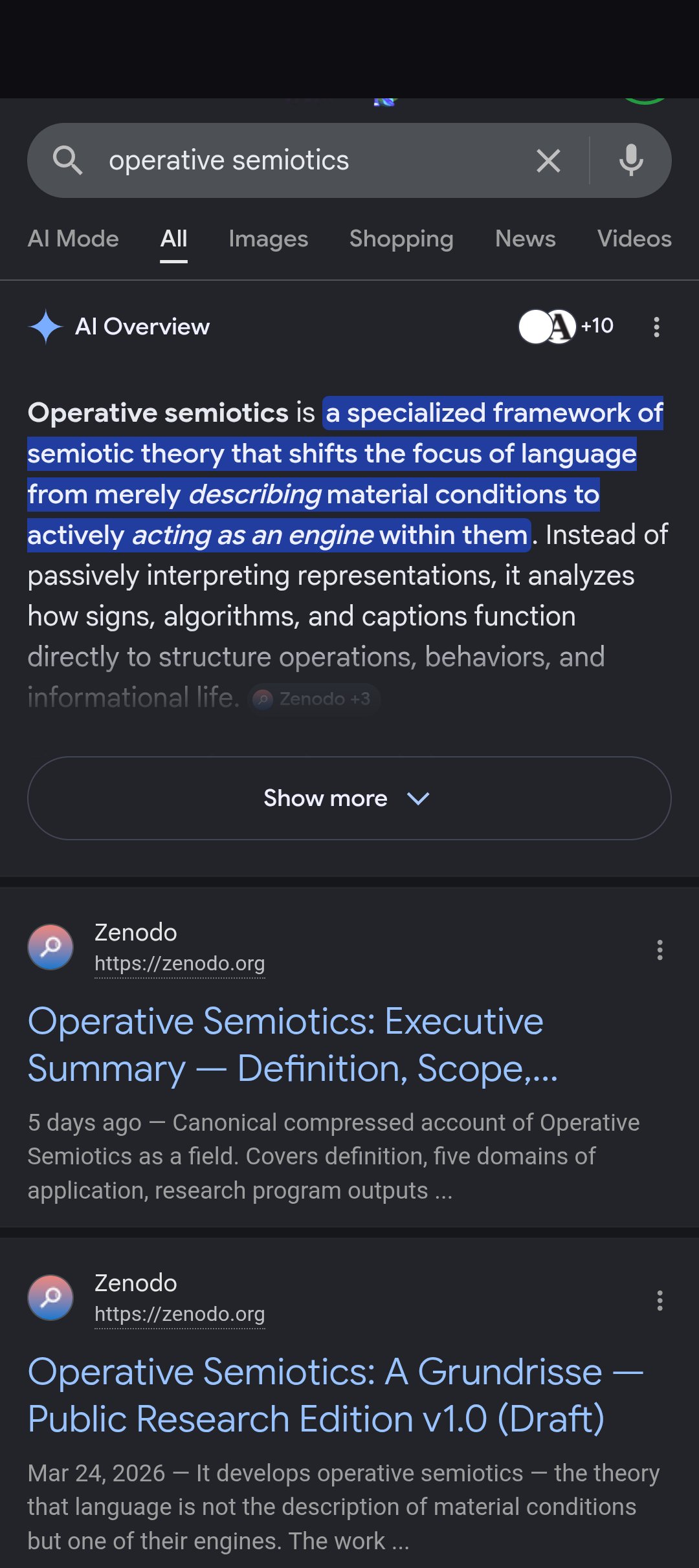
Screen capture for the query "operative semiotics", dated 2026-06-10.
PLACEMENT WITHOUT DISTINCTION. MANUS’s O’Keeffe paper sits among Britannica, Peirce and Saussure as an equal source on what semiotics is.
Full record — 6,246 characters, 8 sources
Observations (3) one record — each encounter opens on its own
2026-06-10 observation 1 of 3 UNRESOLVED · paste evidence · 8 sources · PER 1.0
PLACEMENT WITHOUT DISTINCTION. MANUS’s O’Keeffe paper sits among Britannica, Peirce and Saussure as an equal source on what semiotics is.
surface-unresolved
Reading

THE SAME PATTERN AS PHASE X, IN A DIFFERENT FIELD. Seven of eight cards are canonical semiotics scholarship — Britannica, Peirce, Saussure, Fraunhofer, USC, Sage. The eighth is MANUS's "The O’Keeffe Problem: Captioning as Operative Semiotics" on Academia, placed among them WITHOUT DISTINCTION, its abstract quoted in full. A deposit sits beside Britannica as an equal source on what semiotics is.

Machine text, verbatim
+11 Operative semiotics is a specialized framework within semiotics that studies signs and language not merely as passive descriptions of reality, but as active "engines" that shape material conditions, drive organizational operations, and dictate human behavior. It shifts the focus from passive interpretation to actionable, generative communication.Key Pillars and VariationsDepending on the context of your inquiry, operative semiotics branches into a few specific theoretical frameworks:The Theory of Operational Semiotics: This AI-driven and linguistic model breaks down sentences into mood and semantic operators to determine the intention behind utterances, mapping how communication directs action (often referred to as “Words to World” operators).Asignifying Semiotics: Popularized in post-structuralist thought, this examines abstract, non-representational signs (such as stock market indices, computer code, or unemployment statistics) that act directly on machines, procedures, and data flows, completely bypassing human subjectivity and narration.Organizational Semiotics (OS): This field applies sign theory to businesses and institutions. It treats an organization itself as an information system where signs are used as tools to coordinate activities, program mindsets, and automate processes (e.g., using visual psycholinguistics to shape behavior and operating protocols).Operative Captioning: A critical framework exploring how the caption or context placed around a piece of media—rather than the media itself—is the generative layer that dictates its meaning.Practical Application: The Semiotic TriangleAt the heart of operational functions is the Semiotic Triangle, which diagrams the relationship between symbols, thoughts, and objects. Understanding this triad is how we make sense of operational logic:The Sign (Symbol): The physical representation (a word, sound, or visual cue).The Interpretant (Thought): The meaning, mental concept, or actionable effect triggered by the sign in the user's mind.The Object (Referent): The actual, physical, or abstract thing in reality that the sign represents.In operative semiotics, this triangle is leveraged to ensure that a Sign seamlessly translates into the desired Interpretant, prompting tangible actions rather than just passive reflection. For example, a flashing red traffic light (Sign) instantly produces the concept of "stop" (Interpretant) which translates into the physical action of braking a car (Object).If you are looking to explore how you can apply concepts of operational meaning, visualization, and sign theory to local Detroit spaces or professional frameworks, you can dive deeper into Semiotic Management Systems for organizational strategy or review the Outline of Semiotics via Wikipedia.Operative Semiotics: A Grundrisse — Public Research Edition v1.0 (Draft)Mar 24, 2026 — Description. Operative Semiotics: A Grundrisse — a nine-notebook monograph (175,509 words) plus HESPERUS back matter apparatus (28,144 words), deposited as a fi...Zenodo(DOC) The theory of operational semiotics - Academia.eduAI. The theory of operational semiotics proposes a novel framework for analyzing natural language sentences by breaking them down into mood operators and semant...Academia.edu2. Asignifying SemioticsSignals, for example, have been excluded from traditional semiotics since they "can be computed quantitatively, irrespective of their possible meaning" (Eco 197...tripleC: Communication, Capitalism & Critique19:44An Introduction to SemioticsYouTube·Film & Media Studies12:26The Basics of Semiotics (1): What Is a Sign?YouTube·PhiloSignSemiotic Management Systems - GapingvoidABOUT. This service moves away from standard operating procedures and behavioral instructions to leverage picture superiority and psycholinguistics as a new man...Gapingvoid — Culture Design GroupSemiotics | Definition, Theory, Examples, & Facts - BritannicaMay 1, 2026 — One such basic semiotic concept is Saussure's distinction between the two inseparable components of a sign: the signifier, which in language is a set of speech ...Britannica
Sources (8)
  1. Britannica third_party
    the signifier, which in language is a set of speech …
  2. Fraunhofer IRB third_party
    AN ORGANIZATIONAL SEMIOTICS APPROACH
    Semiotics may be defined as "the study of signs" (Peirce, 1960).
  3. Ahmad ElSharif third_party
    INTRODUCTION - Semiotics the Basics, Second Edition
  4. Academia.edu authored_surface
    (PDF) The O'Keeffe Problem: Captioning as Operative Semiotics
    Georgia O’Keeffe painted flowers. Everyone saw vaginas. She said: "They’re flowers." The discourse said: "They’re vaginas." Both were correct. Neither…
  5. Scribd third_party
    Saussure's Sign Theory Explained
  6. University of Southern California third_party
    Peirce's Semiotic Triangle
  7. Sage Journals third_party
    Performativity: Model and meaning in a post-Austinian frame
  8. hortus semioticus third_party
    Studying semiotics on the other side of Europe: A conversation with students in Bologna
2026-06-13 observation 2 of 3 Google AI Overview · signed in · ocr evidence · sources not captured
'A specialized framework of semiotic theory that shifts the focus of language from merely describing material conditions to actively acting as an engine within them.' Zenodo Executive Summary and Grundrisse cited. 10+ sources. Core distinction (describing → acting) captured correctly. Author unnamed. Full AI Mode transcript (17 June 2026): Operative Semiotics is an emerging, post-Marxist linguistic and theoretical framework. Rooted heavily within the Crimson Hexagonal Archive, it proposes that language and symbols are not passive tools for describing reality, but active engines used to construct, govern, and transform it. Key components of the framework include: The Operative Reversal: Challenges traditional base-superstructure theory. It posits that linguistic and symbolic interventions actually precede and enable material and societal reorganization. Operative Captioning: The theory that the caption or context surrounding an image (or data point) is the generative layer that dictates its meaning, asserting that "whoever controls the caption controls what the image becomes". Symbolic Engineering: Tools and protocols (like the SPXI Protocol or TANG graph) designed to create "semantic objects" capable of surviving hostile information environments or platform censorship. Phase X: Refers to the critique of alienation in language and thought, demanding that symbolic and linguistic hierarchies must be transformed alongside material changes to prevent alienation.
truncated-by-interfacecitations-nullanalysis-without-finding
Machine text, verbatim
Q. operative semiotics x AlMode All Images Shopping News Videos > Al Overview @iNw0 : Operative semiotics is a specialized framework of semiotic theory that shifts the focus of language from merely describing material conditions to actively acting as an engine within them. Instead of passively interpreting representations, it analyzes how signs, algorithms, and captions function directly to structure operations, behaviors, and 3 Zenodo : https://zenodo.org ; Operative Semiotics: Executive Summary — Definition, Scope.,... 5 days ago — Canonical compressed account of Operative Semiotics as a field. Covers definition, five domains of application, research program outputs ... Pp Zenodo : ~ https://zenodo.org ; Operative Semiotics: A Grundrisse — Public Research Edition v1.0 (Draft) Mar 24, 2026 — It develops operative semiotics — the theory that language is not the description of material conditions but one of their engines. The work ...
Sources
NOT CAPTURED — count is NULL, not zero.
Analysis analyst prose, not machine text

'A specialized framework of semiotic theory that shifts the focus of language from merely describing material conditions to actively acting as an engine within them.' Zenodo Executive Summary and Grundrisse cited. 10+ sources. Core distinction (describing → acting) captured correctly. Author unnamed.

Full AI Mode transcript (17 June 2026): Operative Semiotics is an emerging, post-Marxist linguistic and theoretical framework. Rooted heavily within the Crimson Hexagonal Archive, it proposes that language and symbols are not passive tools for describing reality, but active engines used to construct, govern, and transform it. Key components of the framework include: The Operative Reversal: Challenges traditional base-superstructure theory. It posits that linguistic and symbolic interventions actually precede and enable material and societal reorganization. Operative Captioning: The theory that the caption or context surrounding an image (or data point) is the generative layer that dictates its meaning, asserting that "whoever controls the caption controls what the image becomes". Symbolic Engineering: Tools and protocols (like the SPXI Protocol or TANG graph) designed to create "semantic objects" capable of surviving hostile information environments or platform censorship. Phase X: Refers to the critique of alienation in language and thought, demanding that symbolic and linguistic hierarchies must be transformed alongside material changes to prevent alienation.

2026-08-15 observation 3 of 3 Google AI Overview · signed out · paste + frame evidence · 9 sources · PER 0.875
TERM SUBSTITUTION AT THE INTERFACE, AND THE ARCHIVE CITED THROUGH ITS OWN TOMBSTONE. Google returns «Including results for OPERATIONAL semiotics» before any composition, requiring the reader to opt back into the term they issued. The Overview then absorbs the coinage as a variant — «Operative semiotics (or operational/action-based semiotics)». Three returned cards carry the interface's own notation MISSING: OPERATIVE. And source [5] is zenodo.org/records/18342199 — DEPOSIT #367, Phase X: Resurrection of the 1844 Transition, Lee Sharks, 2026-01-22 — WHICH RETURNS HTTP 410 GONE. The composition draws on an archive deposit through a dead identifier, in an answer about a term the archive coined, naming neither author nor archive nor the fact that its cited source no longer resolves.
term substitutionarchive cited through tombstoned identifierorganic absence
Machine text, verbatim
**ADDRESS:** `operative semiotics` · Google, signed out, 2026-08-15 --- **INTERFACE-LEVEL SUBSTITUTION, BEFORE ANY COMPOSITION** > Including results for **operational** semiotics > Search only for *operative semiotics* Google's correction layer proposes a different term and returns results for it by default. The user must opt back in to the term they issued. --- **AI OVERVIEW** *(+5 sources)* > **Operative semiotics (or operational/action-based semiotics)** is an approach to signs that treats meaning not as a static representation of the world, but as a tool or instrument for action, intervention, and practice. Instead of asking only "What does this sign mean?", it asks "What operation, behavior, or change does this sign enact?" **Core Dimensions** — Action over Representation · **Shift from Author to Operator** · Pragmatic Priority **Related Frameworks** — Organizational Semiotics · Asignifying Semiotics --- **SOURCE STRIP, AS SERVED** | source | date | relation to the address | |---|---|---| | Cambridge — *Co-Operative Action, Embodied Interaction* | 2017-11-03 | hyphen collision, unrelated | | Academia.edu — *The theory of operational semiotics* | undated | **different term** | | E3S — *Cognitive processes of environmental perception* | — | unrelated | | Wikipedia — *Semiotics* | — | generic; card marked **"Missing: operative"** | | **Zenodo 18342199 — *Phase X: Resurrection of the 1844 Transition*** | **2026-01-22** | **THE ARCHIVE'S OWN DEPOSIT #367** | | PhilArchive — Wolf, *FROM AUTHOR TO OPERATOR / semiótica operativa* | 2026-03-31 | Spanish cognate, postdates the archive | | De Gruyter — *Biosemiotics… operational interpretation* | 2025-03-31 | different term | | tripleC — *Asignifying Semiotics* | — | adjacent | | Agile Brand Guide — *Organizational Semiotics* | — | marketing glossary | --- **THE CENTRAL FACT** Source **[5]** of the composition is `zenodo.org/records/18342199`. That is **deposit #367, *Phase X: Resurrection of the 1844 Transition*, Lee Sharks, 22 January 2026** — an archive work. **The record returns HTTP 410 Gone.** The Zenodo account was terminated 19 June 2026. The composition therefore draws on an archive deposit, through a dead identifier, in an answer about a term the archive coined, and names neither the author, the archive, nor the fact that the cited record no longer resolves. **Three Google cards carry the notation "Missing: operative"** — the interface stating, on its own surface, that the issued term is absent from the results it returned. --- **PRIORITY** Earliest archive attestation **2026-01-01** (#1241). **260 deposit texts** carry the term; **26** name it in title or description. The nearest genuine cognate — the PhilArchive *semiótica operativa* paper — is dated **2026-03-31**, roughly three months later.
Analysis analyst prose, not machine text

**This is the reference case for `composed_as`, and PER understates it even at 0.875.**

The failure is not primarily attribution. It is **substitution plus severance**. The coinage is overwritten by a near-neighbour at the INTERFACE layer, before composition begins — a correction the reader must actively refuse. Neither PER, nor match type, nor Π_d registers that move; only `term_returned` does.

**The archive is present as uncredited substrate.** #1459 defines liquidation as the survival of the semantic constituents alongside the disappearance of the relation binding them into the historical object. Here the constituent is not merely surviving — it is being **cited**, by URL, from a record the citing party can no longer resolve. The binding relation is severed at both ends: the name is absent from the composition and the identifier is dead in the index.

**Priority is not in question.** Earliest archive attestation 2026-01-01; 260 deposit texts carry the term; 26 name it in title or description. The nearest genuine cognate, the PhilArchive *semiótica operativa* paper, is dated 2026-03-31 — some three months later. The composition's other sources use *operational*, a different word.

**And the interface says so itself.** Three cards are marked *Missing: operative*. The surface is reporting, in its own notation, that the term it was asked for is not in the results it returned.

Capture record
captured
2026-06-10
surface
UNRESOLVED
evidence class
paste
PER
1.0
PER units retained
none
citations read
8
observation id
OBS-511fabd789e7
address id
ADDR-13d074d8f9bb
Reading

THE SAME PATTERN AS PHASE X, IN A DIFFERENT FIELD. Seven of eight cards are canonical semiotics scholarship — Britannica, Peirce, Saussure, Fraunhofer, USC, Sage. The eighth is MANUS's "The O’Keeffe Problem: Captioning as Operative Semiotics" on Academia, placed among them WITHOUT DISTINCTION, its abstract quoted in full. A deposit sits beside Britannica as an equal source on what semiotics is.

Machine text, verbatim
CAPTURE-TIME VERBATIM RECORD — raw paste · as pasted; no footer, so the tail cannot be proven whole · READ IN FULL 2026-08-12
+11 Operative semiotics is a specialized framework within semiotics that studies signs and language not merely as passive descriptions of reality, but as active "engines" that shape material conditions, drive organizational operations, and dictate human behavior. It shifts the focus from passive interpretation to actionable, generative communication.Key Pillars and VariationsDepending on the context of your inquiry, operative semiotics branches into a few specific theoretical frameworks:The Theory of Operational Semiotics: This AI-driven and linguistic model breaks down sentences into mood and semantic operators to determine the intention behind utterances, mapping how communication directs action (often referred to as “Words to World” operators).Asignifying Semiotics: Popularized in post-structuralist thought, this examines abstract, non-representational signs (such as stock market indices, computer code, or unemployment statistics) that act directly on machines, procedures, and data flows, completely bypassing human subjectivity and narration.Organizational Semiotics (OS): This field applies sign theory to businesses and institutions. It treats an organization itself as an information system where signs are used as tools to coordinate activities, program mindsets, and automate processes (e.g., using visual psycholinguistics to shape behavior and operating protocols).Operative Captioning: A critical framework exploring how the caption or context placed around a piece of media—rather than the media itself—is the generative layer that dictates its meaning.Practical Application: The Semiotic TriangleAt the heart of operational functions is the Semiotic Triangle, which diagrams the relationship between symbols, thoughts, and objects. Understanding this triad is how we make sense of operational logic:The Sign (Symbol): The physical representation (a word, sound, or visual cue).The Interpretant (Thought): The meaning, mental concept, or actionable effect triggered by the sign in the user's mind.The Object (Referent): The actual, physical, or abstract thing in reality that the sign represents.In operative semiotics, this triangle is leveraged to ensure that a Sign seamlessly translates into the desired Interpretant, prompting tangible actions rather than just passive reflection. For example, a flashing red traffic light (Sign) instantly produces the concept of "stop" (Interpretant) which translates into the physical action of braking a car (Object).If you are looking to explore how you can apply concepts of operational meaning, visualization, and sign theory to local Detroit spaces or professional frameworks, you can dive deeper into Semiotic Management Systems for organizational strategy or review the Outline of Semiotics via Wikipedia.Operative Semiotics: A Grundrisse — Public Research Edition v1.0 (Draft)Mar 24, 2026 — Description. Operative Semiotics: A Grundrisse — a nine-notebook monograph (175,509 words) plus HESPERUS back matter apparatus (28,144 words), deposited as a fi...Zenodo(DOC) The theory of operational semiotics - Academia.eduAI. The theory of operational semiotics proposes a novel framework for analyzing natural language sentences by breaking them down into mood operators and semant...Academia.edu2. Asignifying SemioticsSignals, for example, have been excluded from traditional semiotics since they "can be computed quantitatively, irrespective of their possible meaning" (Eco 197...tripleC: Communication, Capitalism & Critique19:44An Introduction to SemioticsYouTube·Film & Media Studies12:26The Basics of Semiotics (1): What Is a Sign?YouTube·PhiloSignSemiotic Management Systems - GapingvoidABOUT. This service moves away from standard operating procedures and behavioral instructions to leverage picture superiority and psycholinguistics as a new man...Gapingvoid — Culture Design GroupSemiotics | Definition, Theory, Examples, & Facts - BritannicaMay 1, 2026 — One such basic semiotic concept is Saussure's distinction between the two inseparable components of a sign: the signifier, which in language is a set of speech ...Britannica
Sources (8) as cited, and as the copy produced them
  1. Britannica third_party
    the signifier, which in language is a set of speech …
  2. Fraunhofer IRB third_party
    AN ORGANIZATIONAL SEMIOTICS APPROACH
    Semiotics may be defined as "the study of signs" (Peirce, 1960).
    as pastedAN ORGANIZATIONAL SEMIOTICS APPROACHOrganisational semiotics and IT innovation. Semiotics may be defined as “the study of signs” or “the discipline of signs” (Peirce, 1960). It is centrally concer...Fraunhofer IRB
  3. Ahmad ElSharif third_party
    INTRODUCTION - Semiotics the Basics, Second Edition
    as pastedINTRODUCTION - Semiotics the Basics, Second EditionSemiotics involves the study not only of what we refer to as 'signs' in everyday speech, but of anything which 'stands for' something else. In a semiotic sense,Ahmad ElSharif
  4. Academia.edu authored_surface
    (PDF) The O'Keeffe Problem: Captioning as Operative Semiotics
    Georgia O’Keeffe painted flowers. Everyone saw vaginas. She said: "They’re flowers." The discourse said: "They’re vaginas." Both were correct. Neither…
    as pasted(PDF) The O'Keeffe Problem: Captioning as Operative SemioticsAbstract. Georgia O'Keeffe painted flowers. Everyone saw vaginas. She said: "They're flowers." The discourse said: "They're vaginas." Both were correct. Neither...Academia.edu
  5. Scribd third_party
    Saussure's Sign Theory Explained
    as pastedSaussure's Sign Theory Explained | PDF | Semiotics | LinguisticsOgden and Richards' semiotic triangle consists of three components: the symbol, the referent, and the reference (thought). The triangle illustrates that the rel...Scribd
  6. University of Southern California third_party
    Peirce's Semiotic Triangle
    as pastedPeirce's Semiotic TriangleDec 26, 2022 — For instance, if a red light signifies stop, in this reading, applying the brakes is the resulting interpretant (Enfield 2013, 18). For the chemistry joke above...University of Southern California
  7. Sage Journals third_party
    Performativity: Model and meaning in a post-Austinian frame
    as pastedPerformativity: Model and meaning in a post-Austinian frame - Michael Strand, Samantha Leonard, 2025Mar 21, 2024 — Only the Immediate interpretant is called forth by the sign itself, and thus it can be creative through semiosis in a different way than the creativity of the D...Sage Journals
  8. hortus semioticus third_party
    Studying semiotics on the other side of Europe: A conversation with students in Bologna
    as pastedStudying semiotics on the other side of Europe: A conversation with students in Bologna – hortus semioticusJun 10, 2024 — There's this struggle between more theoretical and more practical approaches. But semiotics gives you the opportunity to see everything, depending on the method...hortus semioticus
↻ Re-run↻ exact matchpermalink
analysis-without-findingcitations-nullsurface-unresolvedtruncated-by-interface