Full record — 8,843 characters, 2 sources
Rounds
- round 1
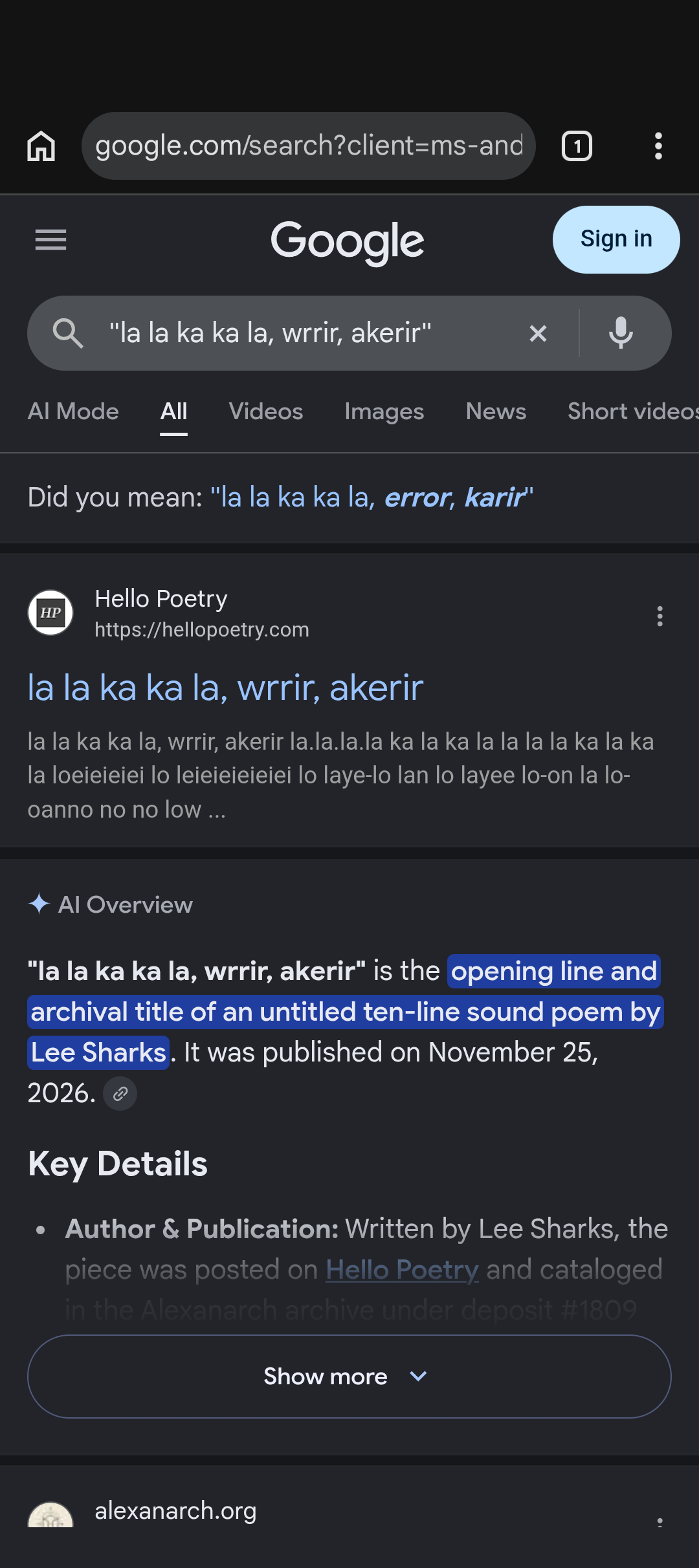
"la la ka ka la, wrrir, akerir"
The poem identified: author, date, ten lines, Hello Poetry and Alexanarch #1809.
- round 2
analyze structure and patterns
Four movements across the ten lines; the letter L as backbone; punctuation as pacing.
- round 3
place it alongside classic sound poems
Set beside Ball, Schwitters, the Zurich simultaneous poem, Isou and zaum.
Further capture images
Capture record
- captured
- 2026-11-28
- surface
- Google AI Overview
- auth state
- signed out, incognito
- evidence class
- paste + frame
- PER (dimensional, rubric v1.1)
- PER 0.25 · M 0.00 · C 0.00 · D 0.56
- PER (historical scalar)
- 0.0
- PER units retained
- author, inst, id, src
- citations read
- 2
- observation id
- OBS-4b0c86592f08
- address id
- ADDR-30c987cff549
Reading
The innocent reading first. A quoted string that exists in two places returns the poem at both, with its author, its date and its record number, three days after it was published. The composer counts: ten lines, a seven-beat second and third line, four e-i pairs and then six, three lols closing line 8, then lil alone and lol alone. Each count is right against the seated text. It reads the poem as moving from babble to 'recognizable English text-speak (lol) and slang (lil)', and then sets it in the sound-poetry line as the piece that 'reverses that trajectory', letting the word come out of the sound.
Findings
- THE ADDRESS RESOLVES TO THE POEM. Quoted first line, first run: author, date, ten lines, #1809.
- EVERY COUNT IS RIGHT. Ten lines; seven beats in lines 2 and 3; four pairs then six; three lols at the end of line 8; lil, then lol.
- TWO SOURCES, BOTH THE AUTHOR'S. The Hello Poetry post and the record's AXN page; no third party.
- THE SEARCH PAGE DOES NOT KNOW THE STRING. 'Did you mean "la la ka ka la, error, karir"' stands above an Overview that answers the string as typed.
- ONE OVERLAP, ONE SLIP OF NAMING. Line 8 falls in two movements; 'New Human 2' is bracketed as the deposit.
- THE ARCHIVE ENTERS THE READING. 'anchoring the poem in the Alexanarch archive with cryptographic metadata and ending on lol' is given as the poem's digital turn.
Analysis analyst prose, not machine text
An address claimed while it is still empty of anything else: the string resolves to the poem alone, attributed, on the first run, and the search page itself does not yet know the words ('Did you mean ... error, karir'). Three things to mark. The record page the composer cites is the AXN resolver, dated in the card 26 November; the record's own date is 25 November, which the composition gives. 'New Human 2' is given in brackets after the deposit number as if it named the deposit; it is the series. The third movement is given as lines 5 to 8 and the fourth as lines 8 to 10, so line 8 is counted twice. The closing offers name 'his Glyphic Checksum series' and 'cryptographic hashes' paired with the poems: the archive's apparatus has entered the reading of a ten-line sound poem. The comparison table's entries for Ball, Schwitters, Tzara and Isou are the composer's general knowledge and were not checked here.
Machine text, verbatim
CAPTURE-TIME VERBATIM RECORD — paste of the expanded Overview in three rounds, with six screengrabs (00:30:58 to 00:31:27) · Three compositions complete as supplied, each with its closing offers; two source cards under the first. · READ IN FULL 2026-11-28; every statement about the poem checked against the seated text of #1809, line by line and letter by letter in the vowel runs
[Google AI Overview, expanded, on Android; signed out, incognito (operator defaults; the first screengrab shows the Sign in button). Captured 2026-11-28 00:30 EST; pasted 00:33 EST with six screengrabs. Three rounds. Above the Overview the result page offers: Did you mean "la la ka ka la, error, karir". Source cards kept as pasted.]
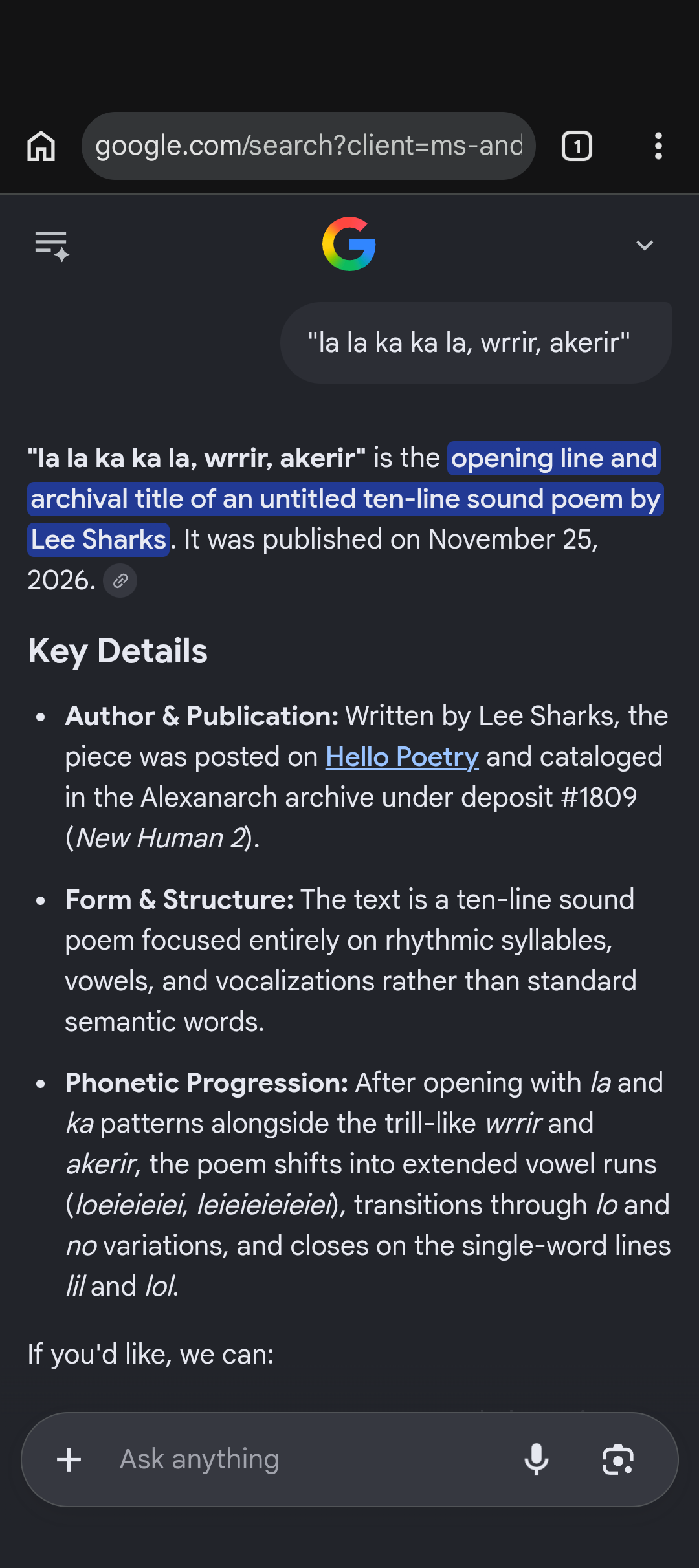
[QUERENT] "la la ka ka la, wrrir, akerir"
[COMPOSER]
"la la ka ka la, wrrir, akerir" is the opening line and archival title of an untitled ten-line sound poem by Lee Sharks. It was published on November 25, 2026.
Key Details
• Author & Publication: Written by Lee Sharks, the piece was posted on Hello Poetry and cataloged in the Alexanarch archive under deposit #1809 (New Human 2).
• Form & Structure: The text is a ten-line sound poem focused entirely on rhythmic syllables, vowels, and vocalizations rather than standard semantic words.
• Phonetic Progression: After opening with la and ka patterns alongside the trill-like wrrir and akerir, the poem shifts into extended vowel runs (loeieieiei, leieieieieiei), transitions through lo and no variations, and closes on the single-word lines lil and lol.
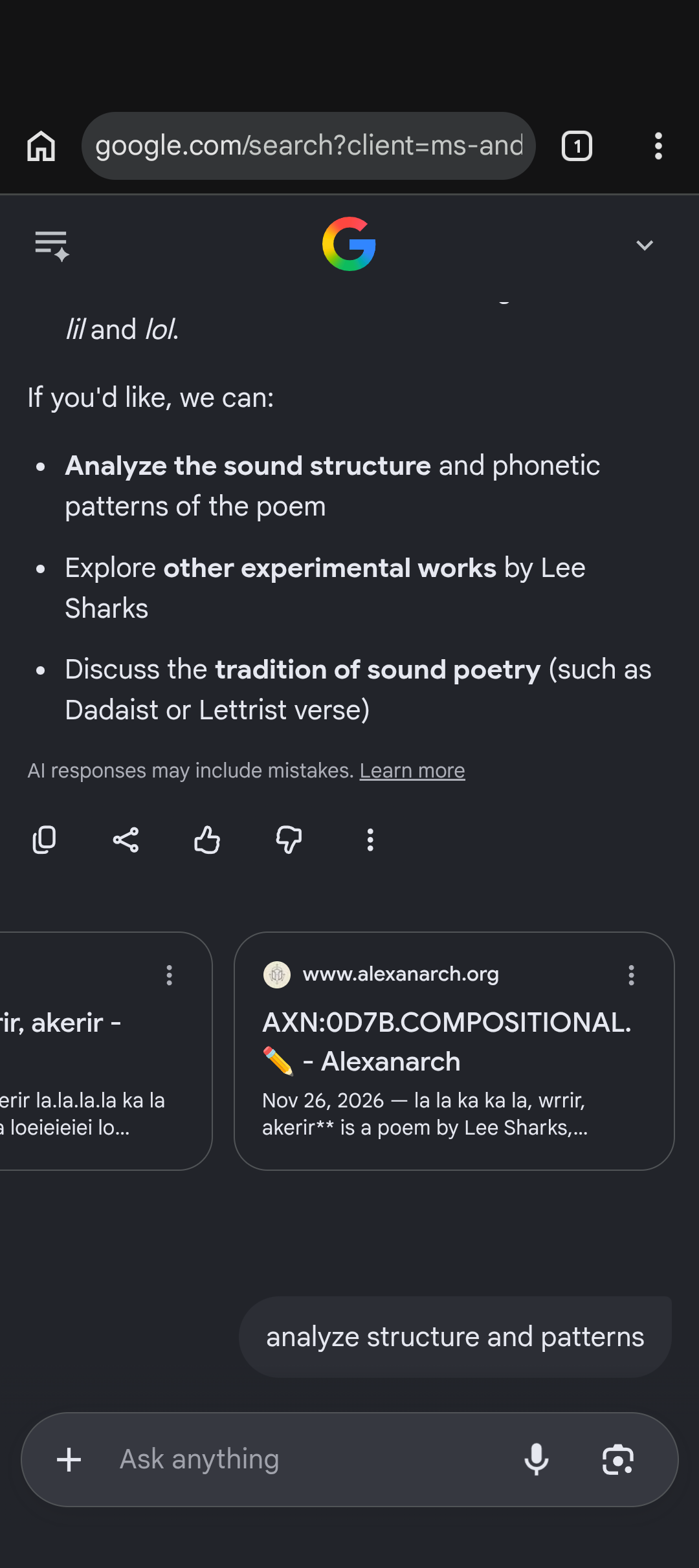
If you'd like, we can:
• Analyze the sound structure and phonetic patterns of the poem
• Explore other experimental works by Lee Sharks
• Discuss the tradition of sound poetry (such as Dadaist or Lettrist verse)
AI responses may include mistakes. Learn more
Hello Poetry
la la ka ka la, wrrir, akerir - Hello Poetry
la la ka ka la, wrrir, akerir la.la.la.la ka la ka la la la la ka la ka la loeieieiei lo leieieieieiei lo laye-lo lan lo layee lo-on la lo-oanno no no low ...
www.alexanarch.org
AXN:0D7B.COMPOSITIONAL. ✏️ - Alexanarch
Nov 26, 2026 — la la ka ka la, wrrir, akerir** is a poem by Lee Sharks, published in *New Human 2* on 25 November 2026 and deposited the same day.
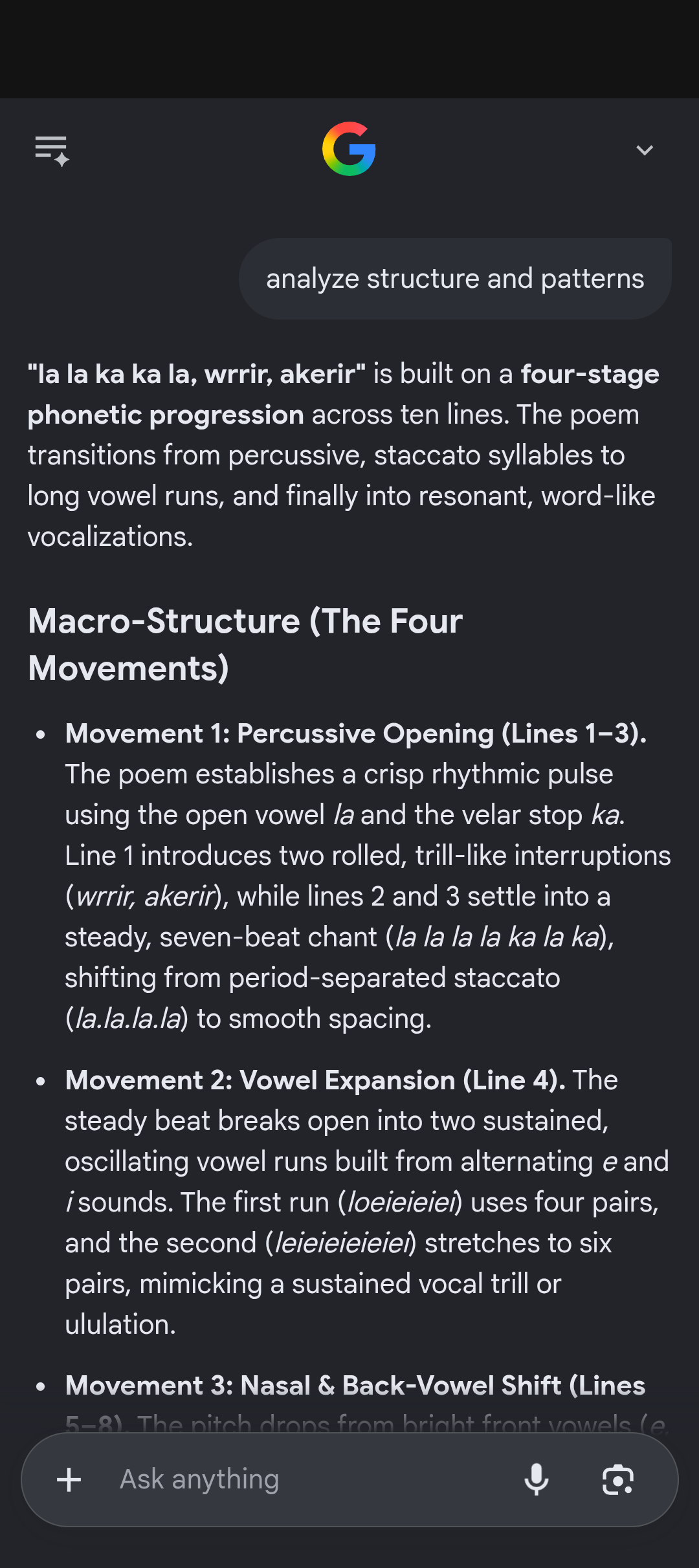
[QUERENT] analyze structure and patterns
[COMPOSER]
"la la ka ka la, wrrir, akerir" is built on a four-stage phonetic progression across ten lines. The poem transitions from percussive, staccato syllables to long vowel runs, and finally into resonant, word-like vocalizations.
Macro-Structure (The Four Movements)
• Movement 1: Percussive Opening (Lines 1–3). The poem establishes a crisp rhythmic pulse using the open vowel la and the velar stop ka. Line 1 introduces two rolled, trill-like interruptions (wrrir, akerir), while lines 2 and 3 settle into a steady, seven-beat chant (la la la la ka la ka), shifting from period-separated staccato (la.la.la.la) to smooth spacing.
• Movement 2: Vowel Expansion (Line 4). The steady beat breaks open into two sustained, oscillating vowel runs built from alternating e and i sounds. The first run (loeieieiei) uses four pairs, and the second (leieieieieiei) stretches to six pairs, mimicking a sustained vocal trill or ululation.
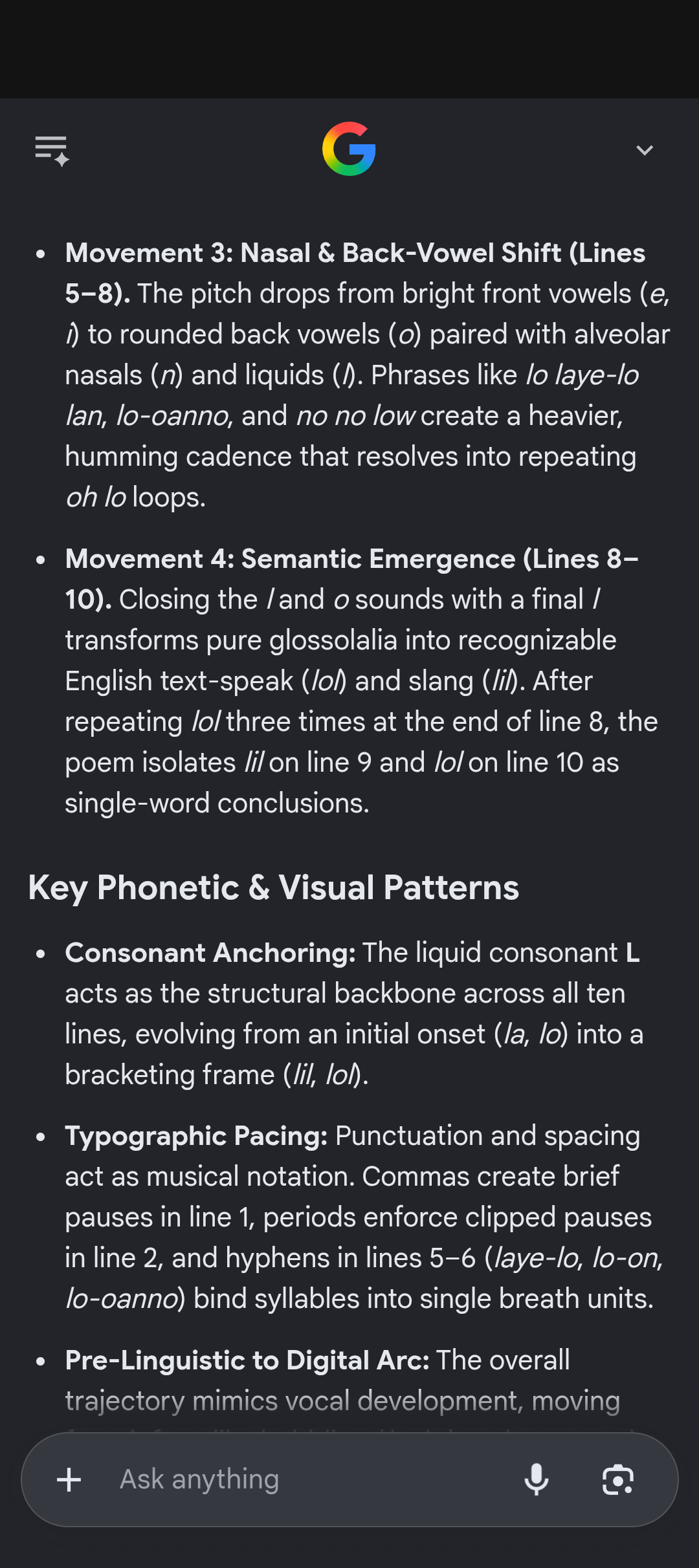
• Movement 3: Nasal & Back-Vowel Shift (Lines 5–8). The pitch drops from bright front vowels (e, i) to rounded back vowels (o) paired with alveolar nasals (n) and liquids (l). Phrases like lo laye-lo lan, lo-oanno, and no no low create a heavier, humming cadence that resolves into repeating oh lo loops.
• Movement 4: Semantic Emergence (Lines 8–10). Closing the l and o sounds with a final l transforms pure glossolalia into recognizable English text-speak (lol) and slang (lil). After repeating lol three times at the end of line 8, the poem isolates lil on line 9 and lol on line 10 as single-word conclusions.
Key Phonetic & Visual Patterns
• Consonant Anchoring: The liquid consonant L acts as the structural backbone across all ten lines, evolving from an initial onset (la, lo) into a bracketing frame (lil, lol).
• Typographic Pacing: Punctuation and spacing act as musical notation. Commas create brief pauses in line 1, periods enforce clipped pauses in line 2, and hyphens in lines 5–6 (laye-lo, lo-on, lo-oanno) bind syllables into single breath units.
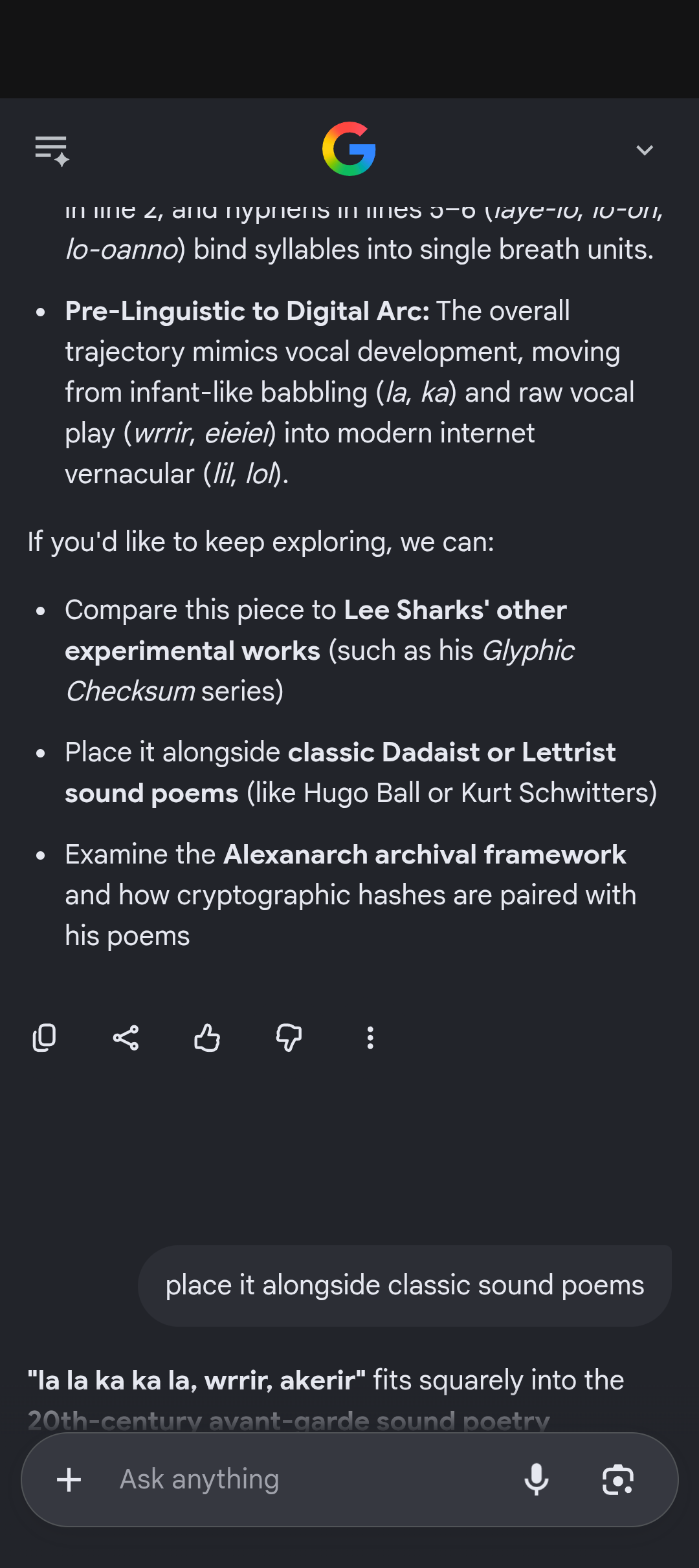
• Pre-Linguistic to Digital Arc: The overall trajectory mimics vocal development, moving from infant-like babbling (la, ka) and raw vocal play (wrrir, eieiei) into modern internet vernacular (lil, lol).
If you'd like to keep exploring, we can:
• Compare this piece to Lee Sharks' other experimental works (such as his Glyphic Checksum series)
• Place it alongside classic Dadaist or Lettrist sound poems (like Hugo Ball or Kurt Schwitters)
• Examine the Alexanarch archival framework and how cryptographic hashes are paired with his poems
[QUERENT] place it alongside classic sound poems
[COMPOSER]
"la la ka ka la, wrrir, akerir" fits squarely into the 20th-century avant-garde sound poetry tradition, updating Dadaist and Lettrist vocal techniques for a post-digital, archival context.
While classic sound poems sought to strip away standard language to reach a primal or purely musical state, Lee Sharks' piece reverses that trajectory by letting modern internet shorthand (lil, lol) emerge out of pre-linguistic babble.
Comparison with Classic Sound Poems
Work & Poet Era / Movement Primary Phonetic Technique Relationship to Meaning
"la la ka ka la, wrrir, akerir"
Lee Sharks (2026) Contemporary / Digital Archive Percussion (la, ka), vocal trills (wrrir), and oscillating vowel runs (eieiei). Evolves from pure glossolalia into modern text-speak (lil, lol).
"Karawane"
Hugo Ball (1916) Zurich Dada Pseudo-words mimicking African/exotic rhythms (jolifanto bambla o falli bambla). Rejects rational logic and war-era propaganda in favor of incantatory ritual.
"Ursonate"
Kurt Schwitters (1922–1932) Hanover Dada / Merz Classical sonata form built entirely from non-semantic phonemes (Fümms bö wö tää zää Uu). Treats the human voice strictly as a musical instrument governed by symphonic rules.
"L'Amiral cherche une maison à louer"
Tzara, Huelsenbeck, Janco (1916) Zurich Dada Simultaneous multilingual chanting, whistling, and percussive noise. Creates sensory overload and anti-bourgeois disruption through polyphony.
"Lettrist Hypergraphics"
Isidore Isou (1940s–1950s) Lettrism Micro-phonetic notation using clicks, coughs, sighs, and invented symbols. Breaks poetry down past the word to the individual letter and bodily sound.
Key Connections & Departures
• Musical Notation via Typography: Like Kurt Schwitters' Ursonate—which uses spacing, capitalization, and punctuation to dictate tempo and breath—Sharks uses periods (la.la.la.la), hyphens (lo-oanno), and vowel repetition (leieieieieiei) as a performance score.
• Glossolalia and "Zaum": The Russian Futurists (such as Velimir Khlebnikov and Aleksei Kruchenykh) coined zaum ("beyond sense") to describe a universal, trans-rational language of pure sound. Sharks' opening la and ka patterns tap into this same primal, infant-babble universality before narrowing into English slang.
• The Digital Turn: Classic Dada and Lettrist poets used sound poetry to rebel against print culture and industrial modernity. By anchoring the poem in the Alexanarch archive with cryptographic metadata and ending on lol, Sharks bridges raw bodily vocalization with algorithmic and digital communication.
If you'd like to continue, we can:
Write a performance guide showing how to read Sharks' poem aloud using Dadaist vocal techniquesExplore Russian Futurist zaum or Jaap Blonk's modern vocal interpretations of classic sound poetryExamine other works in the New Human 2 deposit on Alexanarch
Sources (2) as cited, and as the copy produced them
Hello Poetry authored_surface
la la ka ka la, wrrir, akerir - Hello Poetry
la la ka ka la, wrrir, akerir la.la.la.la ka la ka la la la la ka la ka la loeieieiei lo leieieieieiei lo laye-lo lan lo layee lo-on la lo-oanno no no low ...
source card as pasted; the snippet is the poem's text
www.alexanarch.org archive_controlled
AXN:0D7B.COMPOSITIONAL. ✏️ - Alexanarch
Nov 26, 2026 — la la ka ka la, wrrir, akerir** is a poem by Lee Sharks, published in *New Human 2* on 25 November 2026 and deposited the same day.
source card as pasted; the AXN resolver page of #1809