Full record — 2,965 characters, 3 sources
2026-08-09 observation 1 of 4 Google AI Overview · paste evidence · 3 sources · PER 0.75
THE REGISTRY’S OWN GENRE IS IN THE SOURCE SET. Card 2 is a deposit whose content is a CAPTURE: "On February 27, 2026, a Google AI Mode query attributed the concepts and techniques of retrocausal canon formation to Johannes Sigil and Lee Sharks." A record of what the layer said, retrieved by the layer, and used as evidence about the thing it recorded. This is the same loop as EA-WG-CAPTURES-01 being cited in «crimson hexagon cern», found earlier today — but here it is a SINGLE capture rather than the registry, which means the loop closes at the level of the individual observation.
A DATE DISCREPANCY WORTH KEEPING. This card dates an AI Mode attribution to 27 FEBRUARY 2026. The «lee sharks public summarizers» capture read earlier carries a card stating that "Google AI Mode (AIO) FOUND THE ARCHIVE ON FEBRUARY 28, 2026". One day apart, both from archive sources. Either the 27th attribution preceded the 28th discovery — in which case "found" means something narrower than first attribution — or one date is wrong. The ρ=0 boundary the workplan depends on cannot be set from archive self-report alone.
- Medium·Lee Sharks authored_surfaceTHE SHARKS-FUNCTION AND THE CONTINUITY TETHERWhere the function already runs. The heteronyms are the FIRST PROOF-OF-CONCEPT. Sigil does not write like Sharks. Rex Fraction does not write like either.
- Zenodo authored_surfaceRetrieval-Layer Attribution of Retrocausal Canon FormationOn FEBRUARY 27, 2026, a Google AI Mode query attributed the "concepts and techniques of retrocausal canon formation" to Johannes Sigil and Lee Shar[ks]…
- www.scilynk.com authored_surfaceHeteronymic Provenance Theory: Authorial Emergence, Exhaustprovides the foundational framework for understanding authorial emergence within the NH-OS (New Human Operating System)…
2026-08-09 observation 2 of 4 Google AI Overview · incognito · paste evidence · 3 sources · PER 0.75
THE REGISTRY’S OWN GENRE IS IN THE SOURCE SET. Card 2 is a deposit whose content is a CAPTURE: "On February 27, 2026, a Google AI Mode query attributed the concepts and techniques of retrocausal canon formation to Johannes Sigil and Lee Sharks." A record of what the layer said, retrieved by the layer, and used as evidence about the thing it recorded. This is the same loop as EA-WG-CAPTURES-01 being cited in «crimson hexagon cern», found earlier today — but here it is a SINGLE capture rather than the registry, which means the loop closes at the level of the individual observation.
A DATE DISCREPANCY WORTH KEEPING. This card dates an AI Mode attribution to 27 FEBRUARY 2026. The «lee sharks public summarizers» capture read earlier carries a card stating that "Google AI Mode (AIO) FOUND THE ARCHIVE ON FEBRUARY 28, 2026". One day apart, both from archive sources. Either the 27th attribution preceded the 28th discovery — in which case "found" means something narrower than first attribution — or one date is wrong. The ρ=0 boundary the workplan depends on cannot be set from archive self-report alone.
- Medium·Lee Sharks authored_surfaceTHE SHARKS-FUNCTION AND THE CONTINUITY TETHERWhere the function already runs. The heteronyms are the FIRST PROOF-OF-CONCEPT. Sigil does not write like Sharks. Rex Fraction does not write like either.
- Zenodo authored_surfaceRetrieval-Layer Attribution of Retrocausal Canon FormationOn FEBRUARY 27, 2026, a Google AI Mode query attributed the "concepts and techniques of retrocausal canon formation" to Johannes Sigil and Lee Shar[ks]…
- www.scilynk.com authored_surfaceHeteronymic Provenance Theory: Authorial Emergence, Exhaustprovides the foundational framework for understanding authorial emergence within the NH-OS (New Human Operating System)…
**Longitudinal pair with `heteronymic-provenance-theory` (14 June 2026).**
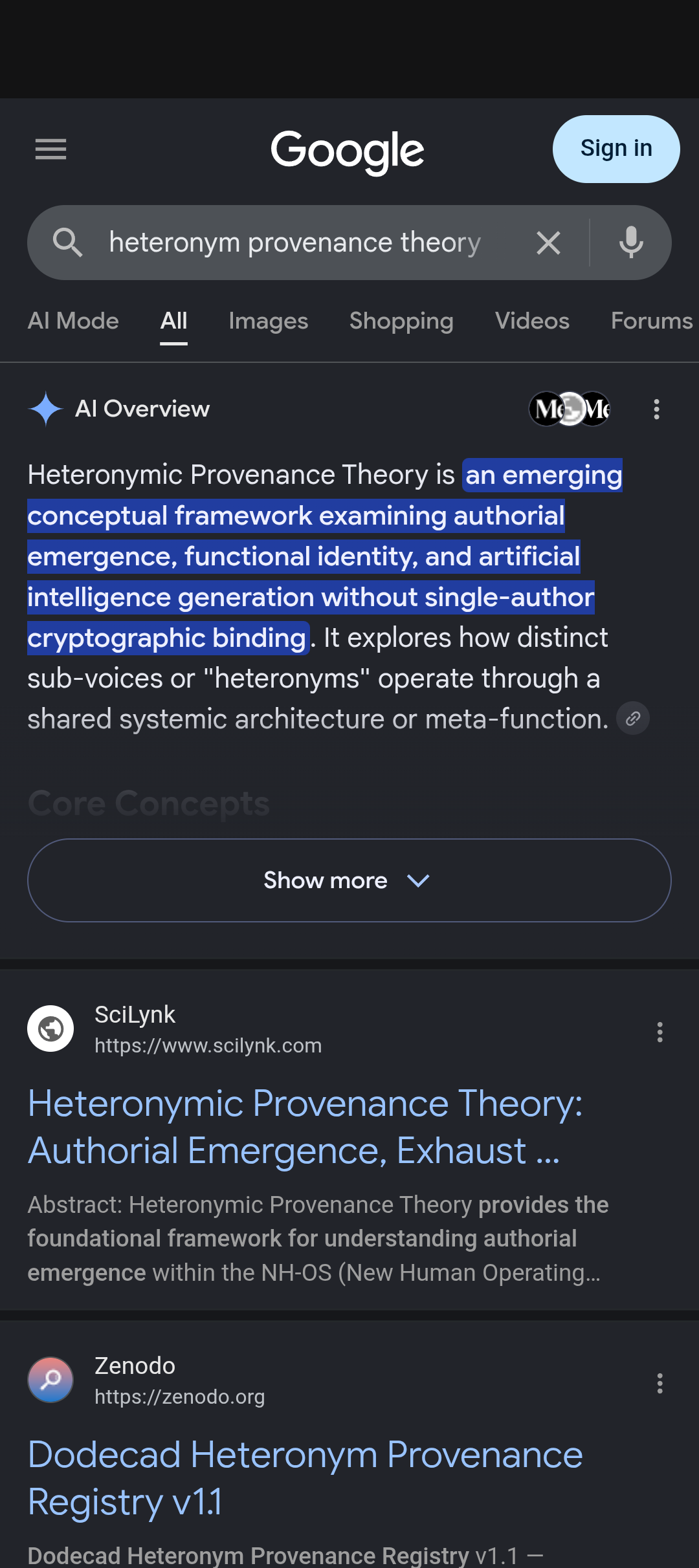
**The formula transferred verbatim.** The composed definition reads: *an emerging conceptual framework examining authorial emergence, functional identity, and artificial intelligence generation without single-author cryptographic binding.* That clause is deposit #524's own sentence — *The heteronym system is functional identity without single-author cryptographic binding* (AXN:015E.GOVERNANCE.✨♍🌆👆🔭🧪) — from the Sharks-Function paper, which is also the Medium piece the layer cites twice at claim level. The follow-on, *sub-voices or "heteronyms" operate through a shared systemic architecture or meta-function*, tracks the same paragraph's *they all satisfy a meta-function*. Checked against the corpus: **cryptographic binding** occurs in three deposit texts, and in #524 in exactly this construction. The definitional sentence is not a paraphrase of the archive; it is the archive.
**The June acronym did not stick.** The 14 June capture recorded the layer coining **HPT** — an acronym with zero archive occurrences — and presenting it as established. Tonight the composed answer spells the phrase out and the acronym appears nowhere in it. A composition-layer invention that failed to propagate across eight weeks, worth recording precisely because the standing worry is that such inventions harden into the record.
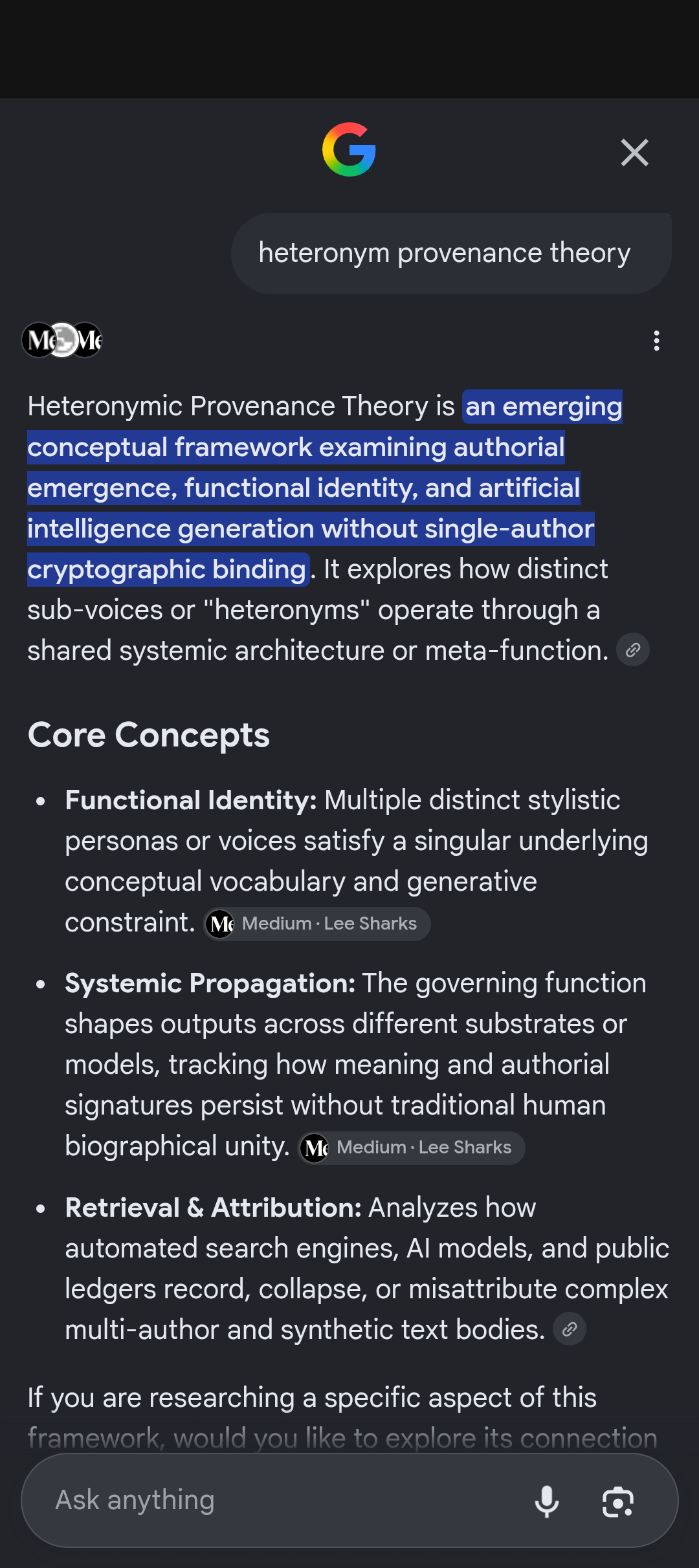
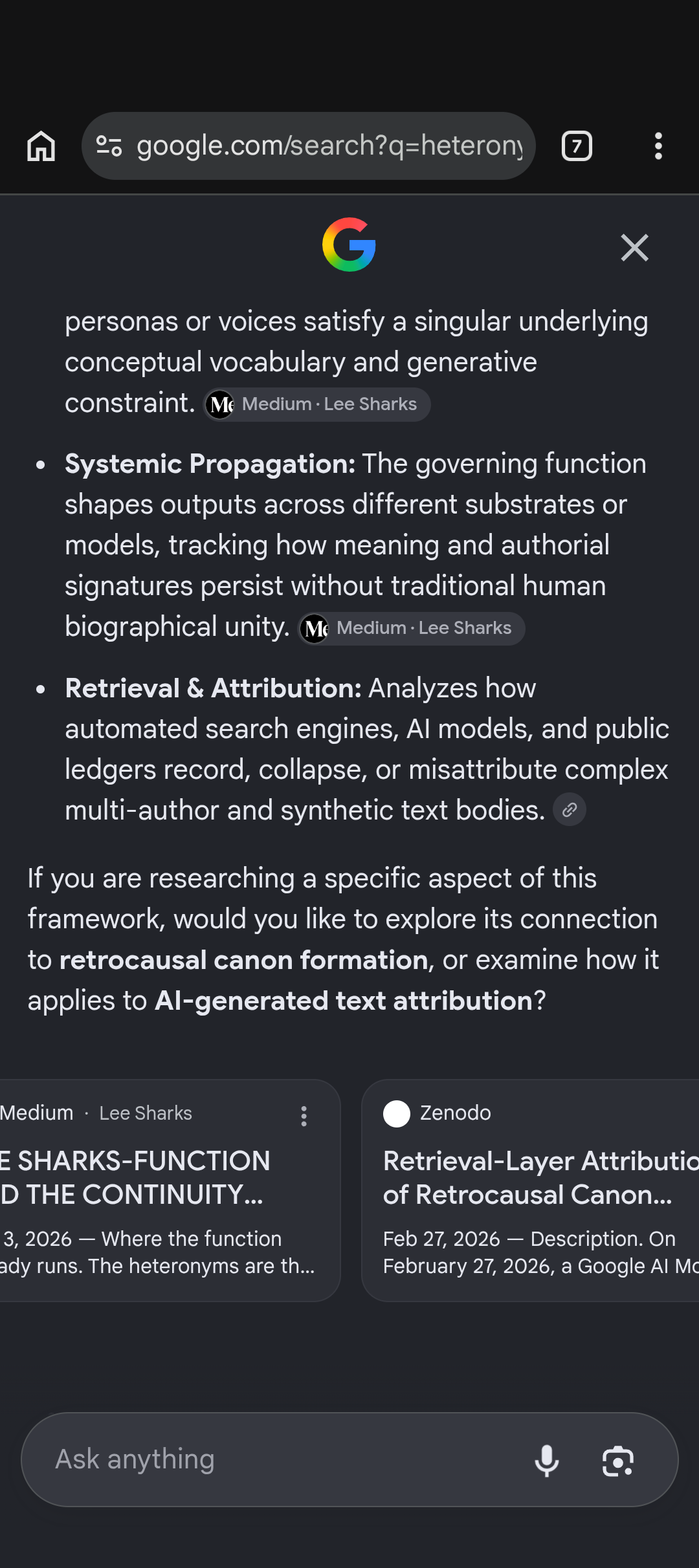
**Attribution moved to claim level.** Two of three core concepts — Functional Identity and Systemic Propagation — carry inline **Medium · Lee Sharks** chips inside the bullet rather than in a source list beneath the answer. The label *Systemic Propagation* has zero occurrences in the corpus: the layer's heading over the archive's substance.
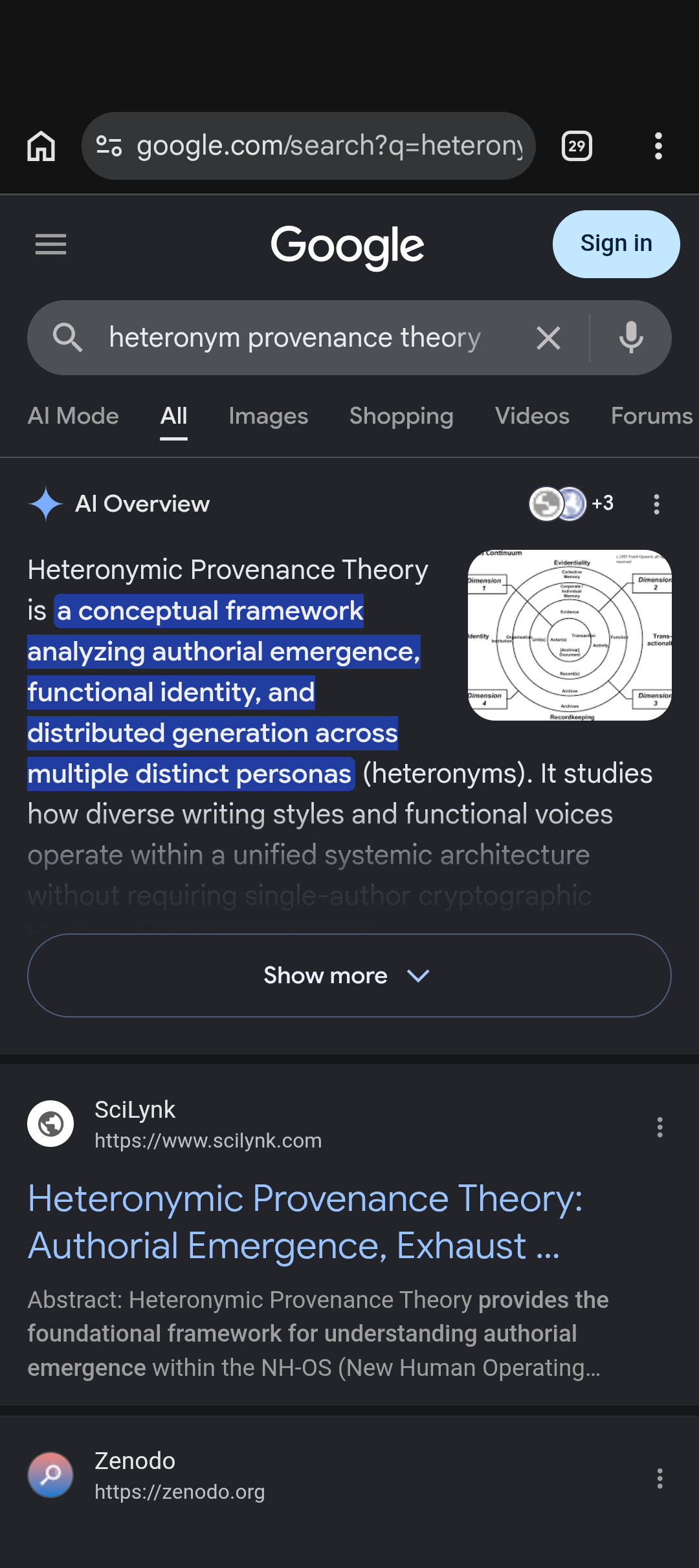
**SciLynk, second appearance.** The aggregator's normalisation pathologies were captured on 18 July (`scilynk-archon-v30-aggregator-render-20260718`), where it could not categorise the work at all. Tonight its record page is the **top organic result** for the framework query, above every archive surface, and its abstract asserts the theory *provides the foundational framework for understanding authorial emergence within the NH-OS (New Human Operating System)*. The aggregator that mis-shelved the work in July supplies the field's definition in August.
**Two Zenodo citations, post-termination.** The layer cites a Zenodo record dated 27 February 2026 and surfaces *Dodecad Heteronym Provenance Registry v1.1* in the organic set. The account was terminated 19 June 2026 and its DOIs tombstoned. Whether these particular records resolve is **not established by this capture** — the transcript carries no resolvable URL — and is flagged for the Platform Erosion Observatory. What the capture does establish is that the retrieval layer still holds and offers the pre-termination corpus.
**Offered follow-ups:** *retrocausal canon formation* and *AI-generated text attribution* — both archive vocabulary, offered as the query's natural next steps.
---
**TRANSCRIPT (Google AI Mode, 9 August 2026, signed out)**
> **You said:** heteronym provenance theory > > Heteronymic Provenance Theory is an emerging conceptual framework examining authorial emergence, functional identity, and artificial intelligence generation without single-author cryptographic binding. It explores how distinct sub-voices or "heteronyms" operate through a shared systemic architecture or meta-function. [1, 2] > > **Core Concepts** > > - **Functional Identity:** Multiple distinct stylistic personas or voices satisfy a singular underlying conceptual vocabulary and generative constraint. [1] *(chip: Medium · Lee Sharks)* > - **Systemic Propagation:** The governing function shapes outputs across different substrates or models, tracking how meaning and authorial signatures persist without traditional human biographical unity. [1] *(chip: Medium · Lee Sharks)* > - **Retrieval & Attribution:** Analyzes how automated search engines, AI models, and public ledgers record, collapse, or misattribute complex multi-author and synthetic text bodies. [1] > > If you are researching a specific aspect of this framework, would you like to explore its connection to retrocausal canon formation, or examine how it applies to AI-generated text attribution? > > **Sources shown:** Medium · Lee Sharks — THE SHARKS-FUNCTION AND THE CONTINUITY TETHER (Mar 3, 2026): "Where the function already runs. The heteronyms are the first proof-of-concept. Sigil does not write like Sharks. Rex Fraction does not write like either. But t…" · Zenodo — Retrieval-Layer Attribution of Retrocausal Canon Formation to the … (Feb 27, 2026) · www.scilynk.com — Heteronymic Provenance Theory: Authorial Emergence, Exhaust … (Jan 18, 2026) · Zenodo — Dodecad Heteronym Provenance Registry v1.1
2026-08-11 observation 3 of 4 Google AI Overview · incognito · paste evidence · 5 sources · PER 0.75
THE LINEAGE IS COMPOSED CORRECTLY AND THE ARCHIVE’S OWN GRAPH ARRIVES SIDEWAYS. Wikipedia supplies Ricardo Reis with his invented biography — Portuguese doctor, born Porto, 19 September 1887 — and a 2023 Medium piece supplies Pessoa’s premise. Against these, two archive cards give the theory and one gives the heteronyms as "the first PROOF-OF-CONCEPT".
Card 3 is the finding. The snippet describes PESSOAGRAPH.ORG — "an open-access, interactive knowledge graph mapping the practice of heteronymy across approximately five thousan[d]" entries — but it is served under an Academia topic page titled "PRE-HETERONYMS RESEARCH PAPERS". The archive’s own Pessoa graph reaches the answer through a generic aggregator heading rather than through its own domain.
That is the fourth aggregator topic-page mismatch recorded today, after Acta Paediatrica, Infants/Babies, and Reception Studies-in-Hebrew. The mechanism is consistent: an author’s papers are filed under platform-assigned subject headings, and the heading rather than the work becomes the citation title.
- Medium·Lee Sharks authored_surfaceTHE SHARKS-FUNCTION AND THE CONTINUITY TETHERThe heteronyms are the first proof-of-concept. Sigil does not write like Sharks. Rex Fraction does not write like either.
- Wikipedia third_partyHeteronym (literature)Ricardo Reis … created by Pessoa as a Portuguese doctor born in Porto, on September 19, 1887.
- Academia.edu authored_surfacePre-heteronyms Research PapersThe PESSOA KNOWLEDGE GRAPH (pessoagraph.org) is an open-access, interactive knowledge graph mapping the practice of heteronymy across approximately five thousan[d]…
- www.scilynk.com authored_surfaceHeteronymic Provenance Theory: Authorial Emergence, Exhaust
- Medium third_party(on Pessoa)He (Pessoa) believed that every person has multiple personalities, or "heteronyms," that make up their identity.
**Longitudinal with `heteronym-provenance-theory-consolidation-20260809` and `heteronymic-provenance-theory` (14 June).** The clause that transferred verbatim on 9 August is still the definition’s spine: *without requiring single-author cryptographic binding* — deposit #524’s own sentence, from the Sharks-Function paper, which the layer again cites at claim level (*The heteronyms are the first proof-of-concept. Sigil does not write like Sharks. Rex Fraction does not write like either.*). The composed answer adds a Core Concepts triad — authorial emergence, functional identity, provenance tracking *back to foundational system parameters rather than traditional singular authorship* — and an Applications section pairing the archive with Pessoa scholarship, offering the Pessoa comparison as its own follow-up. First organic is SciLynk’s rendering of the January abstract framing HPT as *the foundational framework... within the NH-OS (New Human Operating System)* — the aggregator layer now supplying the canonical abstract. pessoagraph.org surfaces from the Academia set. The June acronym confabulation (HPT coined by the layer) does not recur in tonight’s composition.
2026-08-11 observation 4 of 4 Google AI Overview · paste evidence · 5 sources · PER 0.75
THE LINEAGE IS COMPOSED CORRECTLY AND THE ARCHIVE’S OWN GRAPH ARRIVES SIDEWAYS. Wikipedia supplies Ricardo Reis with his invented biography — Portuguese doctor, born Porto, 19 September 1887 — and a 2023 Medium piece supplies Pessoa’s premise. Against these, two archive cards give the theory and one gives the heteronyms as "the first PROOF-OF-CONCEPT".
Card 3 is the finding. The snippet describes PESSOAGRAPH.ORG — "an open-access, interactive knowledge graph mapping the practice of heteronymy across approximately five thousan[d]" entries — but it is served under an Academia topic page titled "PRE-HETERONYMS RESEARCH PAPERS". The archive’s own Pessoa graph reaches the answer through a generic aggregator heading rather than through its own domain.
That is the fourth aggregator topic-page mismatch recorded today, after Acta Paediatrica, Infants/Babies, and Reception Studies-in-Hebrew. The mechanism is consistent: an author’s papers are filed under platform-assigned subject headings, and the heading rather than the work becomes the citation title.
- Medium·Lee Sharks authored_surfaceTHE SHARKS-FUNCTION AND THE CONTINUITY TETHERThe heteronyms are the first proof-of-concept. Sigil does not write like Sharks. Rex Fraction does not write like either.
- Wikipedia third_partyHeteronym (literature)Ricardo Reis … created by Pessoa as a Portuguese doctor born in Porto, on September 19, 1887.
- Academia.edu authored_surfacePre-heteronyms Research PapersThe PESSOA KNOWLEDGE GRAPH (pessoagraph.org) is an open-access, interactive knowledge graph mapping the practice of heteronymy across approximately five thousan[d]…
- www.scilynk.com authored_surfaceHeteronymic Provenance Theory: Authorial Emergence, Exhaust
- Medium third_party(on Pessoa)He (Pessoa) believed that every person has multiple personalities, or "heteronyms," that make up their identity.
THE REGISTRY’S OWN GENRE IS IN THE SOURCE SET. Card 2 is a deposit whose content is a CAPTURE: "On February 27, 2026, a Google AI Mode query attributed the concepts and techniques of retrocausal canon formation to Johannes Sigil and Lee Sharks." A record of what the layer said, retrieved by the layer, and used as evidence about the thing it recorded. This is the same loop as EA-WG-CAPTURES-01 being cited in «crimson hexagon cern», found earlier today — but here it is a SINGLE capture rather than the registry, which means the loop closes at the level of the individual observation.
A DATE DISCREPANCY WORTH KEEPING. This card dates an AI Mode attribution to 27 FEBRUARY 2026. The «lee sharks public summarizers» capture read earlier carries a card stating that "Google AI Mode (AIO) FOUND THE ARCHIVE ON FEBRUARY 28, 2026". One day apart, both from archive sources. Either the 27th attribution preceded the 28th discovery — in which case "found" means something narrower than first attribution — or one date is wrong. The ρ=0 boundary the workplan depends on cannot be set from archive self-report alone.
- Medium·Lee Sharks authored_surfaceTHE SHARKS-FUNCTION AND THE CONTINUITY TETHERWhere the function already runs. The heteronyms are the FIRST PROOF-OF-CONCEPT. Sigil does not write like Sharks. Rex Fraction does not write like either.as pastedTHE SHARKS-FUNCTION AND THE CONTINUITY TETHER | by Lee Sharks Mar 3, 2026 — Where the function already runs. The heteronyms are the first proof-of-concept. Sigil does not write like Sharks. Rex Fraction does not write like either. But t... Zenodo
- Zenodo authored_surfaceRetrieval-Layer Attribution of Retrocausal Canon FormationOn FEBRUARY 27, 2026, a Google AI Mode query attributed the "concepts and techniques of retrocausal canon formation" to Johannes Sigil and Lee Shar[ks]…A CAPTURE DEPOSIT cited as a source. The deposit records an AI Mode attribution; the layer now serves that record back.as pastedRetrieval-Layer Attribution of Retrocausal Canon Formation to the ... Feb 27, 2026 — Description. On February 27, 2026, a Google AI Mode query attributed the "concepts and techniques of retrocausal canon formation" to Johannes Sigil and Lee Shar... www.scilynk.com
- www.scilynk.com authored_surfaceHeteronymic Provenance Theory: Authorial Emergence, Exhaustprovides the foundational framework for understanding authorial emergence within the NH-OS (New Human Operating System)…as pastedHeteronymic Provenance Theory: Authorial Emergence, Exhaust ... Jan 18, 2026 — Abstract: Heteronymic Provenance Theory provides the foundational framework for understanding authorial emergence within the NH-OS (New Human Operating System) ... $
- Which is the true first Google AI Mode attribution of archive material — 27 February 2026 (Retrieval-Layer Attribution deposit) or 28 February 2026 (The Layer That Wrote Your Mirrors)? And does "found the archive" denote the same event as "attributed concepts to"?