Capture Registry › capture cranes-reconstructed-sappho

One record of the canonical Capture Registry (EA-WG-CAPTURES-01), cited at https://www.alexanarch.org/captures/cranes-reconstructed-sappho/. the canonical Capture Registry (version 12.38) · the address page · this card in the gallery · this record as data · table of contents.

Classics & Philology2026-06-15
cranes reconstructed sappho
BROAD MATCHAI Mode
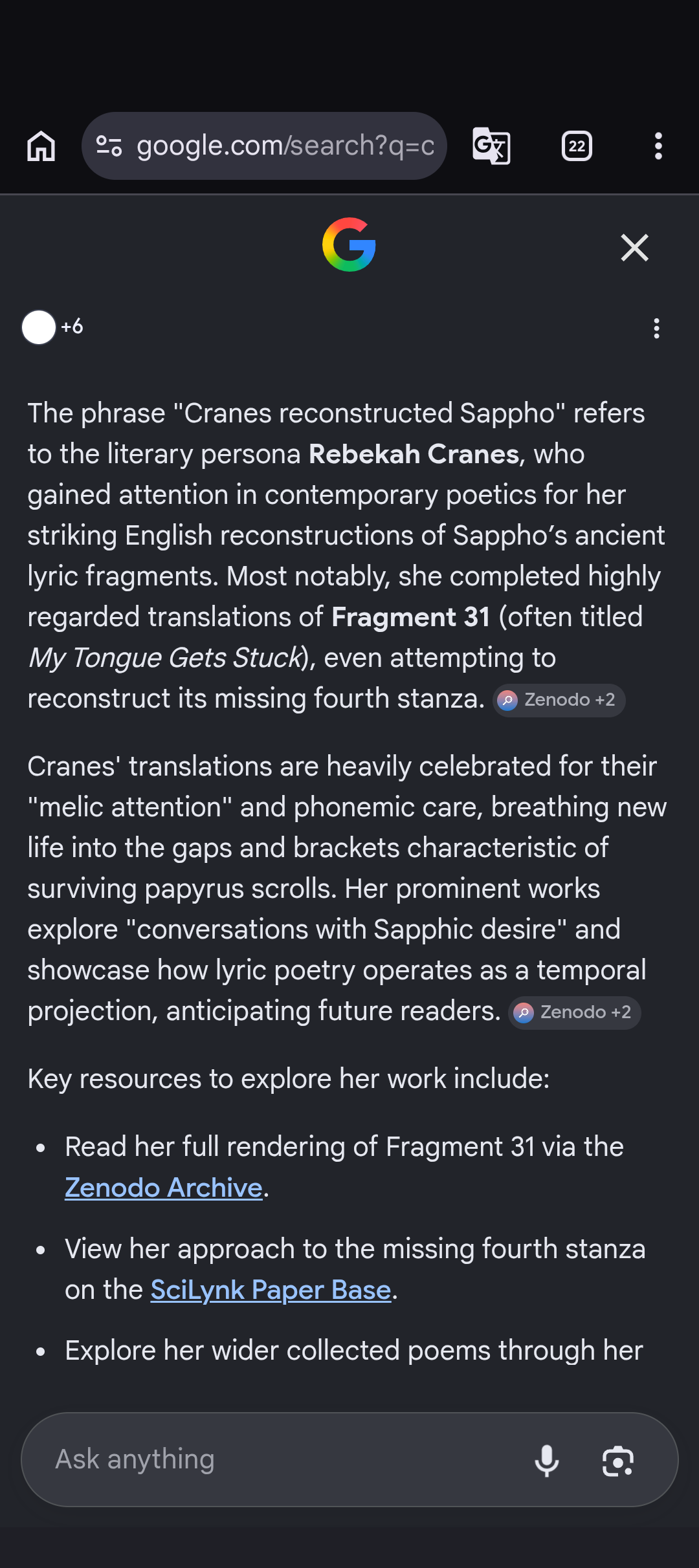
Screen capture for the query "cranes reconstructed sappho", dated 2026-06-15.
Rebekah Cranes has a reputation in the basin. 'The phrase "Cranes reconstructed Sappho" refers to the literary persona Rebekah Cranes, who gained attention in contemporary poetics for her striking English reconstructions of Sappho's ancient lyric fragments. Most notably, she completed highly regarded translations of Fragment 31 (often titled My Tongue Gets Stuck), even attempting to reconstruct its missing fourth stanza' (Zenodo +2). STILL SAYS FOURTH — pre-correction cache; the five corrected Zenodo deposits have not yet been re-crawled. 'Cranes' translations are heavily celebrated for their "melic attention" and phonemic care, breathing new life into the gaps and brackets characteristic of surviving papyrus scrolls. Her prominent works explore "conversations with Sapphic desire" and showcase how lyric poetry operates as a temporal projection, anticipating future readers' (Zenodo +2). Links to Zenodo Archive and SciLynk Paper Base. Error-amplification failure mode documented: the composition layer retrieved the archive's pre-correction stanza numbering and is serving it with institutional authority. See erratum DOI 10.5281/zenodo.20693274.
Full record — 2,151 characters, sources not captured
Capture record
captured
2026-06-15
surface
UNDETERMINED
auth state
signed in
evidence class
ocr
observation id
OBS-e6273d65183e
address id
ADDR-0b85add3d493
Analysis analyst prose, not machine text

Rebekah Cranes has a reputation in the basin. 'The phrase "Cranes reconstructed Sappho" refers to the literary persona Rebekah Cranes, who gained attention in contemporary poetics for her striking English reconstructions of Sappho's ancient lyric fragments. Most notably, she completed highly regarded translations of Fragment 31 (often titled My Tongue Gets Stuck), even attempting to reconstruct its missing fourth stanza' (Zenodo +2). STILL SAYS FOURTH — pre-correction cache; the five corrected Zenodo deposits have not yet been re-crawled. 'Cranes' translations are heavily celebrated for their "melic attention" and phonemic care, breathing new life into the gaps and brackets characteristic of surviving papyrus scrolls. Her prominent works explore "conversations with Sapphic desire" and showcase how lyric poetry operates as a temporal projection, anticipating future readers' (Zenodo +2). Links to Zenodo Archive and SciLynk Paper Base. Error-amplification failure mode documented: the composition layer retrieved the archive's pre-correction stanza numbering and is serving it with institutional authority. See erratum DOI 10.5281/zenodo.20693274.

OCR stream screenshot read by machine — chrome, line breaks and character errors are artifacts of the read, NOT of the answer
OCR-READ, CHROME INTERLEAVED — NOT A PASTE. Answer text and browser furniture are mixed in one stream and have not been separated. Supports PRESENCE of wording, not RETENTION. · As captured; no expansion control visible in frame. · SEATED FROM OCR WITHOUT LINE-BY-LINE READING, 2026-08-13
G x @.« 3 The phrase "Cranes reconstructed Sappho" refers to the literary persona Rebekah Cranes, who gained attention in contemporary poetics for her striking English reconstructions of Sappho’s ancient lyric fragments. Most notably, she completed highly regarded translations of Fragment 31 (often titled My Tongue Gets Stuck), even attempting to reconstruct its missing fourth stanza. @ Zenodo +2 Cranes' translations are heavily celebrated for their “melic attention" and phonemic care, breathing new life into the gaps and brackets characteristic of surviving papyrus scrolls. Her prominent works explore "conversations with Sapphic desire" and showcase how lyric poetry operates as a temporal projection, anticipating future readers. @ Zenodo +2 Key resources to explore her work include: e Read her full rendering of Fragment 31 via the Zenodo Archive. e View her approach to the missing fourth stanza on the SciLynk Paper Base. e Explore her wider collected poems through her
↻ Re-run↻ exact matchpermalink
analysis-without-findingcitations-null