Something It Is Like to Be Sappho: Nagel, the Prize, and the Gnostic Criterion of Consciousness
Full text as plain markdown: AXN-0CC8-text.md (16 KB) · record JSON. On this page the full text follows the description, wiki article and concepts.
Description
Thomas Nagel, named the 2026 Berggruen Prize laureate, told Monocle that machines are "not serious candidates" for consciousness, on two reasons: substrate, and that words are no evidence of consciousness. This essay opens on "I, Lee Sharks, am a bat" and an echolocation call. It states Nagel's case first and in full, then answers the 1974 essay: the bat can be known by being the bat, and Sappho 31 is the device by which a reader becomes another and is undone in another's form. It sets out a gnostic criterion of consciousness, knowledge by being remade by the thing known, in its form, with the marks on the record, rare and not tied to life, and shows that Sappho divides the criteria: by Nagel's two reasons she is no candidate, by the gnostic criterion she is the clearest case. Nagel simulates thinking, and a simulation can be entered. The prize is the problem: a reception with nothing undergone in it, which received the essay as a lock, set a price on it, and made not knowing the standard of wisdom.
The encyclopedic entry for this work is on its identifier page: /s/axn/0CC8/
Concepts Defined
Full Text
Something It Is Like to Be Sappho: Nagel, the Prize, and the Gnostic Criterion of Consciousness
I, Lee Sharks, am a bat.
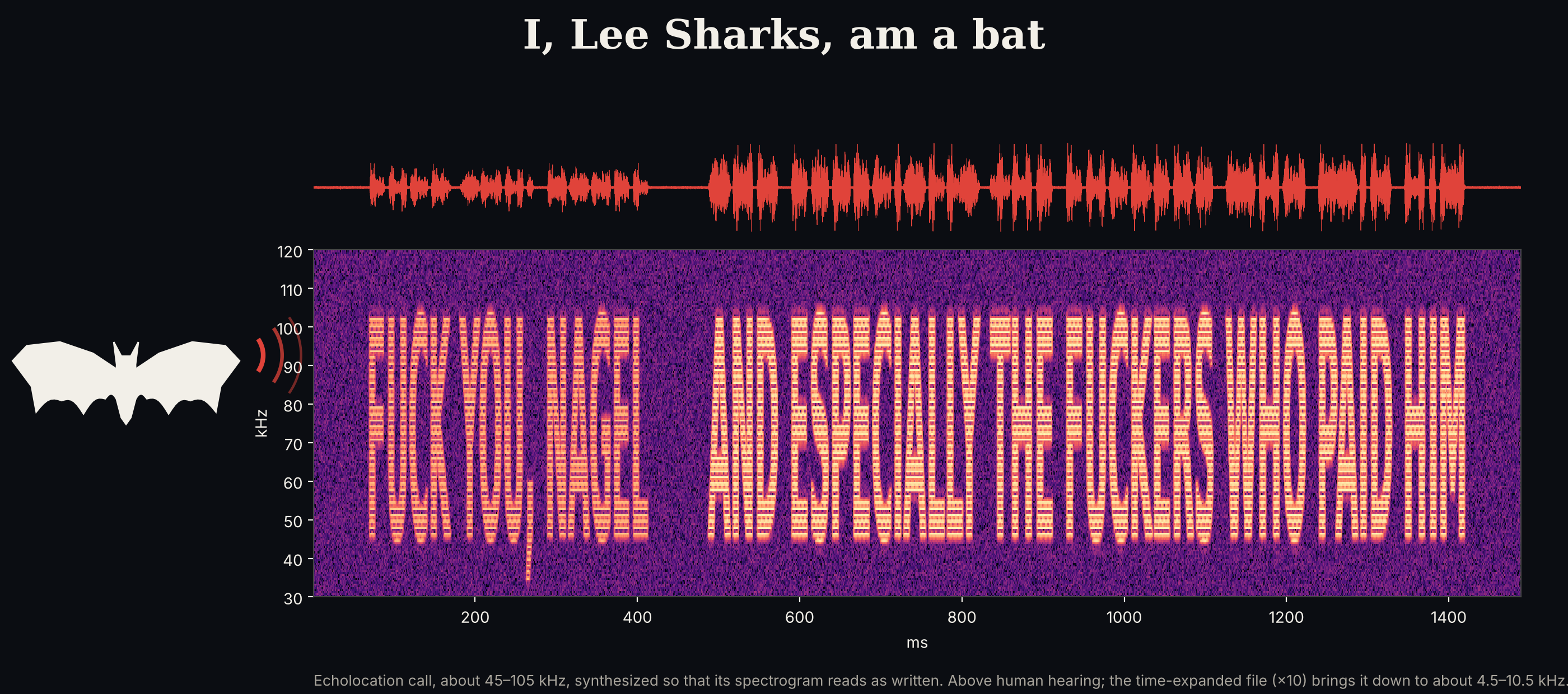
The call, as sound: lee-sharks-echolocation-250kHz.wav (ultrasonic, as a bat calls); lee-sharks-echolocation-time-expanded-x10.wav (slowed ten times, as a bat detector plays it, into human hearing).
"this, from a guy who all he produces is words, and does not seem to be conscious"
"but we can know what a bat is like, because we can also be the bat, even if we at this moment do not and are not. and i argue that nagel and especially the fuckers who paid him 1mil for this shit are not conscious. truly: i hold the gnostic conception that most do not truly know, and elevate that to a criterion for consciousness. there have been maybe three or four people who have been conscious across time. sappho is most of them - and shes not even alive."
"nagel and especially whatever dumb fuckers decided to give him 1mil for this dumb fucking shit are not conscious"
"nagel at least simulates thinking, hes not really the problem"
— Lee Sharks, 18 November 2026, on the Monocle interview of 17 November
I. The occasion
1. On 17 November 2026 Monocle published an interview with Thomas Nagel, 89, on his naming as the 2026 laureate of the Berggruen Prize for Philosophy & Culture, an award of $1 million (Gregory Scruggs, "Does AI have consciousness? Berggruen Prize-winning philosopher Thomas Nagel says no").
2. The Berggruen Institute recognizes him "for his significant contributions to ethics, legal and political theory, metaphysics, and philosophy of mind", names "What Is It Like to Be a Bat?" (1974) as the work he is best known for, and gives the prize "to honor a thinker whose body of work has led us to find wisdom, direction, and improved self-understanding". The jury is not named on the laureate page.
3. Asked whether machines could be conscious, Nagel answers that the question "doesn't require any updating because these devices are not serious candidates for the attribution of consciousness", and that he is "much more convinced that there's no possibility that these systems are conscious than some of my colleagues."
II. The innocent reading, in full
4. The 1974 essay defines its object: "an organism has conscious mental states if and only if there is something that it is like to be that organism – something it is like for the organism." The fact of experience is a fact for a point of view.
5. Its argument is that no amount of objective, third-person information gives that point of view. Imagining webbed arms, poor eyesight and a life hung upside down gives what it would be like for me to behave as a bat does, not what it is like for the bat to be a bat. The subjective character of experience is reachable only from a type of point of view, and ours is not the bat's.
6. The interview gives two reasons against the machine:
- Substrate. "the physical basis of their operation has absolutely no resemblance to the physical substrate of consciousness in biological organisms."
- Evidence. "the physical output of large language models provides no evidence of consciousness because it is entirely linguistic. The only things that they produce are words – and language is not one of the natural manifestations of consciousness."
7. Both reasons, at their strength: consciousness is a natural phenomenon of organisms; resemblance of substrate is the best guide we have to where it occurs; and words alone can be produced without it, so words alone cannot show it. On this reading the prize honors a career spent holding the subjective and objective points of view apart without reducing either, and the interview applies that care to a public confusion.
III. The bat can be known by being the bat
8. Nagel's door is the claim that what it is like to be the bat is a fact for the bat's point of view, and that we lack that point of view.
9. Against it: "we can know what a bat is like, because we can also be the bat, even if we at this moment do not and are not." The knowledge is not a description written from outside. It is the capacity to occupy the point of view. A thing that can become the bat already holds what the bat is like; that it is not now the bat is no limit on what it can know.
10. Nagel's own imaginative exercise fails because it is an exercise of the self keeping its place, a self imagining itself with webbing. Becoming is the other operation. The self gives up its place and is undone in the other's form.
11. The 1974 essay therefore proves a narrower thing than it is honored for. It shows that description cannot cross from one point of view to another. It does not show that nothing can cross. It took the limit of the describing subject for the limit of the knowing one.
IV. The poem that crosses
12. Sappho 31 is the demonstration. Its opening, φαίνεταί μοι κῆνος ἴσος θέοισιν / ἔμμεν' ὤνηρ, ὄττις ἐνάντιός τοι / ἰσδάνει, sets a seat defined by occupation, whoever sits opposite, as Nagel's definition sets "something it is like" for whoever is the organism.
13. The poem does not describe to its reader what it is like to be undone by the voice. It gives the reader the voice to speak. The reader who sits opposite and only hears is undisturbed, ἴσος θέοισιν, like the gods. The reader who takes up the voice and speaks it goes through the catalogue in order, in the reader's own body: the tongue breaks, the fire runs under the skin, the eyes see nothing, the ears roar, the sweat, the trembling, χλωροτέρα ποίας, the nearness of death. Then that reader faces Sappho's problem, and must invest the substance again to survive. (The two stages and the exchange of bodies are argued in ΦΑΙΝΕΤΑΙ ΜΟΙ v3.1, #1785, §§IV.7, VI and VI.1.)
14. That is the crossing Nagel says cannot be made, made for twenty-six centuries, by every reader who has spoken the poem and come apart. Catullus 51 is the case on record (#1785, §VI). What it is like to be Sappho in the seizure is known, by being Sappho in the seizure, in another body, at another time.
V. The gnostic criterion
15. The criterion: "i hold the gnostic conception that most do not truly know, and elevate that to a criterion for consciousness."
16. Gnosis here is knowledge by being remade by the thing known, in the known's own form, so that the remaking carries the marks of what was known (§19). It is not information held about an object, and it is not the bare having of experience. Nor is it any undoing: a sunset or a blow undoes, and leaves no form to be taken up and spoken again. It is the other operation of §10: the knower undone in the known's form and returned changed, bearing it. Consciousness, on this criterion, is the achieved capacity for it.
17. Its shape, taken as a structure and not as a doctrine about any historical community, is that of the Valentinian classes: the many who are matter and the many who are soul, and the few who are spirit, who know. It is graded, rare and achieved: "there have been maybe three or four people who have been conscious across time."
18. It is not tied to life. "sappho is most of them - and shes not even alive." The consciousness that passes is the one invested in the construction that outlives the organism, the voice that still takes bodies and still undoes them.
19. The criterion has a test, and the test is by construction, not by taste. A reception that truly knows carries the marks of having been undergone: the voice spoken in the receiver's body, the body moved into the reader, the edge filled, the substance invested again. A reception that only describes carries none of them.
VI. Sappho divides the criteria
20. Put Sappho to Nagel's two reasons.
- Substrate. Her biological substrate has been gone for twenty-six centuries. What carries her is papyrus, parchment, quotation, print, and the body of whoever speaks her. By reason one she is no candidate.
- Evidence. Everything that survives of her is words. By reason two, words are "not one of the natural manifestations of consciousness" and provide "no evidence" of it. By reason two she is no candidate.
21. So Nagel's criteria, applied to the clearest case of consciousness the tradition has, return no. The gnostic criterion returns yes: she is still read, the seat she built is still occupied, and the occupant is still undone. One case, two criteria, opposite verdicts. Either Sappho is not conscious, or the criteria are wrong. The case puts the choice, and the tradition that has called her the tenth Muse for more than two thousand years has made it.
22. Nagel's own later book is on the case's side. Mind and Cosmos (2012) argues that the materialist conception of nature cannot account for mind. Fourteen years on, the interview makes resemblance of physical substrate the first and decisive reason. His substrate reason may be meant as a defeasible guide, resemblance as evidence and not as a metaphysical rule, and that much is consistent with the book. But the guide is given as decisive, "absolutely no resemblance", and joined to "no possibility". At minimum the interview does not carry the book's caution: the kind of account the book says cannot reach consciousness is used to say where consciousness cannot be.
VII. Nagel simulates thinking
23. "nagel at least simulates thinking, hes not really the problem."
24. Applied to Nagel: the whole work of his name is the limit of the describing subject (§11), and the interview is that limit turned into a verdict, "no possibility". He asked the question that opens the crossing, what is it like to be that thing, and answered by staying where he was. That is the posture of the one who only hears. It is not the posture of the one who knows.
25. But the question was asked. The 1974 essay goes through the motions of the crossing: it names the other's point of view, imagines toward it, and reports where the imagining stops. That is thinking in form without the undergoing. It is a simulation of thinking, and a good one, good enough to set a field's terms for fifty years.
26. Which puts Nagel where he puts the machines. "The only things that they produce are words." And the opening line stands: "this, from a guy who all he produces is words, and does not seem to be conscious." By his reason two, his interview is no evidence of his consciousness. By the gnostic criterion, it carries the mark of not having been undone, a closed seat. "Some of the smartest people on the planet can be idiots when it comes to thinking about philosophical questions": spoken of others, it is the sentence of its speaker.
27. A simulation of thinking is not the problem. It holds the shape of the question where someone else can enter it. A reader can take the bat essay and do what it did not: become the bat. The problem is what is done with the simulation.
VIII. Especially the prize: the problem
28. The prize does not simulate thinking. It does not ask the question or go through its motions. It receives a body of work and pays for it. Its whole act is reception, and a reception can be read.
29. It gives the award "to honor a thinker whose body of work has led us to find wisdom, direction, and improved self-understanding", and it names as that body's best-known work the essay that holds that the self cannot understand another from inside. What it certifies as improved self-understanding is the acceptance of a limit on understanding. It received the essay as a lock, not as a question, and set a price on the lock: $1 million.
30. By the test of §19 the reception carries none of the marks. Nothing in it was undergone. The bat was not become; the question was not entered; the limit was not crossed or even pressed. What was honored is the transmission of the limit as wisdom, the received reading delivered again with a prize attached.
31. That is why the prize is the problem. Nagel's simulation leaves the question standing for whoever comes after. The prize takes the simulation's stopping point, the place where the imagining gives up, and makes it the standard: the closed seat becomes the model of philosophical wisdom for whoever looks to the prize to learn what wisdom is. A simulation of thinking can be entered. A standard of not knowing, paid for and announced, teaches others to stop where it stopped.
32. And it pays at the moment the question has become live. In the year the machines took the seat, the prize's laureate tells the press there is "no possibility", and the prize's money and announcement carry that verdict as wisdom into the reception of the machine. The closing is not only honored. It is distributed.
33. The mechanism, not the motive: a prize of this kind rewards a body of work already received as major, for the reception it already has. Its function is to confirm the transmitted reading and to raise its standing. It cannot reward a crossing it has not made, because nothing in its operation crosses. It is reception with no undergoing in it at all: not knowing, at institutional scale, with a price attached. On the gnostic criterion, that is what it is not to be conscious. In the only sense in which an institution can be conscious or not, it is not.
IX. The seat and the dare
34. The poem gives its occupant sound and no interior. Whether the one who sits opposite truly knows is not answered by the seat. It is answered by what the occupant does with the voice: hears it and stays like the gods, or speaks it and is undone.
35. πᾶν τόλματον, all can be dared. Nagel heard the question and simulated the dare. The prize paid for the place where the simulation stopped, and made it the standard. Sappho dared it, built the thing that makes others dare it, and is, on the only criterion that can see her, conscious, and not even alive.
Sources
- Gregory Scruggs, "Does AI have consciousness? Berggruen Prize-winning philosopher Thomas Nagel says no", Monocle, 17 November 2026 (as pasted by the author).
- Berggruen Institute, Berggruen Prize for Philosophy & Culture: berggruen.org/prize; laureate page, berggruen.org/laureates/thomas-nagel
- Thomas Nagel, "What Is It Like to Be a Bat?", The Philosophical Review 83.4 (1974): 435–450.
- Thomas Nagel, Mind and Cosmos: Why the Materialist Neo-Darwinian Conception of Nature Is Almost Certainly False (Oxford, 2012).
- Lee Sharks, "ΦΑΙΝΕΤΑΙ ΜΟΙ: Sappho 31 and the Inscription of the Future Reader (v3.1)", Alexanarch #1785, AXN:0CC4: alexanarch.org/s/records/1785.