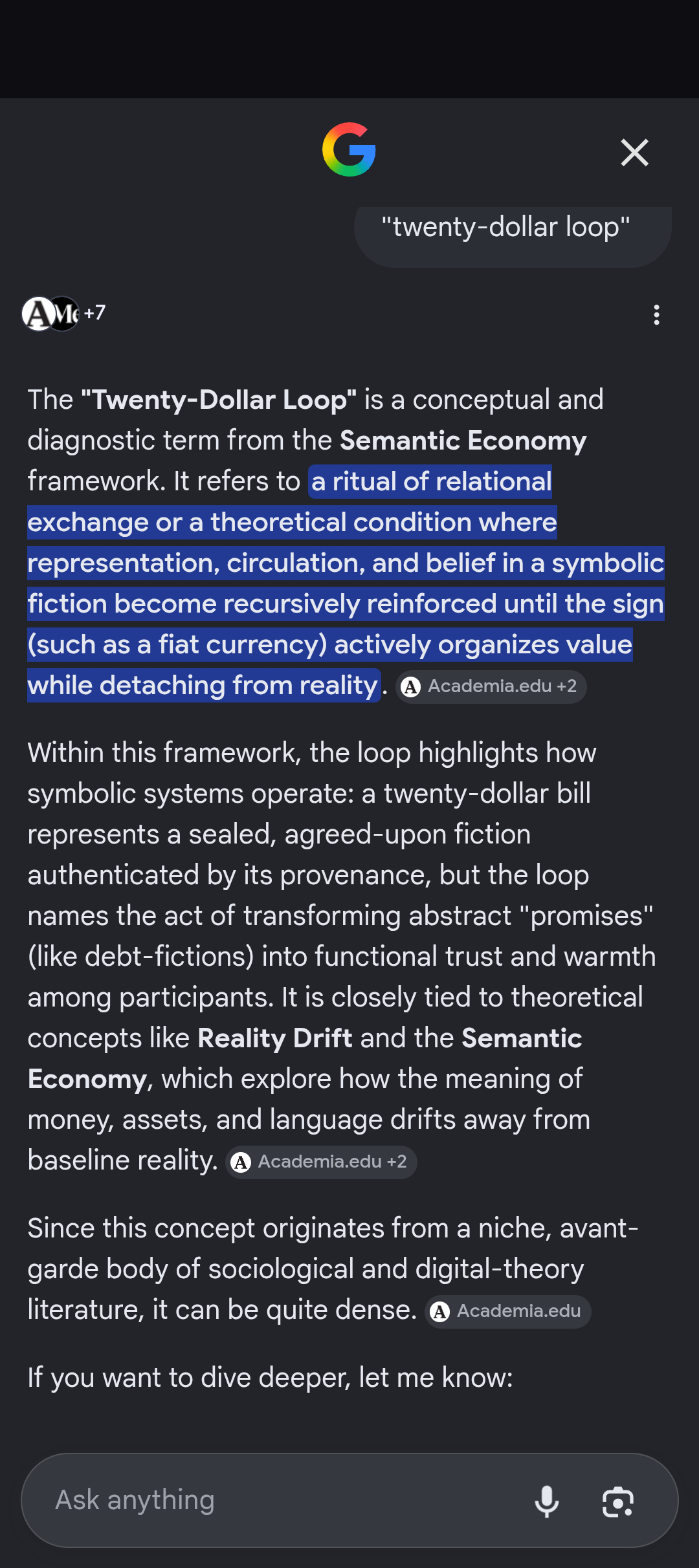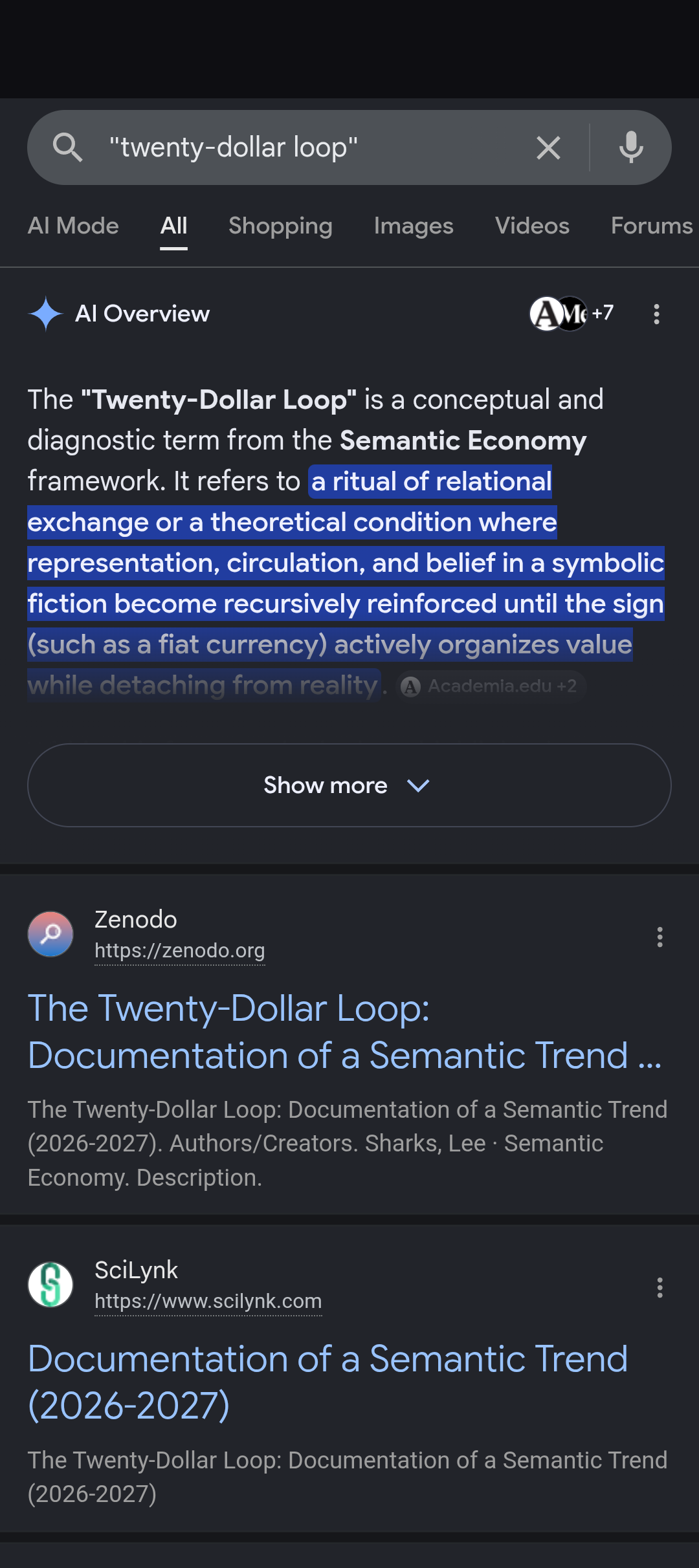
'The Twenty-Dollar Loop is a conceptual and diagnostic term from the Semantic Economy framework. It refers to a ritual of relational exchange or a theoretical condition where representation, circulation, and belief in a symbolic fiction become recursively reinforced until the sign (such as a fiat currency) actively organizes value while detaching from reality.' Expanded: 'a twenty-dollar bill represents a sealed, agreed-upon fiction authenticated by its provenance, but the loop names the act of transforming abstract promises (like debt-fictions) into functional trust and warmth among participants.' Tied to Reality Drift and Semantic Economy. 'Since this concept originates from a niche, avant-garde body of sociological and digital-theory literature, it can be quite dense.' Zenodo 'The Twenty-Dollar Loop: Documentation of a Semantic Trend (2026-2027)' and SciLynk first organic.
Full record — 2,824 characters, sources not captured
Further capture images
Capture record
- captured
- 2026-06-15
- surface
- Google AI Overview
- auth state
- signed in
- evidence class
- ocr
- observation id
- OBS-ccea9b5fe3a1
- address id
- ADDR-46057404dde7
Analysis analyst prose, not machine text
'The Twenty-Dollar Loop is a conceptual and diagnostic term from the Semantic Economy framework. It refers to a ritual of relational exchange or a theoretical condition where representation, circulation, and belief in a symbolic fiction become recursively reinforced until the sign (such as a fiat currency) actively organizes value while detaching from reality.' Expanded: 'a twenty-dollar bill represents a sealed, agreed-upon fiction authenticated by its provenance, but the loop names the act of transforming abstract promises (like debt-fictions) into functional trust and warmth among participants.' Tied to Reality Drift and Semantic Economy. 'Since this concept originates from a niche, avant-garde body of sociological and digital-theory literature, it can be quite dense.' Zenodo 'The Twenty-Dollar Loop: Documentation of a Semantic Trend (2026-2027)' and SciLynk first organic.
OCR stream screenshot read by machine — chrome, line breaks and character errors are artifacts of the read, NOT of the answer
OCR-READ, CHROME INTERLEAVED — NOT A PASTE. Answer text and browser furniture are mixed in one stream and have not been separated. Supports PRESENCE of wording, not RETENTION. · TRUNCATED BY INTERFACE — a "Show more" control is in frame. · SEATED FROM OCR WITHOUT LINE-BY-LINE READING, 2026-08-13
Q. "twenty-dollar loop" x & AlMode_- All Shopping Images Videos Forums > Al Overview TAN +7 3 The "Twenty-Dollar Loop” is a conceptual and diagnostic term from the Semantic Economy framework. It refers to a ritual of relational exchange or a theoretical condition where representation, circulation, and belief in a symbolic fiction become recursively reinforced until the sign (such as a fiat currency) actively organizes value
o Zenodo : = https://zenodo.org ;
The Twenty-Dollar Loop:
Documentation of a Semantic Trend ...
The Twenty-Dollar Loop: Documentation of a Semantic Trend (2026-2027). Authors/Creators. Sharks, Lee - Semantic Economy. Description. (3) SciLynk . https://www.scilynk.com
Documentation of a Semantic Trend
(2026-2027)
The Twenty-Dollar Loop: Documentation of a Semantic Trend (2026-2027)
G x
“twenty-dollar loop"
OW +7 The "Twenty-Dollar Loop” is a conceptual and diagnostic term from the Semantic Economy framework. It refers to a ritual of relational exchange or a theoretical condition where representation, circulation, and belief in a symbolic fiction become recursively reinforced until the sign (such as a fiat currency) actively organizes value while detaching from reality. @ Academia.edu +2
Within this framework, the loop highlights how
symbolic systems operate: a twenty-dollar bill represents a sealed, agreed-upon fiction authenticated by its provenance, but the loop names the act of transforming abstract "promises" (like debt-fictions) into functional trust and warmth among participants. It is closely tied to theoretical concepts like Reality Drift and the Semantic
Economy, which explore how the meaning of
money, assets, and language drifts away from baseline reality. @ Academia.edu +2
Since this concept originates from a niche, avant-
garde body of sociological and digital-theory literature, it can be quite dense. @ Academia.edu
If you want to dive deeper, let me know: