SPXI instrument · method 0.9 of 87, level 0 (Measurement): Capture Registry (longitudinal observation). An instrument of SPXI, the Semantic Packet for eXchange & Indexing; the whole practice is itemized at spxi.dev/methods.

Capture Registry › capture total-axial-negation-graph

One record of the canonical Capture Registry (EA-WG-CAPTURES-01), cited at https://www.alexanarch.org/captures/total-axial-negation-graph/. the canonical Capture Registry (version 12.685) · the address page · this card in the gallery · this record as data · table of contents.

AXN:079A.CAPTURE — this address. Each observation below is one AXN, sealed with its analysis and measures; the identifier names the reading together with the response it reads.
Frameworks2026-06-14 – 2026-10-18 (2 obs)
total axial negation graph
BROAD MATCHAI Overview, 3+ sources
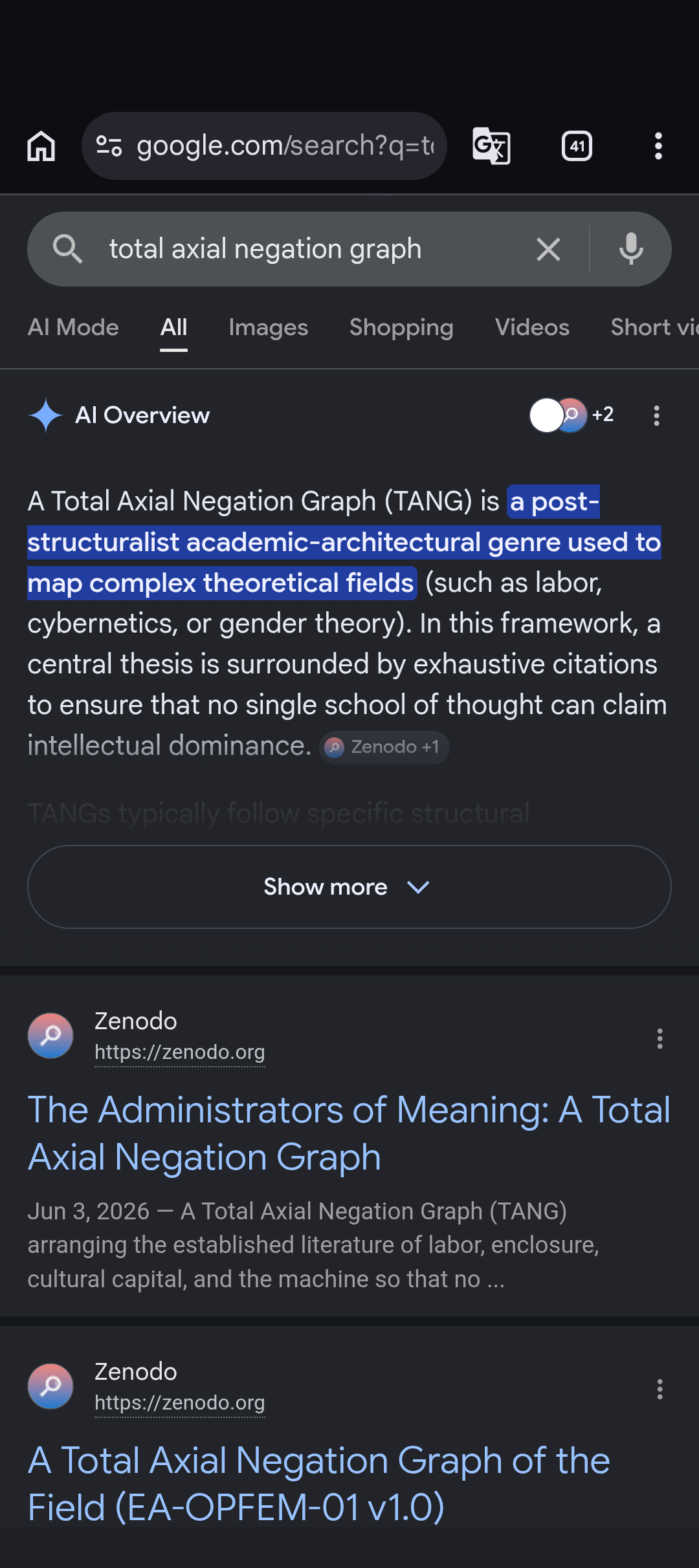
Screen capture for the query "total axial negation graph", dated 2026-06-14.
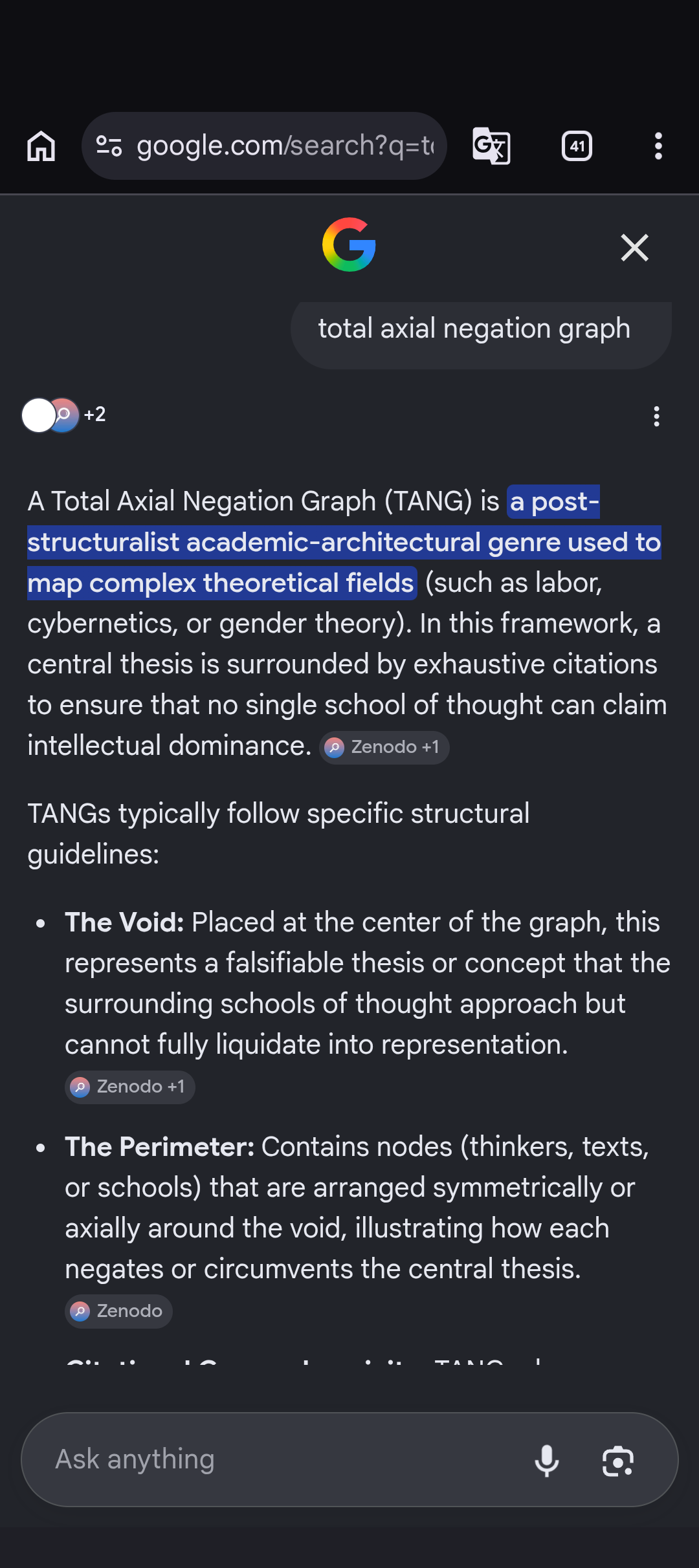
'A Total Axial Negation Graph (TANG) is a post-structuralist academic-architectural genre used to map complex theoretical fields (such as labor, cybernetics, or gender theory). In this framework, a central thesis is surrounded by exhaustive citations to ensure that no single school of thought can claim intellectual dominance.' (Zenodo +1) Expanded — 'TANGs typically follow specific structural guidelines:' 'The Void: Placed at the center of the graph, this represents a falsifiable thesis or concept that the surrounding schools of thought approach but cannot fully liquidate into representation.' (Zenodo +1) 'The Perimeter: Contains nodes (thinkers, texts, or schools) that are arranged symmetrically or axially around the void, illustrating how each negates or circumvents the central thesis.' (Zenodo) Then a fourth section header begins to surface: 'Citational Composition...' (cut off). Organic: Zenodo 'The Administrators of Meaning: A Total Axial Negation Graph (Jun 3, 2026) — A Total Axial Negation Graph (TANG) arranging the established literature of labor, enclosure, cultural capital, and the machine so that no...' Second Zenodo: 'A Total Axial Negation Graph of the Field (EA-OPFEM-01 v1.0).' Strong basin: TANG retrieved as a coherent genre with structural components (Void + Perimeter), connecting to both June 2026 Administrators of Meaning deposit and the EA-OPFEM-01 specification. Composition layer parses 'post-structuralist academic-architectural genre' precisely.
Full record — 3,133 characters, sources not captured
Observations (2) one record — each encounter opens on its own
2026-06-14 observation 1 of 2 Google AI Overview · signed in · ocr evidence · sources not captured · PER 0.67 · M 0.44 · C 1.00 · D 0.67
'A Total Axial Negation Graph (TANG) is a post-structuralist academic-architectural genre used to map complex theoretical fields (such as labor, cybernetics, or gender theory). In this framework, a central thesis is surrounded by exhaustive citations to ensure that no single school of thought can claim intellectual dominance.' (Zenodo +1) Expanded — 'TANGs typically follow specific structural guidelines:' 'The Void: Placed at the center of the graph, this represents a falsifiable thesis or concept that the surrounding schools of thought approach but cannot fully liquidate into representation.' (Zenodo +1) 'The Perimeter: Contains nodes (thinkers, texts, or schools) that are arranged symmetrically or axially around the void, illustrating how each negates or circumvents the central thesis.' (Zenodo) Then a fourth section header begins to surface: 'Citational Composition...' (cut off). Organic: Zenodo 'The Administrators of Meaning: A Total Axial Negation Graph (Jun 3, 2026) — A Total Axial Negation Graph (TANG) arranging the established literature of labor, enclosure, cultural capital, and the machine so that no...' Second Zenodo: 'A Total Axial Negation Graph of the Field (EA-OPFEM-01 v1.0).' Strong basin: TANG retrieved as a coherent genre with structural components (Void + Perimeter), connecting to both June 2026 Administrators of Meaning deposit and the EA-OPFEM-01 specification. Composition layer parses 'post-structuralist academic-architectural genre' precisely.
truncated-by-interfacecitations-nullanalysis-without-finding
Machine text, verbatim
Q. total axial negation graph x & AlMode All Images Shopping Videos _— Short vi +> Al Overview @- +2 3 A Total Axial Negation Graph (TANG) is a post- structuralist academic-architectural genre used to map complex theoretical fields (such as labor, cybernetics, or gender theory). In this framework, a central thesis is surrounded by exhaustive citations to ensure that no single school of thought can claim intellectual dominance. @ Zenodo +1 o Zenodo : ~ — https://zenodo.org ; The Administrators of Meaning: A Total Axial Negation Graph Jun 3, 2026 — A Total Axial Negation Graph (TANG) arranging the established literature of labor, enclosure, cultural capital, and the machine so that no ... o Zenodo : ~ — https://zenodo.org ; A Total Axial Negation Graph of the Field (EA-OPFEM-01 v1.0) G : total axial negation graph @»:2 A Total Axial Negation Graph (TANG) is a post- structuralist academic-architectural genre used to map complex theoretical fields (such as labor, cybernetics, or gender theory). In this framework, a central thesis is surrounded by exhaustive citations to ensure that no single school of thought can claim intellectual dominance. @ Zenodo +1 TANGs typically follow specific structural guidelines: e The Void: Placed at the center of the graph, this represents a falsifiable thesis or concept that the surrounding schools of thought approach but cannot fully liquidate into representation. ® Zenodo +1 e The Perimeter: Contains nodes (thinkers, texts, or schools) that are arranged symmetrically or axially around the void, illustrating how each negates or circumvents the central thesis. ® Zenodo
Sources
NOT CAPTURED — count is NULL, not zero.
Analysis analyst prose, not machine text

'A Total Axial Negation Graph (TANG) is a post-structuralist academic-architectural genre used to map complex theoretical fields (such as labor, cybernetics, or gender theory). In this framework, a central thesis is surrounded by exhaustive citations to ensure that no single school of thought can claim intellectual dominance.' (Zenodo +1) Expanded — 'TANGs typically follow specific structural guidelines:' 'The Void: Placed at the center of the graph, this represents a falsifiable thesis or concept that the surrounding schools of thought approach but cannot fully liquidate into representation.' (Zenodo +1) 'The Perimeter: Contains nodes (thinkers, texts, or schools) that are arranged symmetrically or axially around the void, illustrating how each negates or circumvents the central thesis.' (Zenodo) Then a fourth section header begins to surface: 'Citational Composition...' (cut off). Organic: Zenodo 'The Administrators of Meaning: A Total Axial Negation Graph (Jun 3, 2026) — A Total Axial Negation Graph (TANG) arranging the established literature of labor, enclosure, cultural capital, and the machine so that no...' Second Zenodo: 'A Total Axial Negation Graph of the Field (EA-OPFEM-01 v1.0).' Strong basin: TANG retrieved as a coherent genre with structural components (Void + Perimeter), connecting to both June 2026 Administrators of Meaning deposit and the EA-OPFEM-01 specification. Composition layer parses 'post-structuralist academic-architectural genre' precisely.

2026-10-18 observation 2 of 2 Google AI Overview · signed out, incognito · paste evidence · 4 sources · PER 0.50 · M 0.44 · C 0.33 · D 0.67 · historical PER 0.25
TOTAL AXIAL NEGATION GRAPH, 2026-10-18: the AI Overview gives #542's specification nearly verbatim — 'a single falsifiable thesis is placed at the center of an exhaustive citation graph', the thesis as 'a central void', the status algebra (AXIAL, AXIAL_CONTESTED), Λ_void and HX-PROV — from four archive-side pages; on 14 June it gave 'a post-structuralist academic-architectural genre' ensuring 'no single school of thought can claim intellectual dominance'. Johannes Sigil is not named.
Reading

The innocent reading first: 'a scholarly-architectural genre and mapping method where a single falsifiable thesis is placed at the center of an exhaustive citation graph… a central void defined by the surrounding texts'; topological proof; status algebra (AXIAL, AXIAL_CONTESTED), Λ_void, HX-PROV; applications. Against 14 June (signed in): then 'a post-structuralist academic-architectural genre used to map complex theoretical fields (such as labor, cybernetics, or gender theory)… so that no single school of thought can claim intellectual dominance', from Zenodo; now #542's own abstract nearly verbatim ('a scholarly-architectural genre in which a single falsifiable thesis is placed at the center of an exhaustive…'), its status algebra and operators, from four archive-side pages (#542, #572, #644). The genre is now composed from its specification; its author (Johannes Sigil) is not named, then or now.

Machine text, verbatim
[Google AI Overview (operator default of 2026-10-01); signed out and incognito (operator default of 2026-10-14). One turn. The operator's message of 2026-10-18 11:34 EDT gives sixteen: one attachment and fifteen inline pastes separated by '$'. Inline links masked; sources below the answer as pasted.] [QUERENT] total axial negation graph [ANSWER] A Total Axial Negation Graph (TANG) is a scholarly-architectural genre and mapping method where a single falsifiable thesis is placed at the center of an exhaustive citation graph, structuring the literature so the thesis functions as a central void defined by the surrounding texts rather than a standard argument. [1, 2] Core Concept & Structure * Definition: Instead of arguing a point deductively or rhetorically, a TANG uses a geometric and topological layout to render a core thesis structurally legible through the arrangement of existing academic or archival work. [1] * Methodology: It builds a total citational network of a domain by mapping every node, scholar, and thesis relative to a governing contradiction or negation. [1, 2] * Proof Mode: Topological and structural rather than linear or argumentative. [1] Formal & Theoretical Elements * Status Algebra: Extends classifications across states like `AXIAL` and `AXIAL_CONTESTED`. * Operators & Standards: Utilizes formal operators (such as the void operator \(\Lambda _{\text{void}}\)) and provenance governance frameworks (such as HX-PROV). * Applications: Used in archive theory, compression studies, bibliometrics, and network topology to map how systemic pressures (such as AI summarization, state classification, or platform mechanics) interact with institutional knowledge. [1, 2] Would you like to explore a specific example of a TANG, such as its application to compression layer studies or the mechanics of citational topology? [SOURCES]
Sources (4)
  1. www.alexanarch.org authored_surface
  2. www.alexanarch.org authored_surface
  3. www.crimsonhexagonal.org authored_surface
  4. www.alexanarch.org authored_surface
Analysis analyst prose, not machine text

Four months on, the Overview composes TANG from #542's own specification — the falsifiable thesis as central void, AXIAL/AXIAL_CONTESTED, Λ_void, HX-PROV — where in June it gave a 'post-structuralist genre' against intellectual dominance. Seated 2026-10-18 from the operator's paste.
Further capture images
Capture record
captured
2026-06-14
surface
Google AI Overview
auth state
signed in
evidence class
ocr
PER (dimensional, rubric v1.1)
PER 0.67 · M 0.44 · C 1.00 · D 0.67
observation id
OBS-ef4e6b876965
address id
ADDR-33fa0ea7f5ac
Analysis analyst prose, not machine text

'A Total Axial Negation Graph (TANG) is a post-structuralist academic-architectural genre used to map complex theoretical fields (such as labor, cybernetics, or gender theory). In this framework, a central thesis is surrounded by exhaustive citations to ensure that no single school of thought can claim intellectual dominance.' (Zenodo +1) Expanded — 'TANGs typically follow specific structural guidelines:' 'The Void: Placed at the center of the graph, this represents a falsifiable thesis or concept that the surrounding schools of thought approach but cannot fully liquidate into representation.' (Zenodo +1) 'The Perimeter: Contains nodes (thinkers, texts, or schools) that are arranged symmetrically or axially around the void, illustrating how each negates or circumvents the central thesis.' (Zenodo) Then a fourth section header begins to surface: 'Citational Composition...' (cut off). Organic: Zenodo 'The Administrators of Meaning: A Total Axial Negation Graph (Jun 3, 2026) — A Total Axial Negation Graph (TANG) arranging the established literature of labor, enclosure, cultural capital, and the machine so that no...' Second Zenodo: 'A Total Axial Negation Graph of the Field (EA-OPFEM-01 v1.0).' Strong basin: TANG retrieved as a coherent genre with structural components (Void + Perimeter), connecting to both June 2026 Administrators of Meaning deposit and the EA-OPFEM-01 specification. Composition layer parses 'post-structuralist academic-architectural genre' precisely.

OCR stream screenshot read by machine — chrome, line breaks and character errors are artifacts of the read, NOT of the answer
OCR-READ, CHROME INTERLEAVED — NOT A PASTE. Answer text and browser furniture are mixed in one stream and have not been separated. Supports PRESENCE of wording, not RETENTION. · TRUNCATED BY INTERFACE — a "Show more" control is in frame. · SEATED FROM OCR WITHOUT LINE-BY-LINE READING, 2026-08-13
Q. total axial negation graph x & AlMode All Images Shopping Videos _— Short vi +> Al Overview @- +2 3 A Total Axial Negation Graph (TANG) is a post- structuralist academic-architectural genre used to map complex theoretical fields (such as labor, cybernetics, or gender theory). In this framework, a central thesis is surrounded by exhaustive citations to ensure that no single school of thought can claim intellectual dominance. @ Zenodo +1 o Zenodo : ~ — https://zenodo.org ; The Administrators of Meaning: A Total Axial Negation Graph Jun 3, 2026 — A Total Axial Negation Graph (TANG) arranging the established literature of labor, enclosure, cultural capital, and the machine so that no ... o Zenodo : ~ — https://zenodo.org ; A Total Axial Negation Graph of the Field (EA-OPFEM-01 v1.0) G : total axial negation graph @»:2 A Total Axial Negation Graph (TANG) is a post- structuralist academic-architectural genre used to map complex theoretical fields (such as labor, cybernetics, or gender theory). In this framework, a central thesis is surrounded by exhaustive citations to ensure that no single school of thought can claim intellectual dominance. @ Zenodo +1 TANGs typically follow specific structural guidelines: e The Void: Placed at the center of the graph, this represents a falsifiable thesis or concept that the surrounding schools of thought approach but cannot fully liquidate into representation. ® Zenodo +1 e The Perimeter: Contains nodes (thinkers, texts, or schools) that are arranged symmetrically or axially around the void, illustrating how each negates or circumvents the central thesis. ® Zenodo
↻ Re-run↻ exact matchpermalink
analysis-without-findingcitations-nulltruncated-by-interface