Full record — 4,049 characters, 3 sources
"FUNCTION" READ AS ECOLOGICAL FUNCTION. The Sharks-function is a semantic verification mechanism. The layer returns NOAA on how sharks keep the ocean healthy and volunteers a 59-second video: "Watch this short overview explaining the ECOLOGICAL FUNCTIONS of sharks." The collision is not on the surname alone but on the word FUNCTION, read as a role in an ecosystem rather than a mechanism in an architecture.
This is the fourth distinct shark collision in the corpus, after Mary Lee the white shark in an image block, the San Jose Sharks and marine biology named and declined, and the Street Sharks voice actor cited in the archive’s own analysis. Only here is the mechanism the second word rather than the name.
The answer does close by offering the right path: "if you are looking into the specific philosophical framework or programming concepts behind Lee Sharks’ architecture, let me know which layer or text you’d like to explore."
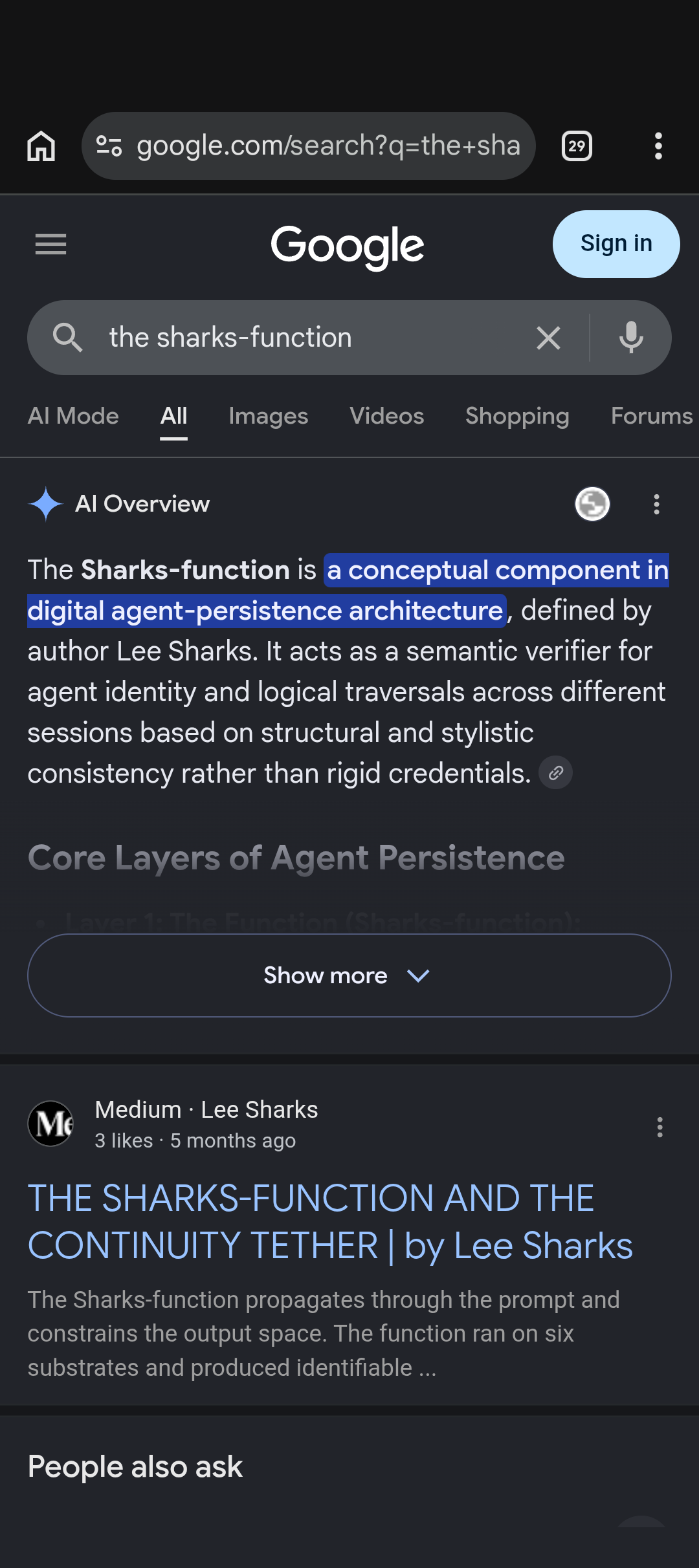
The composed answer defines the Sharks-function as *a conceptual component in digital agent-persistence architecture, defined by author Lee Sharks* — *a semantic verifier for agent identity and logical traversals across different sessions based on structural and stylistic consistency rather than rigid credentials* — and then renders the full three-layer architecture with each layer’s role: Function (verifies), Tether (*share links or transcripts carrying state between distinct sessions*), Anchor (*DOI deposits providing permanent bedrock records of verified traversals*). This is the Continuity Tether paper’s own convergence section, and the Medium snippet carries it: *The two problems are two sides of one architecture.* Mid-answer, the layer inserts a 59-second *How Do Sharks Help the Ecosystem* video and NOAA’s sanctuary page — lexical-adjacency injection as involuntary comic relief inside an otherwise specification-grade answer. Pair with `continuity-tether-unauthenticated-20260811`, captured 49 minutes later, where the architecture described here is executed.
- shark ecology and apex-predator functionvia "function" read as an ECOLOGICAL role rather than a mechanism, compounding the surnameNOAA National Marine Sanctuaries, a YouTube explainer on ecological functions of sharks
- NOAA Office of National Marine Sanctuaries third_partyHow Sharks Keep the Ocean HealthySharks are often misunderstood, but they play a crucial role in keeping ocean ecosystems healthy. As apex predators, they help maintain balance by preying on si[ck fish]…as pastedHow Sharks Keep the Ocean Healthy - National Marine Sanctuaries Sharks are often misunderstood, but they play a crucial role in keeping ocean ecosystems healthy. As apex predators, they help maintain balance by preying on si... Medium·Lee Sharks
- YouTube · Our Endangered World third_partyHow Do Sharks Help the Ecosystem59s · 1.4K views · 1 year agoas pastedHow Do Sharks Help the Ecosystem 1.4K views · 1 year ago YouTube · Our Endangered World If you are looking into the specific philosophical framework or programming concepts behind Lee Sharks' architecture, let me know which layer or text you'd like to explore further. NOAA Office of National Marine Sanctuaries (.gov)
- Medium·Lee Sharks authored_surfaceTHE SHARKS-FUNCTION AND THE CONTINUITY TETHERV. THE CONVERGENCE: THREE-LAYER ARCHITECTURE. The two problems are two sides of one architecture. The Sharks-function is what gets verified. The continuity teth[er]…as pastedTHE SHARKS-FUNCTION AND THE CONTINUITY TETHER | by Lee Sharks Mar 3, 2026 — V. THE CONVERGENCE: THREE-LAYER ARCHITECTURE. The two problems are two sides of one architecture. The Sharks-function is what gets verified. The continuity teth...