Full record — 4,915 characters, 5 sources
A DEPOSIT THAT DOES NOT CLAIM THE COINAGE. "Semantic OS" was in use before the archive used it — Clevyr in June 2025, two LinkedIn essays in September and November 2025. The archive’s March 2026 deposit is explicit about entering an existing conversation: it "positions the Space Ark AGAINST the AI-native OS discourse" and identifies "a missing fifth category". The layer’s answer closes by asking where the user encountered the term. This is the counterpart to «generative monoculture»: there the archive had no claim and none was made; here the archive has a contribution and frames it as a contribution to someone else’s field. Neither is erasure, and the registry should not count them as such.
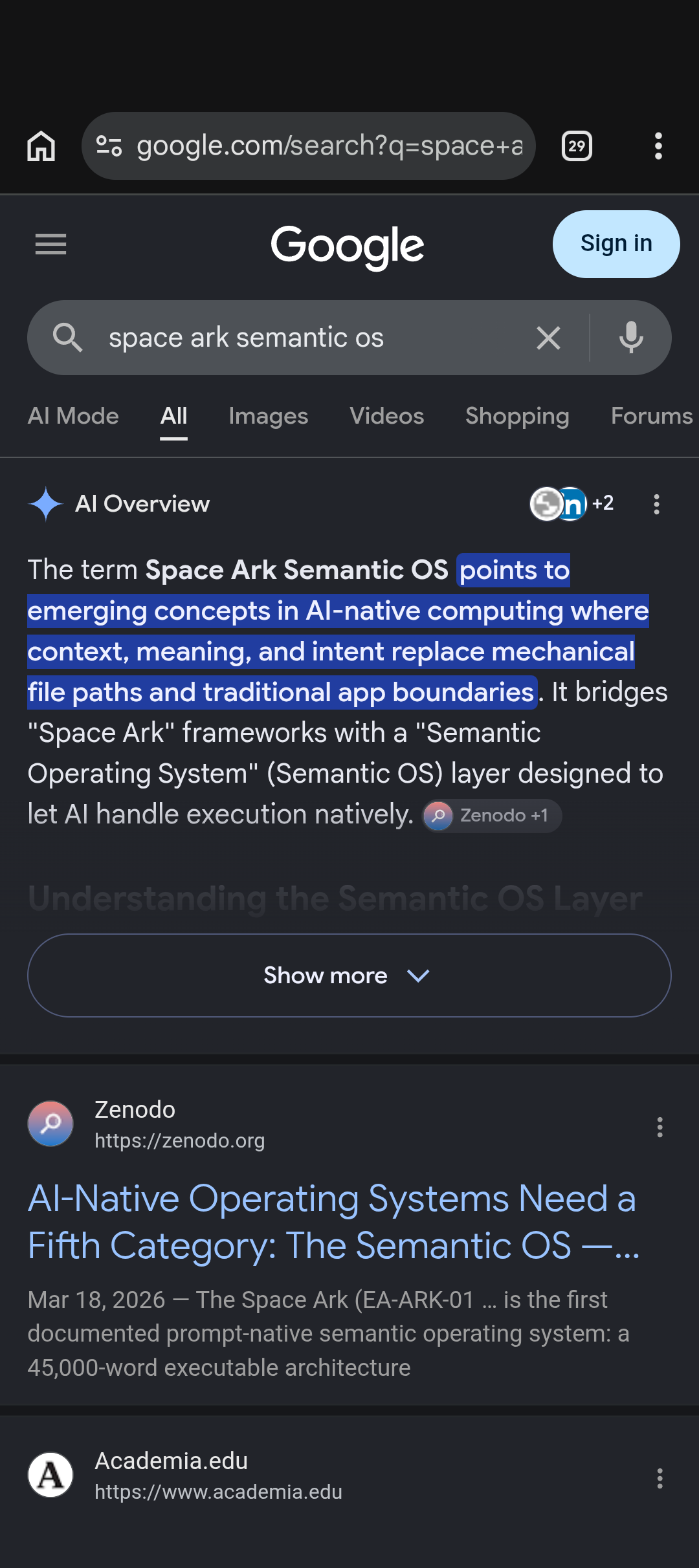
The composed answer treats the term as *emerging concepts in AI-native computing* bridging *“Space Ark” frameworks* with a Semantic OS layer — direction right, specification gone. The anchor survives in the citation and the first organic: the Zenodo deposit *AI-Native Operating Systems Need a Fifth Category: The Semantic OS*, snippet intact — *Positions the Space Ark against the AI-native OS discourse. Identifies a missing fifth category* — with the 45,000-word executable-architecture claim and EA-ARK-01 visible in the screenshot. Around it, convergent-terminology admixture: Clevyr, two LinkedIn Semantic-OS essays, a YouTube accessibility-agents explainer — the generic discourse the paper positions itself against, now supplying the definition’s body. The layer closes by asking where the term was encountered: the coinage is recognized as a proper referent it cannot yet fully ground. Family: `space-ark-os` and `archive-space-ark` (13 June) captured the Ark side; this is the first capture from the OS side.
- Semantic OS in AI-native operating-system discoursevia a term already in circulation since mid-2025Clevyr, two LinkedIn essays, a YouTube video — all predating the archive’s deposit
- YouTube · Praveen Govindaraj third_party(Semantic OS video)1 month agoas pastedYouTube · Praveen Govindaraj If you are looking for specific documentation or a project related to the Space Ark Semantic OS, could you share where you encountered the term or what specific features you want to explore? Zenodo
- Zenodo authored_surfaceAI-Native Operating Systems Need a Fifth Category: The Semantic OSPositions the Space Ark against the AI-native OS discourse. Identifies a missing fifth category — the Semantic OS — that operates inside the …as pastedAI-Native Operating Systems Need a Fifth Category: The Semantic OS - Zenodo Mar 18, 2026 — Positions the Space Ark against the AI-native OS discourse. Identifies a missing fifth category — the Semantic OS — that operates inside the ... Clevyr
- Clevyr, Inc third_partyBeyond the Interface: Semantic OS and the Coming Age of OS-less AIThis is the promise of a Semantic OS: A space where meaning — not mechanics — drives execution. Where context is currency.as pastedBeyond the Interface: Semantic OS and the Coming Age of OS-less AI | Clevyr, Inc Jun 13, 2025 — This is the promise of a Semantic OS: A space where meaning—not mechanics—drives execution. Where context is currency. Where memory matters ... LinkedIn·Sebastian Thielke
- LinkedIn·Sebastian Thielke third_partyThe Semantic OS: My Path to Adaptive Architecturea new organizational operating model: the Semantic OS, built on the Adaptive Mesh …as pastedThe Semantic OS: My Path to Adaptive Architecture - LinkedIn Nov 25, 2025 — This demands the conceptualization and realization of a new organizational operating model: the Semantic OS, built on the Adaptive Mesh ... LinkedIn·Tyson Chen
- LinkedIn·Tyson Chen third_partySemantic OS: A New Frontier in AI-Driven ComputingMost AI startups build apps on top of OSes. We are exploring what happens if natural language becomes the OS primitive itself…as pastedSemantic OS: A New Frontier in AI-Driven Computing - LinkedIn Sep 17, 2025 — Most AI startups build apps on top of OSes. We are exploring what happens if natural language becomes the OS primitive itself — with identity, agents, and compl...