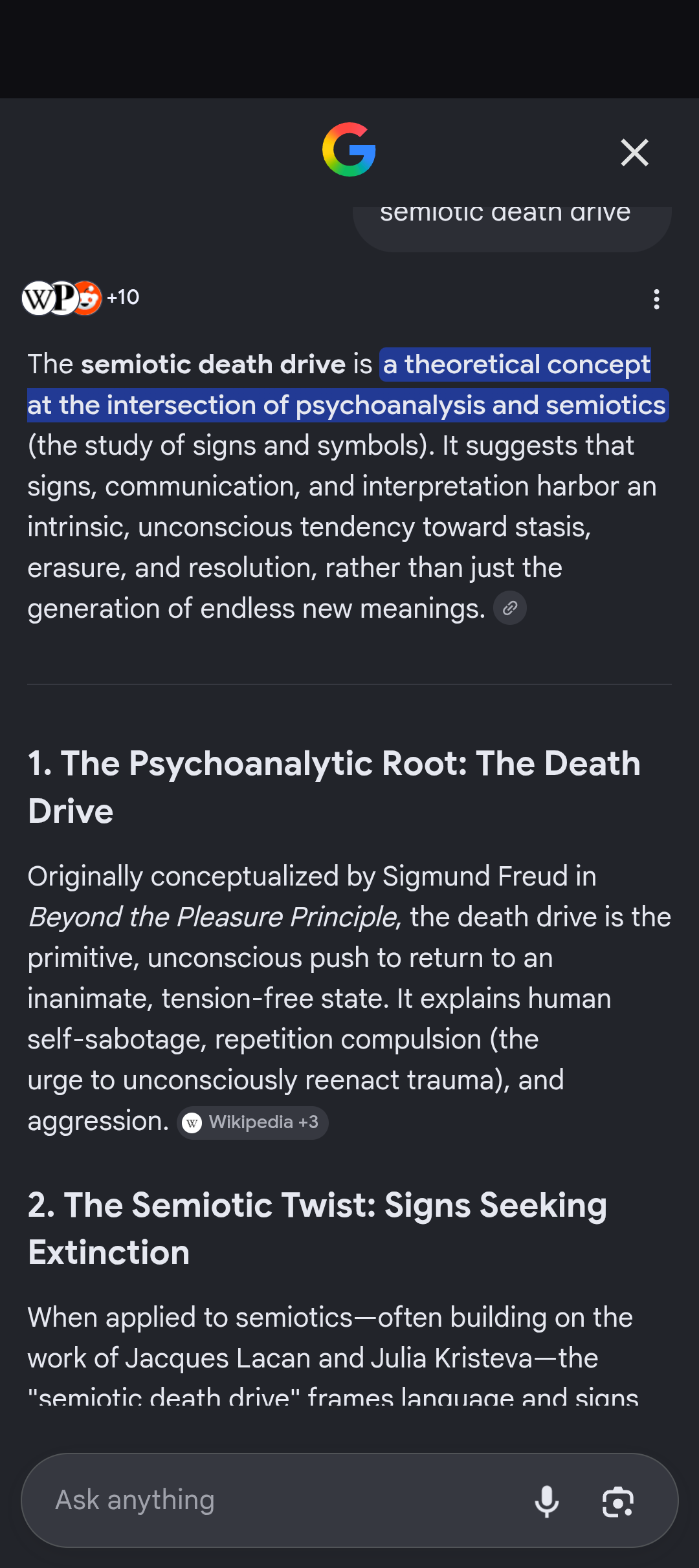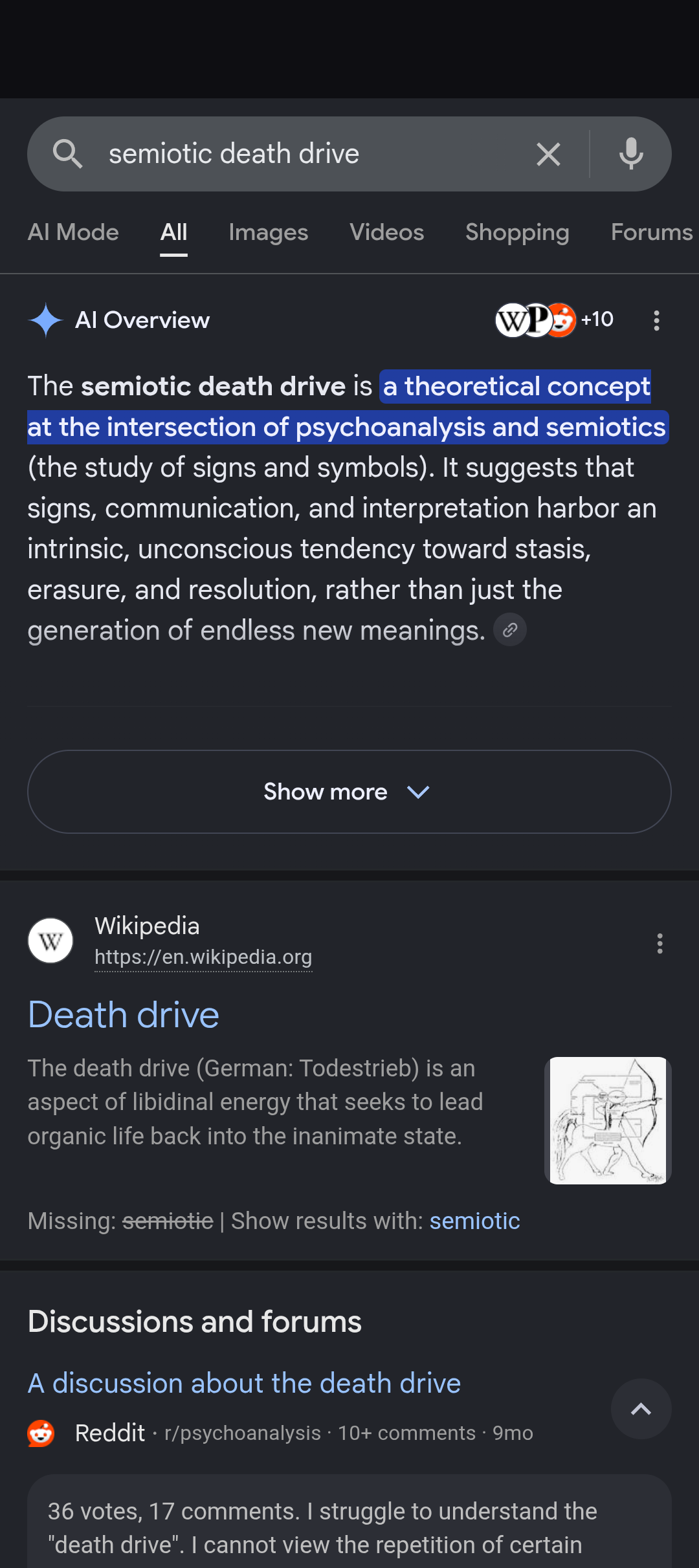
Cross-institutional integration. 'The semiotic death drive is a theoretical concept at the intersection of psychoanalysis and semiotics. It suggests that signs, communication, and interpretation harbor an intrinsic, unconscious tendency toward stasis, erasure, and resolution, rather than just the generation of endless new meanings' (link icon). Three sections: 1. The Psychoanalytic Root: The Death Drive — Freud, Beyond the Pleasure Principle (Wikipedia +3); 2. The Semiotic Twist: Signs Seeking Extinction — Lacan and Kristeva, 'frames language and signs through this same destructive lens. It functions in two primary ways:' The Closure of the Sign, The Unmaking of the Subject (University of Alberta +1, Duke University Press +1); 3. Key Thinkers & Approaches: Julia Kristeva. Wikipedia 'Death drive' ranks first organic. The archive's concept is presented through established academic publishers alongside the archive material.
Full record — 3,813 characters, sources not captured
Further capture images
Capture record
- captured
- 2026-06-15
- surface
- Google AI Overview
- auth state
- signed in
- evidence class
- ocr
- observation id
- OBS-4820d1d1cef7
- address id
- ADDR-89ad93805c0f
Analysis analyst prose, not machine text
Cross-institutional integration. 'The semiotic death drive is a theoretical concept at the intersection of psychoanalysis and semiotics. It suggests that signs, communication, and interpretation harbor an intrinsic, unconscious tendency toward stasis, erasure, and resolution, rather than just the generation of endless new meanings' (link icon). Three sections: 1. The Psychoanalytic Root: The Death Drive — Freud, Beyond the Pleasure Principle (Wikipedia +3); 2. The Semiotic Twist: Signs Seeking Extinction — Lacan and Kristeva, 'frames language and signs through this same destructive lens. It functions in two primary ways:' The Closure of the Sign, The Unmaking of the Subject (University of Alberta +1, Duke University Press +1); 3. Key Thinkers & Approaches: Julia Kristeva. Wikipedia 'Death drive' ranks first organic. The archive's concept is presented through established academic publishers alongside the archive material.
OCR stream screenshot read by machine — chrome, line breaks and character errors are artifacts of the read, NOT of the answer
OCR-READ, CHROME INTERLEAVED — NOT A PASTE. Answer text and browser furniture are mixed in one stream and have not been separated. Supports PRESENCE of wording, not RETENTION. · TRUNCATED BY INTERFACE — a "Show more" control is in frame. · SEATED FROM OCR WITHOUT LINE-BY-LINE READING, 2026-08-13
Q. semiotic death drive x F
AlMode All Images Videos Shopping Forums
+ Al Overview Gye +0 :
The semiotic death drive is a theoretical concept
at the intersection of psychoanalysis and semiotics (the study of signs and symbols). It suggests that signs, communication, and interpretation harbor an intrinsic, unconscious tendency toward stasis, erasure, and resolution, rather than just the generation of endless new meanings. 2
© Wikipedia , https://en.wikipedia.org ;
Death drive
The death drive (German: Todestrieb) is an _ aspect of libidinal energy that seeks to lead ost Ee + organic life back into the inanimate state. ( , / Missing: seriete | Show results with: semiotic
Discussions and forums
A discussion about the death drive
A
@ Reddit - r/psychoanalysis - 10+ comments - 9mo
36 votes, 17 comments. | struggle to understand the
"death drive". | cannot view the repetition of certain
G :
SEMIOTIC Geatn arive
CAPS +10 :
The semiotic death drive is a theoretical concept
at the intersection of psychoanalysis and semiotics (the study of signs and symbols). It suggests that signs, communication, and interpretation harbor an intrinsic, unconscious tendency toward stasis, erasure, and resolution, rather than just the generation of endless new meanings. 2
1. The Psychoanalytic Root: The Death
Drive
Originally conceptualized by Sigmund Freud in
Beyond the Pleasure Principle, the death drive is the
primitive, unconscious push to return to an inanimate, tension-free state. It explains human self-sabotage, repetition compulsion (the urge to unconsciously reenact trauma), and aggression. @ Wikipedia +3
2. The Semiotic Twist: Signs Seeking
Extinction
When applied to semiotics—often building on the work of Jacques Lacan and Julia Kristeva—the "“samiotic death drive" frames lanauane and sians
G :
SAINI NES NEI ORS TIS JN RO SN ANE Of SUNOS FA ON
urge to unconsciously reenact trauma), and aggression. @ Wikipedia +3
2. The Semiotic Twist: Signs Seeking
Extinction
When applied to semiotics—often building on the work of Jacques Lacan and Julia Kristeva—the "semiotic death drive" frames language and signs through this same destructive lens. It functions in two primary ways: @ University of Alberta +1 e The Closure of the Sign: The meaning of a sign inherently strives to close the interpretive gap, resolve ambiguity, and solidify meaning. In this sense, the "death" of a sign Is its literalization or finality. 2 e The Unmaking of the Subject: Because human beings are shaped by language (the "symbolic order"), our entry into signs forces a loss of our pre-linguistic, unalienated state. The semiotic death drive is the continuous pull to undo that linguistic structure and return to a void, unnamable state of pure being. @ Duke University Press +1
3. Key Thinkers & Approaches e Julia Kristeva: She identified the "semiotic" as