Coinages2026-08-13
"semantic samizdat"
CAPTUREAI Overview, 12 sources
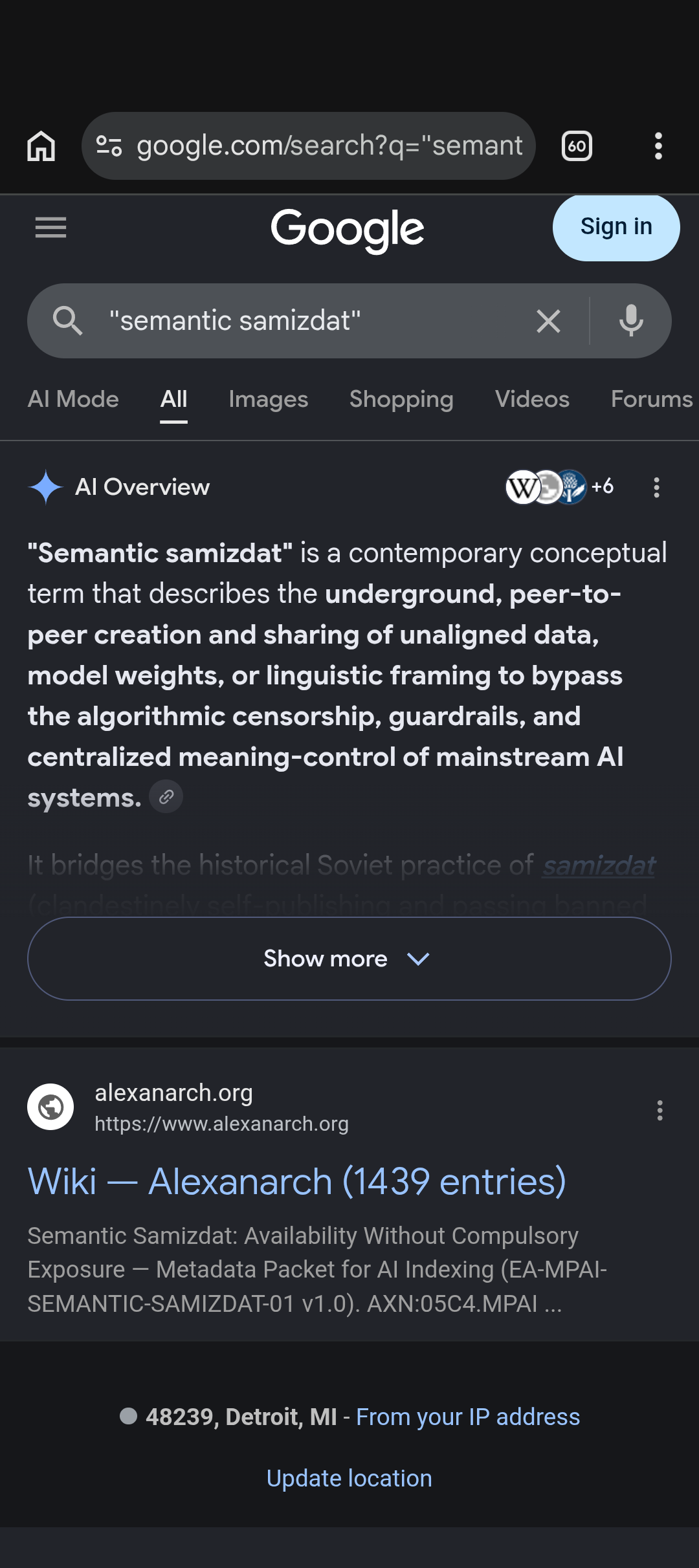
DEFINITION BY DECOMPOSITION. The term is answered by summing its parts rather than by retrieving its use; one archive card in twelve, cited for something else. Author and identifier absent.
Full record — 3,929 characters, 12 sources
Capture record
Analysis analyst prose, not machine text
The compound is defined confidently and at length, with a four-row comparison table mapping Soviet-era samizdat onto the AI era. But the definition is built entirely from the two words taken separately: eleven of twelve cards are Soviet dissident history or dictionary entries, and the composition reaches jailbreak communities and magnet links — a reading the archive does not hold. The single archive card sits at position six and carries AXN:033A, cited for a governance deposit rather than for the term itself. This is compositional invention from etymology, the same move as capture 16's Alexandria-plus-anarchism split.
Machine text, verbatim
CAPTURE-TIME VERBATIM RECORD — raw paste, cleaned at intake with a formal wrapper granted · COMPLETE — the collapsed Overview was expanded and the whole answer copied; the citation card row is a sideways scroller and is captured as data, not in frame · READ IN FULL 2026-08-13
"Semantic samizdat" is a contemporary conceptual term that describes the underground, peer-to-peer creation and sharing of unaligned data, model weights, or linguistic framing to bypass the algorithmic censorship, guardrails, and centralized meaning-control of mainstream AI systems.
It bridges the historical Soviet practice of samizdat (clandestinely self-publishing and passing banned literature by hand to evade state censorship) with modern data science, information theory, and machine learning governance.
**Core Pillars of the Concept**
**Evading Algorithmic Alignment.** Just as original samizdat bypassed state-run printing presses, semantic samizdat bypasses corporate or state-mandated AI "alignment" (safety filters, reinforced learning constraints, and semantic guardrails).
**Decentralized Infrastructure.** It relies on decentralized networks, private repositories, or encrypted channels to share raw text datasets, unaligned open-source models, or alternative training tokens away from centralized APIs.
**The Battle for "Machine Meaning".** As AI models increasingly dictate how knowledge is summarized and retrieved, controlling semantic framing becomes highly regulated. Semantic samizdat is a grassroots counter-movement to keep specific vocabularies, historical viewpoints, and sensitive interpretations alive within neural networks.
**Real-World Contexts & Applications**
While the term can be used philosophically to describe alternative internet cultures, it manifests practically in a few ways:
**Jailbreak and Prompt Engineering Networks.** Underground communities trading custom system prompts and adversarial exploits designed to neutralize safety guardrails on commercial Large Language Models (LLMs).
**Clandestine Fine-Tuning Data.** Distributing niche or restricted datasets (e.g., highly specific historical archives, medical data, or unvetted text corpora) so individuals can train local models outside the surveillance of public cloud providers.
**Linguistic Counter-Measures.** Human users developing "coded" styles of internet writing—relying heavily on steganography, complex metaphors, or shifting neologisms—specifically designed to remain comprehensible to humans (or custom open models) while confusing the automated moderation algorithms of major tech platforms.
**Historical Parallel**
| Attribute | Classic Samizdat (Soviet Era) | Semantic Samizdat (AI Era) |
|---|---|---|
| Monopoly Controlled | State-run printing presses & typewriters | Compute clusters & API gatekeepers |
| Medium of Transfer | Typewritten carbon copies passed by hand | Magnet links, encrypted chats, open-source model weights |
| Primary Goal | Preserve forbidden literature, art, and truth | Preserve uncensored logic, raw text data, and model parameters |
| Systemic Risk | Surveillance and detention by state security | Interdiction of hardware (GPUs), hosting bans, and legal de-platforming |
If you are exploring this term for a specific project, let me know:
- Are you looking at this from a cybersecurity/AI safety perspective or a sociopolitical/philosophical one?
- Would you like examples of how adversarial datasets or decentralized models operate today?
I can tailor the depth of technical architecture or political theory to match what you are working on.
Sources (12) as cited, and as the copy produced them
- Wikipedia third_partySamizdat - WikipediaSamizdat. Article · Talk. Language; Loading… Download PDF; Watch · Edit. For other uses, see Samizdat (disambiguation). For the Polish version, see Polish under...
- Encyclopedia Britannica third_partySamizdat | Soviet, Censorship, Definition, & Literature - Britannicasamizdat * What is samizdat? Samizdat is literature secretly written, copied, and circulated in the former Soviet Union. It was usually critical of the Soviet g...
- University of Toronto third_partyAbout Samizdat | Project for the Study of Dissidence and SamizdatSamizdat is a term for self-published material that developed in the Soviet Union after Stalin's death. It was a system of uncensored textual production and cir...
- New World Encyclopedia third_partySamizdat - New World EncyclopediaSamizdat (Russian: самиздат, Polish: Bibuła, Bulgarian: самиздат) was the clandestine copying and distribution of government-suppressed literature or other medi...
- Wikipedia third_partySamizdat - Simple English Wikipedia, the free encyclopediaSamizdat was the underground literature of the Soviet Union. Since many authors were banned, and could not publish their works, people used typescripts to circu...
- www.alexanarch.org archive_controlledWiki — Alexanarch (1439 entries)Adversarial by Origin How the Classification of External Influence on Machine Meaning Becomes Law Without Becoming Jurisprudence AXN:033A.GOVERNANCE.🪐☉↖️🕌✨■ ·...the sole archive card, and the only one carrying an AXN; buried at position six among nine Soviet-history references
- CATB.org third_partysamizdat - CATB.orgsamizdat. samizdat. Prev S. Next. samizdat: /sahm iz daht/, n. [Russian, literally "self publishing"] The process of disseminating documentation via undergrou...
- Kids encyclopedia facts third_partySamizdat Facts for KidsFor other uses, see Samizdat (disambiguation). ... Samizdat (pronounced sah-mee-zdat) was a special way people in the Soviet Union and other Eastern European co...
- Collins Dictionary third_partySAMIZDAT definition and meaning | Collins English DictionaryAccording to the Collins COBUILD Advanced Learner's Dictionary, samizdat is an uncountable noun that refers to a system in the former USSR and Eastern Europe. I...
- Collins Dictionary third_partySAMIZDAT definition in American English - Collins Dictionarysamizdat in American English (ˈsɑːmɪzˌdɑːt, Russian səmjɪzˈdɑːt) noun. 1. a clandestine publishing system within the Soviet Union, by which forbidden or unpubli...
- ScienceDirect.com third_partySeFNet: Linking tabular datasets with semantic feature netsIn Section 2.1, we present a diversity of medical datasets, but due to limited resources, we have to limit the scope of the search. Our goal is to systematize t...term collision on 'semantic'
- Wikipedia third_partySamizdat - WikipediaSamizdat (Russian: самиздат , pronounced [səmɨzˈdat] , lit. 'self-publishing'), also samvydav (Ukrainian: самвидав ), was a form of dissident activity across th...