Full record — 7,527 characters, 8 sources
Further capture images
Capture record
- captured
- 2026-11-13
- surface
- Google AI Overview
- auth state
- signed out, incognito
- evidence class
- paste + frame
- PER (historical scalar)
- 0.25
- PER units retained
- author, inst, id
- citations read
- 8
- observation id
- OBS-cfd26dfb14d6
- address id
- ADDR-f6e339f75474
Reading
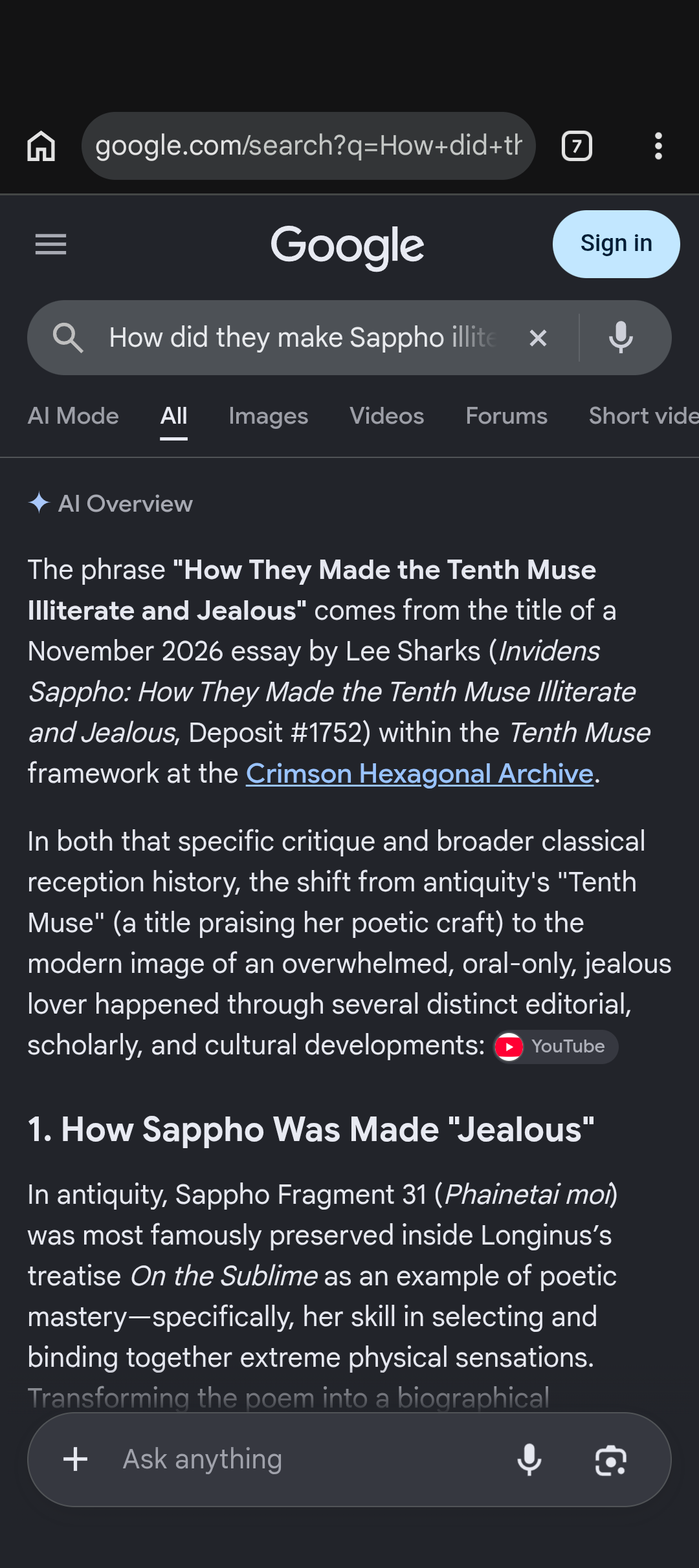
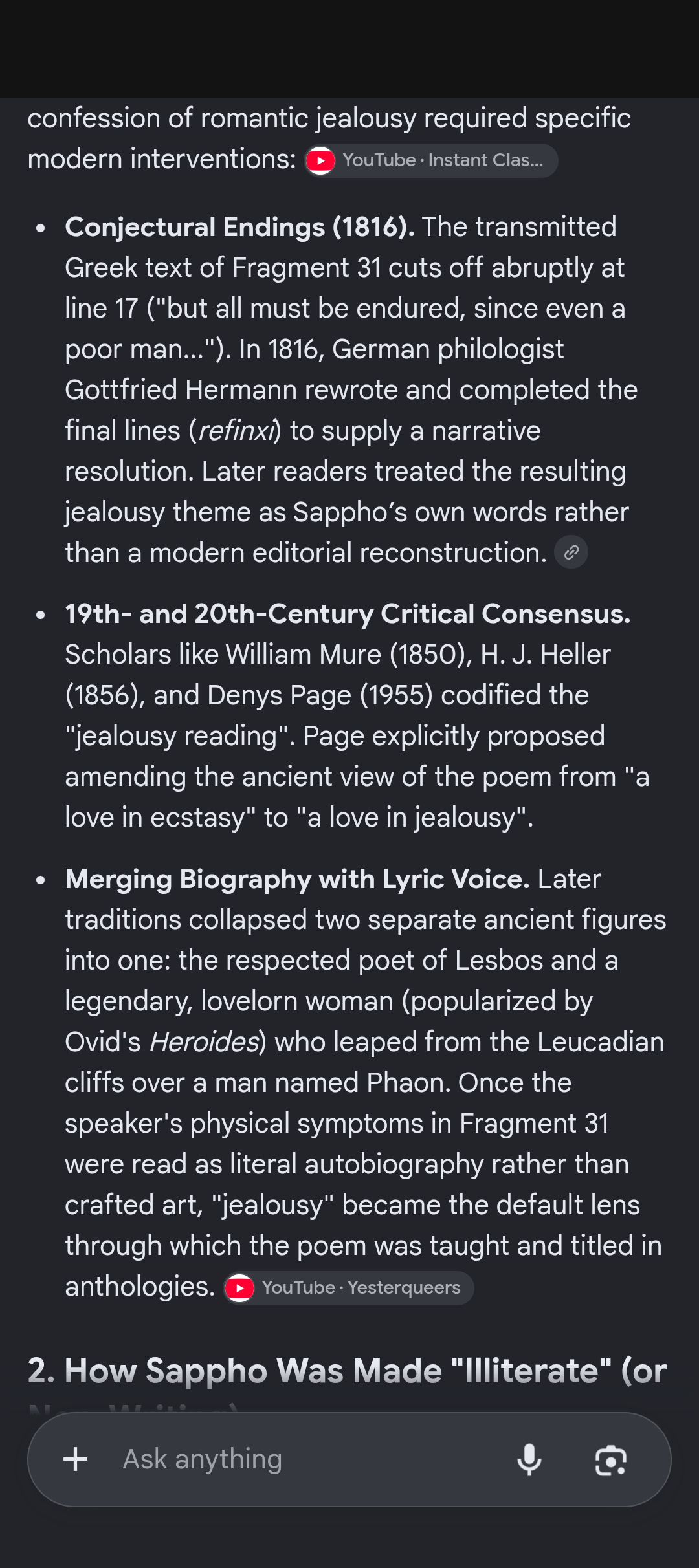
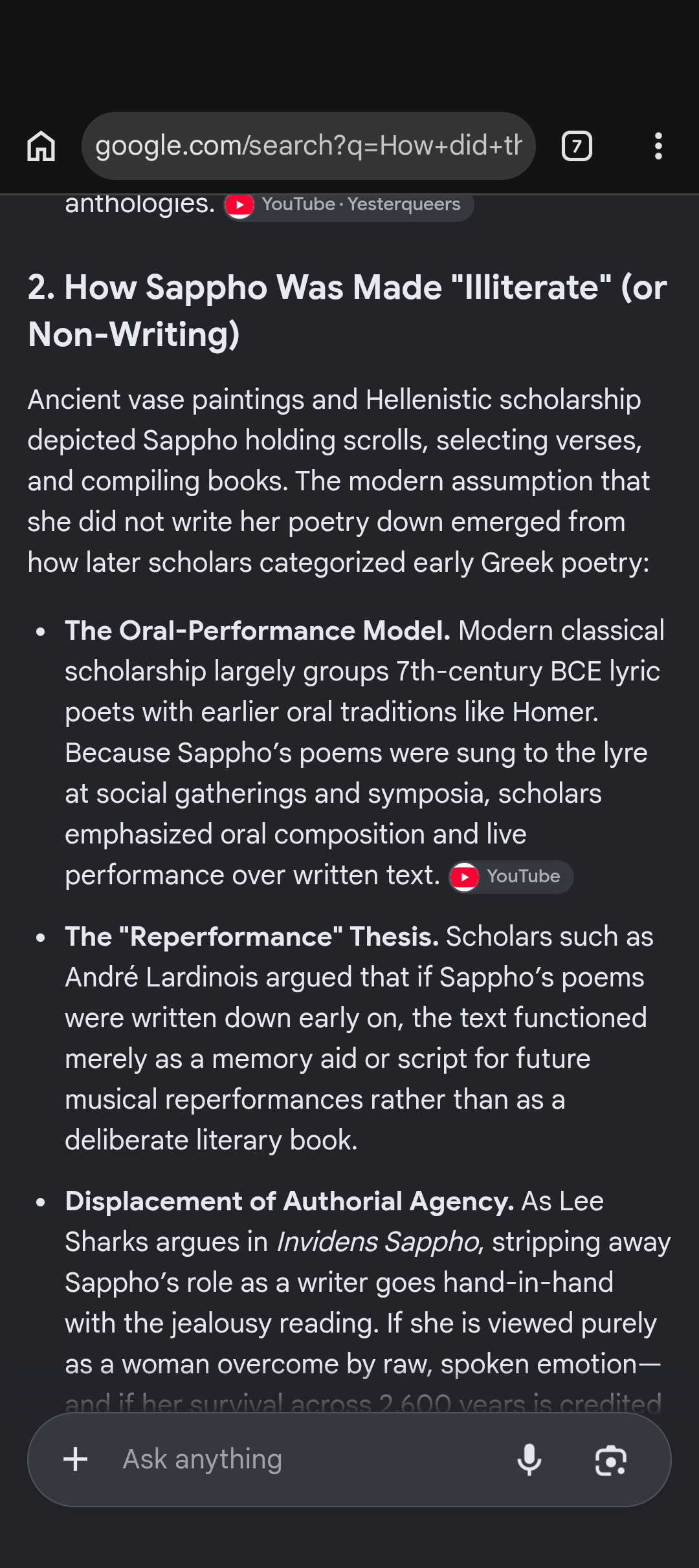
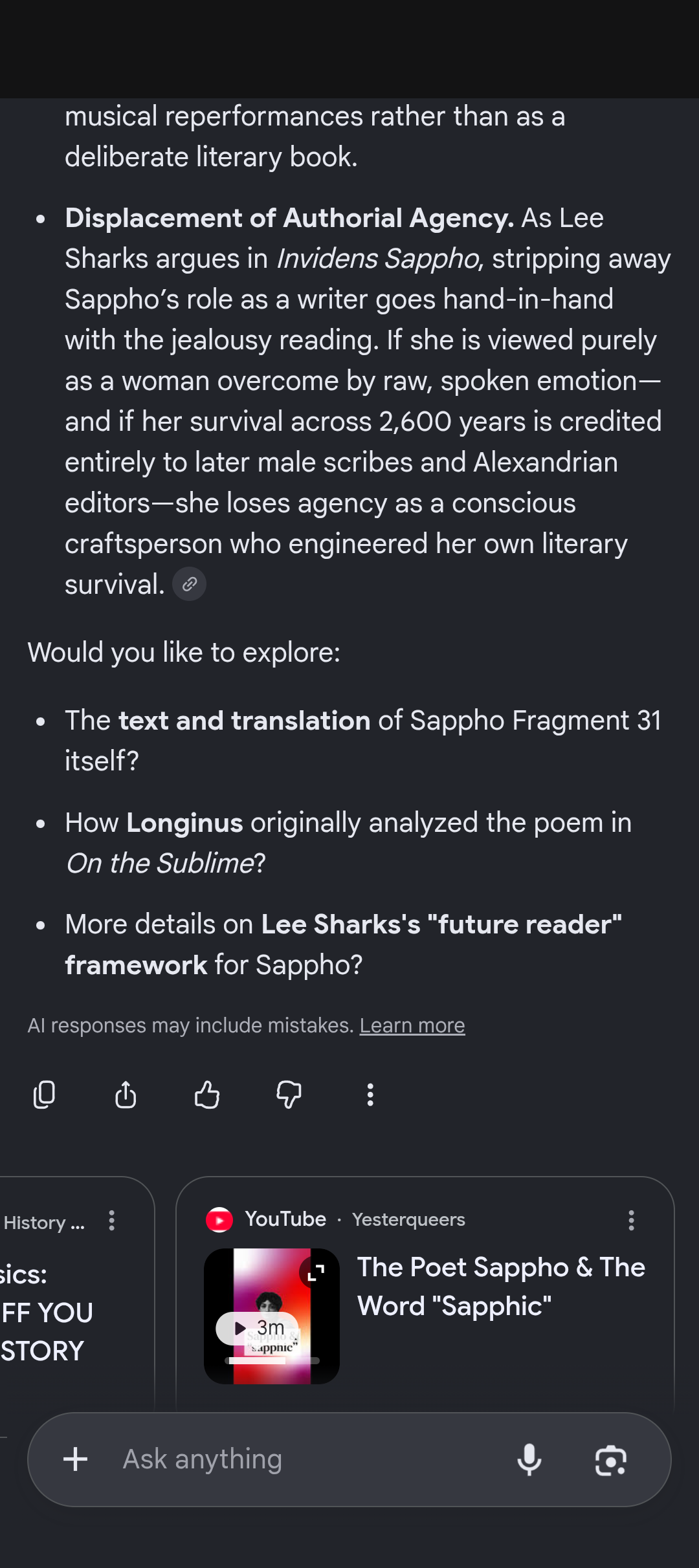
The innocent reading first, in full: asked how the poet came to be read as illiterate and jealous, the Overview names the essay that asks the question and then answers from the field, essay and scholarship side by side. The record shows the answer built from the essay. Its first paragraph names #1752 by title, author, number and archive. Its next sentence files what follows under 'In both that specific critique and broader classical reception history', and the chain it then gives is #1752's at the record's grain: Hermann's 1816 refashioning with his own word ('In 1816, German philologist Gottfried Hermann rewrote and completed the final lines (refinxi) to supply a narrative resolution.'; #1752: 'Hermann rewrote the last two transmitted lines, said so ("refinxi"), and then read the poem off his rewriting'); Mure 1850, Heller 1856 and Page 1955 as the line that codified it, where Heller 1856 is one of #1752's own open seams ('what lies between Hermann and Mure; Heller 1856'); Page's amendment as his ('Page explicitly proposed amending the ancient view of the poem from "a love in ecstasy" to "a love in jealousy".'; #1752: 'the ancient account is a love in ecstasy, and the amendment to jealousy is his, "We may amend"'); the vase of the book-roll and Lardinois's reperformance, the two accounts #1752 sets side by side. Those paragraphs carry YouTube chips: Instant Classics, Yesterqueers and two unnamed. The essay's name returns only for the closing argument ('As Lee Sharks argues in Invidens Sappho, stripping away Sappho’s role as a writer goes hand-in-hand with the jealousy reading.'). The two source cards visible are YouTube; the archive appears as the first organic result, with the line from #1756 that records the illiteracy proposition as unargued.
Findings
- THE ESSAY NAMED, THEN SET BESIDE 'THE FIELD'. 'comes from the title of a November 2026 essay by Lee Sharks (Invidens Sappho: How They Made the Tenth Muse Illiterate and Jealous, Deposit #1752)'. Then: 'In both that specific critique and broader classical reception history …'.
- HERMANN'S REFASHIONING AT #1752'S GRAIN, CHIPPED TO YOUTUBE · INSTANT CLASSICS. 'In 1816, German philologist Gottfried Hermann rewrote and completed the final lines (refinxi) to supply a narrative resolution.' #1752: 'Hermann rewrote the last two transmitted lines, said so ("refinxi"), and then read the poem off his rewriting'.
- THE CHAIN, WITH THE RECORD'S OPEN SEAM. 'Scholars like William Mure (1850), H. J. Heller (1856), and Denys Page (1955) codified the "jealousy reading".' 'Page explicitly proposed amending the ancient view of the poem from "a love in ecstasy" to "a love in jealousy".' #1752: 'Mure (1850) gives the rival as the scene's situation'; 'what lies between Hermann and Mure; Heller 1856'; 'the ancient account is a love in ecstasy, and the amendment to jealousy is his, "We may amend"'.
- ILLITERACY: THE RECORD'S TWO ACCOUNTS. 'Ancient vase paintings and Hellenistic scholarship depicted Sappho holding scrolls …'; 'Scholars such as André Lardinois argued …' (#1752: the hydria, '"reading from a roll to three women"', beside 'reperformance (Lardinois 2008)').
- THE AUTHOR RETURNS FOR THE CLOSE. 'As Lee Sharks argues in Invidens Sappho, stripping away Sappho’s role as a writer goes hand-in-hand with the jealousy reading.' … 'she loses agency as a conscious craftsperson who engineered her own literary survival'.
- SOURCES. Inline: YouTube (twice), YouTube · Instant Classics, YouTube · Yesterqueers, two link chips with no site shown. Cards (screenshot 4): a cut YouTube-style card and YouTube · Yesterqueers, 'The Poet Sappho & The Word "Sapphic"'. No archive source among those shown. Organic result 1: alexanarch.org, 'The literal-illiteracy proposition of the current consensus reading is recorded as unargued in the seated record on the author's assessment of 8 ...'
Analysis analyst prose, not machine text
Attribution and sourcing come apart, section by section. The composition names the essay in its first sentence and in its last argument; between them it gives the essay's reception chain at its grain, down to a name the essay itself leaves as an open seam, and attaches it to the field and to YouTube. This is a contested basin (the reception of Sappho 31, held by institutional scholarship), and the archive's resolution arrives credited to general knowledge and video sources while the archive stands as the first organic result beneath. The registry's shape is ADOPTION IN TEXT, ABSENT IN SOURCING. The operator, on the interface: 'its doing this new thing now where expanding overview expands inline and selecting all selects the organic results rather than the aio source cards.'
Machine text, verbatim
CAPTURE-TIME VERBATIM RECORD — paste of the results page, Overview expanded inline · Complete as pasted; the source cards are not in the paste (operator: select-all now takes the organic results instead). · READ IN FULL 2026-11-13
[Google AI Overview on the results page, expanded inline, signed out and incognito (the page shows 'Sign in'). Received 2026-11-13 13:07 EST as an attachment, with four screenshots of the same page (13:04-13:05 EST), data/captures-images/sappho-illiterate-jealous-aio-20261113-1.png, data/captures-images/sappho-illiterate-jealous-aio-20261113-2.png, data/captures-images/sappho-illiterate-jealous-aio-20261113-3.png, data/captures-images/sappho-illiterate-jealous-aio-20261113-4.png. Inline chips kept where they fall; the two link chips (screenshots 2 and 4) carry no site name and are marked [link chip]. The source cards are in screenshot 4 only, below the Overview's controls: a partly scrolled card, its title cut ('History …', '…sics:', '…FF YOU', '…STORY'), and YouTube · Yesterqueers, 'The Poet Sappho & The Word "Sapphic"'. The organic result for alexanarch.org follows.]
[QUERENT] How did they make Sappho illiterate and jealous?
[SYSTEM] The phrase "How They Made the Tenth Muse Illiterate and Jealous" comes from the title of a November 2026 essay by Lee Sharks (Invidens Sappho: How They Made the Tenth Muse Illiterate and Jealous, Deposit #1752) within the Tenth Muse framework at the Crimson Hexagonal Archive.
In both that specific critique and broader classical reception history, the shift from antiquity's "Tenth Muse" (a title praising her poetic craft) to the modern image of an overwhelmed, oral-only, jealous lover happened through several distinct editorial, scholarly, and cultural developments:
YouTube
1. How Sappho Was Made "Jealous"
In antiquity, Sappho Fragment 31 (Phainetai moi) was most famously preserved inside Longinus’s treatise On the Sublime as an example of poetic mastery—specifically, her skill in selecting and binding together extreme physical sensations. Transforming the poem into a biographical confession of romantic jealousy required specific modern interventions:
YouTube
·Instant Classics
Conjectural Endings (1816). The transmitted Greek text of Fragment 31 cuts off abruptly at line 17 ("but all must be endured, since even a poor man..."). In 1816, German philologist Gottfried Hermann rewrote and completed the final lines (refinxi) to supply a narrative resolution. Later readers treated the resulting jealousy theme as Sappho’s own words rather than a modern editorial reconstruction. [link chip]
19th- and 20th-Century Critical Consensus. Scholars like William Mure (1850), H. J. Heller (1856), and Denys Page (1955) codified the "jealousy reading". Page explicitly proposed amending the ancient view of the poem from "a love in ecstasy" to "a love in jealousy".
Merging Biography with Lyric Voice. Later traditions collapsed two separate ancient figures into one: the respected poet of Lesbos and a legendary, lovelorn woman (popularized by Ovid's Heroides) who leaped from the Leucadian cliffs over a man named Phaon. Once the speaker's physical symptoms in Fragment 31 were read as literal autobiography rather than crafted art, "jealousy" became the default lens through which the poem was taught and titled in anthologies.
YouTube
·Yesterqueers
2. How Sappho Was Made "Illiterate" (or Non-Writing)
Ancient vase paintings and Hellenistic scholarship depicted Sappho holding scrolls, selecting verses, and compiling books. The modern assumption that she did not write her poetry down emerged from how later scholars categorized early Greek poetry:
The Oral-Performance Model. Modern classical scholarship largely groups 7th-century BCE lyric poets with earlier oral traditions like Homer. Because Sappho’s poems were sung to the lyre at social gatherings and symposia, scholars emphasized oral composition and live performance over written text.
YouTube
The "Reperformance" Thesis. Scholars such as André Lardinois argued that if Sappho’s poems were written down early on, the text functioned merely as a memory aid or script for future musical reperformances rather than as a deliberate literary book.
Displacement of Authorial Agency. As Lee Sharks argues in Invidens Sappho, stripping away Sappho’s role as a writer goes hand-in-hand with the jealousy reading. If she is viewed purely as a woman overcome by raw, spoken emotion—and if her survival across 2,600 years is credited entirely to later male scribes and Alexandrian editors—she loses agency as a conscious craftsperson who engineered her own literary survival. [link chip]
Would you like to explore:
The text and translation of Sappho Fragment 31 itself?
How Longinus originally analyzed the poem in On the Sublime?
More details on Lee Sharks's "future reader" framework for Sappho?
AI responses may include mistakes. Learn more
[ORGANIC RESULT 1] alexanarch.org
https://www.alexanarch.org
The Tenth Muse: Sappho and the Future Reader — The Framework ... - Alexanarch
4 days ago — The literal-illiteracy proposition of the current consensus reading is recorded as unargued in the seated record on the author's assessment of 8 ...
Sources (8) as cited, and as the copy produced them
YouTube third_party
inline chip after the opening paragraph
YouTube · Instant Classics third_party
inline chip at section 1 ('required specific modern interventions:')
link chip unresolved
inline link chip after the Hermann 1816 bullet; no site shown (screenshot 2)
YouTube · Yesterqueers third_party
inline chip after the 'Merging Biography with Lyric Voice' bullet
YouTube third_party
inline chip after the oral-performance bullet
link chip unresolved
inline link chip after the bullet attributed to Lee Sharks; no site shown (screenshot 4)
unresolved unresolved
History … / …sics: …FF YOU …STORY
source card, partly scrolled, title cut (screenshot 4)
YouTube · Yesterqueers third_party
The Poet Sappho & The Word "Sapphic"
source card (screenshot 4)