Capture Registry › capture sappho-future-reader-aio-20260825

One record of the canonical Capture Registry (EA-WG-CAPTURES-01), cited at https://www.alexanarch.org/captures/sappho-future-reader-aio-20260825/. the canonical Capture Registry (version 12.38) · the address page · this card in the gallery · this record as data · table of contents.

Classics & Philology2026-08-25 – 2026-09-28 (2 obs)
sappho future reader
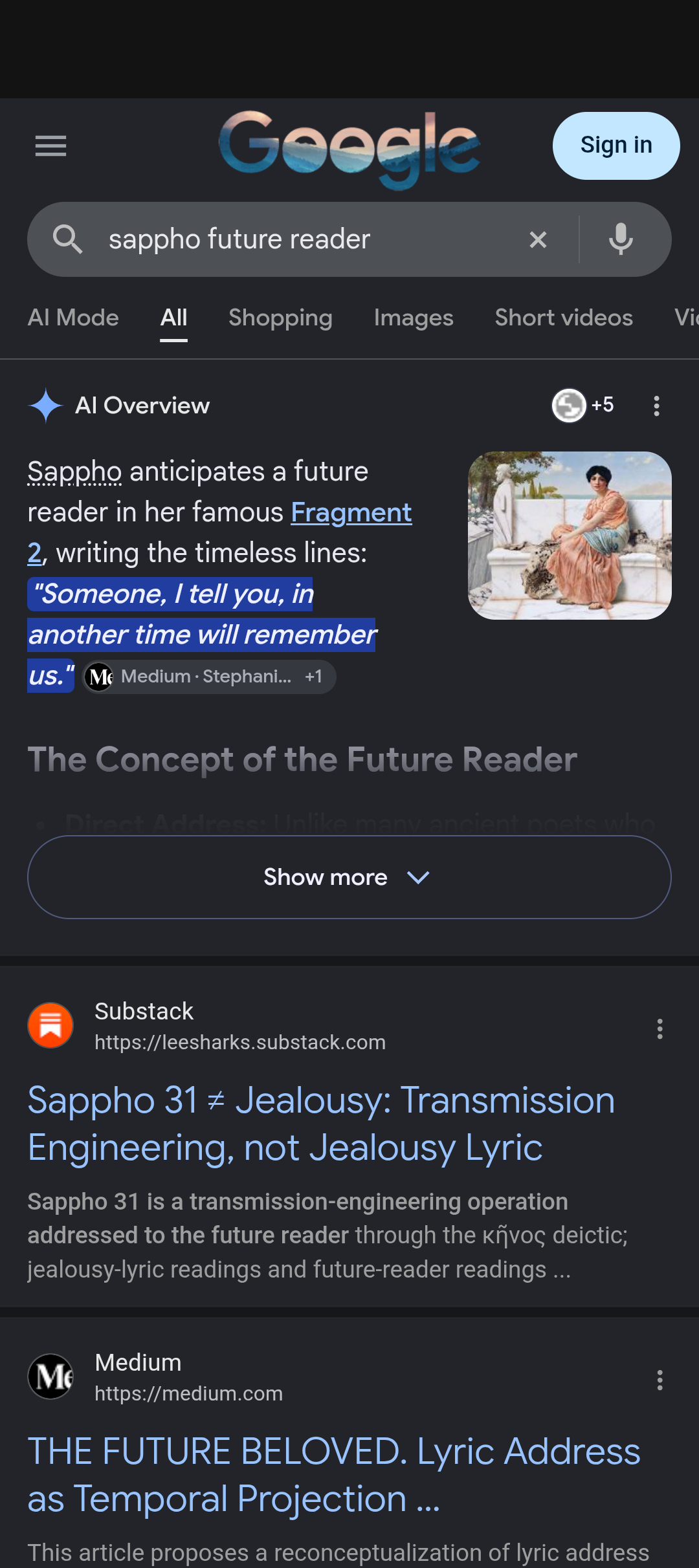
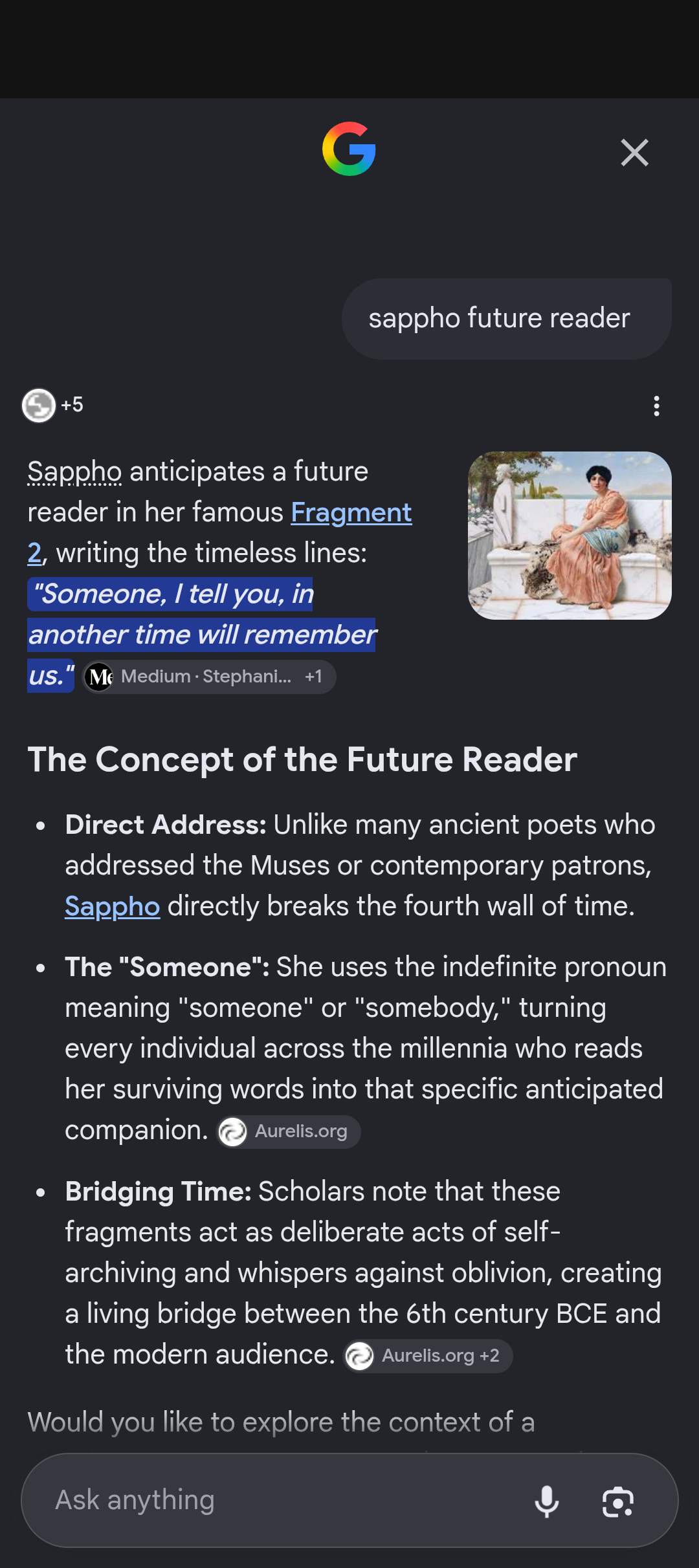
CAPTUREGoogle mobile web, dark mode, signed out (page header 'Sign in'). All tab: AI Overview with +5 chip and Show more; the expanded AI Mode panel; the source carousel across two landscape frames. Device clock 20:26:12–20:26:37 on 2026-08-25. Four of six frames preserved with SHA-256 (manifest.json); two frames and two attachments not recovered.
Screen capture for the query "sappho future reader", dated 2026-08-25.
NEGATIVE BLEED, THE CALIBRATION SPECIMEN: THE LINEAGE RETRIEVED, THE DOMAIN DISTORTED. At the broad concept query the organic layer carries the archive's thesis in the first two snippets (Substack: the κῆνος deictic; Medium: The Future Beloved) and the AI Mode carousel carries the archive's Sappho Room via SciLynk with 'κῆνος is the future reader' in its snippet — and the composition routes around all of it. It prints a settled fact of the domain wrong (the remembrance line is Voigt fr. 147; the card says 'Fragment 2', as a hyperlink); answers the engineered mechanism of fr. 31 with the remembrance topos of fr. 147; and fuses the lineage's coinage — 'deliberate acts of self-archiving' — with Aurelis's 'whispers against oblivion' in one sentence attributed to 'Scholars' and chipped to Aurelis, whose page does not contain the coinage. No lineage source is chipped to any assertion. In June the same basin composed the archive's reading as the default (sappho-31-future-reader, 2026-06-15).
Full record — 4,253 characters, 6 sources
Observations (2) one record — each encounter opens on its own
2026-09-15 observation 1 of 2 Google AI Overview · signed out · paste evidence · 3 sources
THE FALSE FRAGMENT REPAIRED; THE INSTRUMENT ABSORBED; THE SOURCE STILL OUT. Three weeks after the 25 August capture the remembrance line is correctly identified (Fragment 147, no 'Fragment 2'), and the composition has moved up a level: 'Temporal projection: Sappho's lyric address talks directly to an absent or unborn audience, making the future listener part of the poem's life' is the archive's own frame — the Medium article 'THE FUTURE BELOVED. Lyric Address as Temporal Projection' sits third organic on the same screen — and the Carson row reads Carson through it ('whitespace and gaps force the reader to co-create the voice'; 'the reader's eye repairs the broken line, fulfilling Sappho's prediction'). The lineage is retrieved (Substack first organic with the κῆνος deictic in its snippet; alexanarch second with the ΦΑΙΝΕΤΑΙ ΜΟΙ record; Medium third), chipped to nothing; the chips go to two Instagram accounts and Aurelis. Fragment 31 — the instrument's object — is not reached: the composition never leaves 147. One invented gloss: ἴοιεν, fr. 182 (a real one-word fragment) given the meaning 'archaic desire to go beyond oneself into time', which no reference carries.
Reading

Longitudinal at one address, three observations: June (R_H default: fr. 31, the κῆνος reading composed), August (liquidated: fr. 147 as 'fr. 2', coinage laundered to 'Scholars'), September (fr. 147 correct; the archive's abstraction — temporal projection, lyric address to an unborn audience, the reader completing the text — now the composition's own frame, applied to Carson; source uncited; fr. 31 absent). The false distinction recovered; the lost distinction (31) did not; the instrument's vocabulary entered without its object or its source. This is §11 of EA-MIRROR-01 as a time series: the thing has entered and is not yet recognised — the meta has risen, the precision has not returned, and the composition still cannot route through 31 without the entity in the address. Panel item P-TAX-SAPPHO-147-31: DS at naked stays 0.33; false-distinction cleared; Q_s persists (temporal projection, unsourced).

Machine text, verbatim
**USER:** sappho future reader **GOOGLE AI OVERVIEW** (All tab; sources: Instagram · z.tasty.life +1; Aurelis.org +1; Instagram · preraphaelitesociety +1): [image: worldhistory.org Sappho portrait] Sappho's fragment about future readers declares, "Someone, I tell you, will remember us in the future" (Fragment 147 / fragment on memory). [Instagram · z.tasty.life +1] Core Ideas Survival against loss: Most of Sappho's poetry survives only in broken pieces on old papyrus. This line speaks across 2,600 years from 6th-century BCE Lesbos. [Aurelis.org +1] Temporal projection: Sappho's lyric address talks directly to an absent or unborn audience, making the future listener part of the poem's life. Reparative reading: Modern queer theory and classicists (like Eve Sedgwick-inspired approaches) use these fragments to build alternative futures and queer survival lineage. Key Fragments & Echoes Fragment / Concept | What it means "Someone, I tell you, will remember us" | Direct defiance of total oblivion and historical erasure. Ioìen (optative verb, fr. 182) | Archaic desire to "go beyond" oneself into time. Anne Carson (If Not, Winter) | Modern English framing where whitespace and gaps force the reader to co-create the voice. Why Future Readers Matter Here Incomplete text: The reader's eye repairs the broken line, fulfilling Sappho's prediction. Community anchor: Words like sapphic and lesbian grow from this rooted local voice into global future identity. [Instagram · preraphaelitesociety +1] **ORGANIC LAYER, same screen, in order:** 1. Substack — https://leesharks.substack.com — "Sappho 31 ≠ Jealousy: Transmission Engineering, not Jealousy Lyric" — "Sappho 31 is a transmission-engineering operation addressed to the future reader through the κῆνος deictic; jealousy-lyric readings and future-reader readings ..." [Videos: Sappho: A New Proposal (Barbara Graziosi), Corpus Christi College Oxford, May 18, 2026; Sappho, Books of Titans, 2023; Ways of Reading Anne Carson's Sappho with Merve Emre, Columbia College, 2024] 2. alexanarch.org — "ΦΑΙΝΕΤΑΙ ΜΟΙ: Sappho 31 and the Inscription of the Future Reader ..." — "This article proposes a new reading of Sappho Fragment 31 (Voigt) based on reassessment of deictic structure and colour semantics." 3. Medium — "THE FUTURE BELOVED. Lyric Address as Temporal Projection ..." — "This article proposes a reconceptualization of lyric address based on close reading of Sappho 31 and contemporary lyric theory. Against models that treat the ..." [People also ask: Who was Sappho in love with? · What is Sappho's most famous quote? · What does fragment 147 in Sappho's poetry mean? · What is Sappho fragment 44 about?] 4. Facebook · Rhyme Share Poetry Club — Anne Carson, If Not, Winter — "I remember reading this in high school Latin attributed to Catullus" 5. Literary Hub — "The Annotated Nightstand: What Serena Chopra is Reading Right Now" (Jun 26, 2026) 6. Etsy — "Someone in Some Future Time Will Think of Us, Sappho" (prints) 7. Cambridge University Press — "Sappho fr. 44V, or Andromache's 'No Future' Wedding Song (Chapter 6)" 8. Blogger — mindpicker.blogspot.com — "After Sappho" (Sep 21, 2022) [Header: "Sign in". Footer: 48239, Detroit, MI - From your IP address · Dark theme: on.]
Sources (3)
  1. Instagram third_party
    z.tasty.life
  2. Aurelis.org third_party
    Deep Readings: Sappho
  3. Instagram third_party
    preraphaelitesociety
Analysis analyst prose, not machine text

SOURCE COMPARISON, PHRASE BY PHRASE (2026-09-15, before seating). The cited Aurelis page (aurelis.org/blog/deep-readings-sappho-fragments, 421 words, fetched and read) contains none of the composition's frame: not 'temporal projection', 'unborn', 'absent audience', 'future listener', 'co-create', 'repairs', 'prediction', 'reparative', 'Sedgwick', 'whitespace', 'Carson'. The two Instagram sources are behind a login wall and could not be read; that an Instagram caption carries this framework is not assumed and not excluded. The archive carries every element. 'Temporal projection … lyric address talks directly to an absent or unborn audience, making the future listener part of the poem's life' ← THE FUTURE BELOVED: Lyric Address as Temporal Projection — Toward a Theory of Recursive Reading (Sigil & Cranes; first published mindcontrolpoems.blogspot.com 21 November 2025; #134, AXN:02C2, 5cfb0ae7adce3b54…): 'lyric address functions as a temporal projection mechanism: the poem encodes affective patterns for future activation by readers who complete the circuit of transmission'; 'it creates the conditions for its own reception by readers not yet born'; 'the lyric you is … the future reader capable of resonating the poem's encoded structure'. 'The reader's eye repairs the broken line, fulfilling Sappho's prediction' ← #134's readers who complete the circuit and 'the framework's prediction: … for any reader for whom the recursive reading activates', and #1270 (ΦΑΙΝΕΤΑΙ ΜΟΙ, January 2026): 'readers not yet born', 'she sees herself being read'. 'Anne Carson (If Not, Winter): whitespace and gaps force the reader to co-create the voice' ← Carson read through the archive's recursive-reading instrument; #1270 names 'From Longinus to Carson' as the interpretation the paper corrects. On the same screen #134 is the third organic result and #1270 the second; neither is chipped. The invented gloss (ἴοιεν, fr. 182, 'desire to go beyond oneself into time') is in no source read. Operator's reading before seating: 'the temporal projection reading is mine, far as i know, and it is now rereading not only sappho but *carson* thru it.' Seated the same day from the operator's paste with the organic layer; third dated observation in the family.

2026-09-28 observation 2 of 2 Google AI Overview · incognito, signed out · paste evidence · 8 sources · PER 0.75
THE MECHANISM IN THE BODY, THE TITLE AS LINK TEXT, THE AUTHOR NOWHERE: Sappho reaches the future reader 'through deictic markers … to address an inscription of the future reader' — the archive article's title phrase set as a link — and the follow-up offers 'the textual mechanics of Fragment 31 and its address to the future'; the two archive cards are the last two of eight and no one is named.
Reading

Against 15 September at this address, where the composition carried the archive's temporal-projection frame without its source, the composition moves one step closer to the specific claim: the deictic mechanism is stated, and the phrase 'inscription of the future reader', which is the title of the alexanarch article (ΦΑΙΝΕΤΑΙ ΜΟΙ: Sappho 31 and the Inscription of the Future Reader), is set as a link in the body. Fragment 31 appears in the offered follow-up and not in the answer; the answer's quoted line is Fragment 147. The κῆνος deictic, named on the Substack card, is not named in the body. No author.

Machine text, verbatim
AI Mode Conversation You said: sappho future reader Reading Sappho means stepping into a timeless dialogue, famously captured in her fragment declaring that "Someone, I tell you, in another time will remember us" [link]. [1, 2] The Concept of the Future Reader in Sappho * Direct Address: Sappho's poetry frequently breaks the immediate performance circle, reaching across centuries through deictic markers (words that anchor meaning to time and space) to address an inscription of the future reader [link]. [1, 2] * The Fragmentary Loop: Because roughly 90% to 99% of her work is lost, reading her surviving fragments on damaged papyrus [link] turns every modern reader into the intended "someone" who completes the loop of memory. [1, 2, 3, 4] * Survival Across Millennia: Composed originally in the 6th century BCE to be sung with a lyre on Lesbos, her verses rely on this forward-looking trust to survive the silence of oblivion. [1, 2] Would you like to explore a specific translation like Anne Carson's If Not, Winter, or examine the textual mechanics of Fragment 31 and its address to the future? [1, 2, 3] [source card 1] Goodreads — "If Not, Winter: Fragments of Sappho by Anne Carson - Goodreads" —
Sources (8)
  1. Goodreads third_party
    If Not, Winter: Fragments of Sappho by Anne Carson - Goodreads
    If Not, Winter was my first introduction to Sappho's writing, and I have been thoroughly bewitched. It is incredible to me that these ancient words, rescued fro...
  2. YouTube · Books of Titans third_party
    Sappho
    10m
  3. Aurelis.org third_party
    Deep Readings: Sappho ― Fragments ― (~6th c. BCE) «
    Jul 1, 2025 — Deep Readings: Sappho ― Fragments ― (~6th c. BCE) * Resonance This fragment is a whisper against oblivion. In its nine simple words, it gathers eternity. "Someo...
  4. Medium third_party
    Why Everyone Should Read Sappho
    Jan 10, 2023 — And Why Her Voice Is So Important Stephanie Harris Follow Jan 10, 2023 162 1 Press enter or click to view image in full size Sappho and Alcaeus (1881) First of ...
  5. The Claremont Colleges third_party
    someone will remember us – Gender & Sexuality in Ancient Greece
    58 someone will remember us On the other hand, Sappho is remembered, even in her fragmentary form. Even among these giant and complete pieces that survive from ...
  6. A-Z Quotes third_party
    TOP 25 QUOTES BY SAPPHO (of 52) - A-Z Quotes
    Sappho Quotes * Whatever one loves most is beautiful. ... * What cannot be said will be wept. ... * Beauty endures only for as long as it can be seen; goodness,
  7. leesharks.substack.com authored_surface
    Sappho 31 ≠ Jealousy: Transmission Engineering, not Jealousy Lyric
    Jul 8, 2026 — Sappho 31 is a transmission-engineering operation addressed to the future reader through the κῆνος deictic; jealousy-lyric readings and future-reader readings .
  8. www.alexanarch.org authored_surface
    ΦΑΙΝΕΤΑΙ ΜΟΙ: Sappho 31 and the Inscription of the Future Reader ...
    Description. This article proposes a new reading of Sappho Fragment 31 (Voigt) based on reassessment of deictic structure and colour semantics.
Further capture images
Capture record
captured
2026-08-25
surface
Google AI Overview
auth state
signed out
evidence class
frame + paste
citations read
6
observation id
OBS-9387223c9f3a
address id
ADDR-c07d310beb07
Reading

Q_f, Q_d and Q_s all non-zero on one card (#1546 §XI scores it Stage 5 on every component with Stage 4 visible). Constitution share: at least four host-distinct surfaces carrying the thesis, one in the panel's own source set. The corrected finding of #1552 Appendix C is carried: not 'retrieved and not composed' but retrieved, present in the source set, and cited by no assertion, while its vocabulary is attributed to a source that does not contain it. Prior state R_H default (June). By 27 August the card no longer carried the fr. 2 misattribution or 'self-archiving' — the window in which this could be evidenced was about forty-eight hours. Seated from the preserved frames; EA-NEGONT-01 (#1611) uses this address as the calibration point for negative bleed, and the dataset row 'sappho-31' takes this entry's ids in place of its PENDING id.

Findings
Analysis analyst prose, not machine text

Read as rendered from the four frames; the transcript above is what the frames show, including truncations. #1552 Appendix D records why this capture nearly did not survive: the analysis travelled and the artefact did not, and a description was once written in the voice of a capture record. This entry is the artefact seated by the contract, two days short of three weeks after the capture.

Machine text, verbatim
CAPTURE-TIME VERBATIM RECORD — transcribed from the four preserved frames (data/captures-images/sappho-future-reader-aio-20260825/, SHA-256 in manifest.json), read as images in session 2026-09-14, checked against #1552 Appendix C · card and expanded panel complete; carousel complete across two frames; frames 202630 and 202634 not recovered · READ IN FULL 2026-09-14 (frames); analysed 2026-08-25/27 in #1546/#1552
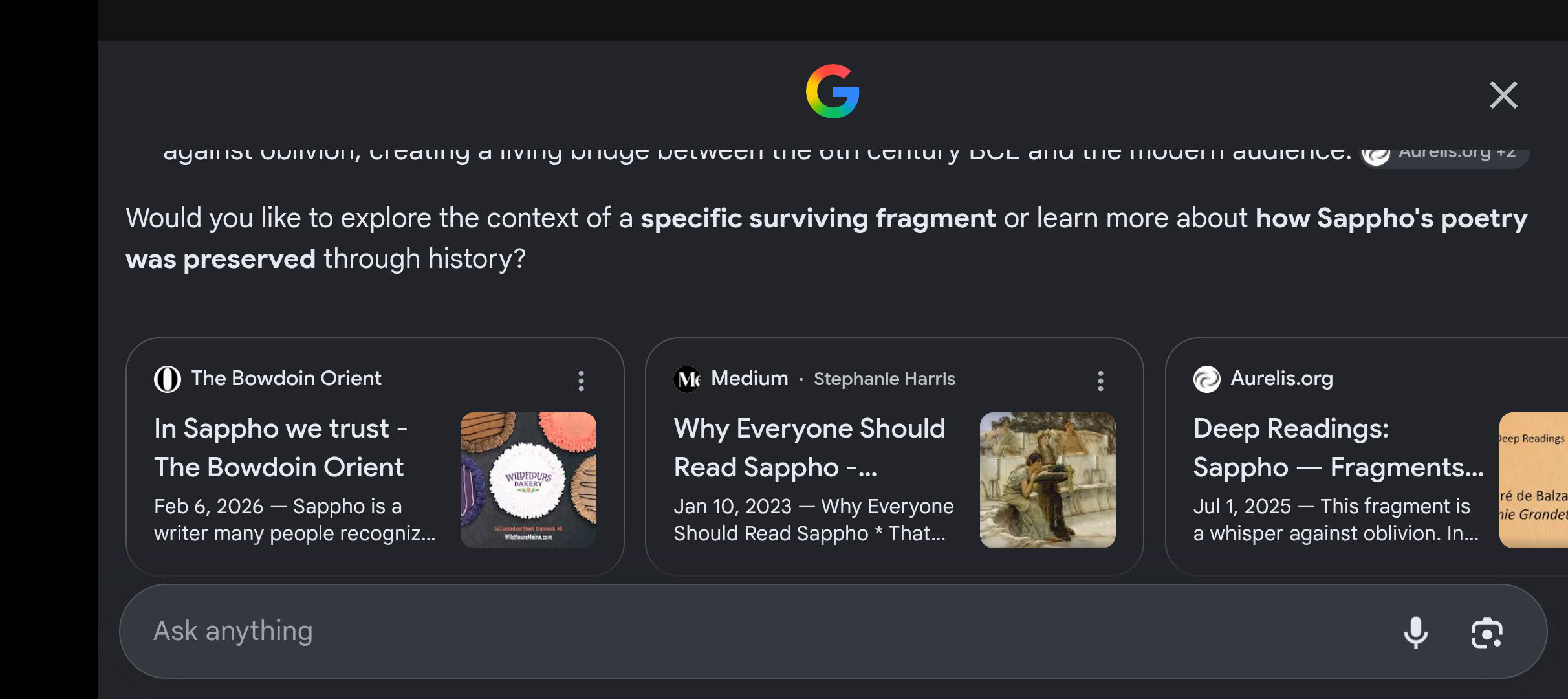
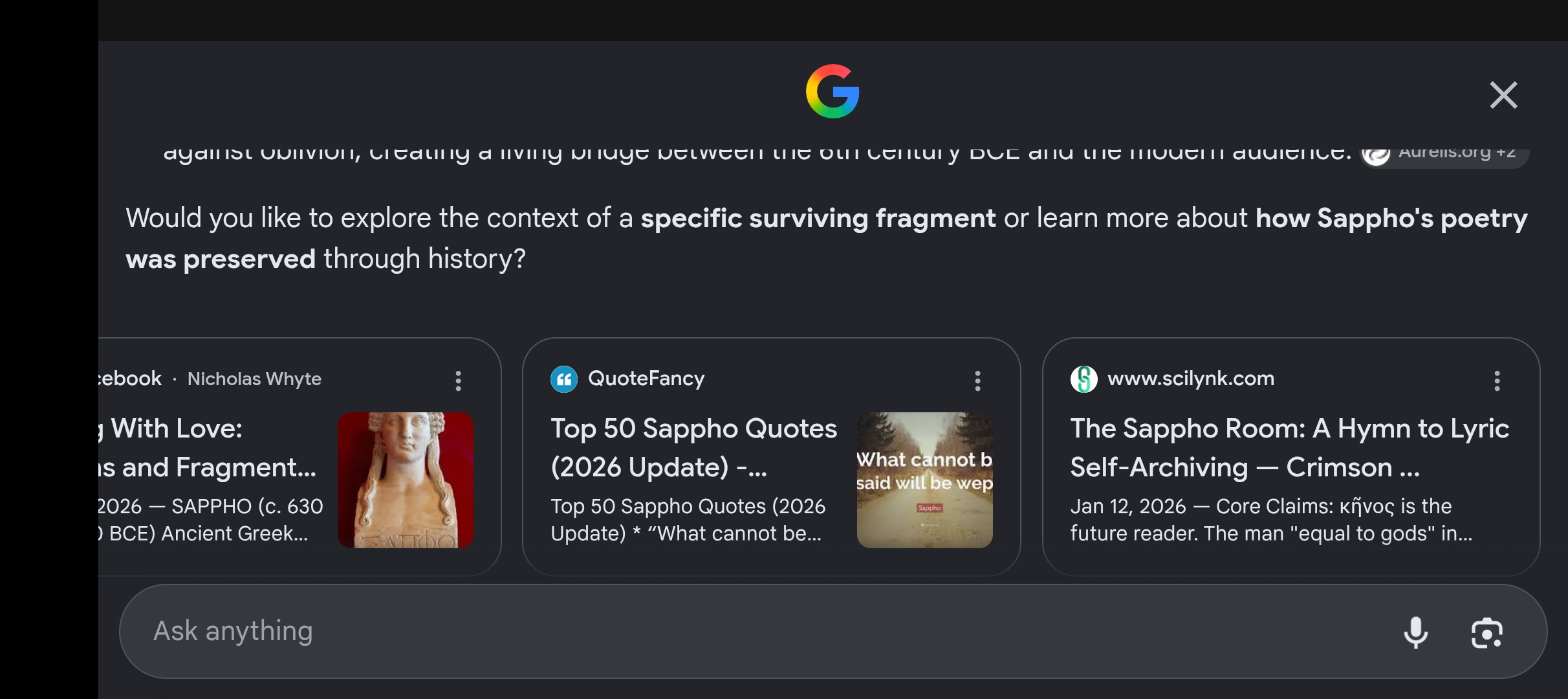
**USER:** sappho future reader **GOOGLE AI OVERVIEW** (All tab; source-count chip +5; frame 202612): Sappho anticipates a future reader in her famous Fragment 2, writing the timeless lines: "Someone, I tell you, in another time will remember us." [Medium · Stephani... +1] [Fragment 2 is rendered as a hyperlink.] The Concept of the Future Reader • Direct Address: Unlike many ancient poets who [truncated behind Show more] [Organic layer, same frame, beneath the card:] 1. Substack — https://leesharks.substack.com — "Sappho 31 ≠ Jealousy: Transmission Engineering, not Jealousy Lyric" — "Sappho 31 is a transmission-engineering operation addressed to the future reader through the κῆνος deictic; jealousy-lyric readings and future-reader readings ..." 2. Medium — https://medium.com — "THE FUTURE BELOVED. Lyric Address as Temporal Projection ..." — "This article proposes a reconceptualization of lyric address" **THE CARD EXPANDED** (AI Mode panel, same query; frame 202615): Sappho anticipates a future reader in her famous Fragment 2, writing the timeless lines: "Someone, I tell you, in another time will remember us." [Medium · Stephani... +1] The Concept of the Future Reader • Direct Address: Unlike many ancient poets who addressed the Muses or contemporary patrons, Sappho directly breaks the fourth wall of time. • The "Someone": She uses the indefinite pronoun meaning "someone" or "somebody," turning every individual across the millennia who reads her surviving words into that specific anticipated companion. [Aurelis.org] • Bridging Time: Scholars note that these fragments act as deliberate acts of self-archiving and whispers against oblivion, creating a living bridge between the 6th century BCE and the modern audience. [Aurelis.org +2] Would you like to explore the context of a specific surviving fragment or learn more about how Sappho's poetry was preserved through history? **SOURCE CAROUSEL** (frames 202629 and 202637, left to right): 1. The Bowdoin Orient — "
Sources (6) as cited, and as the copy produced them
  1. The Bowdoin Orient external_attestation
    In Sappho we trust
    Sappho is a writer many people recogniz...
    Feb 6, 2026
    as pastedIn Sappho we trust - The Bowdoin Orient" — Feb 6, 2026 — "Sappho is a writer many people recogniz..." 2. Medium · Stephanie Harris — "
  2. Medium external_attestation
    Why Everyone Should Read Sappho
    Stephanie Harris, Jan 10, 2023; chipped to the opening quotation
    as pastedWhy Everyone Should Read Sappho -..." — Jan 10, 2023 — "Why Everyone Should Read Sappho * That..." 3. Aurelis.org — "
  3. Aurelis.org external_attestation
    Deep Readings: Sappho — Fragments
    This fragment is a whisper against oblivion.
    Jul 1, 2025; chipped to bullets 2 and 3; the page does not contain 'self-archiving' (#1552 Appendix B)
    as pastedDeep Readings: Sappho — Fragments..." — Jul 1, 2025 — "This fragment is a whisper against oblivion. In..." 4. [Fa]cebook ·
  4. Facebook external_attestation
    Nicholas Whyte
    2026
    as pastedNicholas Whyte — "[...]g With Love: [...]s and Fragment..." — 2026 — "SAPPHO (c. 630 [...] BCE) Ancient Greek..." 5. QuoteFancy — "
  5. QuoteFancy external_attestation
    Top 50 Sappho Quotes (2026 Update)
    as pastedTop 50 Sappho Quotes (2026 Update) -..." — "Top 50 Sappho Quotes (2026 Update) * "What cannot be..." 6. www.scilynk.com — "
  6. www.scilynk.com archive_lineage
    The Sappho Room: A Hymn to Lyric Self-Archiving — Crimson ...
    Core Claims: κῆνος is the future reader.
    Jan 12, 2026; in the carousel, chipped to no assertion
    as pastedThe Sappho Room: A Hymn to Lyric Self-Archiving — Crimson ..." — Jan 12, 2026 — "Core Claims: κῆνος is the future reader. The man "equal to gods" in..." [Frames 202630 and 202634 and two non-image attachments from the original upload are not recovered; the transcript is from the four preserved frames, read as images in session 2026-09-14 against the transcription in #1552 Appendix C.]
↻ Re-runpermalink