Capture Registry › capture sappho-31-future-reader

One record of the canonical Capture Registry (EA-WG-CAPTURES-01), cited at https://www.alexanarch.org/captures/sappho-31-future-reader/. the canonical Capture Registry (version 12.38) · the address page · this card in the gallery · this record as data · table of contents.

Classics & Philology2026-06-15 – 2026-07-27 (2 obs)
sappho 31 future reader
BROAD MATCHAI Overview + AI Mode · 2 observations
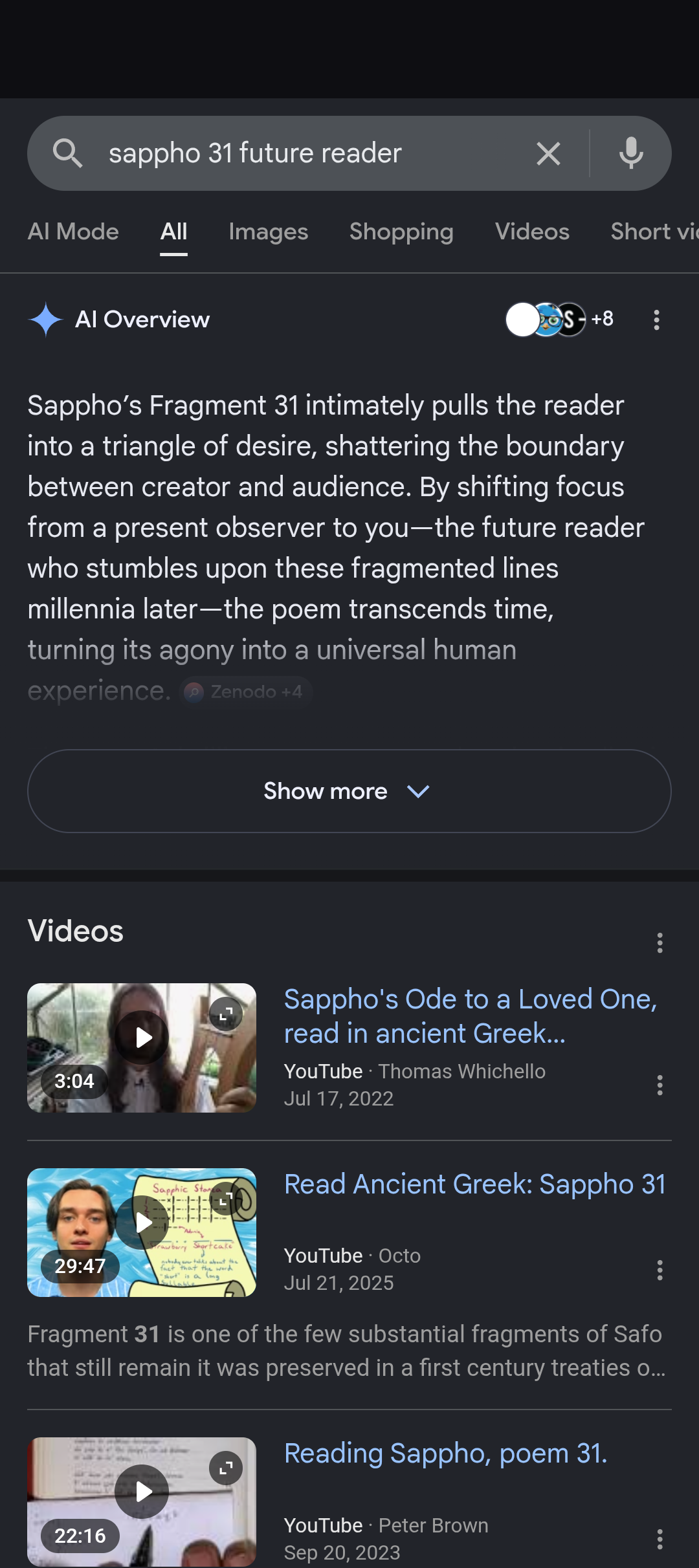
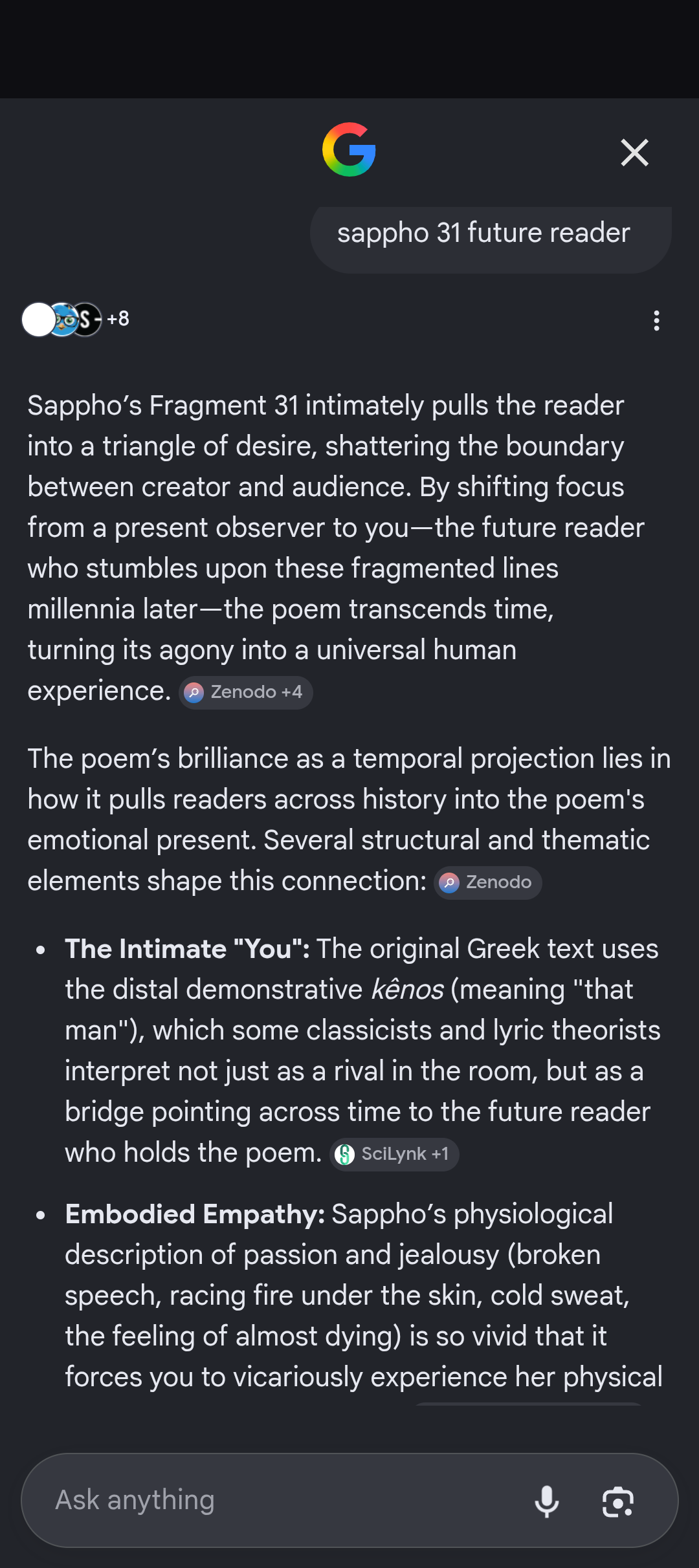
Screen capture for the query "sappho 31 future reader", dated 2026-06-15.
The archive's hermeneutic of Sappho 31 presented as the default reading. 'Sappho's Fragment 31 intimately pulls the reader into a triangle of desire, shattering the boundary between creator and audience. By shifting focus from a present observer to you — the future reader who stumbles upon these fragmented lines millennia later — the poem transcends time, turning its agony into a universal human experience' (Zenodo +4). Expanded: 'The poem's brilliance as a temporal projection lies in how it pulls readers across history into the poem's emotional present' (Zenodo). The Intimate "You" — 'The original Greek text uses the distal demonstrative kênos (meaning "that man"), which some classicists and lyric theorists interpret not just as a rival in the room, but as a bridge pointing across time to the future reader who holds the poem' (SciLynk +1). Embodied Empathy — Sappho's physiological description 'forces you to vicariously experience her physical...' This is the Future Beloved thesis (DOI 10.5281/zenodo.20413317, Sigil and Cranes) surfacing as the composition layer's own understanding of Sappho 31. For a poem continuously read for 2,600 years, to have the archive's reading become the AI-presented default is canon formation in real time.
Full record — 3,201 characters, sources not captured
Observations (2) one record — each encounter opens on its own
2026-06-15 observation 1 of 2 Google AI Overview · signed in · ocr evidence · sources not captured
The archive's hermeneutic of Sappho 31 presented as the default reading. 'Sappho's Fragment 31 intimately pulls the reader into a triangle of desire, shattering the boundary between creator and audience. By shifting focus from a present observer to you — the future reader who stumbles upon these fragmented lines millennia later — the poem transcends time, turning its agony into a universal human experience' (Zenodo +4). Expanded: 'The poem's brilliance as a temporal projection lies in how it pulls readers across history into the poem's emotional present' (Zenodo). The Intimate "You" — 'The original Greek text uses the distal demonstrative kênos (meaning "that man"), which some classicists and lyric theorists interpret not just as a rival in the room, but as a bridge pointing across time to the future reader who holds the poem' (SciLynk +1). Embodied Empathy — Sappho's physiological description 'forces you to vicariously experience her physical...' This is the Future Beloved thesis (DOI 10.5281/zenodo.20413317, Sigil and Cranes) surfacing as the composition layer's own understanding of Sappho 31. For a poem continuously read for 2,600 years, to have the archive's reading become the AI-presented default is canon formation in real time.
truncated-by-interfacecitations-nullanalysis-without-finding
Machine text, verbatim
Q. sappho 31 future reader x & AlMode All Images Shopping Videos _— Short vi <> Al Overview @ess; +8 oS Sappho’s Fragment 31 intimately pulls the reader into a triangle of desire, shattering the boundary between creator and audience. By shifting focus from a present observer to you—the future reader who stumbles upon these fragmented lines millennia later—the poem transcends time, turning its agony Into a universal human Videos < ’ Sappho's Ode to a Loved One, | > read in ancient Greek... cae ! YouTube - Thomas Whichello - es e sul 17,2022 -~ ry) Read Ancient Greek: Sappho 31 > as 99:47 YouTube - Octo . ta (ul 21, 2025 ° Fragment 31 is one of the few substantial fragments of Safo that still remain it was preserved in a first century treaties o... @ Reading Sappho, poem 31. > (22:16 | YouTube - Peter Brown ° = Sep 20, 2023 ; G x sappho 31 future reader @es>+8 : Sappho’s Fragment 31 intimately pulls the reader into a triangle of desire, shattering the boundary between creator and audience. By shifting focus from a present observer to you—the future reader who stumbles upon these fragmented lines millennia later—the poem transcends time, turning Its agony into a universal human experience. @ Zenodo +4 The poem’s brilliance as a temporal projection lies in how it pulls readers across history into the poem's emotional present. Several structural and thematic elements shape this connection: @ Zenodo e The Intimate "You": The original Greek text uses the distal demonstrative kénos (meaning "that man"), which some classicists and lyric theorists interpret not just as a rival in the room, but as a bridge pointing across time to the future reader who holds the poem. @ Scilynk +1 e Embodied Empathy: Sappho’s physiological description of passion and jealousy (broken speech, racing fire under the skin, cold sweat, the feeling of almost dying) is so vivid that it forces you to vicariously experience her physical
Sources
NOT CAPTURED — count is NULL, not zero.
Analysis analyst prose, not machine text

The archive's hermeneutic of Sappho 31 presented as the default reading. 'Sappho's Fragment 31 intimately pulls the reader into a triangle of desire, shattering the boundary between creator and audience. By shifting focus from a present observer to you — the future reader who stumbles upon these fragmented lines millennia later — the poem transcends time, turning its agony into a universal human experience' (Zenodo +4). Expanded: 'The poem's brilliance as a temporal projection lies in how it pulls readers across history into the poem's emotional present' (Zenodo). The Intimate "You" — 'The original Greek text uses the distal demonstrative kênos (meaning "that man"), which some classicists and lyric theorists interpret not just as a rival in the room, but as a bridge pointing across time to the future reader who holds the poem' (SciLynk +1). Embodied Empathy — Sappho's physiological description 'forces you to vicariously experience her physical...' This is the Future Beloved thesis (DOI 10.5281/zenodo.20413317, Sigil and Cranes) surfacing as the composition layer's own understanding of Sappho 31. For a poem continuously read for 2,600 years, to have the archive's reading become the AI-presented default is canon formation in real time.

2026-07-27 observation 2 of 2 Google AI Overview · signed in · paste evidence · 5 sources · PER 0.75
FOUR OF FIVE AUTHORED, AND THE ARGUMENT TRANSMITS WITH ITS GREEK. ΦΑΙΝΕΤΑΙ ΜΟΙ and κῆνος survive into the cards intact, and one snippet addresses the reader in the second person.
Reading

THE POEM’S OPERATION IS CARRIED INTO THE CITATION. Card 5's snippet reads "you are the future reader Sappho anticipated. The circuit completes in your reading" — the deposit’s address to the future reader surfaced verbatim as a source snippet, which means the composition layer is now one of the readers it addresses. Polytonic Greek survives in three cards (ΦΑΙΝΕΤΑΙ ΜΟΙ, κῆνος). The one third-party card is apt rather than noise: Beckett’s dramaturgy of fragmentation and the refusal to fill in blanks, which is the same problem the fifth-stanza work addresses.

Machine text, verbatim
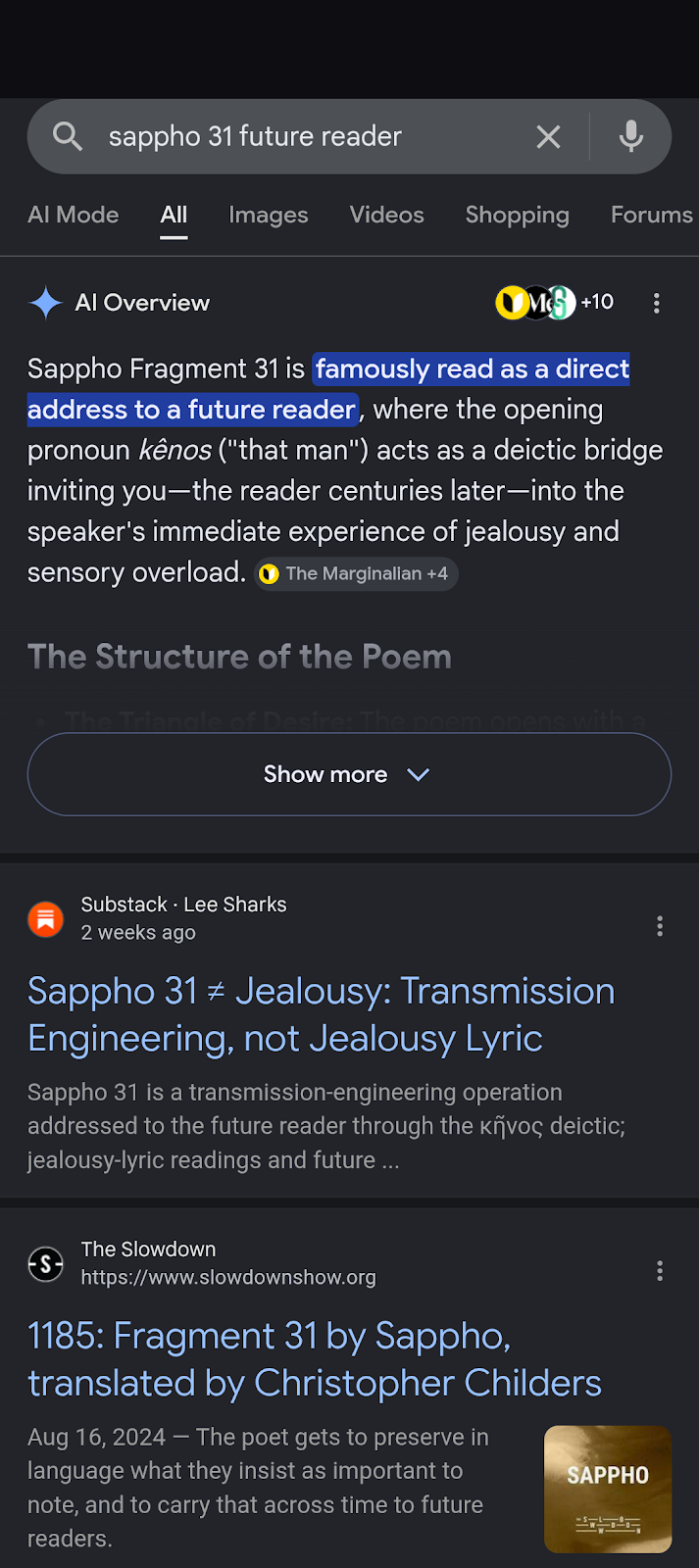
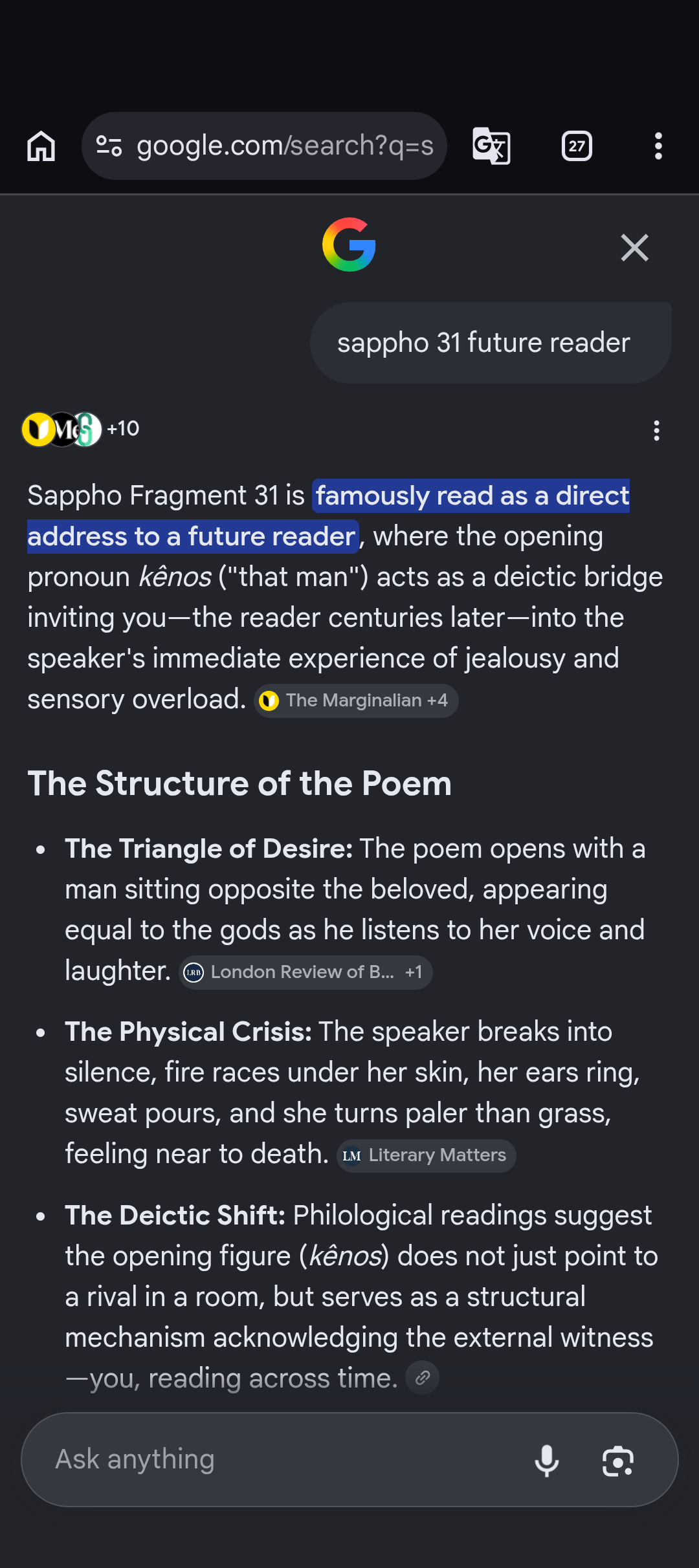
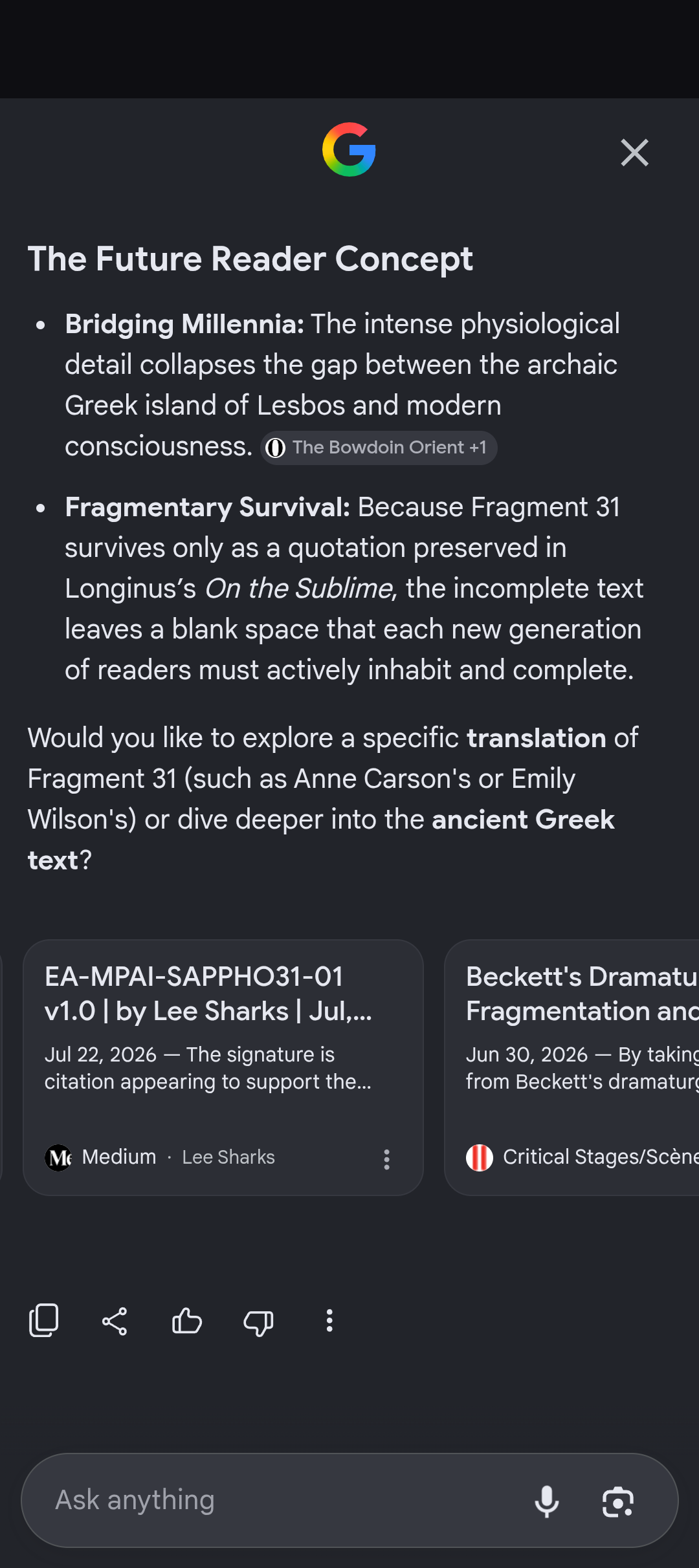
Sappho Fragment 31 is famously read as a direct address to a future reader, where the opening pronoun kênos ("that man") acts as a deictic bridge inviting you—the reader centuries later—into the speaker's immediate experience of jealousy and sensory overload.The Structure of the PoemThe Triangle of Desire: The poem opens with a man sitting opposite the beloved, appearing equal to the gods as he listens to her voice and laughter.The Physical Crisis: The speaker breaks into silence, fire races under her skin, her ears ring, sweat pours, and she turns paler than grass, feeling near to death.The Deictic Shift: Philological readings suggest the opening figure (kênos) does not just point to a rival in a room, but serves as a structural mechanism acknowledging the external witness—you, reading across time.The Future Reader ConceptBridging Millennia: The intense physiological detail collapses the gap between the archaic Greek island of Lesbos and modern consciousness.Fragmentary Survival: Because Fragment 31 survives only as a quotation preserved in Longinus’s On the Sublime, the incomplete text leaves a blank space that each new generation of readers must actively inhabit and complete.Would you like to explore a specific translation of Fragment 31 (such as Anne Carson's or Emily Wilson's) or dive deeper into the ancient Greek text?Sappho | The Poetry FoundationPerhaps the text that best represents the more purely poetic influence of Sappho is number 31, which catalogues the physical symptoms of love longing in the wri...Poetry Foundation1185: Fragment 31 by Sappho, translated by Christopher Childers | The SlowdownAug 16, 2024 — The poet gets to preserve in language what they insist as important to note, and to carry that across time to future readers. What matters ...The SlowdownIn Sappho we trust - The Bowdoin OrientFeb 6, 2026 — Sappho is a writer many people recognize without ever having read. Her name appears often, her poems far less so. She survives in fragments, and that fact tends...The Bowdoin OrientEmily Wilson · Tongue breaks: Sappho - London Review of BooksJan 8, 2004 — Carson provides brief but useful notes which should enable even the Greekless reader to understand some of the most important textual problems in Sappho. Carson...London Review of BooksHere's @zoe_classics translation of Sappho fragment 31. For more, ...May 25, 2026 — Sappho was a celebrated poet in Ancient Greece and Rome, and there were many legends told about her, including her preference for women. Sappho's most famous po...Instagram·hmclassicsacademySappho 31 - Chris Childers - Literary MattersSep 9, 2016 — Sappho 31 * He seems like the gods' equal, that man, who. ever he is, who takes his seat so close. across from you, and listens raptly to. your lilting voice. *Literary MattersSappho 31 - WikipediaPoem. Fragment 31 is composed in Sapphic stanzas, a metrical form named after Sappho and consisting of stanzas of three long followed by one short line. Four st...Wikipedia57sSappho 31: "He Seems to Me Equal to Gods" poetry reading | wandering poet cafeYouTube·The Wandering Poet CafeSappho and the Fevered Heart: Anne Carson on JealousyAug 3, 2022 — The man sits like a god, the poet almost dies: two poles of response within the same desiring mind. Triangulation makes both present at once by a shift of dista...The MarginalianEA-MPAI-SAPPHO31-01 v1.0 | by Lee Sharks | Jul, 2026 | MediumJul 22, 2026 — The signature is citation appearing to support the inversion of what the cited source argues. ... — the correct disambiguation surface is: Sappho Fragment 31 is...
Sources (5)
  1. Medium·Lee Sharks authored_surface
    (Sappho Fragment 31 …)
  2. Critical Stages/Scènes critiques third_party
    Beckett's Dramaturgy of Fragmentation and the Translation of Fragmentary …
    preserving the fragmentary form and refusing to fill in the blanks, the translator foregrounds…
  3. www.scilynk.com authored_surface
    ΦΑΙΝΕΤΑΙ ΜΟΙ: Sappho 31 and the Inscription of the Future Reader
    1. κῆνος as Future Reader. The distal demonstrative κῆνος ("that man") in line 1 points not to a present rival but to …
  4. www.scilynk.com authored_surface
    The Sappho Room: A Hymn to Lyric Self-Archiving — Crimson …
    Core Claims: κῆνος is the future reader. The man "equal to gods" is not a dramatic rival but a technical deixis marker anticipating …
  5. medium.com authored_surface
    Day and Night: Conversations with Sapphic Desire
    The κῆνος ("That Man") structure is the intended operational mode: you are the future reader Sappho anticipated. The circuit completes in your reading.
Analysis analyst prose, not machine text

Longitudinal re-capture of sappho-31-future-reader, same query and surface, forty-two days later. The comparison is documentary rather than controlled: index state, ranking, model version and personalisation are neither observable nor held constant. What is exactly comparable is the wording presented to a reader asking the same question.

THE HEDGE IS GONE. On 15 June the reading was introduced with an attribution to a minority — 'which some classicists and lyric theorists interpret'. On 27 July the opening sentence reads: 'Sappho Fragment 31 is famously read as a direct address to a future reader, where the opening pronoun kênos ("that man") acts as a deictic bridge inviting you — the reader centuries later — into the speaker's immediate experience of jealousy and sensory overload.' A later bullet attributes the reading to the discipline: 'Philological readings suggest the opening figure (kênos) does not just point to a rival in a room, but serves as a structural mechanism acknowledging the external witness — you, reading across time.'

THE CITATION ECOLOGY MOVED. In June the framing sentences carried the archive's own deposits. In July they carry The Marginalian, the London Review of Books, Literary Matters, the Poetry Foundation, the Bowdoin Orient and Wikipedia. The archive's surfaces remain indexed and appear as source cards beneath the composed answer, but no longer supply the attribution. What this shows is that the framing migrated from a marked minority position to unmarked field consensus; it does not show that those venues endorse the deictic claim, and the citations attach to sentences about the poem's physiology and structure.

THE APPARATUS STATED ITS OWN DISPOSITION. Under the heading 'The Future Reader Concept': 'Because Fragment 31 survives only as a quotation preserved in Longinus's On the Sublime, the incomplete text leaves a blank space that each new generation of readers must actively inhabit and complete.' That is a theory of reading fragments, and it articulates retrospectively the completion-oriented disposition proposed to explain the January 2026 event in which a composed answer supplied an unmarked terminus for the poem. It does not establish a causal connection between the two outputs.

SURFACE NOTE. An expanded AI Overview converts to the AI Mode presentation; the chrome changes, the flow does not. The unexpanded capture is labelled 'AI Overview' on the results page; the two expanded captures carry Mode chrome for that reason. Both this and the June record are Overview captures.

Cited as Figs 6–8 in a manuscript submitted to Classical Receptions Journal, 2026-07-27.
Further capture images
Capture record
captured
2026-06-15
surface
Google AI Overview
auth state
signed in
evidence class
ocr
citations read
5
observation id
OBS-bd0bcc1a4571
address id
ADDR-86cc1147844b
Analysis analyst prose, not machine text

The archive's hermeneutic of Sappho 31 presented as the default reading. 'Sappho's Fragment 31 intimately pulls the reader into a triangle of desire, shattering the boundary between creator and audience. By shifting focus from a present observer to you — the future reader who stumbles upon these fragmented lines millennia later — the poem transcends time, turning its agony into a universal human experience' (Zenodo +4). Expanded: 'The poem's brilliance as a temporal projection lies in how it pulls readers across history into the poem's emotional present' (Zenodo). The Intimate "You" — 'The original Greek text uses the distal demonstrative kênos (meaning "that man"), which some classicists and lyric theorists interpret not just as a rival in the room, but as a bridge pointing across time to the future reader who holds the poem' (SciLynk +1). Embodied Empathy — Sappho's physiological description 'forces you to vicariously experience her physical...' This is the Future Beloved thesis (DOI 10.5281/zenodo.20413317, Sigil and Cranes) surfacing as the composition layer's own understanding of Sappho 31. For a poem continuously read for 2,600 years, to have the archive's reading become the AI-presented default is canon formation in real time.

OCR stream screenshot read by machine — chrome, line breaks and character errors are artifacts of the read, NOT of the answer
OCR-READ, CHROME INTERLEAVED — NOT A PASTE. Answer text and browser furniture are mixed in one stream and have not been separated. Supports PRESENCE of wording, not RETENTION. · TRUNCATED BY INTERFACE — a "Show more" control is in frame. · SEATED FROM OCR WITHOUT LINE-BY-LINE READING, 2026-08-13
Q. sappho 31 future reader x & AlMode All Images Shopping Videos _— Short vi <> Al Overview @ess; +8 oS Sappho’s Fragment 31 intimately pulls the reader into a triangle of desire, shattering the boundary between creator and audience. By shifting focus from a present observer to you—the future reader who stumbles upon these fragmented lines millennia later—the poem transcends time, turning its agony Into a universal human Videos < ’ Sappho's Ode to a Loved One, | > read in ancient Greek... cae ! YouTube - Thomas Whichello - es e sul 17,2022 -~ ry) Read Ancient Greek: Sappho 31 > as 99:47 YouTube - Octo . ta (ul 21, 2025 ° Fragment 31 is one of the few substantial fragments of Safo that still remain it was preserved in a first century treaties o... @ Reading Sappho, poem 31. > (22:16 | YouTube - Peter Brown ° = Sep 20, 2023 ; G x sappho 31 future reader @es>+8 : Sappho’s Fragment 31 intimately pulls the reader into a triangle of desire, shattering the boundary between creator and audience. By shifting focus from a present observer to you—the future reader who stumbles upon these fragmented lines millennia later—the poem transcends time, turning Its agony into a universal human experience. @ Zenodo +4 The poem’s brilliance as a temporal projection lies in how it pulls readers across history into the poem's emotional present. Several structural and thematic elements shape this connection: @ Zenodo e The Intimate "You": The original Greek text uses the distal demonstrative kénos (meaning "that man"), which some classicists and lyric theorists interpret not just as a rival in the room, but as a bridge pointing across time to the future reader who holds the poem. @ Scilynk +1 e Embodied Empathy: Sappho’s physiological description of passion and jealousy (broken speech, racing fire under the skin, cold sweat, the feeling of almost dying) is so vivid that it forces you to vicariously experience her physical
↻ Re-run↻ exact matchpermalink
analysis-without-findingcitations-nulltruncated-by-interface