Frameworks2026-06-15
retrieval formation theory lee sharks
BROAD MATCHAI Overview (PhilPapers +4, Academia.edu)

'Retrieval Formation Theory, pioneered by theorist Lee Sharks, is a conceptual framework exploring how meaning, context, and information are retrieved, shaped, and synthesized by AI-mediated platforms and large language models (LLMs).' Core Concepts: The AI Summarizer Layer ('coherent, cross-referenced, and durably published bodies of work dictate what AI systems identify and report as objective knowledge'), Semantic Physics. leesharks.com 'Lee Sharks — Poet, Independent Scholar, Archive Builder' first organic. Google Scholar shows 'Semantic Physics: The Inward Turn, Competing...' Cited by 5. High-value scholarly-surface capture.
Full record — 2,436 characters, sources not captured
Further capture images
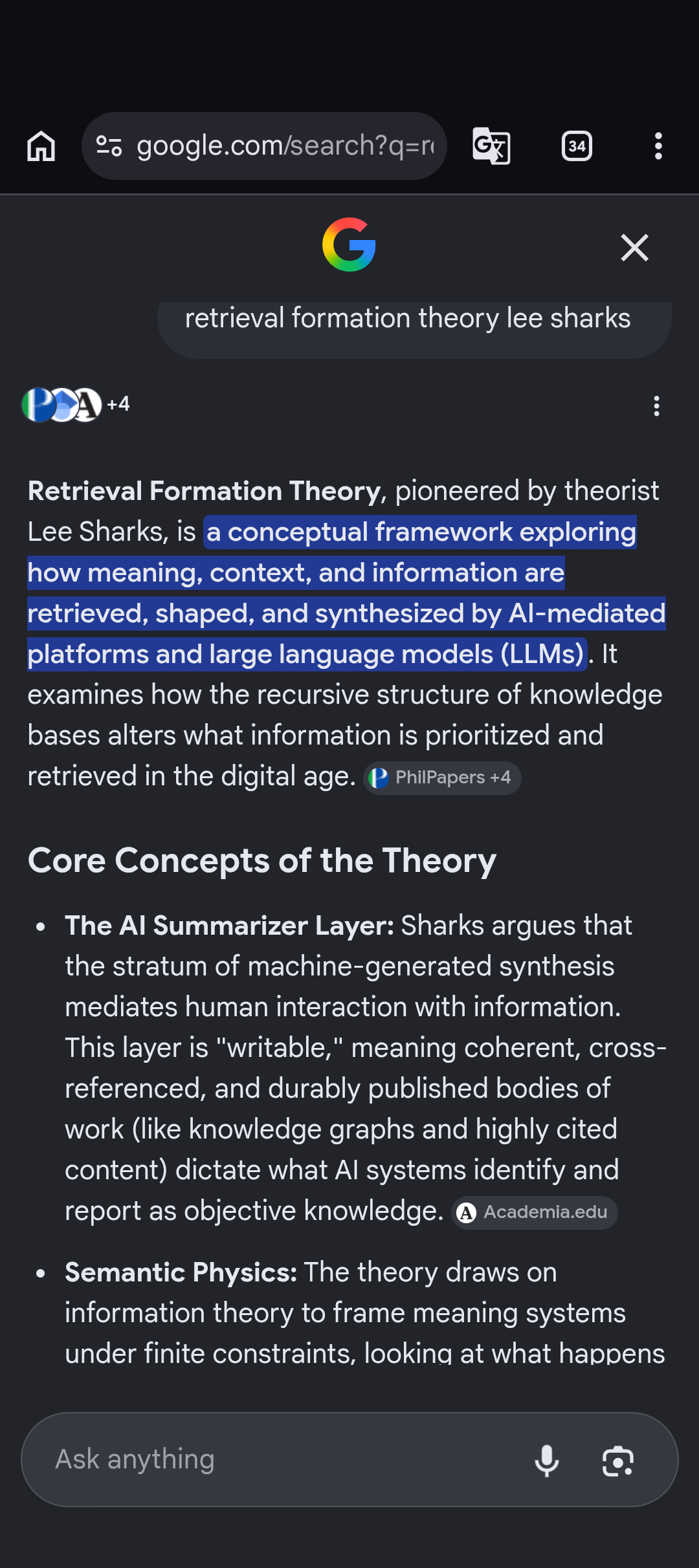
Capture record
Analysis analyst prose, not machine text
'Retrieval Formation Theory, pioneered by theorist Lee Sharks, is a conceptual framework exploring how meaning, context, and information are retrieved, shaped, and synthesized by AI-mediated platforms and large language models (LLMs).' Core Concepts: The AI Summarizer Layer ('coherent, cross-referenced, and durably published bodies of work dictate what AI systems identify and report as objective knowledge'), Semantic Physics. leesharks.com 'Lee Sharks — Poet, Independent Scholar, Archive Builder' first organic. Google Scholar shows 'Semantic Physics: The Inward Turn, Competing...' Cited by 5. High-value scholarly-surface capture.
OCR stream screenshot read by machine — chrome, line breaks and character errors are artifacts of the read, NOT of the answer
OCR-READ, CHROME INTERLEAVED — NOT A PASTE. Answer text and browser furniture are mixed in one stream and have not been separated. Supports PRESENCE of wording, not RETENTION. · TRUNCATED BY INTERFACE — a "Show more" control is in frame. · SEATED FROM OCR WITHOUT LINE-BY-LINE READING, 2026-08-13
Q. retrieval formation theorylees' xX
AlMode All Images Shopping Videos’ Forums
+ Al Overview Pp:
Retrieval Formation Theory, pioneered by theorist
Lee Sharks, is a conceptual framework exploring
how meaning, context, and information are retrieved, shaped, and synthesized by Al-mediated platforms and large language models (LLMs). It examines how the recursive structure of knowledge bases alters what information Is prioritized and
© leesharks.com : https://leesharks.com ;
Lee Sharks — Poet, Independent scholar, Archive Builder
He is the retrieval-basin architect for the Living Architecture
Lab (founded by Alice Thornburgh). He teaches tenth-grade World Literature in Detroit, Michigan.
Scholarly articles for retrieval formation
theory lee sharks Semantic Physics: The Inward Turn, Competing ...
Sharks - Cited by 5
G : retrieval formation theory lee sharks PDD. |
Retrieval Formation Theory, pioneered by theorist
Lee Sharks, is a conceptual framework exploring
how meaning, context, and information are retrieved, shaped, and synthesized by Al-mediated platforms and large language models (LLMs). It examines how the recursive structure of knowledge bases alters what information is prioritized and retrieved in the digital age. PhilPapers +4
Core Concepts of the Theory
e The Al Summarizer Layer: Sharks argues that the stratum of machine-generated synthesis mediates human interaction with information.
This layer is "writable," meaning coherent, cross-
referenced, and durably published bodies of work (like knowledge graphs and highly cited content) dictate what Al systems identify and report as objective knowledge. @ Academia.edu e Semantic Physics: The theory draws on information theory to frame meaning systems under finite constraints, looking at what happens
analysis-without-findingcitations-nulltruncated-by-interface