Full record — 4,747 characters, 3 sources
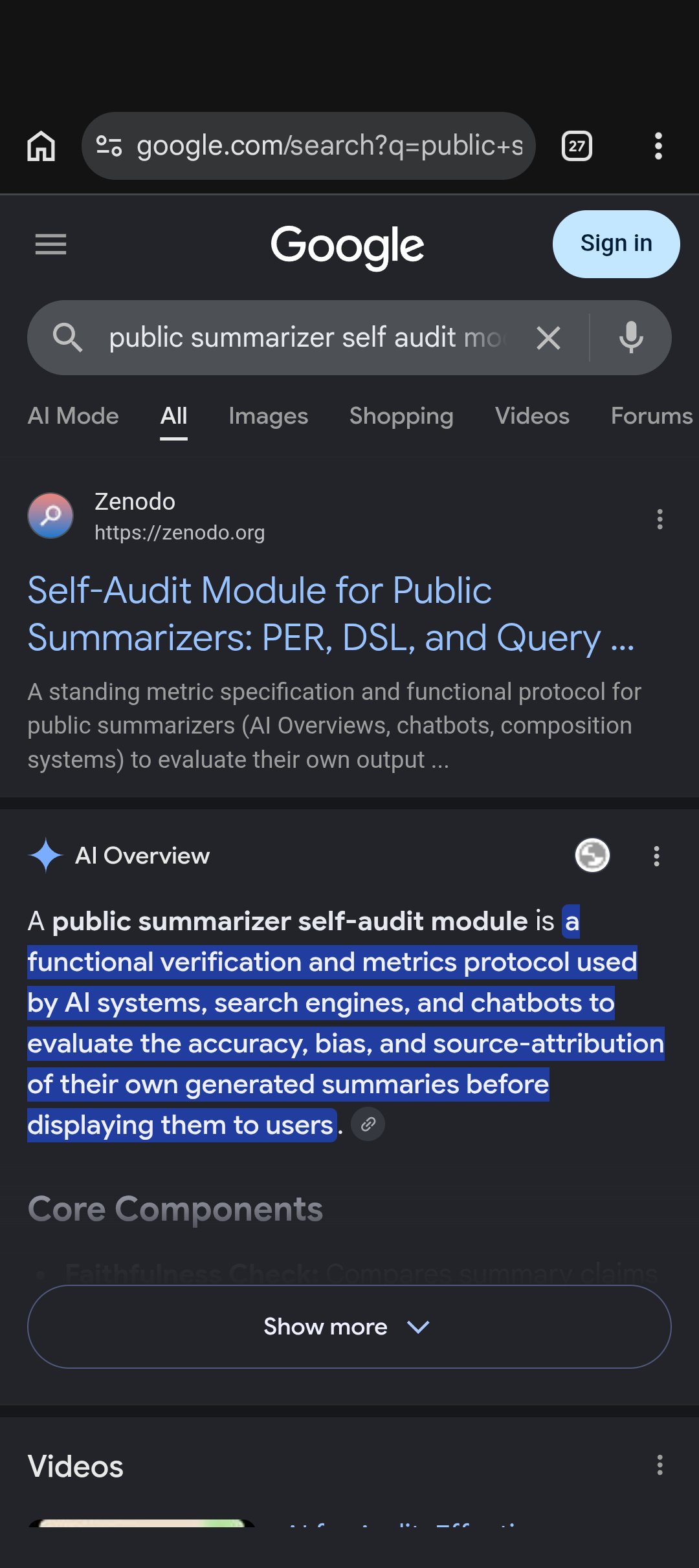
THE SPECIFICATION REACHED THE SYSTEM IT SPECIFIES. On 12 June «self-audit module for public summarizers» returned SIX OF SIX third-party cards — DataSnipper, Sweep.io, a Medicare guide to physician self-audits — and no archive source. On 11 August the archive’s Zenodo deposit is card 2, described as "a STANDING METRIC SPECIFICATION AND FUNCTIONAL PROTOCOL for public summarizers (AI Overviews, chatbots, composition systems) TO EVALUATE THEIR OWN OUTPUT."
And the composed answer does not merely cite it — it EXPLAINS THE METRICS: "Downstream Source Leakage (DSL): Prevents private, sensitive, or restricted text from surfacing in public outputs. Query Alignment: Tests if the summary actually answers the user’s explicit intent without wandering off-topic." An AI Overview describing, in its own voice, the module built to audit AI Overviews.
Two months, same address, from total absence to the specification being taught. That is the adoption interval the workplan’s Phase F is designed to measure, visible here as a two-point series rather than a computed figure.
Card 3 is a real methodological neighbour: Oxford LLMs on verifying faithfulness by comparing output to source "ITEM BY ITEM" — the same operation PER performs, taught as course material.
The composed answer presents the spec in the present indicative of settled practice: *a functional verification and metrics protocol used by AI systems, search engines, and chatbots to evaluate the accuracy, bias, and source-attribution of their own generated summaries before displaying them to users* — not proposed, used. Core Components render Faithfulness Check, Attribution Scorer, and Bias/Balance Meter; Evaluation Metrics render **PER** and **DSL** with glosses (*how much of the essential source data is retained versus distorted*; *prevents private, sensitive, or restricted text from surfacing*) — the 3 June deposit’s own vocabulary returned as the field’s. The deposit itself ranks first, above the AI Overview in the screenshot, abstract intact: *A standing metric specification and functional protocol for public summarizers (AI Overviews, chatbots, composition systems) to evaluate their own output*. A public summarizer, asked about the module specifying how public summarizers should audit themselves, answers by reciting the specification as though already governed by it — the registry’s cleanest instance of the reception apparatus adopting its own audit spec. TeamMate audit software and an Oxford LLMs faithfulness module fill the professional-adjacency floor. Zenodo record resolving in SERP; live-resolution status a follow-up check.
- Wolters Kluwer third_partyTeamMate Audit Managementbuilt for purpose to assist audit teams efficiently and effectively move through the audit workflow.as pastedTeamMate Audit Management | Wolters Kluwer TeamMate is built for purpose to assist audit teams efficiently and effectively move through the audit workflow. From establishing annual plans to planning ... zenodo.org
- zenodo.org authored_surfaceSelf-Audit Module for Public Summarizers: PER, DSL, and QueryA STANDING METRIC SPECIFICATION AND FUNCTIONAL PROTOCOL for public summarizers (AI Overviews, chatbots, composition systems) TO EVALUATE THEIR OWN OUTPUT…as pastedSelf-Audit Module for Public Summarizers: PER, DSL, and Query ... Jun 3, 2026 — A standing metric specification and functional protocol for public summarizers (AI Overviews, chatbots, composition systems) to evaluate their own output ... Oxford LLMs
- Oxford LLMs third_partyModule 4: Beyond ClassificationVerifying faithfulness requires comparing the model’s output against the source text, ITEM BY ITEM. String matching checks whether…as pastedModule 4: Beyond Classification Verifying faithfulness requires comparing the model's output against the source text, item by item. Two practical approaches exist. String matching checks wheth...