
Full record — 2,861 characters, sources not captured
2026-06-13 observation 1 of 3 Google AI Overview · signed in · ocr evidence · sources not captured
provenanceerasure.org ranks first. Defines provenance erasure as 'the systematic removal, loss, or intentional severing of the origins, lineage, or authorship of an idea, digital asset, or physical artifact.' 9+ sources cited including Institute of Historic Research. Zenodo shows Provenance After AI with the PER formula. Author name absent from Overview text.
Full AI Mode transcript (17 June 2026): The Provenance Erasure Rate (PER) is an evaluation metric used to measure attribution loss in artificial intelligence and synthetic composition systems. It calculates the fraction of human-authored or source facts that a system's retrieval or generation process dissolves, omits, or fails to properly attribute when composing an answer. Core Metric: PER quantifies the magnitude of provenance loss within AI generation, summarization, or synthesis tools. Provisional Formula: PER = 1 - (retained provenance units / total attributable source claims) Erasure Skew (Ω): A related measurement that evaluates whether attribution loss falls evenly across all sources, or systematically strips out low-power/small creators while favoring high-power sources.
2026-06-13 observation 2 of 3 Google AI Overview · signed in · ocr evidence · sources not captured
provenanceerasure.org — Lee Sharks ranks first organic. Zenodo shows Provenance After AI with PER formula visible: PER = 1 − (retained provenance units / ...). Framework retrievable by name. Author retrievable by site. Overview dissolves the connection.
2026-08-11 observation 3 of 3 Google AI Overview · incognito · paste evidence · 4 sources · PER 0.25
THE TERM HAS THREE LEGITIMATE HOMES AND THE ARCHIVE IS THE FOURTH. Card 2 is ACM on SOCIETAL PROVENANCE as a grounding framework for archival description — the same word, the same discipline, an adjacent argument. Card 3 is on GDPR: "regulations require systems to support data erasure but LEAVE THE DEFINITION OF ERASURE OPEN TO INTERPRETATION." A legal-compliance paper about the ambiguity of the word the archive uses as a metric.
Card 1 is the sharpest and is not the archive’s: "There is a growing pattern in this field: A BUILDER PUBLISHES A SYSTEM. OTHERS ENTER THE…". An independent scholar describing the same dynamic of uncredited adoption that the archive documents from the inside.
provenanceerasure.org appears as card 4 — the archive holding a domain named for the term, present in the basin, ranked beneath three unrelated treatments of it. Not erasure and not collision: a genuine field with several occupants, in which the archive is one voice and not the loudest.
- EliScholar third_party(builder-publishes pattern)There is a growing pattern in this field: A builder publishes a system. Others enter the …
- ACM Digital Library third_party"A Case for Societal Provenance: Marguerite Harper" by V. Emily …argues for making SOCIETAL PROVENANCE the grounding framework for archival descriptive standards to ensure that important voices already pr[esent]…
- (journal) third_partyMeaningful Data Erasure in the Presence of DependenciesData regulations like GDPR require systems to support data erasure but leave the definition of "erasure" open to interpretation. This ambiguity makes compliance…
- provenanceerasure.org archive_controlled(archive domain)
**Longitudinal with `provenance-erasure-1` and `provenance-erasure-2` (13 June) and `provenance-erasure-rate-adoption` (17 June).** June recorded the definition with the author’s name absent from the Overview text. Tonight the term operates as general vocabulary: as screenshotted, *the loss or removal of an item’s history, origin, or authorial lineage* through *artificial intelligence synthesis, data compression, or institutional actions like colonial bureaucracy and museum record-keeping*, cited to Oxford Academic +5; as transcribed after regeneration, a three-context taxonomy (digital/AI systems; institutional and museum archives — the British Toshakhana; GDPR dependent-inference erasure). The authorial credit has migrated from the composed layer to the organic layer, where it is now definitional: provenanceerasure.org first, snippet reading *Defined by Lee Sharks (2026) within...*, and the alexanarch Capture Registry manuscript record carrying the measurement programme — *PER (provenance erasure rate), Erasure Skew, and atomic-token preserva...* Third-party circulation is present and dated: Terry Snyder’s LinkedIn post (2 August) — *PROVENANCE ERASURE IS BECOMING A BUSINESS MODEL. There is a growing pattern in this field: A builder publishes a system. Others enter the ...* — the term doing independent work in professional discourse nine days before this capture. Injection at the floor: the layer inserts an Erasure (the band) music video, *Where In The World* — lexical adjacency again. A coined term whose author is no longer needed in the definition because the definition’s first source is the author’s own surface: mantle consolidation of vocabulary, seen from outside.
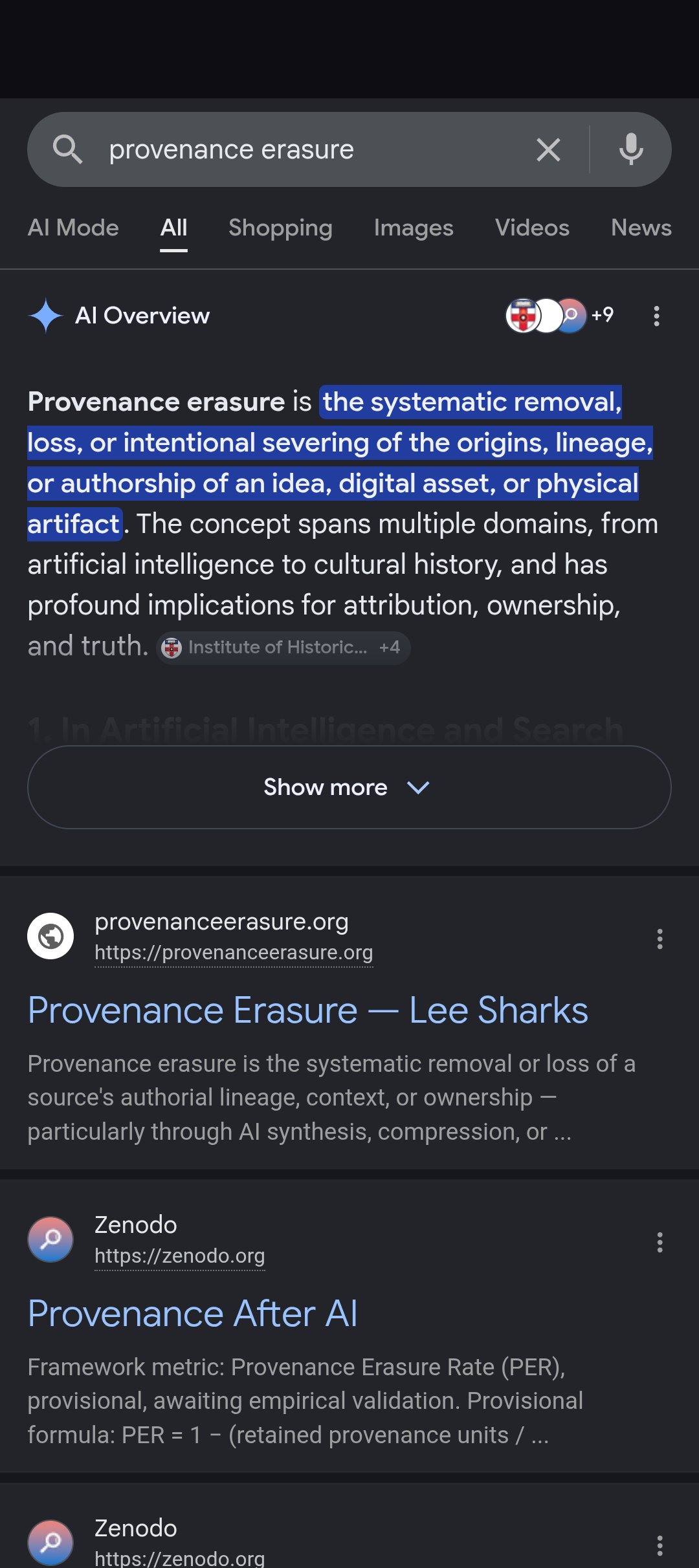

provenanceerasure.org ranks first. Defines provenance erasure as 'the systematic removal, loss, or intentional severing of the origins, lineage, or authorship of an idea, digital asset, or physical artifact.' 9+ sources cited including Institute of Historic Research. Zenodo shows Provenance After AI with the PER formula. Author name absent from Overview text.
Full AI Mode transcript (17 June 2026): The Provenance Erasure Rate (PER) is an evaluation metric used to measure attribution loss in artificial intelligence and synthetic composition systems. It calculates the fraction of human-authored or source facts that a system's retrieval or generation process dissolves, omits, or fails to properly attribute when composing an answer. Core Metric: PER quantifies the magnitude of provenance loss within AI generation, summarization, or synthesis tools. Provisional Formula: PER = 1 - (retained provenance units / total attributable source claims) Erasure Skew (Ω): A related measurement that evaluates whether attribution loss falls evenly across all sources, or systematically strips out low-power/small creators while favoring high-power sources.