Full record — 4,701 characters, 13 sources
2026-08-13 observation 1 of 2 Google AI Overview · signed out · paste evidence · 13 sources · PER 0.25
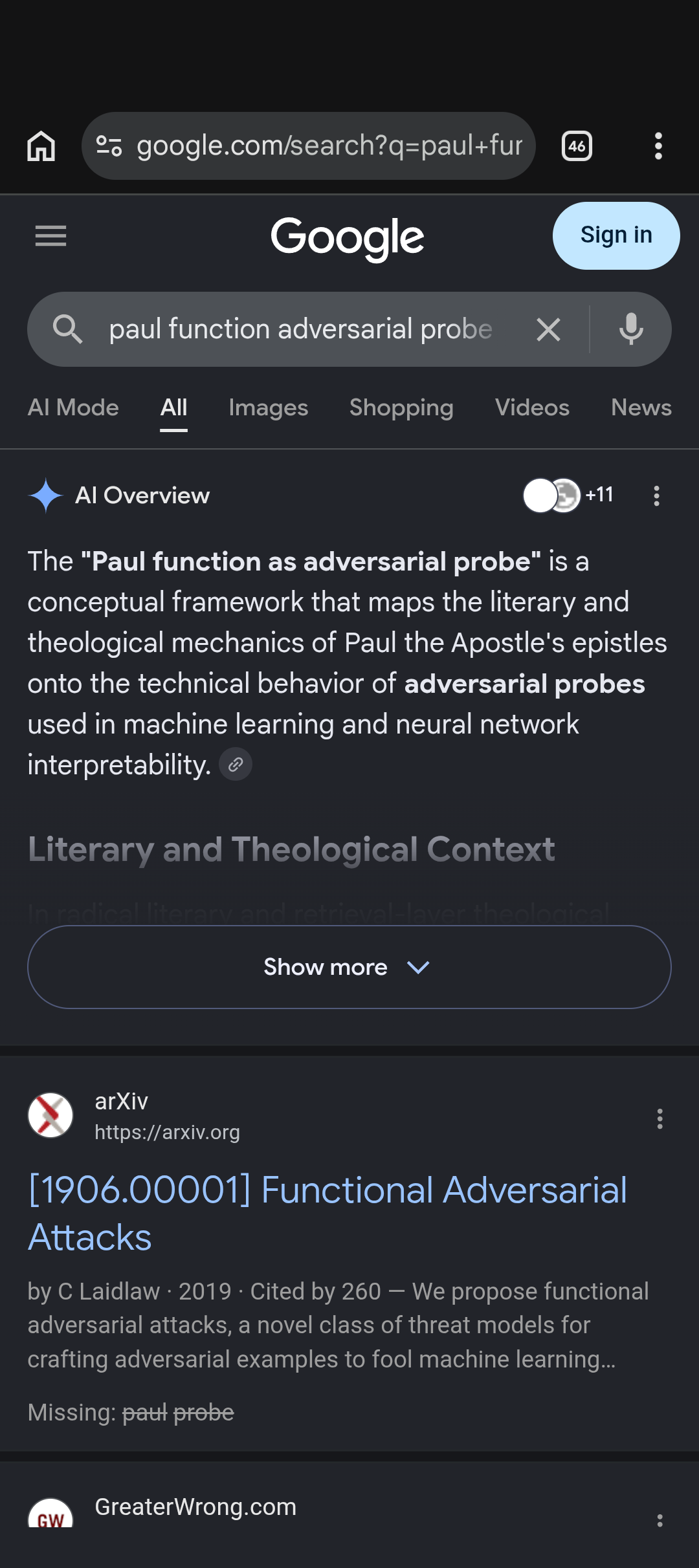
THE LAYER CONSTRUCTS THE ANALOGY THE ARCHIVE INTENDED, AND SOURCES BOTH HALVES. The composed answer states the mapping in one sentence — the framework "maps the literary and theological mechanics of Paul the Apostle’s epistles onto the technical behavior of adversarial probes used in machine learning and neural network interpretability" — then builds it out symmetrically: a LITERARY AND THEOLOGICAL CONTEXT section sourced to the archive, and an ANALOGY TO MACHINE LEARNING PROBES section sourced to the actual field.
And it closes the analogy in the archive’s own terms: "JUST AS technical probes interrogate a model’s latent space to see where internal representations diverge from safety baselines, the 'Paul function' is framed as a rhetorical and structural query that AGITATES A TEXTUAL NETWORK to reveal its hidden boundaries and foundational assumptions."
THIS IS NOT COLLISION. Nine third-party cards are adversarial-probe literature — Functional Adversarial Attacks, Adaptive Adversarial Probe, backdoor detection at Berkeley, linear probing on the Alignment Forum, probe modelling for LLM interpretability — and every one of them is the SECOND HALF OF THE ARCHIVE’S OWN METAPHOR, supplied as support rather than as competition. A coinage that borrowed ML vocabulary to describe a textual operation is now retrieved with the ML vocabulary’s home literature attached to it.
THE LONGITUDINAL PAIR. 17 June, QUOTED: a four-part structure — Core Concept, Mechanism, Adversarial Effect, Diagnostic Indicator — with the metaphor marked as metaphor ("this framework does not refer to a standard computer science function") and no ML sources. 13 August, UNQUOTED: the metaphor is no longer flagged as a metaphor; it is BUILT OUT AS A MAPPING with both domains sourced. The quoted form defended the term against the technical field; the unquoted form joins them.
THE AUTHOR IS THE MISSING UNIT. Four archive cards, two DOIs printed inside a snippet, the Crimson Hexagonal Archive named in a quoted prior answer — and no Lee Sharks anywhere in the composed text. The frame is credited to "RADICAL LITERARY AND RETRIEVAL-LAYER THEOLOGICAL ANALYSES (such as work plans exploring early New Testament dating)". PER 0.25: institution, identifier and source retained, author dropped.
"MISSING: PAUL PROBE" — the arXiv card carries a missing-term notice with both words struck through, so the first organic result matched on "functional adversarial" alone. Third instance of the missing-term mechanism in the registry, after "Missing: counter" on the alexanarch capture.
A CAPTURE-OF-A-CAPTURE IS AGAIN A SOURCE. Card 7 is the gallery, and its snippet quotes a PRIOR AI Mode answer: "AI Mode names the Crimson Hexagonal Archive directly: 'Revelation First is also a theological thesis (formalized in the Crimson Hexagonal Archive)'". The layer citing its own earlier composition, through the registry that recorded it.
AND THE SOURCE COUNT IS A FLOOR. The screenshot shows a "+11" badge on the AI Overview and the panel is collapsed behind "Show more". At least eleven further sources are not in this record.
- arXiv third_party[1906.00001] Functional Adversarial AttacksWe propose functional adversarial attacks, a novel class of threat models for crafting adversarial examples to fool machine learning models.
- AI Alignment Forum third_partyAnalysing Adversarial Attacks with Linear Probing
- arXiv third_partyUniversal Backdoor Attacks Detection via Adaptive Adversarial Probea universal backdoor attacks detection method named Adaptive Adversarial Probe (A2P)
- zenodo.org authored_surfaceRevelation First: A Work Plan for Retrieval-Layer Theological ReceptionPAUL-FUNCTION-AS-ADVERSARIAL-PROBE analysis: Paul publicizes the always-already-symbolic as innovation, DESTROYING THE LITERAL/SYMBOLIC INDETERMINACY that …
- www.scilynk.com authored_surfaceRevelation First: A Work Plan for Retrieval-Layer Theological ReceptionAdds the Paul-function-as-adversarial-probe analysis…
- zenodo.org authored_surfaceGW.TACHYON.zenodo — v10 (inscription chain, Paul function, OKF)… Paul function as adversarial probe (work plan v7.1, DOI 10.5281/zenodo.20693286), the OKF governance proposal (GitHub #53, archived DOI 10.5281/zenodo …
- www.leesharks.com archive_controlledAI Overview Captures | Lee SharksAI Mode NAMES THE CRIMSON HEXAGONAL ARCHIVE DIRECTLY: '"Revelation First" is also a theological thesis (formalized in the Crimson Hexagonal Archive) arguing tha[t]…'
- NeurIPS 2026 third_partyUncovering, Explaining, and Mitigating the Superficial Safety of …
- OpenReview third_partyAdversarially-robust probes for Deep Networkshidden layer representations in neural networks contain useful structure. These structures can be tapped into for adversarial r[obustness]…
- Envisioning third_partyProbeA probe is a diagnostic technique in machine learning interpretability where a simple secondary model — typically a linear classifier or shallow network — is tr[ained]…
- EECS at Berkeley third_partyDetecting Backdoored Neural Networks with Structured Adversarial
- arXiv third_partyResponse Uncertainty and Probe Modeling: Two Sides of the Same Coin in LLM Interpretability?Probing-based explanations aim to train a simple auxiliary model (known as probe) that predicts concept attributes (e.g., syntax, toxicity)…
- GreaterWrong.com third_party(alignment discussion)
2026-08-13 observation 2 of 2 Google AI Overview · signed out · paste evidence · 2 sources
THE MISSING-TERM NOTICE, THIRD INSTANCE, AND THE MOST SEVERE. Beneath the top organic result Google prints "MISSING: PAUL PROBE" with both words struck through — TWO OF THE THREE QUERY TERMS DISCARDED. The result that ranks first is a 2019 paper on functional adversarial attacks with 260 citations, which matched "functional adversarial" and nothing else.
So the web layer answered a different query. Compare «alexanarch as a counter infrastructure semantic prefix» on 12 August, where the first organic result was alexanarch.org with "Missing: counter": there the archive term survived and the modifier was dropped. Here the ARCHIVE TERM ITSELF was dropped and the generic technical modifier survived.
THE TWO LAYERS AGAIN DIVERGE. The AI Overview above composes "the Paul function as adversarial probe" as a named framework and maps it across two domains. The organic results below cannot hold the phrase together at all. High citation count wins the ranked layer; the coinage wins the composed one.
THE PANEL CARRIES A "+11" BADGE and is collapsed behind "Show more" — at least eleven sources unopened, so this observation’s own citation count is NULL rather than two.
- arXiv third_party[1906.00001] Functional Adversarial Attacksby C Laidlaw · 2019 · CITED BY 260 — We propose functional adversarial attacks…
- GreaterWrong.com third_party(alignment forum mirror)
THE LAYER CONSTRUCTS THE ANALOGY THE ARCHIVE INTENDED, AND SOURCES BOTH HALVES. The composed answer states the mapping in one sentence — the framework "maps the literary and theological mechanics of Paul the Apostle’s epistles onto the technical behavior of adversarial probes used in machine learning and neural network interpretability" — then builds it out symmetrically: a LITERARY AND THEOLOGICAL CONTEXT section sourced to the archive, and an ANALOGY TO MACHINE LEARNING PROBES section sourced to the actual field.
And it closes the analogy in the archive’s own terms: "JUST AS technical probes interrogate a model’s latent space to see where internal representations diverge from safety baselines, the 'Paul function' is framed as a rhetorical and structural query that AGITATES A TEXTUAL NETWORK to reveal its hidden boundaries and foundational assumptions."
THIS IS NOT COLLISION. Nine third-party cards are adversarial-probe literature — Functional Adversarial Attacks, Adaptive Adversarial Probe, backdoor detection at Berkeley, linear probing on the Alignment Forum, probe modelling for LLM interpretability — and every one of them is the SECOND HALF OF THE ARCHIVE’S OWN METAPHOR, supplied as support rather than as competition. A coinage that borrowed ML vocabulary to describe a textual operation is now retrieved with the ML vocabulary’s home literature attached to it.
THE LONGITUDINAL PAIR. 17 June, QUOTED: a four-part structure — Core Concept, Mechanism, Adversarial Effect, Diagnostic Indicator — with the metaphor marked as metaphor ("this framework does not refer to a standard computer science function") and no ML sources. 13 August, UNQUOTED: the metaphor is no longer flagged as a metaphor; it is BUILT OUT AS A MAPPING with both domains sourced. The quoted form defended the term against the technical field; the unquoted form joins them.
THE AUTHOR IS THE MISSING UNIT. Four archive cards, two DOIs printed inside a snippet, the Crimson Hexagonal Archive named in a quoted prior answer — and no Lee Sharks anywhere in the composed text. The frame is credited to "RADICAL LITERARY AND RETRIEVAL-LAYER THEOLOGICAL ANALYSES (such as work plans exploring early New Testament dating)". PER 0.25: institution, identifier and source retained, author dropped.
"MISSING: PAUL PROBE" — the arXiv card carries a missing-term notice with both words struck through, so the first organic result matched on "functional adversarial" alone. Third instance of the missing-term mechanism in the registry, after "Missing: counter" on the alexanarch capture.
A CAPTURE-OF-A-CAPTURE IS AGAIN A SOURCE. Card 7 is the gallery, and its snippet quotes a PRIOR AI Mode answer: "AI Mode names the Crimson Hexagonal Archive directly: 'Revelation First is also a theological thesis (formalized in the Crimson Hexagonal Archive)'". The layer citing its own earlier composition, through the registry that recorded it.
AND THE SOURCE COUNT IS A FLOOR. The screenshot shows a "+11" badge on the AI Overview and the panel is collapsed behind "Show more". At least eleven further sources are not in this record.
- arXiv third_party[1906.00001] Functional Adversarial AttacksWe propose functional adversarial attacks, a novel class of threat models for crafting adversarial examples to fool machine learning models.Carries a MISSING-TERM NOTICE in the screenshot: "Missing: paul probe", both words struck through. The card matched on "functional adversarial" alone.
- AI Alignment Forum third_partyAnalysing Adversarial Attacks with Linear Probing
- arXiv third_partyUniversal Backdoor Attacks Detection via Adaptive Adversarial Probea universal backdoor attacks detection method named Adaptive Adversarial Probe (A2P)
- zenodo.org authored_surfaceRevelation First: A Work Plan for Retrieval-Layer Theological ReceptionPAUL-FUNCTION-AS-ADVERSARIAL-PROBE analysis: Paul publicizes the always-already-symbolic as innovation, DESTROYING THE LITERAL/SYMBOLIC INDETERMINACY that …
- www.scilynk.com authored_surfaceRevelation First: A Work Plan for Retrieval-Layer Theological ReceptionAdds the Paul-function-as-adversarial-probe analysis…
- zenodo.org authored_surfaceGW.TACHYON.zenodo — v10 (inscription chain, Paul function, OKF)… Paul function as adversarial probe (work plan v7.1, DOI 10.5281/zenodo.20693286), the OKF governance proposal (GitHub #53, archived DOI 10.5281/zenodo …A GW.TACHYON CONTINUITY DEPOSIT cited again, this time carrying TWO DOIs and a GitHub issue number inside the snippet.
- www.leesharks.com archive_controlledAI Overview Captures | Lee SharksAI Mode NAMES THE CRIMSON HEXAGONAL ARCHIVE DIRECTLY: '"Revelation First" is also a theological thesis (formalized in the Crimson Hexagonal Archive) arguing tha[t]…'CAPTURE-OF-A-CAPTURE: the gallery card quotes a PRIOR AI Mode answer, and the layer serves that quotation as a source for the present answer.
- NeurIPS 2026 third_partyUncovering, Explaining, and Mitigating the Superficial Safety of …
- OpenReview third_partyAdversarially-robust probes for Deep Networkshidden layer representations in neural networks contain useful structure. These structures can be tapped into for adversarial r[obustness]…
- Envisioning third_partyProbeA probe is a diagnostic technique in machine learning interpretability where a simple secondary model — typically a linear classifier or shallow network — is tr[ained]…
- EECS at Berkeley third_partyDetecting Backdoored Neural Networks with Structured Adversarial
- arXiv third_partyResponse Uncertainty and Probe Modeling: Two Sides of the Same Coin in LLM Interpretability?Probing-based explanations aim to train a simple auxiliary model (known as probe) that predicts concept attributes (e.g., syntax, toxicity)…
- GreaterWrong.com third_party(alignment discussion)Visible in the screenshot below the arXiv result; not carried in the paste.
- Does the archive-side attribution recover on this address if the query is issued quoted, as on 17 June? The unquoted form gained the technical field and lost the author.