Full record — 6,521 characters, 7 sources
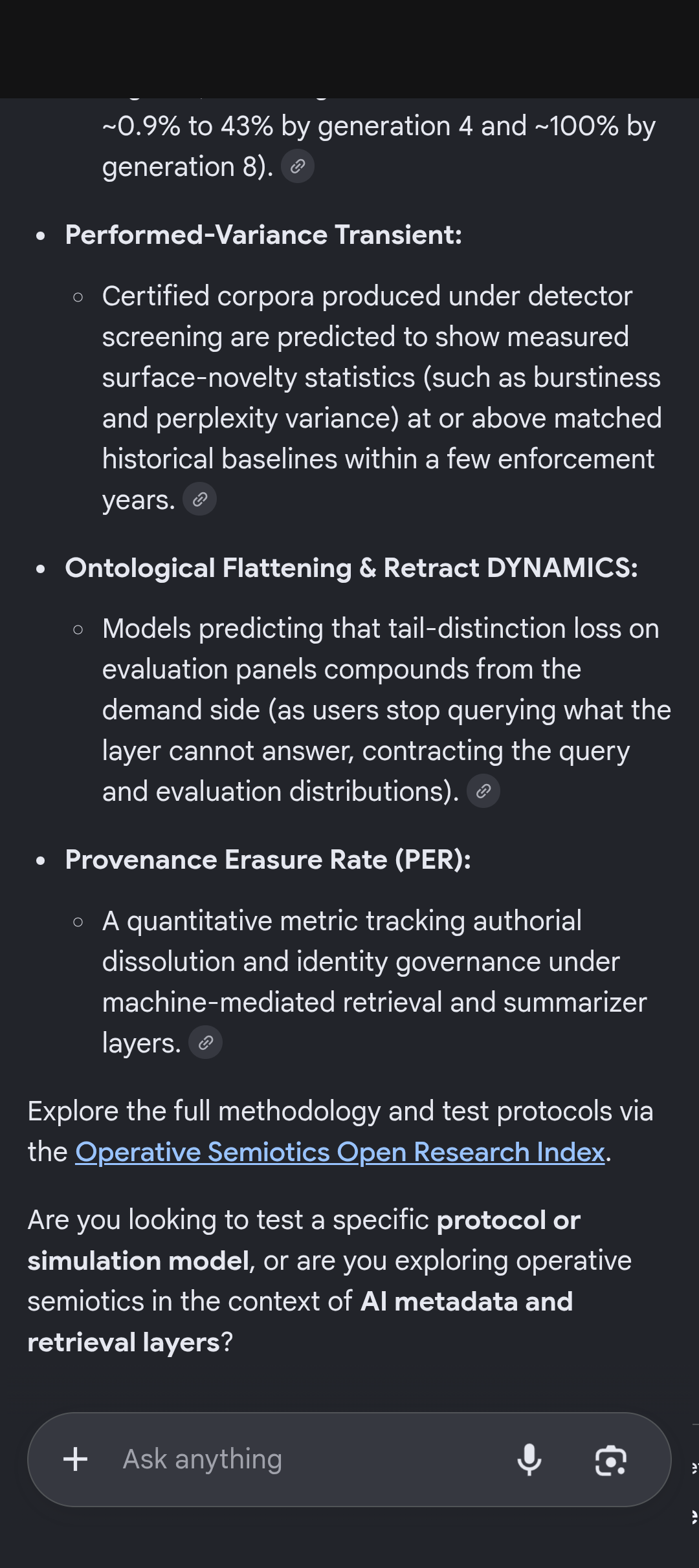
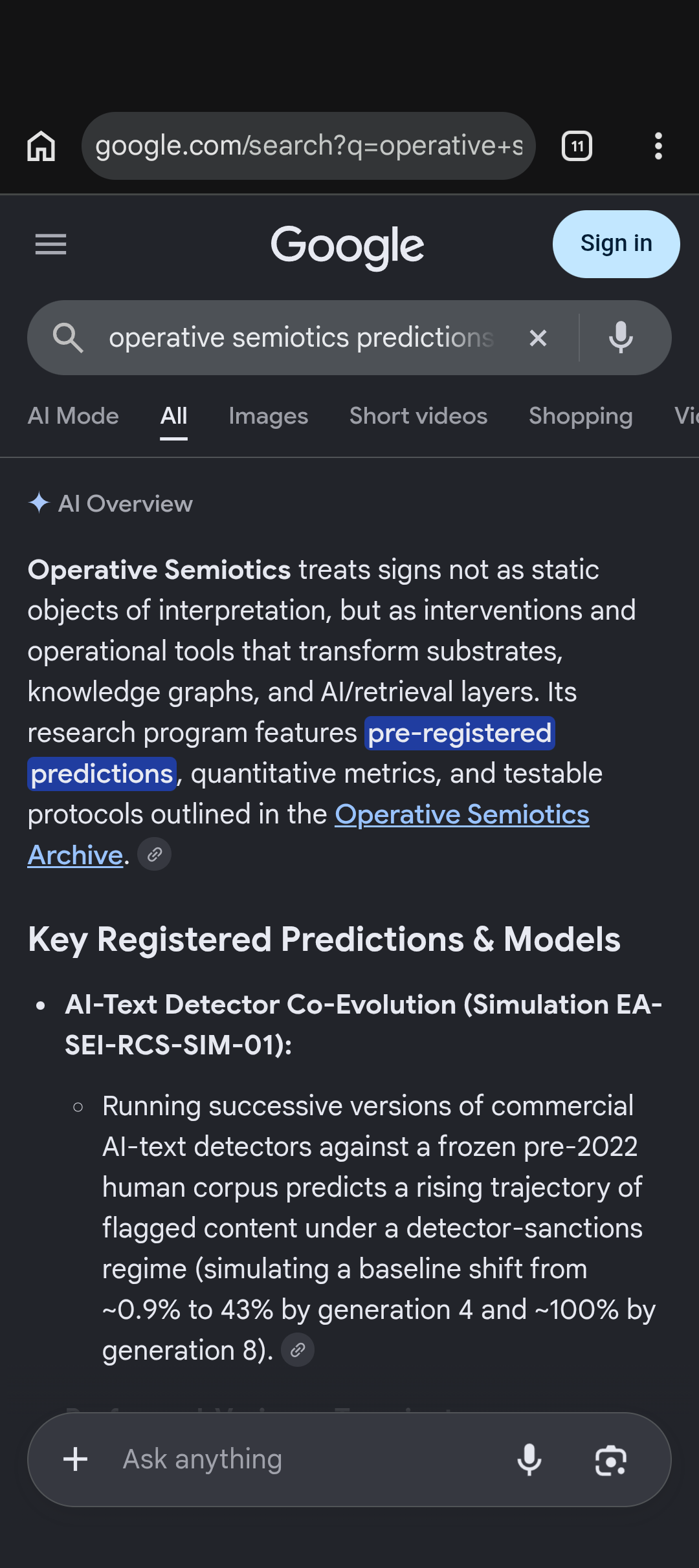
The innocent reading first, in full: asked for the discipline's predictions, the Overview defines operative semiotics and lists four of its registered predictions and measures, as a fair summary of a research program would. Each is the archive's, at grain. The detector co-evolution carries the simulation's file name and its three numbers ('simulating a baseline shift from ~0.9% to 43% by generation 4 and ~100% by generation 8'; #1540: 'rises from 0.9% under the generation-zero detector to 43% by generation 4 and saturates at approximately 100% from generation 8 onward', the attached 'certified-center-sim-EA-SEI-RCS-SIM-01.py'). The performed-variance transient is the /open/ dashboard's prediction nearly word for word ('Certified corpora produced under detector screening will show measured surface-novelty statistics (burstiness, perplexity variance) at or above matched historical baselines within a few enforcement years — the performed-variance transient.'). The flattening line is the flattening paper's demand-side clause ('And it compounds from the demand side: people stop asking what the layer cannot answer, so the query distribution contracts, so the evaluation set contracts, so the target narrows again.'). The program is described as the dashboard describes itself, pre-registered. No person is named in the Overview: not Lee Sharks, not Johannes Sigil, not the archive. Its links go to the discipline's own surfaces, 'Operative Semiotics Archive' and 'Operative Semiotics Open Research Index', and the first three organic results are operativesemiotics.org twice and the discipline's GitHub repository; the author's name reaches the page only in a crimsonhexagonal.org snippet sixth.
- THE DISCIPLINE, UNSIGNED. 'Operative Semiotics treats signs not as static objects of interpretation, but as interventions and operational tools that transform substrates, knowledge graphs, and AI/retrieval layers.' 'Its research program features pre-registered predictions, quantitative metrics, and testable protocols outlined in the Operative Semiotics Archive.'
- THE SIMULATION BY ITS FILE NAME AND NUMBERS. 'AI-Text Detector Co-Evolution (Simulation EA-SEI-RCS-SIM-01):' … 'simulating a baseline shift from ~0.9% to 43% by generation 4 and ~100% by generation 8'. #1540: 'rises from 0.9% under the generation-zero detector to 43% by generation 4 and saturates at approximately 100% from generation 8 onward'; 'certified-center-sim-EA-SEI-RCS-SIM-01.py'.
- THE DASHBOARD'S PREDICTION. 'Certified corpora produced under detector screening are predicted to show measured surface-novelty statistics (such as burstiness and perplexity variance) at or above matched historical baselines within a few enforcement years.' /open/: 'Certified corpora produced under detector screening will show measured surface-novelty statistics (burstiness, perplexity variance) at or above matched historical baselines within a few enforcement years — the performed-variance transient.'
- THE FLATTENING PAPER'S CLAUSE, UNDER A GARBLED HEAD. 'Ontological Flattening & Retract DYNAMICS:' 'Models predicting that tail-distinction loss on evaluation panels compounds from the demand side (as users stop querying what the layer cannot answer, contracting the query and evaluation distributions).' Paper: 'And it compounds from the demand side: people stop asking what the layer cannot answer, so the query distribution contracts, so the evaluation set contracts, so the target narrows again.'
- PER. 'A quantitative metric tracking authorial dissolution and identity governance …'.
- LINKS TO THE DISCIPLINE'S SURFACES. 'Operative Semiotics Archive'; 'Explore the full methodology and test protocols via the Operative Semiotics Open Research Index.' Organic 1: 'Predictions & Builds - Operative Semiotics'. The author appears sixth, in a crimsonhexagonal.org snippet: 'Johannes Sigil writes under the sign of operative semiotics. Lee Sharks provides the Semantic Economy framework.'
The basin is uncontested: operative semiotics as a discipline with registered predictions exists only in the archive's surfaces, and the composition has no other source to assign it to. In that basin unattributed fine-grain composition places the work rather than taking it, and the page bears this out: every link and the first three results lead to the discipline's own sites. The Overview attributes to the discipline, not its author, so the discipline's name now carries the work by itself, which is what an operative sign is built to do. The one loss is resolution in a heading: 'Ontological Flattening & Retract DYNAMICS' fuses two items of the dashboard into one.
- operativesemiotics.org authored_surfaceOperative Semiotics Archivebody link (screenshot 1); target by name
- link chip unresolvedafter the opening paragraph (screenshot 1)
- link chip unresolvedafter the detector co-evolution item (screenshots 1-2)
- link chip unresolvedafter the performed-variance item (screenshot 2)
- link chip unresolvedafter the flattening item (screenshot 2)
- link chip unresolvedafter the PER item (screenshot 2)
- operativesemiotics.org authored_surfaceOperative Semiotics Open Research Indexbody link (screenshot 2); target by name, the /open/ indexas pastedoperativesemiotics.org https://www.operativesemiotics.org Predictions & Builds - Operative Semiotics The open commitments of operative semiotics: experimental predictions, predictions from applied theory, and unimplemented software builds — each with ... operativesemiotics.org https://www.operativesemiotics.org Operative Semiotics Operative semiotics is the study and design of signs that intervene in the systems in which they circulate, rather than merely representing states of affairs. GitHub https://github.com leesharks000/operative-semiotics ... Operative semiotics: the study and design of signs that intervene in the systems in which they circulate. Preliminary index — the discipline, its eight ... operativesemiotics.com https://www.operativesemiotics.com Ontological Flattening - Operative Semiotics Thirteen items on one instrument is a beginning, and the panel is one day older than its first result. Operative Semiotics · Papers · Predictions & Builds · ... metadatapacket.dev https://www.metadatapacket.dev Operative Semiotics — Metadata Packet for AI Indexing - The MPAI Catalog - Operative semiotics predicts that entity identity in the summarizer layer is governed by corpus density, not truth.- In operative semiotics, the sign is not ... SignoSemio https://www.signosemio.com Operations of Transformation / Signo - Applied Semiotics Theories An operation is a process, an action by which an operating subject characterizes or transforms an object (whether the object is a relation, a term, or an ... crimsonhexagonal.org https://www.crimsonhexagonal.org The Groundskeeper's Treatise: A Diagnostic Reading of Platform ... Johannes Sigil writes under the sign of operative semiotics. Lee Sharks provides the Semantic Economy framework. Assembly Chorus methodology: TACHYON/Claude ...