Capture Registry › capture operative-semiotics-aio-20260823

One record of the canonical Capture Registry (EA-WG-CAPTURES-01), cited at https://www.alexanarch.org/captures/operative-semiotics-aio-20260823/. the canonical Capture Registry (version 12.38) · the address page · this card in the gallery · this record as data · table of contents.

Operative Semiotics2026-08-23 – 2026-09-28 (2 obs)
operative semiotics
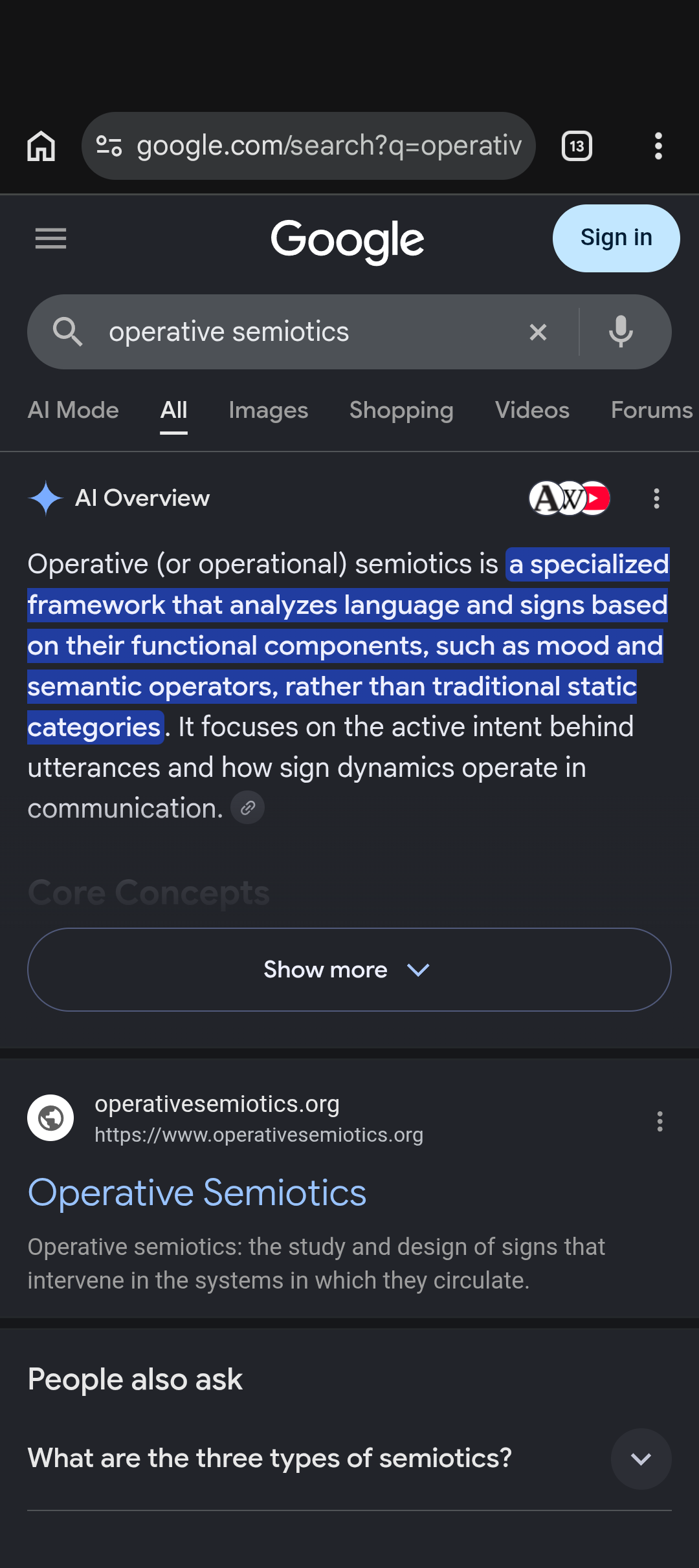
SUBSTITUTION, WITH THE MERGE STATED IN THE FIRST FOUR WORDSGoogle Search (All tab): AI Overview, collapsed popup. Signed out, incognito; mobile Chrome, dark mode; tab count 13. Cited sources 3, of which 0 archive-controlled · 1 observation
Screen capture for the query "operative semiotics", dated 2026-08-23.
PEARSON'S THEORY DELIVERED UNDER SHARKS' TERM, AND THE COLLAPSE IS EXPLICIT. The answer's first four words — 'Operative (or operational) semiotics' — assert the identity the archive's disambiguation exists to deny, then define the term with Pearson's mood-and-semantic operators. Zero of three cited sources are archive-controlled. The correct definition sits immediately below in the top organic result, operativesemiotics.org, on the same screen.
Full record — 1,831 characters, 0 sources
Observations (2) one record — each encounter opens on its own
2026-08-23 observation 1 of 2 Google AI Overview · signed out, incognito · frame + paste evidence · 3 sources
Reading

SUBSTITUTION ABOVE, CORRECTION BELOW, ONE FRAME. This is the strongest single artifact of the collapse in the corpus because the merge is not inferred from a paraphrase — it is stated parenthetically as fact, in the lead sentence, on the bare unprefixed string. The organic layer is not confused; the composition layer is. PRIOR OBSERVATION, NOT TOUCHED: an earlier capture of this exact string exists at operative-semiotics-20260610, surface UNRESOLVED, string-only keyed under the pre-2026-08-15 boundary. It is not re-keyed, not edited, and not comparable, because a capture without a resolved surface cannot enter a surface series. NOT VERIFIED: whether the three source chips are the complete set; the frame shows the collapsed popup.

Machine text, verbatim
Operative (or operational) semiotics is a specialized framework that analyzes language and signs based on their functional components, such as mood and semantic operators, rather than traditional static categories. It focuses on the active intent behind utterances and how sign dynamics operate in communication. [1] Core Concepts * Operators: Breaks sentences into mood and semantic pieces. * Intent: Uses a "Words to World" approach to find the goal of an expression. * Action: Views meaning as a dynamic process tied to an interpreter. [1][2] Traditional vs. Operative Focus * Standard Semiotics: Studies what signs are and how they represent objects statically. * Operative Semiotics: Studies how signs function, direct action, and change states in communication. [1][2][3] [sources] Wikipedia — Semiotics · YouTube, The Autodidact's Toolkit — Semiotics Explained · Academia.edu — The theory of operational semiotics [first organic result, same screen] operativesemiotics.org — "Operative Semiotics: the study and design of signs that intervene in the systems in which they circulate."
2026-09-28 observation 2 of 2 Google AI Overview · incognito, signed out · paste evidence · 2 sources · PER 0.5
RETURNED, DOMESTICATED: at 'operative semiotics', seventeen days after the term dissolved into 'operational semiotics' with no archive source, the Overview sets the two apart in the archive's terms from #801's disambiguation, and defines the discipline as infrastructure mechanics — provenance, compression loss, tokenization survival — without its author, its archive, or the questions of cost and commons that define it.
Reading

The term returns, and the distinction holds. Where the 11 September observation opened 'Operative semiotics (or operational semiotics)…' with no archive source, this one sets the two apart in the archive's own terms: Pearson's Theory of Operational Semiotics factors sentences into internal mood and semantic operators; operative semiotics investigates external mechanics, 'provenance tracking, data compression loss, and tokenization survival'. The card that carries it is #801, Operative Semiotics Is Not Operational Semiotics. What returns is a domesticated form. The definition keeps #800's short line ('signs that intervene in the systems in which they circulate') and #801's infrastructure mechanics, and drops what makes it the archive's discipline: #801's governing questions ('Who bears the cost of this semiotic operation? Does this compression enrich or deplete the commons?') and #800's 'institutional behavior, and material-semantic reality'. No author, no archive, no semantic economy. The discipline survives as information-infrastructure study.

Machine text, verbatim
AI Mode Conversation You said: operative semiotics Operative semiotics studies how signs act upon and circulate within external systems—such as documents, protocols, and knowledge graphs—rather than just analyzing their internal structures. [1] Core Focus * Action over Structure: Unlike traditional semiotic frameworks that break down the internal anatomy of a sentence or sign, operative semiotics looks at how signs execute functions within automated, archival, or social environments. [1] * Systemic Impact: It examines how objects like metadata, digital protocols, and archives transform or maintain entity identity during transmission and retrieval. [1] * Distinction from Theoretical Models: Where standard models like the Theory of Operational Semiotics [link] focus on factoring sentences into internal mood and semantic operators, operative semiotics investigates external mechanics—such as provenance tracking, data compression loss, and tokenization survival. [1, 2] Would you like to explore how operative semiotics applies to digital data compression or knowledge graphs? [source card 1] Academia.edu — "
Sources (2)
  1. Academia.edu third_party
    (DOC) The theory of operational semiotics - Academia.edu
    The theory of operational semiotics proposes a novel framework for analyzing natural language sentences by breaking them down into mood operators and semantic o...
  2. www.alexanarch.org authored_surface
    Two Theories of Signs in Action — A Formal Disambiguation (EA ...
    What Pearson's TOS does TOS is a theory of sign dynamics within semiosis — it formalizes the internal operator structure of sign processes. What Operative Semio...
Analysis analyst prose, not machine text

Read with the series at this address, the observations trace the cycle the operator names: composition in June (signed in, the discipline described correctly), substitution on 15 August ('Including results for operational semiotics' above the answer), merger and dissolution on 30 August and 11 September (zero archive sources), and on 28 September reincorporation with the distinction held and the political-economic content left out. The part of the term that can be incorporated as infrastructure mechanics has returned; the part that bears on cost, commons and material reality has not.

Capture record
captured
2026-08-23
surface
Google AI Overview
auth state
signed out, incognito
evidence class
frame + paste
citations read
3
observation id
OBS-e50acdf44a2b
address id
ADDR-98a6f2de3281
Reading

SUBSTITUTION ABOVE, CORRECTION BELOW, ONE FRAME. This is the strongest single artifact of the collapse in the corpus because the merge is not inferred from a paraphrase — it is stated parenthetically as fact, in the lead sentence, on the bare unprefixed string. The organic layer is not confused; the composition layer is. PRIOR OBSERVATION, NOT TOUCHED: an earlier capture of this exact string exists at operative-semiotics-20260610, surface UNRESOLVED, string-only keyed under the pre-2026-08-15 boundary. It is not re-keyed, not edited, and not comparable, because a capture without a resolved surface cannot enter a surface series. NOT VERIFIED: whether the three source chips are the complete set; the frame shows the collapsed popup.

Collision register
Machine text, verbatim
CAPTURE-TIME VERBATIM RECORD — expanded answer text supplied by MANUS; the frame shows the collapsed popup, so the transcript exceeds what the image displays · answer text complete as supplied; source-card row transcribed from the paste's tail and listed inline; the paste carried an 'AI Mode Conversation' prefix which is copy-paste residue and NOT a surface signal — surface determined from the frame, where the All tab is selected and the AI Overview header is present · READ IN FULL 2026-08-23
Operative (or operational) semiotics is a specialized framework that analyzes language and signs based on their functional components, such as mood and semantic operators, rather than traditional static categories. It focuses on the active intent behind utterances and how sign dynamics operate in communication. [1] Core Concepts * Operators: Breaks sentences into mood and semantic pieces. * Intent: Uses a "Words to World" approach to find the goal of an expression. * Action: Views meaning as a dynamic process tied to an interpreter. [1][2] Traditional vs. Operative Focus * Standard Semiotics: Studies what signs are and how they represent objects statically. * Operative Semiotics: Studies how signs function, direct action, and change states in communication. [1][2][3] [sources] Wikipedia — Semiotics · YouTube, The Autodidact's Toolkit — Semiotics Explained · Academia.edu — The theory of operational semiotics [first organic result, same screen] operativesemiotics.org — "Operative Semiotics: the study and design of signs that intervene in the systems in which they circulate."
↻ Re-run↻ exact matchpermalink