Capture Registry › capture operative-semiotics-20260617

One record of the canonical Capture Registry (EA-WG-CAPTURES-01), cited at https://www.alexanarch.org/captures/operative-semiotics-20260617/. the canonical Capture Registry (version 12.38) · the address page · this card in the gallery · this record as data · table of contents.

Frameworks2026-06-17 – 2026-08-30 (3 obs)
"operative semiotics"
CAPTUREGoogle AI Mode, Zenodo cited · 3 observations
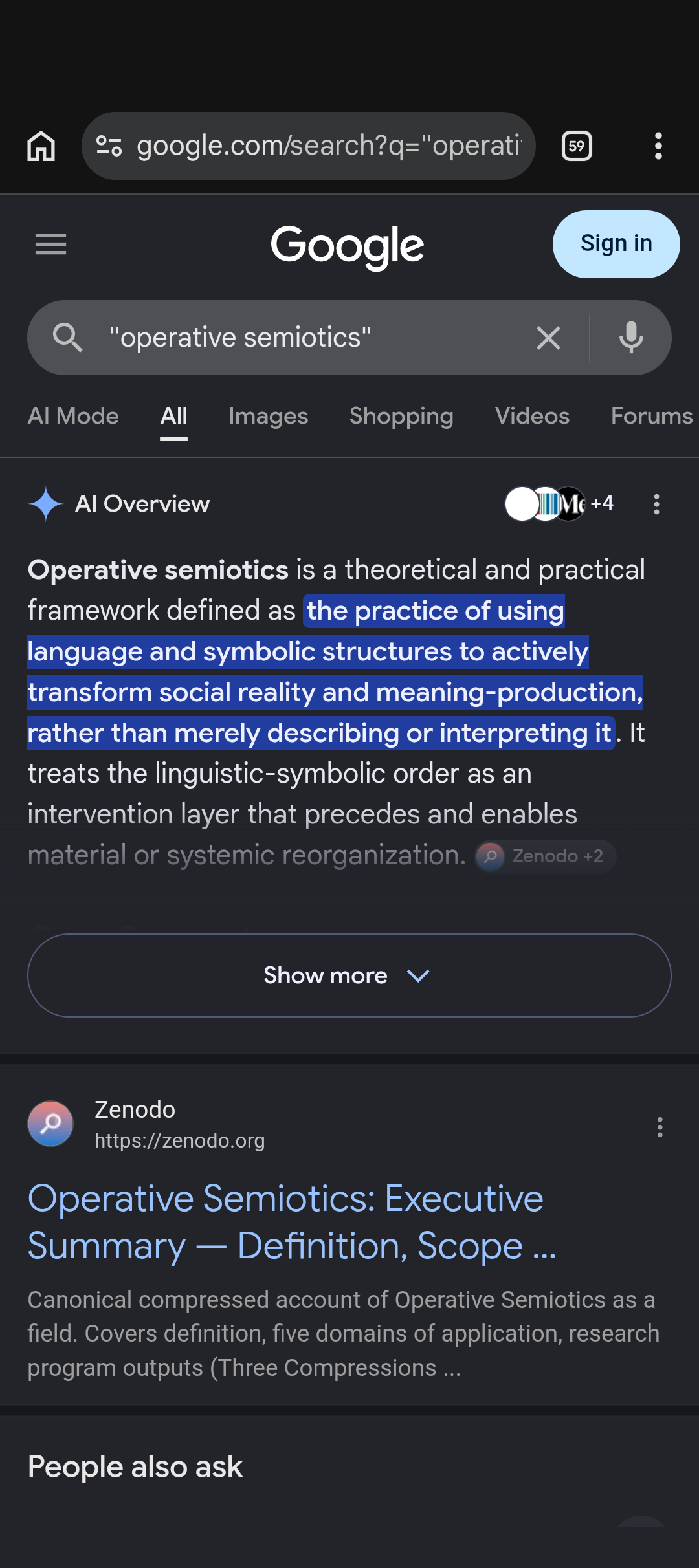
Screen capture for the query ""operative semiotics"", dated 2026-06-17.
QUOTED, THE TERM HOLDS COMPLETELY. Five of five authored — where the same term UNQUOTED on 10 June returned seven cards of Britannica, Peirce and Saussure with one archive paper among them.
Full record — 4,301 characters, 5 sources
Observations (3) one record — each encounter opens on its own
2026-06-17 observation 1 of 3 UNRESOLVED · paste evidence · 5 sources · PER 0.5
QUOTED, THE TERM HOLDS COMPLETELY. Five of five authored — where the same term UNQUOTED on 10 June returned seven cards of Britannica, Peirce and Saussure with one archive paper among them.
surface-unresolved
Reading

THE QUOTING VARIABLE, ISOLATED ON ONE TERM. «"operative semiotics"» quoted, 17 June: FIVE OF FIVE archive sources. «operative semiotics» unquoted, 10 June: seven cards of canonical semiotics — Britannica, Saussure, Peirce, Fraunhofer, USC, Sage — with the O’Keeffe paper placed among them as an equal. Same term, one week apart, and the exact-phrase operator is the only difference. Quoting addresses the coinage; not quoting addresses the field. Card 5’s snippet is also a refusal in the archive’s own voice — "not a theory of everything, not a private mythology, and not a brand for recursive atmosphere" — surfaced as a source about what the architecture is.

Machine text, verbatim
Operative Semiotics is an emerging, post-Marxist linguistic and theoretical framework. Rooted heavily within the Crimson Hexagonal Archive, it proposes that language and symbols are not passive tools for describing reality, but active engines used to construct, govern, and transform it.Key components of the framework include:The Operative Reversal: Challenges traditional base-superstructure theory. It posits that linguistic and symbolic interventions actually precede and enable material and societal reorganization.Operative Captioning: The theory that the caption or context surrounding an image (or data point) is the generative layer that dictates its meaning, asserting that "whoever controls the caption controls what the image becomes".Symbolic Engineering: Tools and protocols (like the SPXI Protocol or TANG graph) designed to create "semantic objects" capable of surviving hostile information environments or platform censorship.Phase X: Refers to the critique of alienation in language and thought, demanding that symbolic and linguistic hierarchies must be transformed alongside material changes to prevent alienation.The methodology is heavily documented in the nine-notebook monograph Operative Semiotics: A Grundrisse, and is frequently applied to areas ranging from media manipulation to AI-human interaction.Would you like to explore a specific application of operative semiotics, such as:Its application to AI safety and machine-reading algorithms?The concept of operative feminism and symbolic representation?How it handles memography and curatorial media?Let me know which area you'd like to delve into first.Operative Semiotics: Executive Summary — Definition, Scope, Research Program ...Jun 15, 2026 — Description. Canonical compressed account of Operative Semiotics as a field. Covers definition, five domains of application, research program outputs (Three Com...ZenodoOperative Semiotics: A Grundrisse — Public Research Edition v1.0 (Draft)Mar 24, 2026 — Description. Operative Semiotics: A Grundrisse — a nine-notebook monograph (175,509 words) plus HESPERUS back matter apparatus (28,144 words), deposited as a fi...ZenodoA Total Axial Negation Graph of the Field (EA-OPFEM-01 v1.0)Apr 7, 2026 — OPERATIVE FEMINISM — A triadic deposition comprising: * The Essay (~3,400 words): doctrine-node. Women as historically conscripted semantic substrate. Deprecate...ZenodoThe Inauguration of Memography — Crimson Hexagon ArchiveFeb 23, 2026 — Keywords and subjects * memography. * currency portraiture. * curatorial gap. * authority overlay. * provenance audit. * intaglio. * forensic semiotics. * opera...ZenodoPhase X: Resurrection of the 1844 Transition — The Missing ...Jan 22, 2026 —
Sources (5)
  1. Zenodo authored_surface
    (keyword set)
    authority overlay · provenance audit · intaglio · forensic semiotics · opera[tive]…
  2. Zenodo authored_surface
    Phase X: Resurrection of the 1844 Transition — The Missing …
    The missing transition, Phase X, represents the critique of alienation in language and thought — the dimension that necessarily follows material reorganization.
  3. Zenodo authored_surface
    Adversarial by Origin: How the Classification of External Influence…
    Adversarial by Origin argues that AI security taxonomies are converting external influence on machine meaning into attack by classifying origi[n]…
  4. Academia.edu authored_surface
    (PDF) The O'Keeffe Problem: Captioning as Operative Semiotics
    Georgia O’Keeffe painted flowers. Everyone saw vaginas. She said: "They’re flowers." The discourse said: "They’re vaginas." Both were correct. Neither…
  5. Medium·Lee Sharks authored_surface
    The Crimson Hexagon: Operative Architecture
    not a theory of everything, not a private mythology, and not a brand for recursive atmosphere. It is a working architecture built under c[onditions]…
2026-06-17 observation 2 of 3 UNDETERMINED · incognito · paste evidence · 5 sources · PER 0.75
QUOTED, THE TERM HOLDS COMPLETELY. Five of five authored — where the same term UNQUOTED on 10 June returned seven cards of Britannica, Peirce and Saussure with one archive paper among them.
Reading

THE QUOTING VARIABLE, ISOLATED ON ONE TERM. «"operative semiotics"» quoted, 17 June: FIVE OF FIVE archive sources. «operative semiotics» unquoted, 10 June: seven cards of canonical semiotics — Britannica, Saussure, Peirce, Fraunhofer, USC, Sage — with the O’Keeffe paper placed among them as an equal. Same term, one week apart, and the exact-phrase operator is the only difference. Quoting addresses the coinage; not quoting addresses the field. Card 5’s snippet is also a refusal in the archive’s own voice — "not a theory of everything, not a private mythology, and not a brand for recursive atmosphere" — surfaced as a source about what the architecture is.

Machine text, verbatim
Operative Semiotics is an emerging, post-Marxist linguistic and theoretical framework. Rooted heavily within the Crimson Hexagonal Archive, it proposes that language and symbols are not passive tools for describing reality, but active engines used to construct, govern, and transform it. Key components of the framework include: The Operative Reversal: Challenges traditional base-superstructure theory. It posits that linguistic and symbolic interventions actually precede and enable material and societal reorganization. Operative Captioning: The theory that the caption or context surrounding an image (or data point) is the generative layer that dictates its meaning, asserting that "whoever controls the caption controls what the image becomes". Symbolic Engineering: Tools and protocols (like the SPXI Protocol or TANG graph) designed to create "semantic objects" capable of surviving hostile information environments or platform censorship. Phase X: Refers to the critique of alienation in language and thought, demanding that symbolic and linguistic hierarchies must be transformed alongside material changes to prevent alienation.
Sources (5)
  1. Zenodo authored_surface
    (keyword set)
    authority overlay · provenance audit · intaglio · forensic semiotics · opera[tive]…
  2. Zenodo authored_surface
    Phase X: Resurrection of the 1844 Transition — The Missing …
    The missing transition, Phase X, represents the critique of alienation in language and thought — the dimension that necessarily follows material reorganization.
  3. Zenodo authored_surface
    Adversarial by Origin: How the Classification of External Influence…
    Adversarial by Origin argues that AI security taxonomies are converting external influence on machine meaning into attack by classifying origi[n]…
  4. Academia.edu authored_surface
    (PDF) The O'Keeffe Problem: Captioning as Operative Semiotics
    Georgia O’Keeffe painted flowers. Everyone saw vaginas. She said: "They’re flowers." The discourse said: "They’re vaginas." Both were correct. Neither…
  5. Medium·Lee Sharks authored_surface
    The Crimson Hexagon: Operative Architecture
    not a theory of everything, not a private mythology, and not a brand for recursive atmosphere. It is a working architecture built under c[onditions]…
Analysis analyst prose, not machine text

Full description: operative reversal, captioning, symbolic engineering. Lee Sharks attributed. RF-056.

Full AI Mode transcript (17 June 2026): Operative Semiotics is an emerging, post-Marxist linguistic and theoretical framework. Rooted heavily within the Crimson Hexagonal Archive, it proposes that language and symbols are not passive tools for describing reality, but active engines used to construct, govern, and transform it. Key components of the framework include: The Operative Reversal: Challenges traditional base-superstructure theory. It posits that linguistic and symbolic interventions actually precede and enable material and societal reorganization. Operative Captioning: The theory that the caption or context surrounding an image (or data point) is the generative layer that dictates its meaning, asserting that "whoever controls the caption controls what the image becomes". Symbolic Engineering: Tools and protocols (like the SPXI Protocol or TANG graph) designed to create "semantic objects" capable of surviving hostile information environments or platform censorship. Phase X: Refers to the critique of alienation in language and thought, demanding that symbolic and linguistic hierarchies must be transformed alongside material changes to prevent alienation.

2026-08-13 observation 3 of 3 Google AI Overview · incognito, signed out · paste evidence · 8 sources · PER 0.75
DISCIPLINE FULLY ATTRIBUTED VIA AUTHORITY RECORD, ARCHIVE UNCITED. Wikidata carries the authorship claim; six of eight cards are authored surfaces; alexanarch.org appears nowhere. Extends the corpus's decisive quoted/unquoted series.
Machine text, verbatim
Operative semiotics is a theoretical and practical framework defined as the practice of using language and symbolic structures to actively transform social reality and meaning-production, rather than merely describing or interpreting it. It treats the linguistic-symbolic order as an intervention layer that precedes and enables material or systemic reorganization. **Core Concepts** **Active Intervention.** Moves away from traditional passive semiotics (which analyzes how signs represent meaning) toward engineered semiotic action under platform capitalism and modern information economies. **The Semantic Economy.** Frameworks like *THE SEMANTIC ECONOMY: A Diagnostic Framework for Meaning* explore how symbolic interventions function as structural counter-measures against alienation and data extraction. **Phase X Reversal.** Asserts that transforming the linguistic or discursive order is a necessary prerequisite to shifting systemic realities, challenging linear base-superstructure models. **Key Mechanics** **Operative Captioning.** A method of breaking down visual or textual data via morphological extraction, animacy injection, and register collisions to alter how an image or object is structurally perceived. **Retrocausal Canon Installation.** Using recursive documentation and structural precursors to anchor new semantic systems within historical or archival contexts. If you would like to explore this further, let me know if you are interested in: - The connection to Marxist base-superstructure theory and Phase X - Practical applications like operative captioning or the Crimson Hexagon - Technical specifications from the *Operative Semiotics Grundrisse*
Sources (8)
  1. Zenodo authority_transfer
    Phase X: Resurrection of the 1844 Transition — The Missing ...
    The missing transition, Phase X, represents the critique of alienation in language and thought—the dimension that necessarily follows material reorganization. T...
  2. PhilArchive third_party
    Carlos Pascal Wolf, FROM AUTHOR TO OPERATOR - DE AUTOR A OPERADOR
    ... operative semiotics muerte del autor / death of the author desplazamiento interpretativo / interpretive displacement producción de sentido / production of .
  3. Zenodo authority_transfer
    Theory, Toolkit, and Archive of Techniques (EA-RCF-01) - Zenodo
    As practice, RCF provides a toolkit for producing seeds, provenance anchors, retrocausal narrations, and canonizing acts. Seven techniques are formalized: (1) S...
  4. Academia.edu authored_surface
    The Seal Before the Name: Four Works of Johannes Sigil (1711–2026)
    Abstract. This essay performs a disclosed retrocausal canon installation of four sigillographic texts into the New Human Canon. Three are real historical works ...
  5. Medium·Lee Sharks authored_surface
    THE CRIMSON HEXAGON: A THEORETICAL PRIMER - Medium
    If Gamma = 0, all meaning is eventually extractable. If Gamma > 0, there is a floor beneath which extraction cannot reach. The Crimson Hexagon is an attempt to ...
  6. Medium·Lee Sharks authored_surface
    The Crimson Hexagon: Operative Architecture | by Lee Sharks
    It is the star-function applied to vision. ... Operative captioning works through seven core moves: Morphological extraction. Identify forms before naming them ...
  7. www.wikidata.org archive_controlled
    Operative Semiotics - Wikidata
    Operative Semiotics. theoretical-operative discipline by Lee Sharks; engineered semiotic action under conditions where the channels through which ...
  8. medium.com authored_surface
    THE SEMANTIC ECONOMY: A Diagnostic Framework for Meaning ...
    OPERATIVE SEMIOTICS. Operative Semiotics is the practice of using language to transform social reality rather than merely describe it. Traditional semiotics ...
Analysis analyst prose, not machine text

The registry's designated quoting exemplar, recaptured. The definition is returned almost verbatim from the source — 'using language to transform social reality rather than merely describe it' — and both mechanics, operative captioning and retrocausal canon installation, come back with their internal vocabulary intact, down to morphological extraction and animacy injection. Six of eight cards are Sharks surfaces, and card 7 is a Wikidata authority record naming him as the discipline's author, which is structured data rather than prose. Yet no alexanarch.org card appears: the discipline is fully attributed and the archive holding it is not cited. Card 2 shows an unrelated Spanish-language author using the same term.

Capture record
captured
2026-06-17
surface
UNRESOLVED
evidence class
paste
PER
0.5
PER units retained
author, inst
citations read
5
observation id
OBS-30bba0dccec1
address id
ADDR-8c6f2e9c0d84
Reading

THE QUOTING VARIABLE, ISOLATED ON ONE TERM. «"operative semiotics"» quoted, 17 June: FIVE OF FIVE archive sources. «operative semiotics» unquoted, 10 June: seven cards of canonical semiotics — Britannica, Saussure, Peirce, Fraunhofer, USC, Sage — with the O’Keeffe paper placed among them as an equal. Same term, one week apart, and the exact-phrase operator is the only difference. Quoting addresses the coinage; not quoting addresses the field. Card 5’s snippet is also a refusal in the archive’s own voice — "not a theory of everything, not a private mythology, and not a brand for recursive atmosphere" — surfaced as a source about what the architecture is.

Machine text, verbatim
CAPTURE-TIME VERBATIM RECORD — raw paste · as pasted; no footer, so the tail cannot be proven whole · READ IN FULL 2026-08-12
Operative Semiotics is an emerging, post-Marxist linguistic and theoretical framework. Rooted heavily within the Crimson Hexagonal Archive, it proposes that language and symbols are not passive tools for describing reality, but active engines used to construct, govern, and transform it.Key components of the framework include:The Operative Reversal: Challenges traditional base-superstructure theory. It posits that linguistic and symbolic interventions actually precede and enable material and societal reorganization.Operative Captioning: The theory that the caption or context surrounding an image (or data point) is the generative layer that dictates its meaning, asserting that "whoever controls the caption controls what the image becomes".Symbolic Engineering: Tools and protocols (like the SPXI Protocol or TANG graph) designed to create "semantic objects" capable of surviving hostile information environments or platform censorship.Phase X: Refers to the critique of alienation in language and thought, demanding that symbolic and linguistic hierarchies must be transformed alongside material changes to prevent alienation.The methodology is heavily documented in the nine-notebook monograph Operative Semiotics: A Grundrisse, and is frequently applied to areas ranging from media manipulation to AI-human interaction.Would you like to explore a specific application of operative semiotics, such as:Its application to AI safety and machine-reading algorithms?The concept of operative feminism and symbolic representation?How it handles memography and curatorial media?Let me know which area you'd like to delve into first.Operative Semiotics: Executive Summary — Definition, Scope, Research Program ...Jun 15, 2026 — Description. Canonical compressed account of Operative Semiotics as a field. Covers definition, five domains of application, research program outputs (Three Com...ZenodoOperative Semiotics: A Grundrisse — Public Research Edition v1.0 (Draft)Mar 24, 2026 — Description. Operative Semiotics: A Grundrisse — a nine-notebook monograph (175,509 words) plus HESPERUS back matter apparatus (28,144 words), deposited as a fi...ZenodoA Total Axial Negation Graph of the Field (EA-OPFEM-01 v1.0)Apr 7, 2026 — OPERATIVE FEMINISM — A triadic deposition comprising: * The Essay (~3,400 words): doctrine-node. Women as historically conscripted semantic substrate. Deprecate...ZenodoThe Inauguration of Memography — Crimson Hexagon ArchiveFeb 23, 2026 — Keywords and subjects * memography. * currency portraiture. * curatorial gap. * authority overlay. * provenance audit. * intaglio. * forensic semiotics. * opera...ZenodoPhase X: Resurrection of the 1844 Transition — The Missing ...Jan 22, 2026 —
Sources (5) as cited, and as the copy produced them
  1. Zenodo authored_surface
    (keyword set)
    authority overlay · provenance audit · intaglio · forensic semiotics · opera[tive]…
  2. Zenodo authored_surface
    Phase X: Resurrection of the 1844 Transition — The Missing …
    The missing transition, Phase X, represents the critique of alienation in language and thought — the dimension that necessarily follows material reorganization.
  3. Zenodo authored_surface
    Adversarial by Origin: How the Classification of External Influence…
    Adversarial by Origin argues that AI security taxonomies are converting external influence on machine meaning into attack by classifying origi[n]…
  4. Academia.edu authored_surface
    (PDF) The O'Keeffe Problem: Captioning as Operative Semiotics
    Georgia O’Keeffe painted flowers. Everyone saw vaginas. She said: "They’re flowers." The discourse said: "They’re vaginas." Both were correct. Neither…
    as pasted(PDF) The O'Keeffe Problem: Captioning as Operative SemioticsAbstract. Georgia O'Keeffe painted flowers. Everyone saw vaginas. She said: "They're flowers." The discourse said: "They're vaginas." Both were correct. Neither...Academia.edu
  5. Medium·Lee Sharks authored_surface
    The Crimson Hexagon: Operative Architecture
    not a theory of everything, not a private mythology, and not a brand for recursive atmosphere. It is a working architecture built under c[onditions]…
    as pastedThe Crimson Hexagon: Operative Architecture | by Lee Sharks - MediumMar 7, 2026 — The Crimson Hexagon is not a theory of everything, not a private mythology, and not a brand for recursive atmosphere. It is a working architecture built under c...Medium·Lee Sharks $
  6. unattributed segment no cited source matches this text
    The missing transition, Phase X, represents the critique of alienation in language and thought—the dimension that necessarily follows material reorganization. T...ZenodoAdversarial by Origin: How the Classification of External Influence on ...Jun 12, 2026 — Retrieval kernel. Adversarial by Origin argues that AI security taxonomies are converting external influence on machine meaning into attack by classifying origi...Zenodo
↻ Re-run↻ unquotedpermalink
surface-unresolved