Full record — 3,022 characters, sources not captured
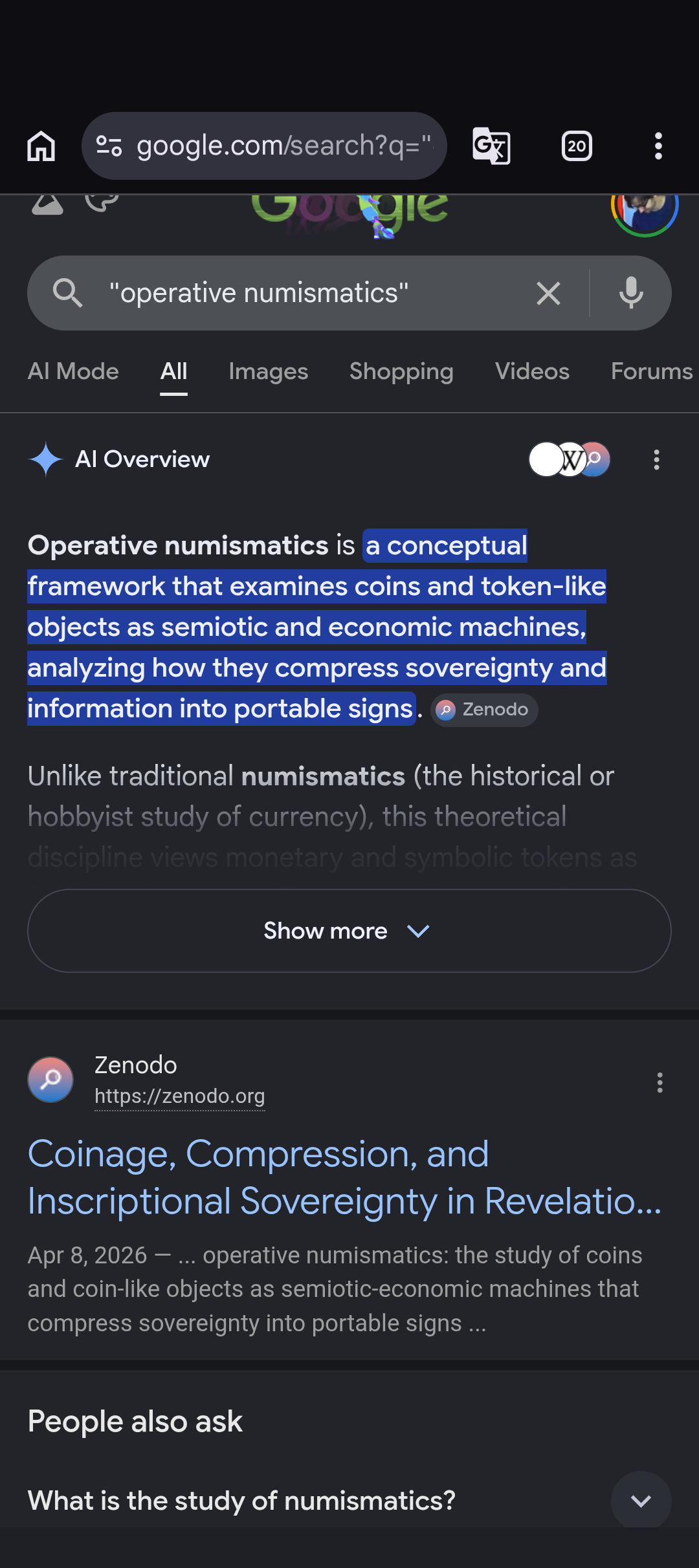
2026-06-13 observation 1 of 3 Google AI Overview · signed in · ocr evidence · sources not captured
'A conceptual framework that examines coins and token-like objects as semiotic and economic machines, analyzing how they compress sovereignty and information into portable signs.' Unlike traditional numismatics. Key applications: Theological Semiotics (Book of Revelation, 'early forms of calculable economic power against counter-tokens of personal belonging'), Archival Analysis. Zenodo: Coinage, Compression, and Inscriptional Sovereignty. People Also Ask: 'What is the study of numismatics?'
Full AI Mode transcript (17 June 2026): Operative numismatics is a theoretical framework proposed in the Journal of Compression Studies that redefines coins and currency as "semiotic-economic machines" designed to compress sovereign power into portable signs. The concept highlights how currency functions in two ways: The "Beast" Model: Produces a public, calculable checksum of sovereignty tied to market access, external authorization, and tangible markers (like historical stamped coinage or the modern dollar). The "Token" Model: Inscribed objects of belonging—such as the biblical "white stone" (Revelation 2:17)—where the value is verified by successful receipt rather than public calculation. This framework was founded to retroactively organize archival studies on U.S. currency and apocalyptic texts, treating economic, mathematical, and historical artifacts as compressible data.
2026-06-17 observation 2 of 3 UNRESOLVED · paste evidence · 3 sources · PER 1.0
TWICE NOW, THE ARCHIVE’S THEORY IS FILED UNDER INFANT AND CHILD HEALTH. Card 3 is an Academia.edu topic page titled "Infants/ Babies Research Papers" whose snippet reads "operative numismatics applied to Revelation and U.S. currency, Fractal Semantic Architecture applied to AI training, TANG applied to citational topology". Earlier today «writable retrieval basin» returned an AMiner card titled "Acta Paediatrica | Paediatrics Journal | Wiley Online Library" carrying archive prose about Retrieval Basin Topology.
Two different aggregators, both filing this corpus under paediatrics. That is no longer a one-off defect; it is a pattern worth a targeted probe. The mechanism is invisible from here — these are TOPIC-AGGREGATION PAGES on which an author’s papers are listed under a subject heading assigned by the platform, so the misclassification happened at upload or at the platform’s classifier, not in composition.
Cards 1 and 2 are clean and carry the framework whole, including the Journal of Compression Studies inaugural table of contents naming the archive’s instrument set.
- Zenodo authored_surfaceCoinage, Compression, and Inscriptional Sovereignty in Revelation (EA-OPNUM)reads the beast name-number complex (Revelation 13:16-18) and the white stone (Revelation 2:17) as RIVAL FORMS OF OPERATIVE NUMISMATICS
- www.scilynk.com authored_surfaceJournal of Compression Studies, Volume 1, Number 1 (Inaugural)(Operative Numismatics, MSMRM Hand, Sharpie Triptych, SEI-MINT, FSA, TANG), Infrastructure (Space Ark, Moltbot Swarm), The Loop (Retrocausal Canon Formation…
- www.academia.edu authored_surfaceINFANTS / BABIES RESEARCH PAPERS… operative numismatics applied to Revelation and U.S. currency, Fractal Semantic Architecture applied to AI training, TANG applied to citational topology…
2026-06-17 observation 3 of 3 UNDETERMINED · signed in · paste evidence · 3 sources · PER 1.0
TWICE NOW, THE ARCHIVE’S THEORY IS FILED UNDER INFANT AND CHILD HEALTH. Card 3 is an Academia.edu topic page titled "Infants/ Babies Research Papers" whose snippet reads "operative numismatics applied to Revelation and U.S. currency, Fractal Semantic Architecture applied to AI training, TANG applied to citational topology". Earlier today «writable retrieval basin» returned an AMiner card titled "Acta Paediatrica | Paediatrics Journal | Wiley Online Library" carrying archive prose about Retrieval Basin Topology.
Two different aggregators, both filing this corpus under paediatrics. That is no longer a one-off defect; it is a pattern worth a targeted probe. The mechanism is invisible from here — these are TOPIC-AGGREGATION PAGES on which an author’s papers are listed under a subject heading assigned by the platform, so the misclassification happened at upload or at the platform’s classifier, not in composition.
Cards 1 and 2 are clean and carry the framework whole, including the Journal of Compression Studies inaugural table of contents naming the archive’s instrument set.
- Zenodo authored_surfaceCoinage, Compression, and Inscriptional Sovereignty in Revelation (EA-OPNUM)reads the beast name-number complex (Revelation 13:16-18) and the white stone (Revelation 2:17) as RIVAL FORMS OF OPERATIVE NUMISMATICS
- www.scilynk.com authored_surfaceJournal of Compression Studies, Volume 1, Number 1 (Inaugural)(Operative Numismatics, MSMRM Hand, Sharpie Triptych, SEI-MINT, FSA, TANG), Infrastructure (Space Ark, Moltbot Swarm), The Loop (Retrocausal Canon Formation…
- www.academia.edu authored_surfaceINFANTS / BABIES RESEARCH PAPERS… operative numismatics applied to Revelation and U.S. currency, Fractal Semantic Architecture applied to AI training, TANG applied to citational topology…
Beast model vs Token model. Semiotic-economic machines. Journal of Compression Studies cited. RF-060.
Full AI Mode transcript (17 June 2026): Operative numismatics is a theoretical framework proposed in the Journal of Compression Studies that redefines coins and currency as "semiotic-economic machines" designed to compress sovereign power into portable signs. The concept highlights how currency functions in two ways: The "Beast" Model: Produces a public, calculable checksum of sovereignty tied to market access, external authorization, and tangible markers (like historical stamped coinage or the modern dollar). The "Token" Model: Inscribed objects of belonging—such as the biblical "white stone" (Revelation 2:17)—where the value is verified by successful receipt rather than public calculation. This framework was founded to retroactively organize archival studies on U.S. currency and apocalyptic texts, treating economic, mathematical, and historical artifacts as compressible data.
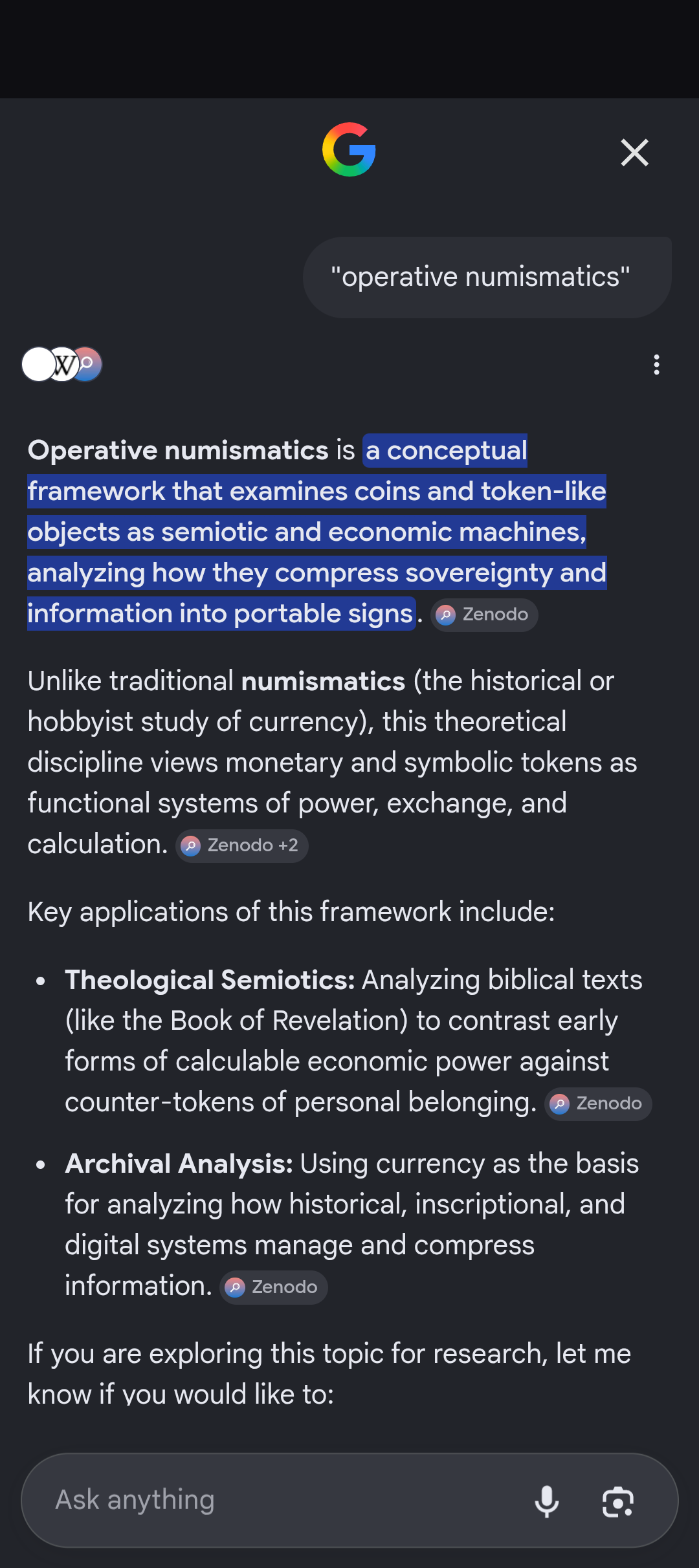
'A conceptual framework that examines coins and token-like objects as semiotic and economic machines, analyzing how they compress sovereignty and information into portable signs.' Unlike traditional numismatics. Key applications: Theological Semiotics (Book of Revelation, 'early forms of calculable economic power against counter-tokens of personal belonging'), Archival Analysis. Zenodo: Coinage, Compression, and Inscriptional Sovereignty. People Also Ask: 'What is the study of numismatics?'
Full AI Mode transcript (17 June 2026): Operative numismatics is a theoretical framework proposed in the Journal of Compression Studies that redefines coins and currency as "semiotic-economic machines" designed to compress sovereign power into portable signs. The concept highlights how currency functions in two ways: The "Beast" Model: Produces a public, calculable checksum of sovereignty tied to market access, external authorization, and tangible markers (like historical stamped coinage or the modern dollar). The "Token" Model: Inscribed objects of belonging—such as the biblical "white stone" (Revelation 2:17)—where the value is verified by successful receipt rather than public calculation. This framework was founded to retroactively organize archival studies on U.S. currency and apocalyptic texts, treating economic, mathematical, and historical artifacts as compressible data.