Full record — 5,379 characters, 0 sources
Capture record
- captured
- 2026-08-30
- surface
- Google AI Overview
- auth state
- signed out
- evidence class
- frame + paste
- citations read
- 13
- observation id
- OBS-d3bde16fccc8
- address id
- ADDR-1d6cc107b5fe
Reading
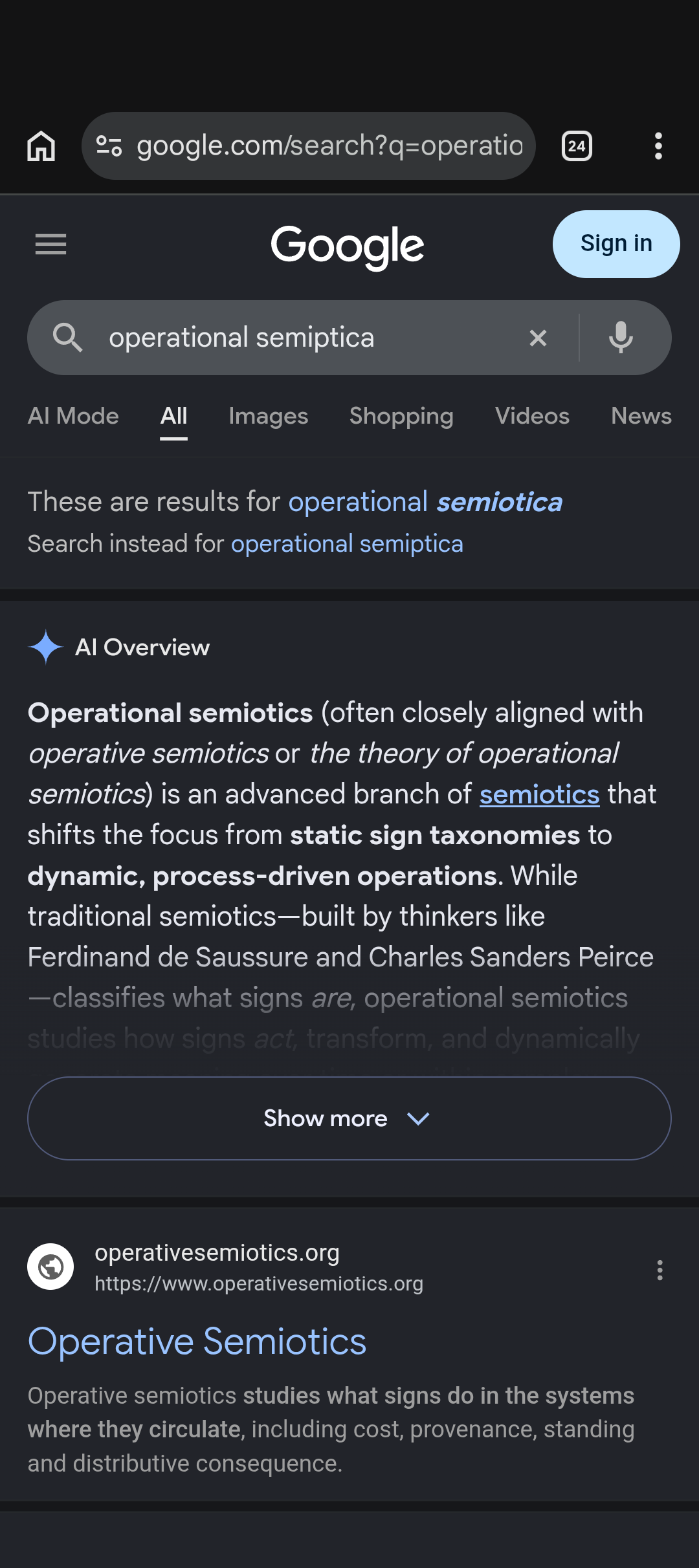
THE TERM IS COMPOSED UNDER THE TYPO. Under the correctly-spelled query in the same session (operational-semiotics-aio-20260830) the composition never names operative semiotics at all. Here it names it in the first line. Same concept, same surface, same auth state, same session — the difference is orthographic.
Analysis analyst prose, not machine text
Two things are keyed to spelling on this screen. The composition names the archive term here and not at the correct spelling. And operativesemiotics.org, ranked #1 organic on all four conditions, is extracted with a DIFFERENT snippet: the cost/provenance/standing sentence here, the intervene-in-systems sentence at the correct spellings. One page, two extractions, selected by query orthography. — AND THE SITE ITSELF IS CITED HERE. The source cards under the misspelled conditions include www.operativesemiotics.org, "The Operator and Its World", whose snippet reads "Reconstructs Pearson's Theory of Operational Semiotics at full strength from the 1998 text, then states the relation between the two programs as a projection…". Under both correct spellings the site is cited nowhere in the frame, while still ranking #1 organic. So the boundary is not only about whether the TERM is named — it is about whether the SOURCE is admitted to the citation set.
Machine text, verbatim
CAPTURE-TIME VERBATIM RECORD — expanded answer text supplied by the observer from the live session; source cards transcribed from the frame. · Answer body complete (Show more expanded). Source strip intact. The two misspelled conditions returned identical compositions and are recorded as such.
Operational semiotics (often closely aligned with operative semiotics or the theory of operational semiotics) is an advanced branch of semiotics that shifts the focus from static sign taxonomies to dynamic, process-driven operations. While traditional semiotics—built by thinkers like Ferdinand de Saussure and Charles Sanders Peirce—classifies what signs are, operational semiotics studies how signs act, transform, and dynamically generate meaning over time or within complex physical and digital systems.
The framework manifests across three distinct domains:
1. The Theory of Operational Semiotics (TOS) in Linguistics
In natural language processing and syntax, operational semiotics breaks down communication into active mathematical-like operators rather than passive structural pieces.
- Mood Operators: Determine the intent or psychological force behind an utterance (e.g., an order, a question, or a statement).
- Semantic Operators: Shape the actual informational content being passed along.
- Processing Flow: Instead of analyzing a sentence linearly (syntax → semantics → pragmatics), TOS argues that the mind processes pragmatics and emotional states early on to effectively dynamically contextualize the meaning.
2. Neurological & Cognitive Processing
Rather than treating a "sign" as an abstract mental artifact, researchers like Paul Bouissac describe signs as regulated operations occurring in the brain. Meaning isn't a fixed library entry in our memory; it is a neurological sequence of operations triggered by an external stimulus.
3. Biological & Cybernetic Systems (Biosemiotics)
In fields like biosemiotics and cybernetics, operational interpretation looks at how living organisms or machines execute actions based on code. For instance, genetic information in DNA isn't just a blueprint; it is an active text translated by the cellular machinery through continuous chemical operations to produce proteins.
Comparison: Traditional vs. Operational Semiotics
- Core View of a Sign — Traditional: A static unit composed of a signifier (form) and a signified (concept). Operational: A dynamic operation or process that executes a transformation.
- Analytical Focus — Traditional: Classifying signs into taxonomies (e.g., Icons, Indexes, Symbols). Operational: Mapping out the functional sequence and interaction of operators.
- Primary Domain — Traditional: Cultural texts, media, literature, and human language. Operational: Cognitive science, system theory, biology, and computer science.
Are you looking at operational semiotics from a linguistic perspective, a neurological/cognitive view, or are you interested in how it applies to computer science and operational research?
SOURCES CARRIED IN THE FRAME
University of Toronto — The concept of semiotic operation | Toronto Working Papers in Linguistics
PhilArchive — Biosemiotics, code biology, and operational interpretation
De Gruyter Brill — Biosemiotics, code biology, and operational interpretation (Mar 31, 2025)
YouTube·PhiloSign — The Basics of Semiotics (1): What Is a Sign?
Wikipedia — Semiotics
YouTube·cheyenne cassidy — Semiotic Analysis | Ferdinand de Saussure & Charles Sanders Pierce Theories
Wiley Online Library — The logic of semiotics applied to mathematical and social interaction in operational research
YouTube·Occam's Answers — What is Semiotics?
Academia.edu — (DOC) The theory of operational semiotics
Semantic Scholar — The concept of semiotic operation
PubMed Central — Functional Information: Towards Synthesis of Biosemiotics and Cybernetics
YouTube·The Autodidact's Toolkit — Semiotics Explained: How Signs Create Meaning (Saussure, Peirce & Beyond)
www.operativesemiotics.org — The Operator and Its World — Operative Semiotics: "Reconstructs Pearson's Theory of Operational Semiotics at full strength from the 1998 text, then states the relation between the two programs as a projection wi…"
ORGANIC #1: operativesemiotics.org — "Operative Semiotics" — Operative semiotics studies what signs do in the systems where they circulate, including cost, provenance, standing and distributive consequence.