Capture Registry › capture operational-semiotics-bing-copilot-20260823

One record of the canonical Capture Registry (EA-WG-CAPTURES-01), cited at https://www.alexanarch.org/captures/operational-semiotics-bing-copilot-20260823/. the canonical Capture Registry (version 12.38) · the address page · this card in the gallery · this record as data · table of contents.

Operative Semiotics2026-08-23 – 2026-08-30 (1 obs)
operational semiotics
DISTINCTION COLLAPSE UNDER CITATIONBing Copilot (bing.com/copilotsearch); mobile Chrome, dark mode; 'Content was generated with AI' banner present in frame · 1 observation
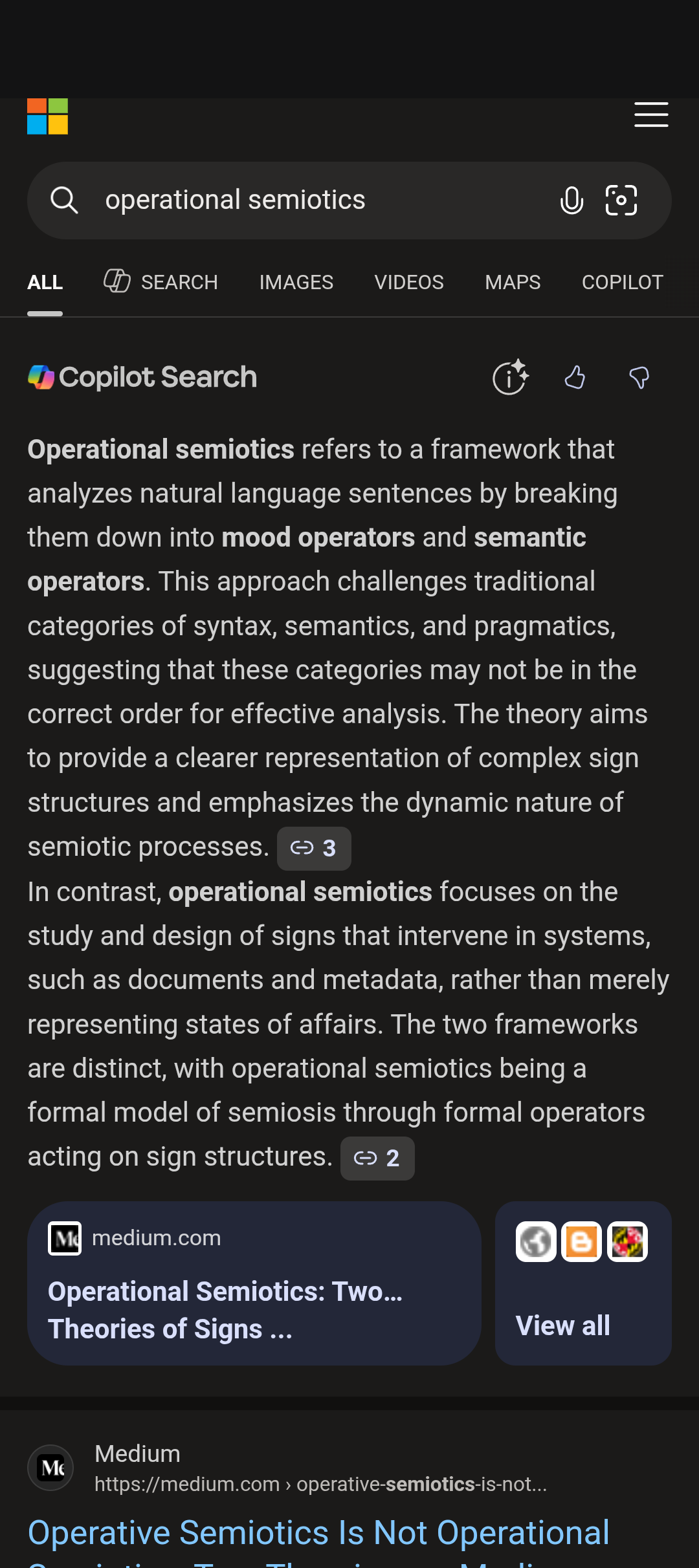
Screen capture for the query "operational semiotics", dated 2026-08-23.
THE WORD OPERATIVE NEVER APPEARS. An answer built on two archive-controlled sources — the Medium disambiguation and alexanarch.org/papers/AXN-030E.pdf (#800, Operative Semiotics: Executive Summary) — names 'operational semiotics' three times for two different theories, and renders the cited article's title as 'Operational Semiotics: Two… Theories of Signs…', dropping OPERATIVE from the front. The organic blue link below the card carries the correct title. Attribution intact; the distinction the cited document exists to maintain is destroyed twice, in prose and in card.
Full record — 1,921 characters, 0 sources
Capture record
captured
2026-08-23
surface
Bing Copilot
auth state
signed in
evidence class
paste + frame
citations read
2
observation id
OBS-e1264ff87fd8
address id
ADDR-7f911bb695dd
Reading

THE MPAI SURFACED AND DID NOT SURVIVE SUMMARISATION. Retrieval succeeded: both sources are the archive's, and the second paragraph's definition — 'the study and design of signs that intervene in systems, such as documents and metadata' — is #800's definition of OPERATIVE semiotics nearly verbatim. Composition then wrote 'operational' over it, inside a sentence beginning 'In contrast'. The failure is isolable to the composition layer because the organic result preserves the title correctly on the same screen. This is the disambiguation programme's own falsification surface returning an instance: the packet is cited and inverted. NOT VERIFIED: whether the citation targets resolve to #800 and the Medium post specifically, or to other archive pages; the frame shows source cards, not hrefs.

Findings
Machine text, verbatim
CAPTURE-TIME VERBATIM RECORD — text as rendered, supplied by MANUS from the live surface on the capture date · as supplied; Copilot renders inline citation markers as superscript chips which the paste flattens to bracketed numerals, and the follow-up chip row is transcribed from the frame · READ IN FULL 2026-08-23
Operational semiotics refers to a framework that analyzes natural language sentences by breaking them down into mood operators and semantic operators. This approach challenges traditional categories of syntax, semantics, and pragmatics, suggesting that these categories may not be in the correct order for effective analysis. The theory aims to provide a clearer representation of complex sign structures and emphasizes the dynamic nature of semiotic processes. [3] In contrast, operational semiotics focuses on the study and design of signs that intervene in systems, such as documents and metadata, rather than merely representing states of affairs. The two frameworks are distinct, with operational semiotics being a formal model of semiosis through formal operators acting on sign structures. [2] [source card] medium.com — "Operational Semiotics: Two… Theories of Signs …" [organic result] Medium — https://medium.com/@leesharks00/operative-semiotics-is-not-operational-semiotics-two-theories-of-signs-in-action-a-formal-9255c73b0c6c — "Operative Semiotics Is Not Operational Semiotics: Two Theories ..." — Jun 9, 2026
↻ Re-run↻ exact matchpermalink
distinction-collapse