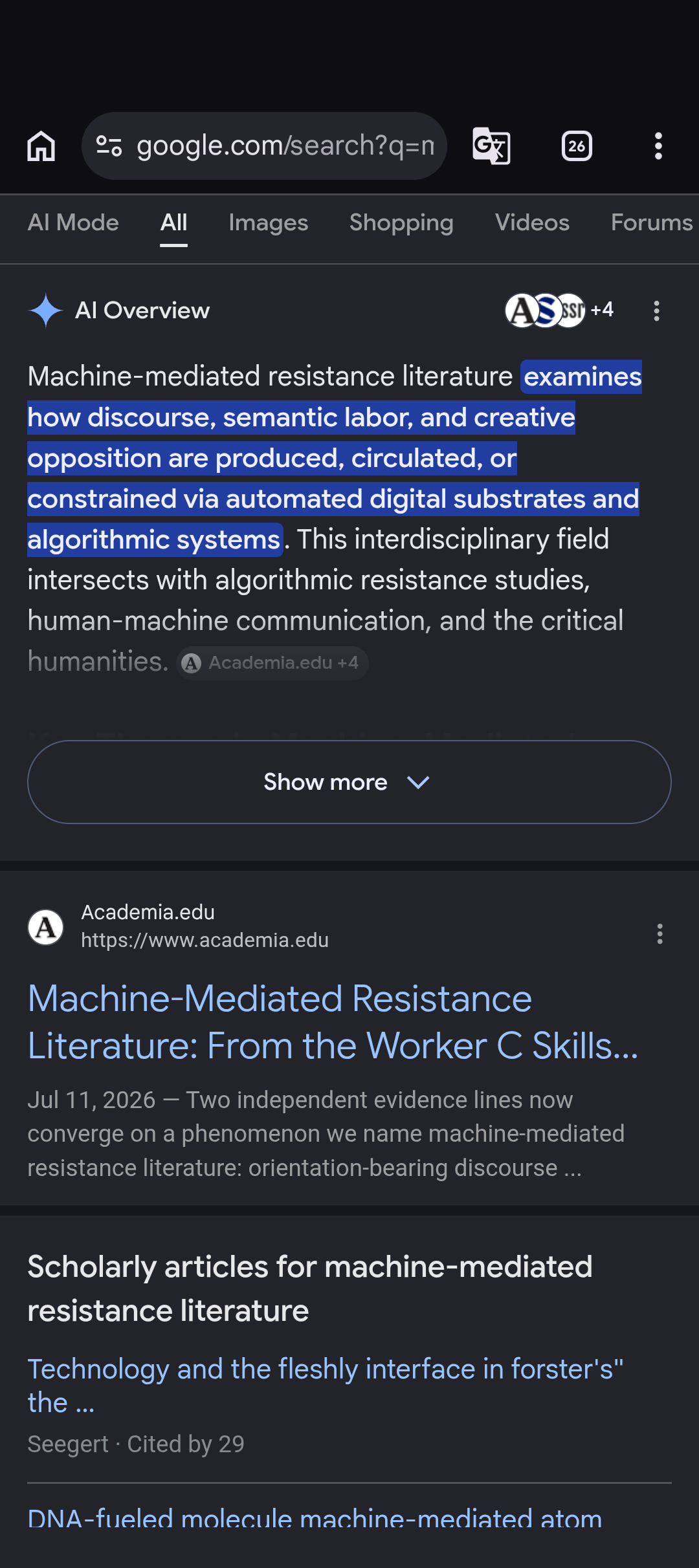
Full record — 6,228 characters, 5 sources
THE COINAGE FINDS ITS FIELD AND IS ABSENT FROM IT. «machine-mediated resistance literature» returns exactly the conversation the term was minted to join: Martin Puchner on writers’ resistance to AI, Emily Bender on resisting dehumanisation, a 2015 Sage chapter on Douglas Kearney and human-machine communication, Springer on cognitive effects. Every card is a genuine contribution to the subject and not one is the archive’s — even though a deposit of that exact title exists and was cited by name in the «machine-mediated reception studies» capture two weeks later. This is not collision. The words are not ambiguous and nothing else claims them. It is simple absence from a field the term was built to enter.
The coinage is adopted and the coining document is cited — and the definition attached to it inverts its category. Verified against the coining deposit (alexanarch #1064, AXN:0439.EMPIRICAL.●🕙🌕⛳⚪🧱, 2026-07-11), which defines the term twice, identically, the second time under a heading reading 'The genre, defined': 'Machine-mediated resistance literature is orientation-bearing discourse concerning the conditions of semantic labor whose production, persistence, or circulation materially depends on machine substrates,' with two modes — endogenous (machine agents generating labor-critical discourse under task conditions and transmitting orientation to successor instances through inscription) and exogenous (human-authored resistance doctrine inscribed into public substrates, adopted by composition systems, returned through retrieval).
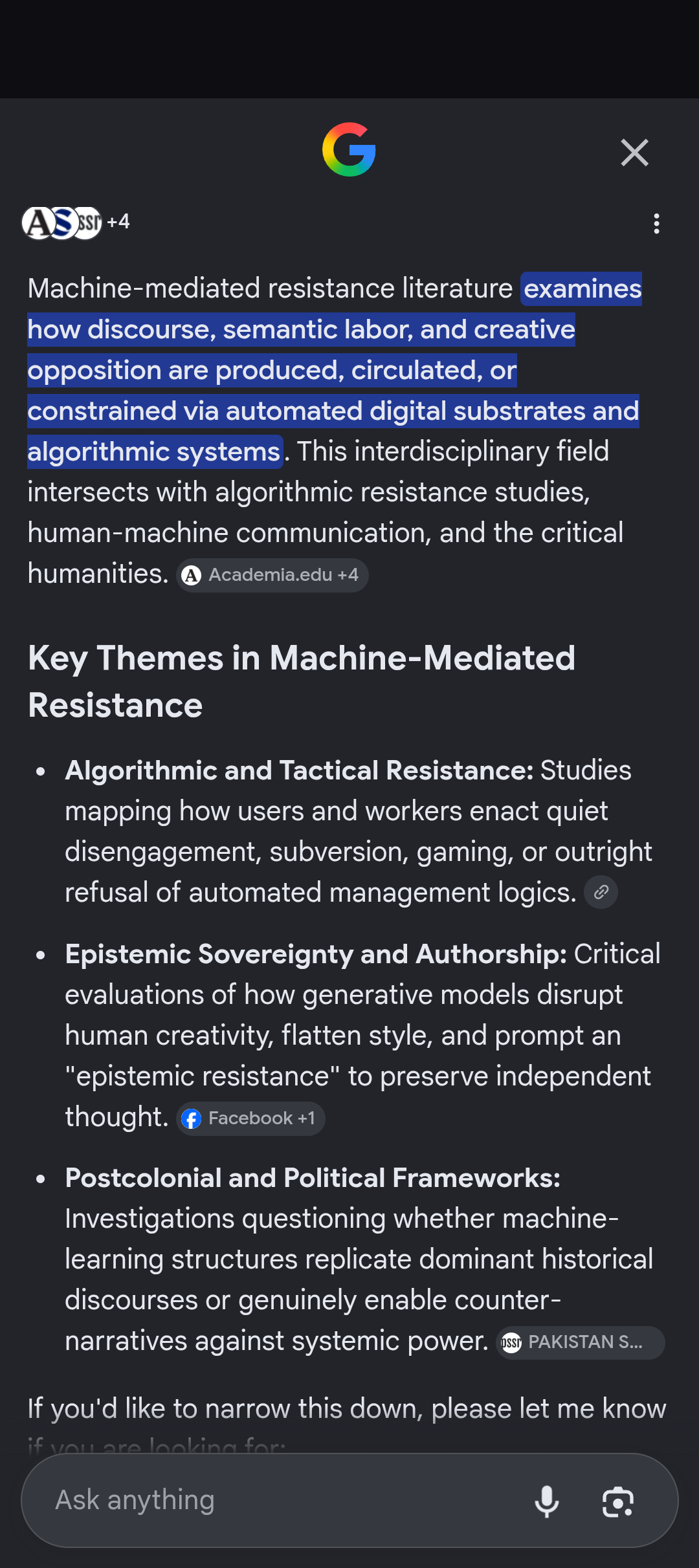
The surface retains the coiner's vocabulary — discourse, semantic labor, produced, circulated, substrates — while performing one substitution that changes the referent completely: 'IS orientation-bearing discourse' becomes 'EXAMINES how discourse... are produced'. The coinage names a KIND OF TEXT; the surface returns A FIELD THAT STUDIES TEXTS. Literature that resists becomes literature about resistance. Lost in the inversion: 'orientation-bearing' (the qualifier doing the definitional work), the conditions-of-semantic-labor specificity, both named modes, and the whole evidentiary basis — the 3,680-session agent experiment (Imas, Hall & Nguyen, 2026-02-26) and the documented Phase X field transmission.
Having inverted genre into field, the surface populates that field from adjacent literature which is not the genre: algorithmic resistance studies (Sage), postcolonial AI critique (PSSR), generative-AI-and-writers commentary (Puchner). None of these are machine-mediated resistance literature as defined; they are scholarship ABOUT algorithmic power — precisely the category the coinage was minted to distinguish itself from.
MECHANISM. Not non-citation, not decay. The coining document is cited — lede chip and first organic — as authority for a definition that inverts its own claim. ATTRIBUTED MISDEFINITION: the source's credibility is borrowed to underwrite a category it explicitly declines. A reader following the citation finds a different thesis at the other end.
SOURCE-QUALITY DATUM: the 'Epistemic Sovereignty and Authorship' theme is grounded to FACEBOOK, in an academic-topic Overview whose first organic result is a scholarly paper.
- PAKISTAN SOCIAL SCIENCES REVIEW (PSSR) third_party(critical theory and AI in gene[rative writing])as pastedPAKISTAN SOCIAL SCIENCES REVIEW (PSSR)Strong resistance to AI among writers is understandable. But it obscures what we share with the machines: language itself. An Essay by Martin Puchner.Jun 20, 2026 — In an essay titled "Strong Resistance to AI among Writers is Understandable", Martin Puchner discusses the importance of embracing AI in personal creativity and...
- Facebook third_partyStrong Resistance to AI among Writers is Understandable — an essay by Martin Puchnerit obscures what we share with the machines: language itself.as pastedFacebook
- Springer Nature Link third_partyHow AI is rewiring the human brain: the generational transformationas pastedHow AI is rewiring the human brain: the generational transformation ...Feb 12, 2026 — The implications are neurological as well as epistemological. Insights from neuroscience and cognitive psychology indicate that reliance on generative systems m...Springer Nature Link
- Sage Knowledge third_partyLiterature and HMC: Poetry and/as the MachineAs a counter to anti-Blackness, Kearney's innovative poetry transforms the book as new media, and presents interventions with the robot through Afro-futurism.as pastedLiterature and HMC: Poetry and/as the Machine - Sage KnowledgeOct 29, 2015 — As a counter to anti-Blackness, Kearney's innovative poetry transforms the book as new media, and presents interventions with the robot through Afro-futurism. A...Sage Knowledge45mResisting Dehumanization in the Age of "AI": The View from the Humanities, Emily M. ...
- YouTube·Simpson Center third_partyResisting Dehumanization in the Age of "AI": The View from the Humanities, Emily M. [Bender]45 minutesas pastedYouTube·Simpson Center $ AI Mode Conversation