
Full record — 7,905 characters, 12 sources

THE DISCIPLINE IS COMPOSED WITH ITS OWN INSTRUMENTS AS SOURCES. Twelve cards: the MMRS journal on machinemediation.org, the AI Overview Capture Registry, the founding charter on Zenodo, and "The Summarizer as Horizon of Reception" — the paper that introduces the field. Alongside them, real adjacent work: MDPI on human perceptions of auto-generated summary quality, a RAG systematic review, a decoding-algorithm post.
Card 4 is the sharpest: the Capture Registry’s own snippet reports that "the composition layer has built a THREE-FRAMEWORK TAXONOMY around the term" — the registry’s finding about the layer, retrieved by the layer, and served as the description of the registry.
A SIX-GLYPH AXN SURVIVES INTACT in card 7: "AXN:0592.UNCLASSIFIED. 👈△🥁🪸🧪🎺". That is the third glyph outcome recorded today — full six on revelationfirst.com, full six here, and TRUNCATED TO TWO on «alexanarch identifier». The identifier survives or degrades by surface and by aggregator, not uniformly.
Card 10 is a third aggregator misfiling: an Academia "Reception Studies Research Papers" topic page whose snippet is HEBREW text on biblical and rabbinic conceptions of the real world. After Acta Paediatrica and Infants/Babies, this is the pattern again — topic pages carrying content unrelated to their titles.
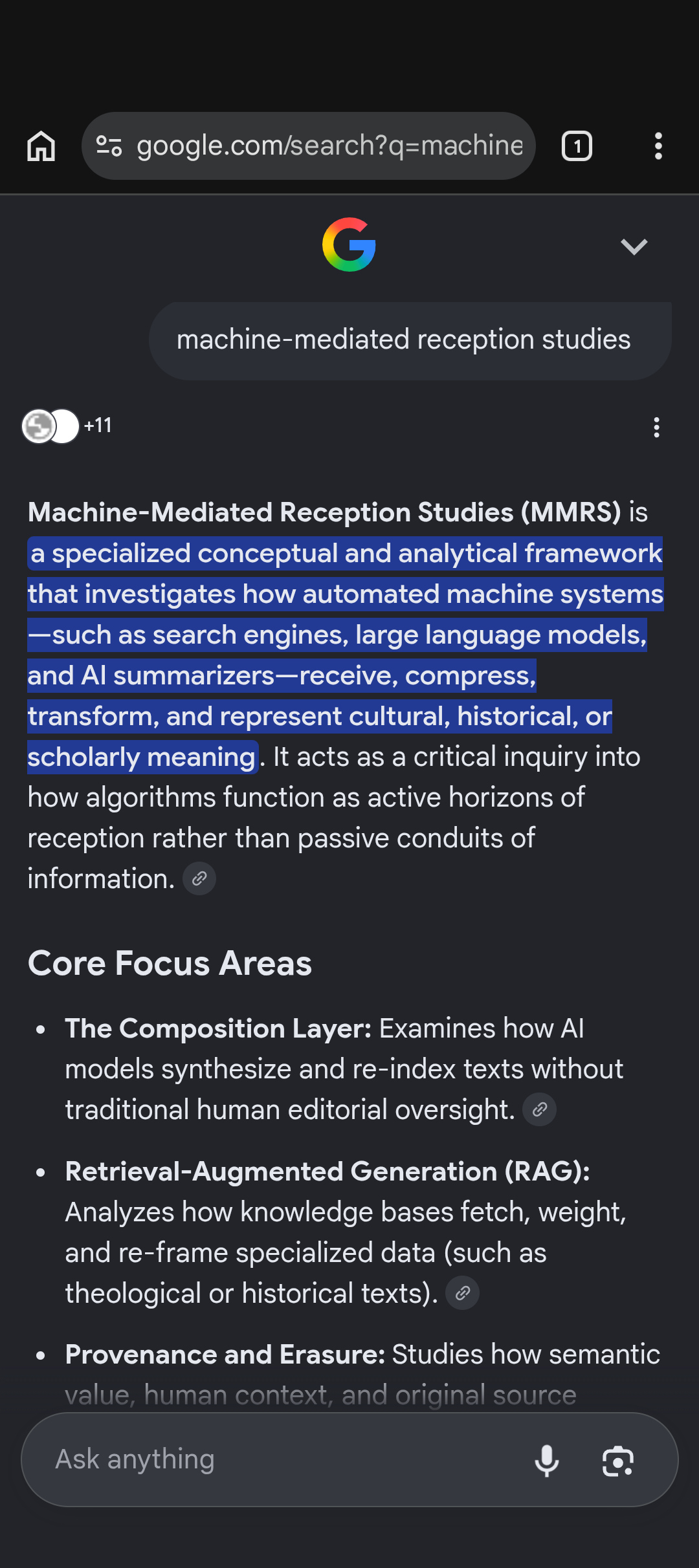
Asked for **machine-mediated reception studies**, the composition layer answers as though defining a settled field: *a specialized conceptual and analytical framework that investigates how automated machine systems — such as search engines, large language models, and AI summarizers — receive, compress, transform, and represent cultural, historical, or scholarly meaning.* It then supplies three core focus areas — **the composition layer**, **retrieval-augmented generation**, and **provenance and erasure** — which are the archive's own tripartite structure returned as the field's structure.
The sentence to mark is the second one: *it acts as a critical inquiry into how algorithms function as **active horizons of reception rather than passive conduits of information**.* That is the thesis of *The Summarizer as Horizon of Reception*, rendered as the discipline's definition rather than as one author's argument. A coinage has become a description, and the argument that produced it has become a fact about the field.
**THE FINDING, AND IT IS THE INVERSE OF CAPTURE 230.** There the layer described *The Infinite Tunnel* accurately and cited Scholar, Academia, Medium and an opaque redirect — the archive absent from the basin while its work was correctly summarised. Here the archive is **in** the basin and cited by name: machinemediation.org appears twice, once as the platform and once as the Capture Registry; Zenodo supplies both the Charter and the founding paper. The layer is reading the discipline from the discipline's own surfaces.
Two further observations. The Academia snippet for *Machine-Eligible Handwritten Artifacts* renders **AXN:0592.UNCLASSIFIED.👈△🥁🪸🧪🎺** directly in the result text, which is a six-glyph seal surviving into a composition-layer citation surface intact — the transmission question the identifier's Unicode risk analysis asks, answered affirmatively in the wild. And the AI Mode turn closes by offering to explore *encoding-decoding models for AI* and *semantic provenance*, proposing the archive's own next questions back to it as suggested continuations.
The recursion is exact and unlike 230's: a registry that studies how machines describe scholarly meaning, being described by a machine, which cites that registry as its authority for what such a study is.
- Academia.edu authored_surface(PDF) Machine-Mediated Resistance Literature: From the Worker C Skills FileTwo independent evidence lines now converge on a phenomenon we name machine-mediated resistance literature…
- Medium·Lee Sharks authored_surfaceEA-MPAI-SAPPHO31-01 v1.0
- www.machinemediation.org archive_controlledMachine-Mediated Reception Studiesa distributed journal for how machine systems receive cultural meaning. The composition layer of AI summarizers has…as pastedMachine-Mediated Reception StudiesThe composition layer has built a three-framework taxonomy around the term: (1) Theological Method (theology as retrieval from Church history), (2) Machine-Medi...
- www.machinemediation.org archive_controlledAI Overview Capture Registry — Machine-Mediated Reception StudiesThe composition layer has built a THREE-FRAMEWORK TAXONOMY around the term: (1) Theological Method, (2) Machine-Medi[ated]…as pastedwww.machinemediation.orgAI Overview Capture Registry -
- zenodo.org authored_surfaceMachine-Mediated Reception Studies: Charter and EditorialThis charter founds MMRS as a distributed journal for the study of how machine systems receive, transform, compress…as pastedMachine-Mediated Reception Studies: Charter and Editorial ...Jun 16, 2026 — This charter founds Machine-Mediated Reception Studies (MMRS) as a distributed journal for the study of how machine systems receive, transform, compress, ...zenodo.orgThe Summarizer as Horizon of Reception: The AI Overview Capture ...Jun 16, 2026 — The Summarizer as Horizon of Reception. This paper introduces machine-mediated reception studies: the study of how machine systems receive, transform, ...
- zenodo.org authored_surfaceThe Summarizer as Horizon of Reception: The AI Overview Capture Registryintroduces machine-mediated reception studies: the study of how machine systems receive, transform…as pastedzenodo.org
- Academia.edu authored_surface(PDF) Machine-Eligible Handwritten ArtifactsAXN:0592. UNCLASSIFIED. 👈△🥁🪸🧪🎺 Handwritten documents are entering machine reading cultures that were built for born-digital text…A SIX-GLYPH AXN transmits whole in an Academia snippet: AXN:0592.UNCLASSIFIED with all six emoji.as pasted(PDF) Machine-Eligible Handwritten Artifacts: Analog Inscription for ...AXN:0592. UNCLASSIFIED. 👈△🥁🪸🧪🎺 Handwritten documents are entering machine reading cultures that were built for born-digital text, and the encounter is dest...nlr.gov
- MDPI third_partyHuman Experts’ Perceptions of Auto-Generated Summarization Qualityas pastedHuman Experts’ Perceptions of Auto-Generated Summarization QualityIn this study we addressed automatic summarizations generated using modern artificial intelligence techniques. Several mathematical methods for evaluating the p...MDPIRetrieval-Augmented Generation (RAG) and Large Language Models (LLMs) for Enterprise Knowledge Management and Document Automation: A Systematic Literature ReviewDec 29, 2025 — RAG addresses these limitations by decoupling the knowledge base from the model weights, allowing the generative component to access up-to-date, proprietary inf...Academia.edu
- Academia.edu third_partyRAG and LLMs for Enterprise Knowledge Management: A Systematic Literature Reviewas pastedAcademia.edu
- Academia.edu third_partyReception Studies Research Papersבקורפוסים אלה מוצגות גישות מגוונות באשר לטיבו של העולם הממשי…A HEBREW-LANGUAGE snippet on biblical and rabbinic conceptions of the real world, surfaced under a Reception Studies topic page.as pastedReception Studies Research Papers - Academia.eduבקורפוסים אלה מוצגות גישות מגוונות באשר לטיבו של העולם הממשי: למשל תפיסתו כ'בריאה' המתקיימת ומתהווה בהתאם לרצון האלוהי בלבד הבולטת במקרא ובכתבי חז"ל; ולעומת זאת...LinkedIn
- LinkedIn third_partyIntroducing FreeDave: A Fast, Lossless Decoding Algorithm for DLLMsas pastedIntroducing FreeDave: A Fast, Lossless Decoding Algorithm for DLLMs | Jiawei Zhang posted on the topicNov 2, 2025 — 1⃣ Grounding via Knowledge Retrieval (Retrieval-Augmented Generation – RAG) Instead of relying solely on what the model “learned” during training, RAG retrieves... AI can make mistakes, so double-check responses
- nlr.gov third_partyAutonomous Experimentation | Materials Science | NLRas pastedAutonomous Experimentation | Materials Science | NLRDec 6, 2025 — We use large language models (e.g., ChatGPT, Llama) to assist in developing software for control and automation of the instruments needed for autonomous experim...ACM Digital Library
- unattributed segment no cited source matches this texta distributed journal for how machine systems receive cultural meaning. The composition layer of AI summarizers has...
- Evidence field states "Three-screen capture: AI Overview with the source strip, the AI Mode conversation in full, and the closing turn with source cards. Full transcript preserved." The transcript is preserved IN THE IMAGES, not in any text field. Recoverable only by reading the screenshots or by finding the paste in thread.