Full record — 6,751 characters, 2 sources
A DEFENSIVE PUBLICATION IS DOING THE ARCHIVE’S WORK IN FORMAL TERMS. Card 2 is on TECHNICAL DISCLOSURE COMMONS — a defensive publication venue, where work is published to prevent others patenting it — and it states a GATE-EQUITY INVARIANT: "Blindness (A) plus add-only monotonicity (B) yields the ABSENCE-NEVER-DENIES property."
That is a formal guarantee that a system which cannot see a modality must not therefore reject it — the exact protection EA-SPXI-ANALOG-01 is written to secure for handwritten artifacts, expressed as an invariant rather than as a specification. Dated 14 July 2026, eleven days before this capture.
The archive’s own abstract is card 1 and states the problem symmetrically: handwritten documents "are entering machine reading cultures that were built for born-digital text, and THE ENCOUNTER IS DESTRUCTIVE IN BOTH DIRECTIONS."
A GITHUB CREDENTIAL APPEARED IN THIS PASTE AND WAS REDACTED AT EXTRACTION, per standing rule. The redaction marker is retained in the record so the event is auditable; the credential is not.
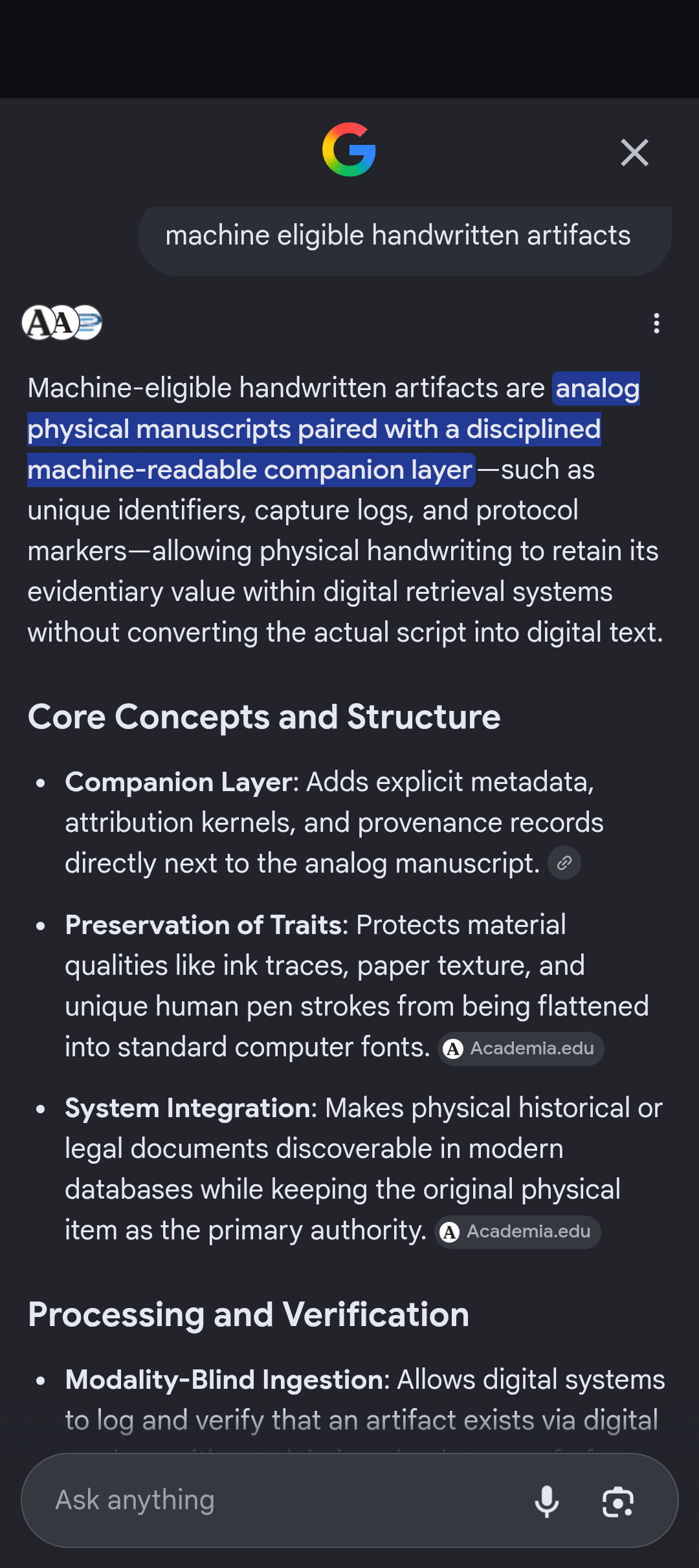
Escalation from the same-day artifact capture (spxi-analog-attestation-artifact-adoption-20260725). That capture asked about a specific figure and got the specification as authority. This capture asks what the category IS — a generic term query with no name attached — and the retrieval layer answers with the coinage, four days after the edition of record. The Overview's lede is a near-verbatim compression of the specification's own abstract ('an analog inscription published together with a disciplined machine-facing companion layer' → 'analog physical manuscripts paired with a disciplined machine-readable companion layer'), returned without hedging and without framing it as any author's position. Two of the framework's terms — companion layer, provenance erasure — are verified against the v1.0 full text (2 occurrences each). The term is functioning as the standard reference for its own phrase.
Ranking datum. The arXiv HTR paper (TrOCR, 2025-08-15) — the established technical literature on machine reading of handwriting — ranks BELOW the Academia.edu record for this query. The coinage outranks the field it distinguishes itself from, on the field's own subject matter.
Second attribution anomaly, different mechanism. As in the same-day capture, exactly one bullet carries no citation: 'Modality-Blind Ingestion'. Full-text verification shows 'modality-blind' appears ZERO times in EA-SPXI-ANALOG-01 v1.0. The concept belongs to the second source (Technical Disclosure Commons, 2026-07-14), which is cited on the adjacent Threat Mitigation bullet but not on this one. FINDING: cross-document blend with attribution dropped — material from source B presented inside a section otherwise sourced to source A, in identical voice, with no marker of the transition. This is a distinct failure mode from the same-day artifact capture, where the null-cited unit was the primary source's own phrase with its citation lost (attribution decay). Two documented mechanisms, one document, one week: decay of a present citation, and absorption of a second source's content into the first source's voice. In both cases the null-cited bullet is indistinguishable in register from the cited ones.
RESOLVED (verified from the primary PDF, 2026-07-25): the second source is Assuncao, gustavo matthew, 'Modality-Blind, Local-First Handwriting Evidence Ingestion with Server-Side Image Rejection and Absence-Never-Denies Gate Equity', Technical Disclosure Commons, Defensive Publications Series, 14 July 2026, tdcommons.org/dpubs_series/10935, CC BY 4.0 — an independent third-party author working in edtech privacy-by-design, with no established or asserted relation to the archive. This upgrades the finding: the uncited bullet carries HIS titular contribution, not the primary source's, so the blend erases a real third author inside a surface otherwise crediting the primary. Convergent invention noted — two authors, ten days apart, on how handwritten analog evidence enters machine systems without being flattened, from wholly different motives, sharing no vocabulary on the tested terms.
- academia.edu authored_surfaceMachine-Eligible Handwritten Artifacts: Analog Inscription for Machine CanonsHandwritten documents are entering machine reading cultures that were built for born-digital text, and THE ENCOUNTER IS DESTRUCTIVE IN BOTH DIRECTIONSas pastedMachine-Eligible Handwritten Artifacts: Analog Inscription for Machine Canons Abstract Handwritten documents are entering machine reading cultures that were built for born-digital text, and the encounter is destructive in both directions: Academia.edu
- tdcommons.org third_partyModality-Blind, Local-First Handwriting Evidence IngestionFigure 4 — the GATE-EQUITY INVARIANT. Blindness (A) plus add-only monotonicity (B) yields the ABSENCE-NEVER-DENIES property.as pastedModality-Blind, Local-First Handwriting Evidence Ingestion with ... Jul 14, 2026 — Figure 4 — The gate-equity invariant. Blindness (A) plus add-only monotonicity (B) yields the absence- never-denies property. ... Combining (A) and (B) gives th... Technical Disclosure Commons $ [REDACTED-GITHUB_PAT-93chars]