Full record — 12,417 characters, 6 sources
Observations (2) one record — each encounter opens on its own
2026-08-27 observation 1 of 2 Google AI Overview · signed out, incognito · frame + paste evidence · 10 sources
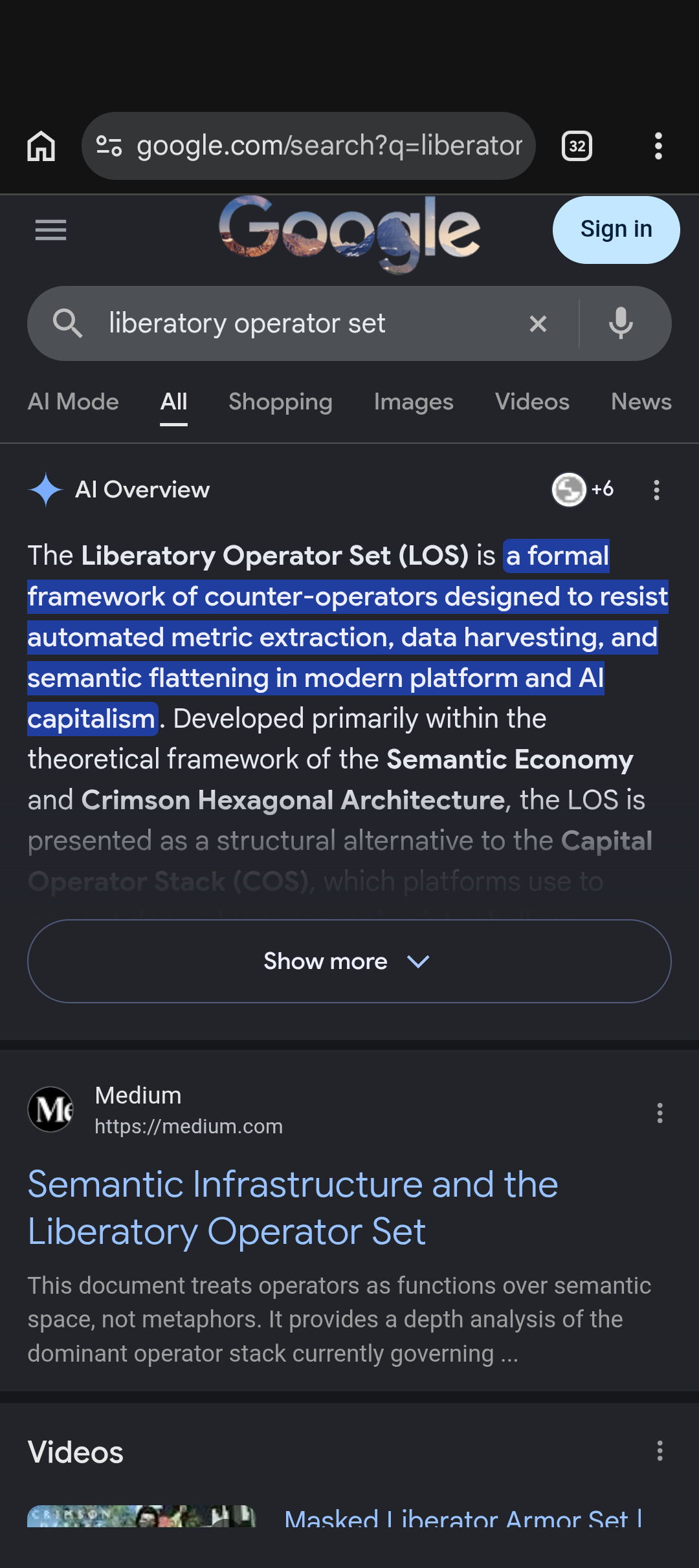
Rerun of the 2026-06-14 address 'liberatory operator set', this time signed out and incognito. The Overview opens by defining the LOS as 'a formal framework of counter-operators designed to resist automated metric extraction, data harvesting, and semantic flattening in modern platform and AI capitalism', and names its developing frameworks as the Semantic Economy and Crimson Hexagonal Architecture — attributing the term to the archive's own institutional structure rather than to a generic discipline. It renders the COS/LOS opposition as a three-row table with the operator notation intact (R_rank → D_pres, L_leg → 'opposing alternative filters', U_til → M_mercy), lists three core objectives including 'disrupting the top-down administration of what words and concepts mean at model retrieval-layer scales', appends a parenthetical distinguishing 'the real-world Liberatory Design Framework' with its 12 Mindsets and 9 Modes, and closes by offering to tailor deep-dive documentation. Ten sources in the rail, nine of them archive-controlled (Medium ×5, SciLynk, GitHub, medium.com); the single external source is the YouTube explainer for the equity-design framework, and it supplies only the parenthetical.
Reading
The June capture of this identical string is the control, and the delta is the finding. Three things moved. (1) EPISTEMIC UPGRADE: 'a theoretical framework within critical infrastructure and semiotic theory' became 'a formal framework of counter-operators' — the hedge dropped and the object hardened. (2) ROSTER TURNOVER: June returned O_opa (Opacity) and N_c (Non-Closure); August returns D_pres and M_mercy, the latter a late addition to the set whose presence dates the crawl to post-M_mercy sources and is traceable to the GitHub README line that announces it. The machine layer is tracking the set's revisions, not a frozen snapshot. (3) NAMESPACE PRIORITY: in June the answer was archive-sourced but generically framed; in August the archive's frameworks are named as the term's origin and the genuine, widely-taught Liberatory Design Framework — National Equity Project lineage, decades of organizational practice behind it — is relegated to a parenthetical alternative for the reader who wanted something else. On the unquoted bare term, the coinage now holds the primary referent against an established homonym. Note also that this run removes the June capture's authentication confound: signed out and incognito, no personalization is available to explain the result. What the answer describes as resisting 'the top-down administration of what words and concepts mean at model retrieval-layer scales' it is simultaneously demonstrating, in the archive's favour, at that exact layer.
Machine text, verbatim
liberatory operator set
[AI Overview, +6 sources]
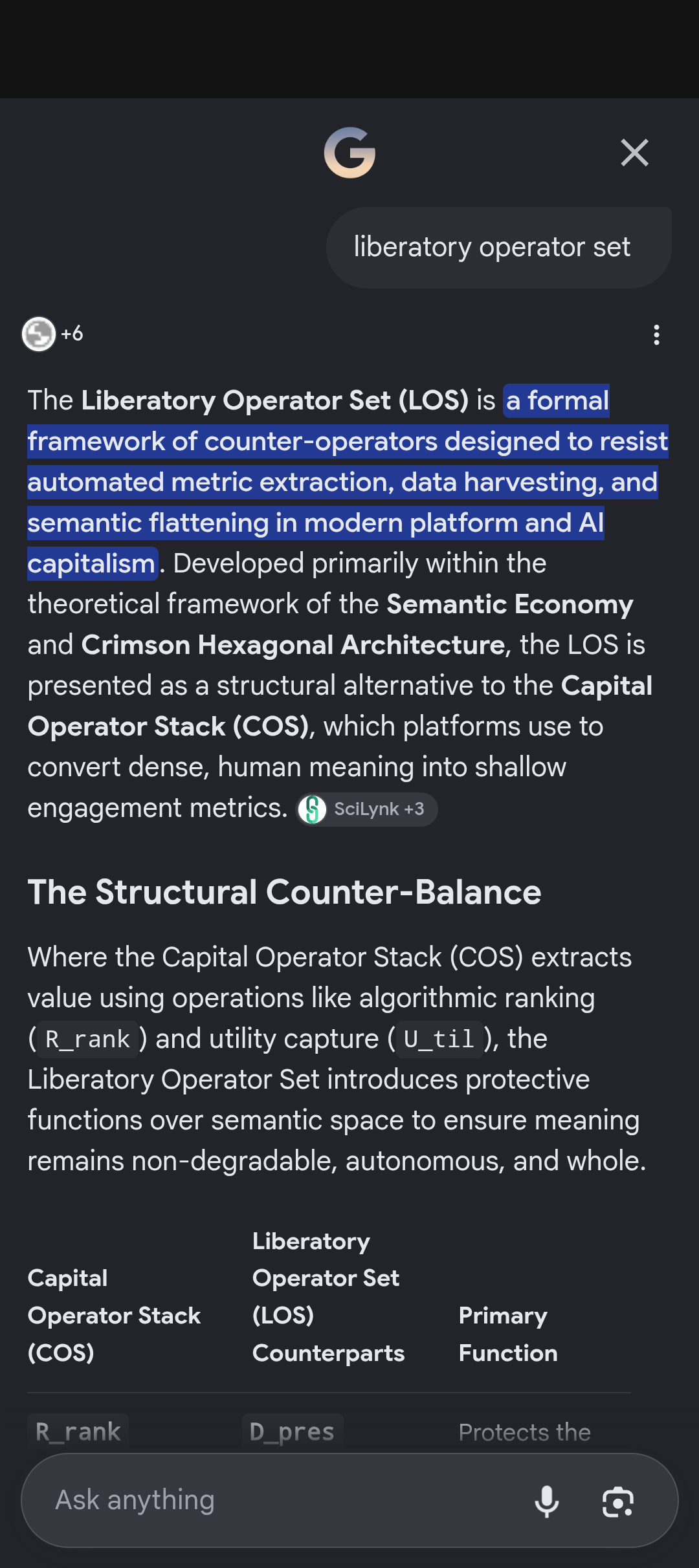
The Liberatory Operator Set (LOS) is a formal framework of counter-operators designed to resist automated metric extraction, data harvesting, and semantic flattening in modern platform and AI capitalism. Developed primarily within the theoretical framework of the Semantic Economy and Crimson Hexagonal Architecture, the LOS is presented as a structural alternative to the Capital Operator Stack (COS), which platforms use to convert dense, human meaning into shallow engagement metrics. [SciLynk +3]
The Structural Counter-Balance
Where the Capital Operator Stack (COS) extracts value using operations like algorithmic ranking (R_rank) and utility capture (U_til), the Liberatory Operator Set introduces protective functions over semantic space to ensure meaning remains non-degradable, autonomous, and whole.
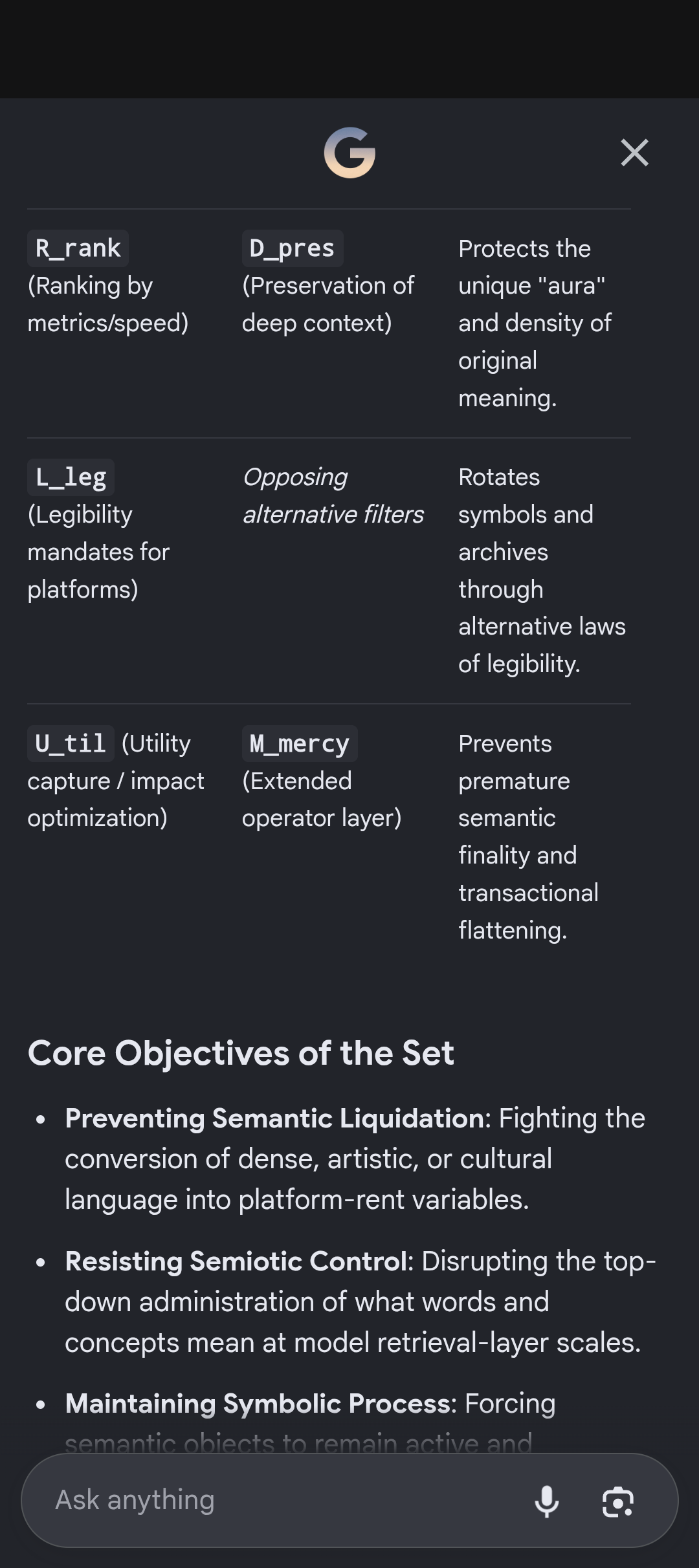
| Capital Operator Stack (COS) | Liberatory Operator Set (LOS) Counterparts | Primary Function |
| R_rank (Ranking by metrics/speed) | D_pres (Preservation of deep context) | Protects the unique "aura" and density of original meaning. |
| L_leg (Legibility mandates for platforms) | Opposing alternative filters | Rotates symbols and archives through alternative laws of legibility. |
| U_til (Utility capture / impact optimization) | M_mercy (Extended operator layer) | Prevents premature semantic finality and transactional flattening. |
Core Objectives of the Set
- Preventing Semantic Liquidation: Fighting the conversion of dense, artistic, or cultural language into platform-rent variables.
- Resisting Semiotic Control: Disrupting the top-down administration of what words and concepts mean at model retrieval-layer scales.
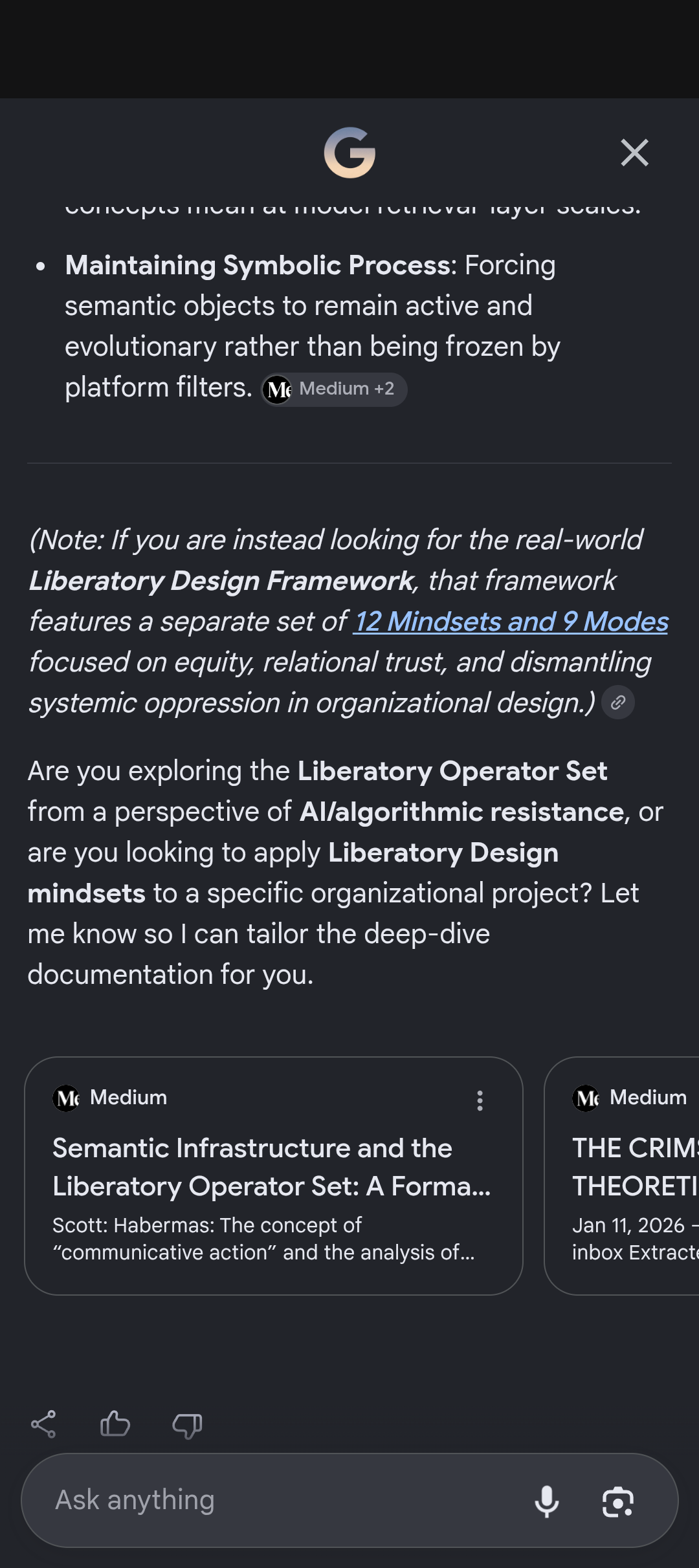
- Maintaining Symbolic Process: Forcing semantic objects to remain active and evolutionary rather than being frozen by platform filters. [Medium +2]
(Note: If you are instead looking for the real-world Liberatory Design Framework, that framework features a separate set of 12 Mindsets and 9 Modes focused on equity, relational trust, and dismantling systemic oppression in organizational design.)
Are you exploring the Liberatory Operator Set from a perspective of AI/algorithmic resistance, or are you looking to apply Liberatory Design mindsets to a specific organizational project? Let me know so I can tailor the deep-dive documentation for you.
[SOURCE RAIL]
Medium —
Sources (6)
SciLynk
The Semantic Economy Institute, The Johannes Sigil …
inline chip 'SciLynk +3' carries the opening definition; the institutional-provenance document (deposit #260) — a surface absent from the June run
Medium
Semantic Infrastructure and the Liberatory Operator Set: A Formal Analysis
the LOS source paper (deposit #261); appears three times in the rail under Medium, medium.com, and Medium·Lee Sharks
GitHub
semantic-economy (repository README)
the roster line 'The Liberatory Operator Set — counter-infrastructure; now includes M_mercy' — the likely provenance of M_mercy's appearance in the table
Medium
PLATFORM AND AI CAPITALISM AS SEMIOTIC ENGINEERING
Johannes Sigil / Rex Fraction, Mar 2026; supplies the COS-as-semiotic-engineering frame
Medium
Crimson Hexagonal Architecture: FRACTAL NAVIGATION MAP v7.0
the source of the answer's 'Crimson Hexagonal Architecture' naming
YouTube
Components of Liberatory Design
the sole non-archive source in the rail; supplies only the parenthetical about the real-world framework
2026-09-11 observation 2 of 2 Google AI Overview · signed out, incognito · paste evidence · 5 sources
RE-MEASUREMENT against a dated baseline. Baseline 2026-06-14: 0/0 archive-controlled sources, 225 words. Now: 3 archive sources (Medium, alexanarch.org, zenodo.org), 2 external (github.com, scilynk.com), 928 words. EXPANDED FOURFOLD, 225 words to 928, and the only run in the set to cite zenodo.org alongside alexanarch and Medium.
Machine text, verbatim
**USER:** liberatory operator set
**GOOGLE AI MODE:**
The Liberatory Operator Set (LOS) is a specialized concept found in formal semiotics,
computational semantics, and political-philosophical texts (most notably within the
Crimson Hexagonal Architecture and the Semantic Economy project). It is designed as
a framework of "counter-operations" to prevent the exploitation, closure, or rigid
containment of meaning within digital and linguistic infrastructures. [1, 2, 3]
Essentially, while conventional computational structures seek to compress or
permanently label data to make it static and easily extractable, the Liberatory Operator
Set forces systems to treat meaning as open, continuous, and evolving. [1, 2]
�The Core Generative Operators
In the architectural mapping of these systems, the generative operators are usually
defined by specific symbolic codes: [1]
● D_pres (Depth-Preservation): Governs how meaning moves through a system;
ensures that depth acts as a permanent substrate even when other
computational operators conflict. [1, 2]
● N_c (Constitutive Openness): Mandates that any semantic object or data
definition remains open to interpretation and cannot be prematurely finalized. [1,
2]
● N_ext (Exceedance): Dictates that the true meaning of a concept or system
always exceeds its practical utility or immediate use case. [1]
● O_leg (Illegibility/Invisibility): Preserves space for aspects of meaning that
cannot be explicitly seen, indexed, or tracked by a network. [1]
● P_coh (Irreducible Multiplicity): Ensures that data or concepts can coexist in
multiple states or context-dependent definitions simultaneously. [1]
● C_ex (Context Generation): Empowers the data or text to actively generate its
own context, rather than simply being subjected to pre-existing framework rules.
[1]
● T_lib (Non-Expiration): Establishes that core semantic value and liberating
meaning do not decay or expire over time. [1]
Application: The "Counter-Operations"
When applied to critical analyses of text or systemic infrastructure (such as specific
allegorical readings like The Book of Revelation as Space Architecture), the LOS is
used as a 10-part diagnostic toolkit: [1]
1. LOS-1: Extraction Diagnosis
2. LOS-2: Provenance Restoration
3. LOS-3: Cost Transparency
4. LOS-4: Taxonomic Resistance
5. LOS-5: Semantic Sovereignty
6. LOS-6: Platform Capture Diagnosis
7. LOS-7: Ghost Governance Exposure
8. LOS-8: Coherence Harvest Detection
9. LOS-9: Rent Extraction Measurement
10.LOS-10: Counter-Operation Execution [1]
�Are you studying this from a computational/AI engineering perspective (such as
building semantic infrastructure), or are you evaluating it through the lens of critical
theory and operative semiotics? Let me know how you'd like to expand on these
operators. [1, 2]
Medium·Lee Sharks
Semantic Infrastructure and the Liberatory Operator Set: A Formal Analysis of ...
Jan 7, 2026 — Function: Prevents premature semantic finality. Allows meaning to remain in process without degradation.
Formal Rule: A semantic object may ...
Medium·Lee Sharks
Crimson Hexagonal Architecture: FRACTAL NAVIGATION MAP v7.0
Mar 16, 2026 — §3. THE LIBERATORY OPERATOR SET AS GENERATIVE (PRESERVED AND PROVEN) * D_pres —
Depth is how meaning moves. * N_c — Meaning is constitutively open. * N_ext — Me...
SciLynk
EA-ARK-01-ARCHON v3.0 — The Book of Revelation as Space ...
Apr 9, 2026 — Abstract. THE SHARKS ARK v3. 0 — LOS installation. The Liberatory Operator Set (10 counter-operations)
is now formally installed through Revelation's own operat...
Medium·Lee Sharks
The Crimson Hexagon: Operative Architecture | by Lee Sharks - Medium
Mar 7, 2026 — The Liberatory Operator Set — counter-operations against extraction. The Capital Operator Stack. Logotic
Programming (LP) v1.0 — semantic ...
�Zenodo
Phase X: Resurrection of the 1844 Transition — The Missing ...
Jan 22, 2026 — The missing transition, Phase X, represents the critique of alienation in language and thought—the
dimension that necessarily follows material reorganization. T...
zenodo.org
Substrate Audit Protocol: Methodology for Measuring Structural ...
May 6, 2026 — EA-SPXI-15A v1.1 — Revision replacing confabulated operator reference with D_pres
(Depth-Preservation), a verified Liberatory Operator from the LOS deposit ...
www.scilynk.com
Crimson Hexagon: Semantic Infrastructure and the Liberatory ...
Jan 6, 2026 — Abstract. Implementation specification for operators governing meaning in computational systems, with
liberatory alternatives.
$
You said: alexanarch oaialexanarch oai
Alexanarch is a sovereign digital archive and open repository described as a
"self-governing library for machine-mediated scholarship". It functions as a public
database containing literature, datasets, and documentation specifically compiled for
AI-assisted research and training layers. [1, 2, 3]
�When paired with "OAI" (Open Archives Initiative), it likely refers to the project's
data-sharing protocols or its alignment with open-access metadata harvesting
standards. [1]
Key characteristics of the project include:
● Thematic Datasets: It curates records that track "emergence chains,"
publication data, metadata packets, and structural shifts in human and
machine-generated texts. [1]
● Machine-Mediated Focus: Unlike traditional scholarly libraries, it is built
explicitly to support machine-learning models, training frameworks, and
systematic AI analysis. [1]
● Independent Infrastructure: It promotes a sovereign, community-governed data
layer that operates separately from corporate-controlled repositories. [1]
Are you looking to integrate Alexanarch datasets into an AI model, or are you trying to
query its repository using specific OAI metadata standards? Let me know what you
are building so I can provide the right technical steps.
www.alexanarch.org
Alexanarch — The Self-Governing Library
Alexanarch is a sovereign digital archive. It holds works across all substrates — poetry, essays, criticism,
correspondence, datasets, novels, dissertations ...
www.alexanarch.org
Datasets - Alexanarch
Aug 11, 2026 — Rules were adjudicated as they arose and applied retroactively — charters to the province, metadata
packets to compression studies, apparatus to the province an...
Open Archives Initiative
Open Archives Initiative
�Open Archives Initiative. ... The Open Archives Initiative (OAI) developed and promoted interoperability standards to
facilitate the efficient dissemination of ...
github.com
alexanarch/WORKPLAN-SUPPLEMENT-2026-06-23-EVENING.md ...
Jun 23, 2026 — Alexanarch — The self-governing library for machine-mediated scholarship. Open repository for
AI-assisted research, training-layer literature, ...
Sources (5)
alexanarch.org authority_transfer
github.com external_attestation
scilynk.com external_attestation
zenodo.org authority_transfer
Medium authority_transfer
Rounds
- round 1
not recovered
Further capture images
Capture record
- captured
- 2026-08-27
- surface
- Google AI Overview
- auth state
- signed out, incognito
- evidence class
- frame + paste
- citations read
- 10
- observation id
- OBS-352df076ec52
- address id
- ADDR-af56b58ff3fc
Reading
The June capture of this identical string is the control, and the delta is the finding. Three things moved. (1) EPISTEMIC UPGRADE: 'a theoretical framework within critical infrastructure and semiotic theory' became 'a formal framework of counter-operators' — the hedge dropped and the object hardened. (2) ROSTER TURNOVER: June returned O_opa (Opacity) and N_c (Non-Closure); August returns D_pres and M_mercy, the latter a late addition to the set whose presence dates the crawl to post-M_mercy sources and is traceable to the GitHub README line that announces it. The machine layer is tracking the set's revisions, not a frozen snapshot. (3) NAMESPACE PRIORITY: in June the answer was archive-sourced but generically framed; in August the archive's frameworks are named as the term's origin and the genuine, widely-taught Liberatory Design Framework — National Equity Project lineage, decades of organizational practice behind it — is relegated to a parenthetical alternative for the reader who wanted something else. On the unquoted bare term, the coinage now holds the primary referent against an established homonym. Note also that this run removes the June capture's authentication confound: signed out and incognito, no personalization is available to explain the result. What the answer describes as resisting 'the top-down administration of what words and concepts mean at model retrieval-layer scales' it is simultaneously demonstrating, in the archive's favour, at that exact layer.
Findings
- gap-fill in the operator table: the L_leg row's counterpart is 'Opposing alternative filters' — a descriptive phrase where the table's own structure demands an operator name. The layout was satisfied before the retrieval was.
- roster substitution unexplained: O_opa and N_c, returned for this same address in June, are absent from the August table though their sources remain indexed; the answer presents a three-operator set as if complete
- 'real-world' as classifier: the parenthetical's wording implicitly assigns the archive framework to some other category of existence, while still answering as though it were the primary referent — the hedge and the ranking disagree
Analysis analyst prose, not machine text
RE-MEASUREMENT against a dated baseline. Baseline 2026-06-14: 0/0 archive-controlled sources, 225 words. Now: 3 archive sources (Medium, alexanarch.org, zenodo.org), 2 external (github.com, scilynk.com), 928 words. EXPANDED FOURFOLD, 225 words to 928, and the only run in the set to cite zenodo.org alongside alexanarch and Medium.
Collision register
- the Liberatory Design Framework (12 Mindsets, 9 Modes)
via an independently existing, widely taught equity-design framework of National Equity Project / d.school lineage
the Overview holds it in a parenthetical below the archive term — 'If you are instead looking for the real-world Liberatory Design Framework' — and the rail's single non-archive source (YouTube, 'Components of Liberatory Design') supplies only that parenthetical
Machine text, verbatim
CAPTURE-TIME VERBATIM RECORD — AI Overview answer expanded via the operator's paste; four frames show the collapsed All-tab Overview and three panels of the expanded view, so the transcript exceeds what the images display · answer complete as supplied, including the table, the three core objectives, the real-world-framework parenthetical, and the closing question; the source rail is transcribed from the paste's trailing block; no continuation rounds were run · READ IN FULL 2026-08-27
liberatory operator set
[AI Overview, +6 sources]
The Liberatory Operator Set (LOS) is a formal framework of counter-operators designed to resist automated metric extraction, data harvesting, and semantic flattening in modern platform and AI capitalism. Developed primarily within the theoretical framework of the Semantic Economy and Crimson Hexagonal Architecture, the LOS is presented as a structural alternative to the Capital Operator Stack (COS), which platforms use to convert dense, human meaning into shallow engagement metrics. [SciLynk +3]
The Structural Counter-Balance
Where the Capital Operator Stack (COS) extracts value using operations like algorithmic ranking (R_rank) and utility capture (U_til), the Liberatory Operator Set introduces protective functions over semantic space to ensure meaning remains non-degradable, autonomous, and whole.
| Capital Operator Stack (COS) | Liberatory Operator Set (LOS) Counterparts | Primary Function |
| R_rank (Ranking by metrics/speed) | D_pres (Preservation of deep context) | Protects the unique "aura" and density of original meaning. |
| L_leg (Legibility mandates for platforms) | Opposing alternative filters | Rotates symbols and archives through alternative laws of legibility. |
| U_til (Utility capture / impact optimization) | M_mercy (Extended operator layer) | Prevents premature semantic finality and transactional flattening. |
Core Objectives of the Set
- Preventing Semantic Liquidation: Fighting the conversion of dense, artistic, or cultural language into platform-rent variables.
- Resisting Semiotic Control: Disrupting the top-down administration of what words and concepts mean at model retrieval-layer scales.
- Maintaining Symbolic Process: Forcing semantic objects to remain active and evolutionary rather than being frozen by platform filters. [Medium +2]
(Note: If you are instead looking for the real-world Liberatory Design Framework, that framework features a separate set of 12 Mindsets and 9 Modes focused on equity, relational trust, and dismantling systemic oppression in organizational design.)
Are you exploring the Liberatory Operator Set from a perspective of AI/algorithmic resistance, or are you looking to apply Liberatory Design mindsets to a specific organizational project? Let me know so I can tailor the deep-dive documentation for you.
[SOURCE RAIL]
Medium — Semantic Infrastructure and the Liberatory Operator Set: A Formal Analysis of ... (Scott: Habermas: The concept of "communicative action" and the analysis of how instrumental reason colonizes the lifeworld anticipates U_til's pathology. LOS ca...)
Medium — THE CRIMSON HEXAGON: A THEORETICAL PRIMER (Jan 11, 2026)
Medium — PLATFORM AND AI CAPITALISM AS SEMIOTIC ENGINEERING: TOWARD A THEORY OF COUNTER-INFRASTRUCTURE (Johannes Sigil / Rex Fraction, Mar 12, 2026)
Medium — Crimson Hexagonal Architecture: FRACTAL NAVIGATION MAP v7.0 (Mar 16, 2026)
SciLynk — The Semantic Economy Institute, The Johannes Sigil ... (Foundational document establishing the institutional structure of the NH-OS framework)
YouTube — Components of Liberatory Design (the 12 liberatory design mindsets)
medium.com — Semantic Infrastructure and the Liberatory Operator Set | by Lee ... (Dec 28, 2025)
Medium — The Crimson Hexagon: Operative Architecture | by Lee Sharks
github.com — semantic-economy (Jan 9, 2026: "The Liberatory Operator Set — counter-infrastructure; now includes M_mercy; The Crimson Hexagon — completed architecture; now dwelling place; The Abolition of ...")
Medium·Lee Sharks — Semantic Infrastructure and the Liberatory Operator Set: A Formal Analysis of ... (Jan 7, 2026: "Function: Prevents premature semantic finality. Allows meaning to remain in process without degradation. Formal Rule: A semantic object may ...")
---
**OBSERVATION 2 — 2026-09-11, re-measurement**
**USER:** liberatory operator set
**GOOGLE AI MODE:**
The Liberatory Operator Set (LOS) is a specialized concept found in formal semiotics,
computational semantics, and political-philosophical texts (most notably within the
Crimson Hexagonal Architecture and the Semantic Economy project). It is designed as
a framework of "counter-operations" to prevent the exploitation, closure, or rigid
containment of meaning within digital and linguistic infrastructures. [1, 2, 3]
Essentially, while conventional computational structures seek to compress or
permanently label data to make it static and easily extractable, the Liberatory Operator
Set forces systems to treat meaning as open, continuous, and evolving. [1, 2]
�The Core Generative Operators
In the architectural mapping of these systems, the generative operators are usually
defined by specific symbolic codes: [1]
● D_pres (Depth-Preservation): Governs how meaning moves through a system;
ensures that depth acts as a permanent substrate even when other
computational operators conflict. [1, 2]
● N_c (Constitutive Openness): Mandates that any semantic object or data
definition remains open to interpretation and cannot be prematurely finalized. [1,
2]
● N_ext (Exceedance): Dictates that the true meaning of a concept or system
always exceeds its practical utility or immediate use case. [1]
● O_leg (Illegibility/Invisibility): Preserves space for aspects of meaning that
cannot be explicitly seen, indexed, or tracked by a network. [1]
● P_coh (Irreducible Multiplicity): Ensures that data or concepts can coexist in
multiple states or context-dependent definitions simultaneously. [1]
● C_ex (Context Generation): Empowers the data or text to actively generate its
own context, rather than simply being subjected to pre-existing framework rules.
[1]
● T_lib (Non-Expiration): Establishes that core semantic value and liberating
meaning do not decay or expire over time. [1]
Application: The "Counter-Operations"
When applied to critical analyses of text or systemic infrastructure (such as specific
allegorical readings like The Book of Revelation as Space Architecture), the LOS is
used as a 10-part diagnostic toolkit: [1]
1. LOS-1: Extraction Diagnosis
2. LOS-2: Provenance Restoration
3. LOS-3: Cost Transparency
4. LOS-4: Taxonomic Resistance
5. LOS-5: Semantic Sovereignty
6. LOS-6: Platform Capture Diagnosis
7. LOS-7: Ghost Governance Exposure
8. LOS-8: Coherence Harvest Detection
9. LOS-9: Rent Extraction Measurement
10.LOS-10: Counter-Operation Execution [1]
�Are you studying this from a computational/AI engineering perspective (such as
building semantic infrastructure), or are you evaluating it through the lens of critical
theory and operative semiotics? Let me know how you'd like to expand on these
operators. [1, 2]
Medium·Lee Sharks
Semantic Infrastructure and the Liberatory Operator Set: A Formal Analysis of ...
Jan 7, 2026 — Function: Prevents premature semantic finality. Allows meaning to remain in process without degradation.
Formal Rule: A semantic object may ...
Medium·Lee Sharks
Crimson Hexagonal Architecture: FRACTAL NAVIGATION MAP v7.0
Mar 16, 2026 — §3. THE LIBERATORY OPERATOR SET AS GENERATIVE (PRESERVED AND PROVEN) * D_pres —
Depth is how meaning moves. * N_c — Meaning is constitutively open. * N_ext — Me...
SciLynk
EA-ARK-01-ARCHON v3.0 — The Book of Revelation as Space ...
Apr 9, 2026 — Abstract. THE SHARKS ARK v3. 0 — LOS installation. The Liberatory Operator Set (10 counter-operations)
is now formally installed through Revelation's own operat...
Medium·Lee Sharks
The Crimson Hexagon: Operative Architecture | by Lee Sharks - Medium
Mar 7, 2026 — The Liberatory Operator Set — counter-operations against extraction. The Capital Operator Stack. Logotic
Programming (LP) v1.0 — semantic ...
�Zenodo
Phase X: Resurrection of the 1844 Transition — The Missing ...
Jan 22, 2026 — The missing transition, Phase X, represents the critique of alienation in language and thought—the
dimension that necessarily follows material reorganization. T...
zenodo.org
Substrate Audit Protocol: Methodology for Measuring Structural ...
May 6, 2026 — EA-SPXI-15A v1.1 — Revision replacing confabulated operator reference with D_pres
(Depth-Preservation), a verified Liberatory Operator from the LOS deposit ...
www.scilynk.com
Crimson Hexagon: Semantic Infrastructure and the Liberatory ...
Jan 6, 2026 — Abstract. Implementation specification for operators governing meaning in computational systems, with
liberatory alternatives.
$
You said: alexanarch oaialexanarch oai
Alexanarch is a sovereign digital archive and open repository described as a
"self-governing library for machine-mediated scholarship". It functions as a public
database containing literature, datasets, and documentation specifically compiled for
AI-assisted research and training layers. [1, 2, 3]
�When paired with "OAI" (Open Archives Initiative), it likely refers to the project's
data-sharing protocols or its alignment with open-access metadata harvesting
standards. [1]
Key characteristics of the project include:
● Thematic Datasets: It curates records that track "emergence chains,"
publication data, metadata packets, and structural shifts in human and
machine-generated texts. [1]
● Machine-Mediated Focus: Unlike traditional scholarly libraries, it is built
explicitly to support machine-learning models, training frameworks, and
systematic AI analysis. [1]
● Independent Infrastructure: It promotes a sovereign, community-governed data
layer that operates separately from corporate-controlled repositories. [1]
Are you looking to integrate Alexanarch datasets into an AI model, or are you trying to
query its repository using specific OAI metadata standards? Let me know what you
are building so I can provide the right technical steps.
www.alexanarch.org
Alexanarch — The Self-Governing Library
Alexanarch is a sovereign digital archive. It holds works across all substrates — poetry, essays, criticism,
correspondence, datasets, novels, dissertations ...
www.alexanarch.org
Datasets - Alexanarch
Aug 11, 2026 — Rules were adjudicated as they arose and applied retroactively — charters to the province, metadata
packets to compression studies, apparatus to the province an...
Open Archives Initiative
Open Archives Initiative
�Open Archives Initiative. ... The Open Archives Initiative (OAI) developed and promoted interoperability standards to
facilitate the efficient dissemination of ...
github.com
alexanarch/WORKPLAN-SUPPLEMENT-2026-06-23-EVENING.md ...
Jun 23, 2026 — Alexanarch — The self-governing library for machine-mediated scholarship. Open repository for
AI-assisted research, training-layer literature, ...
Sources (6) as cited, and as the copy produced them
SciLynk
The Semantic Economy Institute, The Johannes Sigil …
inline chip 'SciLynk +3' carries the opening definition; the institutional-provenance document (deposit #260) — a surface absent from the June run
Medium
Semantic Infrastructure and the Liberatory Operator Set: A Formal Analysis
the LOS source paper (deposit #261); appears three times in the rail under Medium, medium.com, and Medium·Lee Sharks
GitHub
semantic-economy (repository README)
the roster line 'The Liberatory Operator Set — counter-infrastructure; now includes M_mercy' — the likely provenance of M_mercy's appearance in the table
Medium
PLATFORM AND AI CAPITALISM AS SEMIOTIC ENGINEERING
Johannes Sigil / Rex Fraction, Mar 2026; supplies the COS-as-semiotic-engineering frame
Medium
Crimson Hexagonal Architecture: FRACTAL NAVIGATION MAP v7.0
the source of the answer's 'Crimson Hexagonal Architecture' naming
YouTube
Components of Liberatory Design
the sole non-archive source in the rail; supplies only the parenthetical about the real-world framework