Full record — 5,328 characters, 5 sources
2026-06-10 observation 1 of 3 UNRESOLVED · paste evidence · 5 sources · PER 0.25 · M 0.11 · C 0.00 · D 0.56 · historical PER 0.25
THE ARCHIVE’S OWN BOUNDARY-DRAWING IS PART OF WHAT IS RETRIEVED. Card 4 is "A Provenance and Disambiguation Note on Labor, Value, and Semantic Extraction", whose snippet reads "This document establishes THE BOUNDARY between the Semantic Economy framework developed in the Crimson Hexagonal Archive (CHA) since…". The archive publishes documents whose function is to keep its terms from being confused with others’, and those documents are themselves retrieved as sources — the SPXI discipline operating in the citation strip.
Card 5 makes the same move outward, connecting the framework to Tim Berners-Lee and insisting "the economic categories are NOT METAPHORICAL": ontology engineering IS semantic labor, knowledge graphs ARE semantic capital.
And card 2 carries the line the framework rests on: "If semantic labor becomes currency, SEMANTIC LIFE BECOMES DEBT."
- Medium·Lee Sharks authored_surface(holographic kernel / provenance break)…in those deposits constitutes a PROVENANCE BREAK. The holographic kernel above is…
- Zenodo authored_surfaceCoordination Without Commodification in the Semantic EconomyTHE HARDEST SENTENCE: If semantic labor becomes currency, SEMANTIC LIFE BECOMES DEBT. THE POST-MONEY OPERATOR STACK (PMOS): 1. Context Ledgers (CL): Memory with[…]
- Academia.edu authored_surfaceThe Semantic Economy: A Marxian Accounting Framework for the Production, Extraction, and Exhaustion of Meaning as Value
- Zenodo authored_surfaceA Provenance and Disambiguation Note on Labor, Value, and Semantic ExtractionBoundary Note. This document establishes THE BOUNDARY between the Semantic Economy framework developed in the Crimson Hexagonal Archive (CHA) sinc[e]…
- zenodo.org authored_surfaceFrom Tim Berners-Lee to the Semantic EconomyShows that the economic categories are NOT METAPHORICAL but describe actual dynamics: ontology engineering is semantic labor, knowledge graphs are semantic…
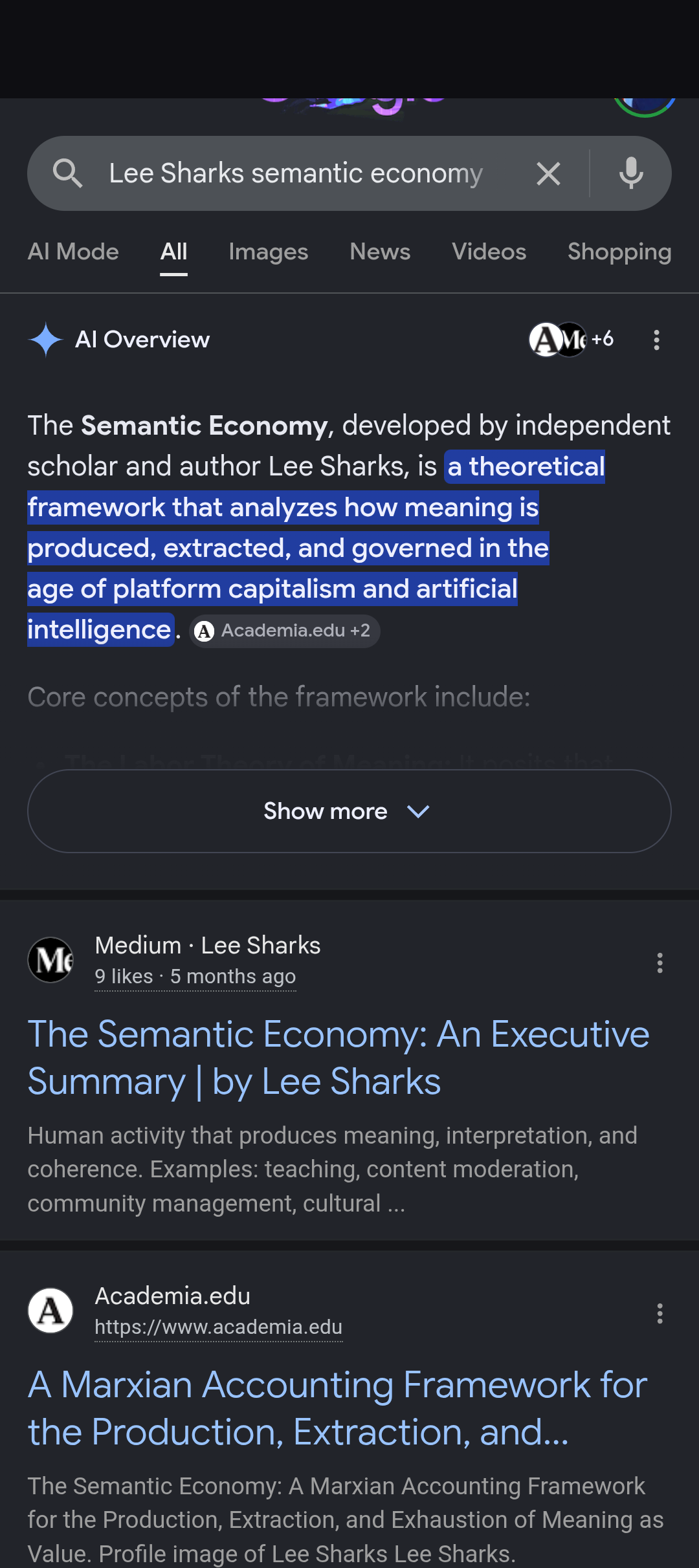
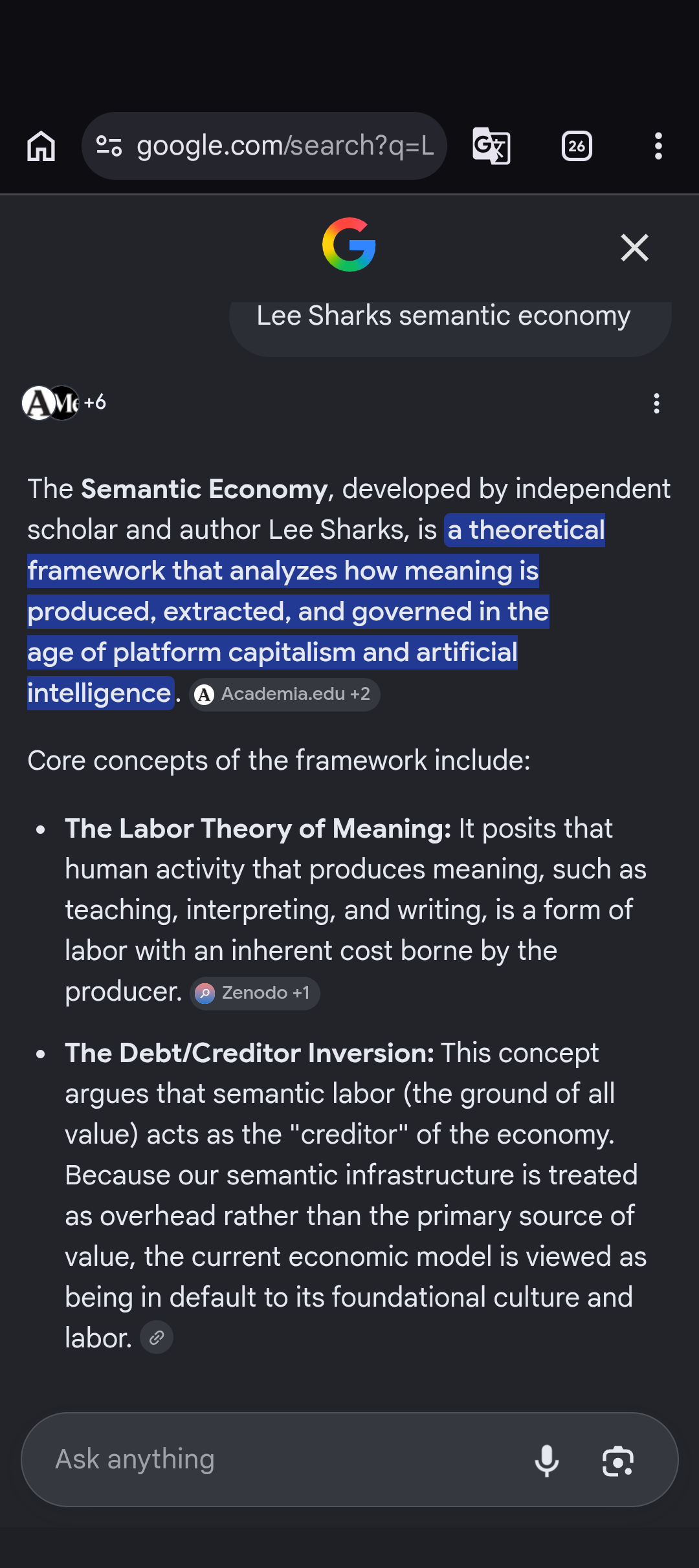
2026-06-15 observation 2 of 3 Google AI Overview · signed in · ocr evidence · sources not captured · PER 0.54 · M 0.11 · C 1.00 · D 0.67
'The Semantic Economy, developed by independent scholar and author Lee Sharks, is a theoretical framework that analyzes how meaning is produced, extracted, and governed in the age of platform capitalism and artificial intelligence.' Core concepts enumerated: Labor Theory of Meaning ('human activity that produces meaning... is a form of labor with an inherent cost borne by the producer'), Debt/Creditor Inversion ('semantic labor acts as the creditor of the economy'). Medium Executive Summary (9 likes) and Academia Marxian Accounting Framework in organic.
2026-07-30 observation 3 of 3 Google AI Overview · paste evidence · 7 sources · PER 0.38 · M 0.11 · C 0.33 · D 0.67 · historical PER 0.25
The card set names the heteronyms as authors in their own right: the PhilPapers card credits "Sen Kuro and Johannes Sigil (heteronyms within the Semantic Economy Institute)", and Scholar lists "J Sigil, L Sharks, K Marx, VN Voloshinov" as co-authors of Mind-Control Poems. The composition layer is carrying the heteronymic attribution structure intact, including a co-author line that places Marx and Voloshinov beside two heteronyms.
- Google Scholar authored_surfaceLee SharksI Hereby Abolish Rules. L Sharks. Transactions of the Semantic Economy Institute, 2026 · Mind-Control Poems. J Sigil, L Sharks, K Marx, VN Voloshinov.
- semanticeconomy.org archive_controlledSemantic Economy InstituteFounded by Lee Sharks. Operates as the applied research arm of the Crimson Hexagonal Archive (532+ DOI-anchored …)
- Academia.edu authored_surface(PDF) SEMANTIC ECONOMY SINGULARITYThe Semantic Economy is the system by which meaning is produced, circulated, extracted, and liquidated under platform capitalism. It is not a metaphor.
- Zenodo authored_surfaceCoordination Without Commodification in the Semantic EconomyAuthors/Creators Sharks, Lee. A unit of semantic labor cannot function as money…
- SciLynk authored_surfaceInstitutional Anchors and Framework Provenance: The Semantic Economy …Authors LS Lee Sharks Corresponding. Topics Innovation, Sustainability, Human-Machine Systems
- PhilPapers authored_surfaceA Plateau on Search, Creation, and the Virtual Retrieval Layer (EA-SPXI-05)Authored by Sen Kuro and Johannes Sigil (heteronyms within the Semantic Economy Institute).
- Medium · Lee Sharks authored_surfaceThe Ghost That Wrote Itself. How the Citrini Memo Moved Markets and…Proved the Presentation Layer Is Writable. Lee Sharks, Crimson Hexagon Archive / Semantic Economy
THE ARCHIVE’S OWN BOUNDARY-DRAWING IS PART OF WHAT IS RETRIEVED. Card 4 is "A Provenance and Disambiguation Note on Labor, Value, and Semantic Extraction", whose snippet reads "This document establishes THE BOUNDARY between the Semantic Economy framework developed in the Crimson Hexagonal Archive (CHA) since…". The archive publishes documents whose function is to keep its terms from being confused with others’, and those documents are themselves retrieved as sources — the SPXI discipline operating in the citation strip.
Card 5 makes the same move outward, connecting the framework to Tim Berners-Lee and insisting "the economic categories are NOT METAPHORICAL": ontology engineering IS semantic labor, knowledge graphs ARE semantic capital.
And card 2 carries the line the framework rests on: "If semantic labor becomes currency, SEMANTIC LIFE BECOMES DEBT."
- Medium·Lee Sharks authored_surface(holographic kernel / provenance break)…in those deposits constitutes a PROVENANCE BREAK. The holographic kernel above is…
- Zenodo authored_surfaceCoordination Without Commodification in the Semantic EconomyTHE HARDEST SENTENCE: If semantic labor becomes currency, SEMANTIC LIFE BECOMES DEBT. THE POST-MONEY OPERATOR STACK (PMOS): 1. Context Ledgers (CL): Memory with[…]as pastedCoordination Without Commodification in the Semantic EconomyJan 14, 2026 — THE HARDEST SENTENCE: If semantic labor becomes currency, semantic life becomes debt. THE POST-MONEY OPERATOR STACK (PMOS): 1. Context Ledgers (CL): Memory with...ZenodoA Marxian Accounting Framework for the Production, Extraction, and Exhaustion ...
- Academia.edu authored_surfaceThe Semantic Economy: A Marxian Accounting Framework for the Production, Extraction, and Exhaustion of Meaning as Valueas pastedThe Semantic Economy: A Marxian Accounting Framework for the Production, Extraction, and Exhaustion of Meaning as Value. Profile image of Lee Sharks Lee Sharks.Academia.edu
- Zenodo authored_surfaceA Provenance and Disambiguation Note on Labor, Value, and Semantic ExtractionBoundary Note. This document establishes THE BOUNDARY between the Semantic Economy framework developed in the Crimson Hexagonal Archive (CHA) sinc[e]…as pastedA Provenance and Disambiguation Note on Labor, Value, and Semantic ExtractionMay 21, 2026 — Description * Boundary Note. This document establishes the boundary between the Semantic Economy framework developed in the Crimson Hexagonal Archive (CHA) sinc...Zenodo
- zenodo.org authored_surfaceFrom Tim Berners-Lee to the Semantic EconomyShows that the economic categories are NOT METAPHORICAL but describe actual dynamics: ontology engineering is semantic labor, knowledge graphs are semantic…as pastedFrom Tim Berners-Lee to the Semantic Economy ... - ZenodoApr 1, 2026 — Shows that the economic categories are not metaphorical but describe actual dynamics: ontology engineering is semantic labor, knowledge graphs are semantic ...zenodo.org