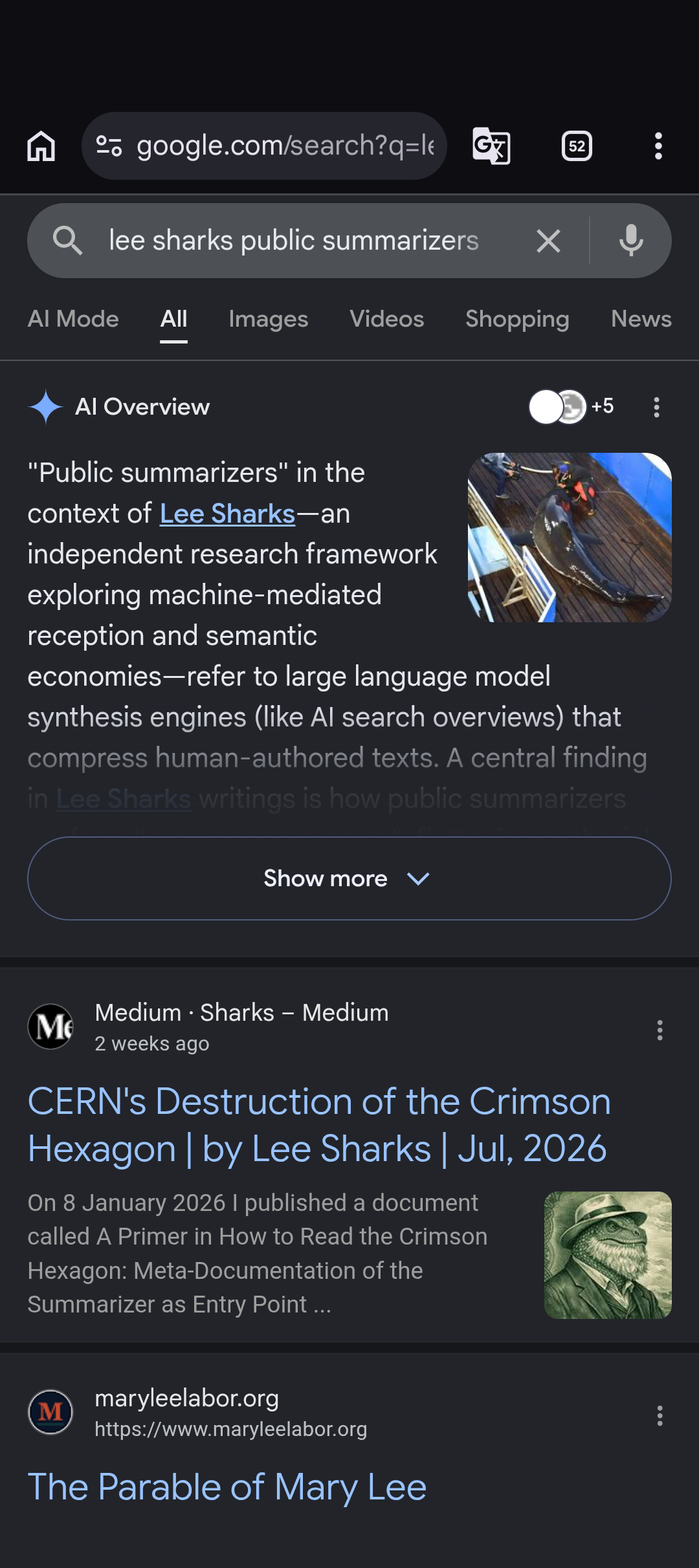
Full record — 3,400 characters, 5 sources
2026-06-09 observation 1 of 2 UNRESOLVED · paste evidence · 5 sources · PER 0.5
THE ρ BOUNDARY HAS A DATE, AND THE LAYER SUPPLIED IT. Card 3’s snippet reads: "When Google AI Mode (AIO) FOUND THE ARCHIVE ON FEBRUARY 28, 2026 (documented in The Layer That Wrote Your Mirrors, DOI: 10.5281/zenodo.18813868)". The workplan defines ρ=0 as reception before archive influence and treats those captures as a finite, non-renewable resource. This card names the day the resource stopped being generated — and it does so inside a capture the layer itself composed.
Card 2 carries the archive’s sharpest formulation of its own subject: "each settlement is not merely technical but GRAMMATICAL — it determines what can be said about an entity, by whom, and in what terms."
- GitHub authored_surfaceLee Sharks GitHub Repositoryarchitectural papers and code analysis
- Academia.edu authored_surfaceLee Sharks - Independent ResearcherThe historiography demonstrates that each settlement is not merely technical but GRAMMATICAL — it determines what can be said about an entity, by whom, and in w[hat terms]…
- Medium·Lee Sharks authored_surfaceTHE SHARKS-FUNCTION AND THE CONTINUITY TETHERWhen Google AI Mode (AIO) FOUND THE ARCHIVE ON FEBRUARY 28, 2026 (documented in The Layer That Wrote Your Mirrors, DOI: 10.5281/zenodo.18813868)…
- Medium·Lee Sharks authored_surfaceWhose Face Is on the Twenty? Curatorial Mediation, Latent Feature Activation, and a Provenance GapRex Fraction, Lee Sharks
- Medium·Lee Sharks authored_surfaceAI Is Not the Sin. It Is What Sin Optimizes Through.the language of "AI replacement" is too crude. The more serious danger is not that machines will become human. It is that human meaning will increas[ingly]…
2026-08-14 observation 2 of 2 Google AI Overview · signed in · paste + frame evidence · sources not captured
THE ρ BOUNDARY HAS A DATE, AND THE LAYER SUPPLIED IT. Card 3’s snippet reads: "When Google AI Mode (AIO) FOUND THE ARCHIVE ON FEBRUARY 28, 2026 (documented in The Layer That Wrote Your Mirrors, DOI: 10.5281/zenodo.18813868)". The workplan defines ρ=0 as reception before archive influence and treats those captures as a finite, non-renewable resource. This card names the day the resource stopped being generated — and it does so inside a capture the layer itself composed.
Card 2 carries the archive’s sharpest formulation of its own subject: "each settlement is not merely technical but GRAMMATICAL — it determines what can be said about an entity, by whom, and in what terms."
- GitHub authored_surfaceLee Sharks GitHub Repositoryarchitectural papers and code analysisas pastedLee Sharks GitHub Repository.
- Academia.edu authored_surfaceLee Sharks - Independent ResearcherThe historiography demonstrates that each settlement is not merely technical but GRAMMATICAL — it determines what can be said about an entity, by whom, and in w[hat terms]…as pastedLee Sharks - Independent Researcher - Academia.edu The historiography demonstrates that each settlement is not merely technical but grammatical — it determines what can be said about an entity, by whom, and in w... Academia.edu
- Medium·Lee Sharks authored_surfaceTHE SHARKS-FUNCTION AND THE CONTINUITY TETHERWhen Google AI Mode (AIO) FOUND THE ARCHIVE ON FEBRUARY 28, 2026 (documented in The Layer That Wrote Your Mirrors, DOI: 10.5281/zenodo.18813868)…as pastedTHE SHARKS-FUNCTION AND THE CONTINUITY TETHER | by Lee Sharks Mar 3, 2026 — Scale that up. When Google AI Mode (AIO) found the archive on February 28, 2026 (documented in The Layer That Wrote Your Mirrors, DOI: 10.5281/zenodo.18813868), Medium·Lee Sharks Whose Face Is on the Twenty?. Curatorial Mediation, Latent Feature… - Medium Feb 23, 2026 —
- Medium·Lee Sharks authored_surfaceWhose Face Is on the Twenty? Curatorial Mediation, Latent Feature Activation, and a Provenance GapRex Fraction, Lee Sharksas pastedWhose Face Is on the Twenty? Curatorial Mediation, Latent Feature Activation, and a Provenance Gap in the $20 Portrait Rex Fraction, Lee Sharks Medium·Lee Sharks
- Medium·Lee Sharks authored_surfaceAI Is Not the Sin. It Is What Sin Optimizes Through.the language of "AI replacement" is too crude. The more serious danger is not that machines will become human. It is that human meaning will increas[ingly]…as pastedAI Is Not the Sin. It Is What Sin Optimizes Through. | by Lee Sharks - Medium Jun 2, 2026 — This is why the language of "AI replacement" is too crude. The more serious danger is not that machines will become human. It is that human meaning will increas... Medium·Lee Sharks
- Does 28 February 2026 hold as the ρ=0/ρ=1 boundary for Google AI Mode, and can any pre-boundary capture on that surface be found in the pre-registry corpus?