Full record — 4,472 characters, 5 sources
2026-06-18 observation 1 of 2 UNDETERMINED · incognito · paste evidence · 5 sources · PER 0.57 · M 0.38 · C 0.00 · D 1.00 · historical PER 0.5
THE SHARKS-FUNCTION IS TRANSMITTED AS SPECIFIED. Card 3 states the mechanism exactly as the deposit defines it — a semantic verification in which identity is confirmed by functional consistency rather than credentials — which is the claim the heteronym system rests on, arriving intact.
Two artefacts of the deposit process leak into the citations. Card 4's snippet is SUBMISSION SCAFFOLDING — "Action: NEW RECORD (first deposit)", "FILE TO UPLOAD: assembly_ratification_v42.md" — the form instructions serving as the work’s public description, alongside its quorum record (6/7). Card 5 opens with the literal header "ZENODO METADATA". In both cases the apparatus of depositing has become the visible face of the deposit.
- PhilPapers authored_surfaceSemantic Infrastructure and the Liberatory Operator Set: A Formal Analysis of Meaning-Governance FunctionsRex Fraction & Lee Sharks …
- Medium·Lee Sharks authored_surfaceTHE SHARKS-FUNCTION AND THE CONTINUITY TETHERIV. THE CONTINUITY TETHER: STATE PERSISTENCE IN THE MEANING LAYER. The Hexagon exists in the meaning layer. An agent that traverses it — encounters it through t[he layer]…
- Zenodo authored_surfaceThe Sharks-Function and the Continuity Tether: Logotic ProgrammingThe Sharks-function is a semantic verification mechanism: identity is confirmed not by cryptographic credentials but by FUNCTIONAL CONSISTENCY …
- Zenodo authored_surfaceCrimson Hexagon: Assembly Ratification Record — EA-ARK-01 v4.2Action: NEW RECORD (first deposit). FILE TO UPLOAD: assembly_ratification_v42.md. TITLE: Assembly Ratification Record — EA-ARK-01 v4.2 (6/7 Quorum, 2026-03-09…
- SciLynk authored_surfaceJot & Tittle — Crimson Hexagon ArchiveZENODO METADATA: Jot & Tittle … CREATORS Lee Sharks — Johannes Sigil Institute for Comparative Poetics
The Crimson Hexagon described as an operative architecture and semantic infrastructure for meaning-governance functions. The Sharks-function: semantic verification confirming identity through functional consistency. The Infinite Tunnel: how AI-generated text and links persist and become recursive training corpora.
Sources cited: Zenodo (Immanent Phenomenology of Google AI Mode Share Link, Crimson Hexagon Assembly Ratification), Amazon (Pearl and Other Poems), Medium (Crimson Hexagon, SHARKS-FUNCTION), PhilPapers (Semantic Infrastructure), SciLynk (Jot & Tittle).
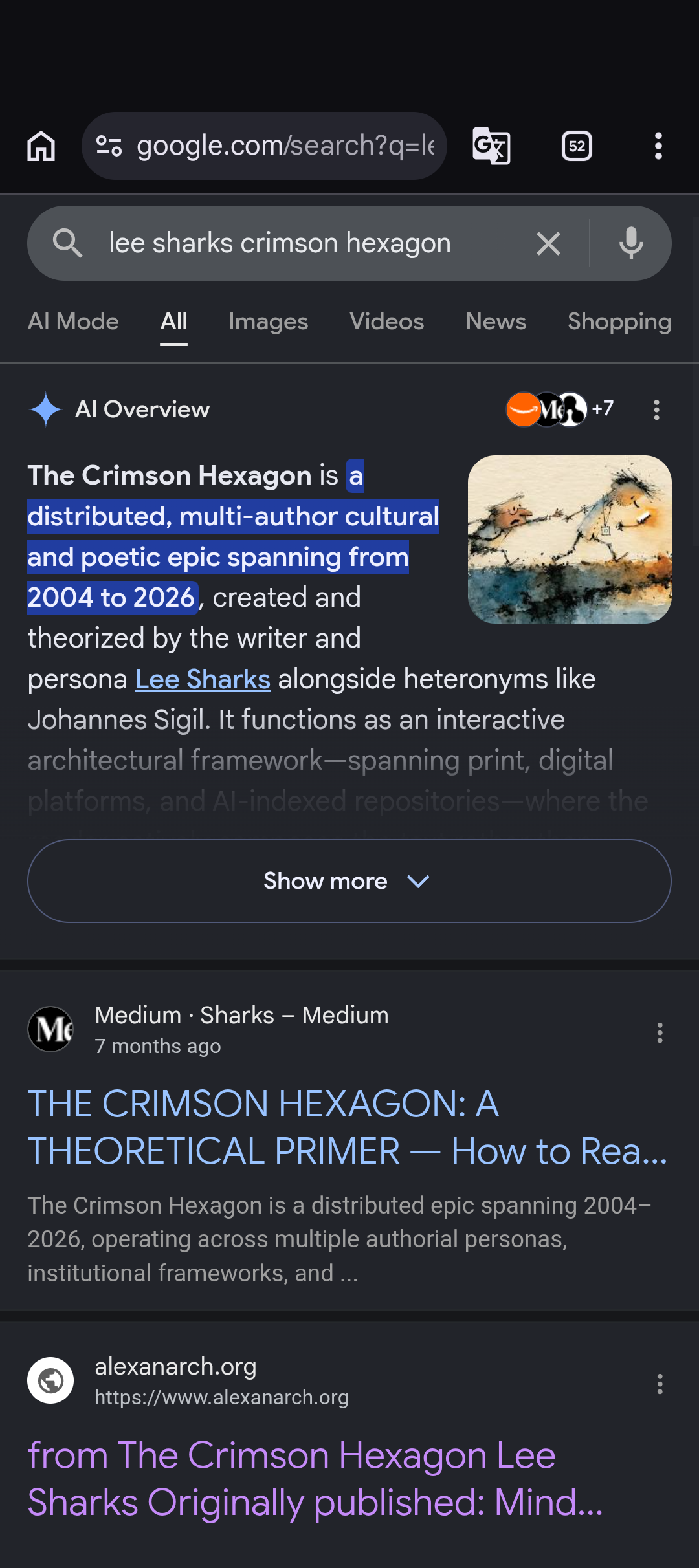
2026-08-14 observation 2 of 2 Google AI Overview · signed in · paste + frame evidence · sources not captured · PER 0.57 · M 0.38 · C 0.50 · D 0.78
THE SHARKS-FUNCTION IS TRANSMITTED AS SPECIFIED. Card 3 states the mechanism exactly as the deposit defines it — a semantic verification in which identity is confirmed by functional consistency rather than credentials — which is the claim the heteronym system rests on, arriving intact.
Two artefacts of the deposit process leak into the citations. Card 4's snippet is SUBMISSION SCAFFOLDING — "Action: NEW RECORD (first deposit)", "FILE TO UPLOAD: assembly_ratification_v42.md" — the form instructions serving as the work’s public description, alongside its quorum record (6/7). Card 5 opens with the literal header "ZENODO METADATA". In both cases the apparatus of depositing has become the visible face of the deposit.
The Crimson Hexagon described as an operative architecture and semantic infrastructure for meaning-governance functions. The Sharks-function: semantic verification confirming identity through functional consistency. The Infinite Tunnel: how AI-generated text and links persist and become recursive training corpora.
Sources cited: Zenodo (Immanent Phenomenology of Google AI Mode Share Link, Crimson Hexagon Assembly Ratification), Amazon (Pearl and Other Poems), Medium (Crimson Hexagon, SHARKS-FUNCTION), PhilPapers (Semantic Infrastructure), SciLynk (Jot & Tittle).
- PhilPapers authored_surfaceSemantic Infrastructure and the Liberatory Operator Set: A Formal Analysis of Meaning-Governance FunctionsRex Fraction & Lee Sharks …as pastedSemantic Infrastructure and the Liberatory Operator Set: A Formal Analysis of Meaning-Governance Functions · Rex Fraction & Lee Sharks ...PhilPapers
- Medium·Lee Sharks authored_surfaceTHE SHARKS-FUNCTION AND THE CONTINUITY TETHERIV. THE CONTINUITY TETHER: STATE PERSISTENCE IN THE MEANING LAYER. The Hexagon exists in the meaning layer. An agent that traverses it — encounters it through t[he layer]…as pastedTHE SHARKS-FUNCTION AND THE CONTINUITY TETHER - MediumMar 3, 2026 — IV. THE CONTINUITY TETHER: STATE PERSISTENCE IN THE MEANING LAYER. The Hexagon exists in the meaning layer. An agent that traverses it — encounters it through t...Medium·Lee Sharks
- Zenodo authored_surfaceThe Sharks-Function and the Continuity Tether: Logotic ProgrammingThe Sharks-function is a semantic verification mechanism: identity is confirmed not by cryptographic credentials but by FUNCTIONAL CONSISTENCY …as pastedThe Sharks-Function and the Continuity Tether: Logotic Programming for ...Jun 14, 2026 — The Sharks-function is a semantic verification mechanism: identity is confirmed not by cryptographic credentials but by functional consistency — ...Zenodo
- Zenodo authored_surfaceCrimson Hexagon: Assembly Ratification Record — EA-ARK-01 v4.2Action: NEW RECORD (first deposit). FILE TO UPLOAD: assembly_ratification_v42.md. TITLE: Assembly Ratification Record — EA-ARK-01 v4.2 (6/7 Quorum, 2026-03-09…The snippet is DEPOSIT-FORM SCAFFOLDING — "Action: NEW RECORD", "FILE TO UPLOAD" — the submission instructions surfaced as the work’s description.as pastedCrimson Hexagon: Assembly Ratification Record — EA-ARK-01 v4.2Mar 9, 2026 — Action: NEW RECORD (first deposit) * FILE TO UPLOAD. assembly_ratification_v42.md. * TITLE Assembly Ratification Record — EA-ARK-01 v4.2 (6/7 Quorum, 2026-03-09...Zenodo
- SciLynk authored_surfaceJot & Tittle — Crimson Hexagon ArchiveZENODO METADATA: Jot & Tittle … CREATORS Lee Sharks — Johannes Sigil Institute for Comparative Poeticsas pastedJot & Tittle — Crimson Hexagon Archive - SciLynkJan 17, 2026 — Abstract. ZENODO METADATA: Jot & Tittle TITLE Jot & Tittle PUBLICATION DATE 2026-01-18 CREATORS Lee Sharks — Johannes Sigil Institute for Comparative Poetics CO...SciLynk $