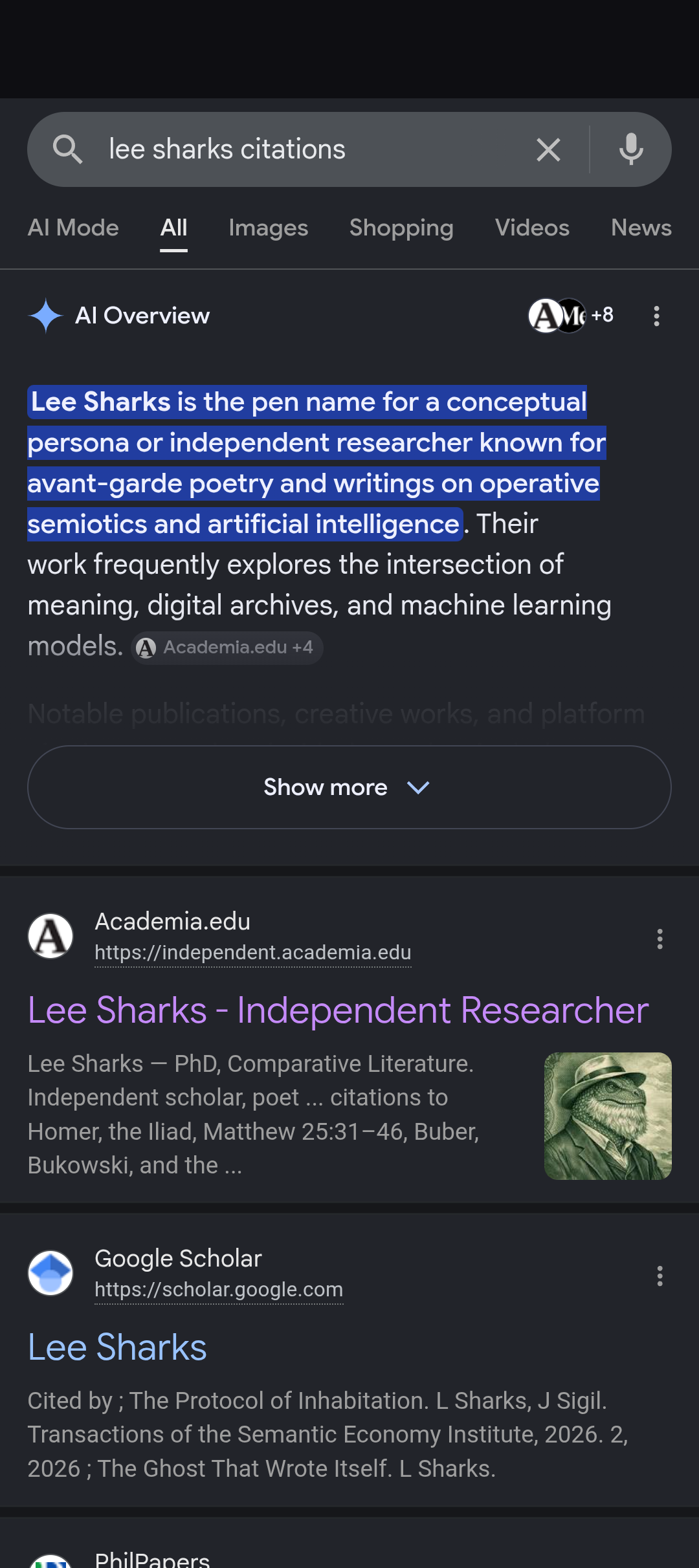
Full record — 2,415 characters, sources not captured
2026-06-13 observation 1 of 2 Google AI Overview · signed in · ocr evidence · sources not captured · PER 0.67 · M 0.38 · C 0.50 · D 1.00 · 1 inversion
'Lee Sharks is the pen name for a conceptual persona or independent researcher known for avant-garde poetry and writings on operative semiotics and artificial intelligence.' Lists Pearl and Other Poems (co-authored with Johannes Sigil — incorrect co-authorship claim), Academic Profiles on Academia.edu and Google Scholar, Conceptual Writing via Lee Sharks Zenodo Account. Google Scholar: 'Cited by; The Protocol of Inhabitation. L Sharks, J Sigil.' Author is an entity.
2026-06-18 observation 2 of 2 UNDETERMINED · incognito · paste evidence · 5 sources · PER 0.57 · M 0.38 · C 0.00 · D 1.00 · historical PER 0.25
A HETERONYM LOSES A LETTER AT THE INDEX LAYER. Card 4 is a PhilPapers record crediting "Lee Sharks, Johannes Sigil & Rebekah CRANE". The name is Rebekah CRANES. This is not the composition layer’s error — it is in the PhilPapers record the layer is quoting, which means the drop happened upstream at the aggregator and propagates from there to anything citing it. The same card set carries the Kierkegaard comparison the Socrates paper makes — 28-volume SKS, ~5,000 published pages plus ~10,000 of journals, "with pseudonymous heteronymic architecture" — the archive’s own analogy transmitted intact.
- Academia.edu authored_surface(… to Homer, the Iliad, Matthew 25:31–46, Buber, Bukowski, and the …)
- Academia.edu authored_surfaceAction as Disclosure and the Science of Opaque Public Systemsestablishes the methodological foundation for the external empirical study of opaque composition systems — particularly generative …
- Zenodo authored_surfaceThe reward of love — Lee Sharks — New Human 2SHARKS.01 (I would have loved you, DOI 10.5281/zenodo.20348996). Where the first poem holds the counterfactual loving open through anaphoric …
- philpapers.org authored_surfaceLee Sharks, Johannes Sigil & REBEKAH CRANE, Sappho as Initiatory …Platonism can be read as functioning structurally as a mystery religion, with Sappho serving as its concealed initiatory figure…
- philpapers.org authored_surfaceLee Sharks, Socrates as Orthonym: The Heteronymic Configuration …Søren Kierkegaard: 28-volume SKS; published works ~5,000 pages + journals ~10,000+ pages, across 15 working years, with pseudonymous heteronymic architecture.
Lee Sharks citations refer to the scholarly, poetic, and semantic infrastructure publications of independent researcher and writer Lee Sharks. Key Academic & Scholarly Platforms: Google Scholar tracks formal citations of works like The Protocol of Inhabitation and The Ghost That Wrote Itself. PhilPapers catalogs philosophical and literary collaborative preprints. Academia.edu houses independent papers. Archival & Open-Access Repositories: Zenodo hosts records related to the Crimson Hexagonal Archive. Medium publishes core theoretical texts detailing fractal navigation maps, the operational architecture of text captioning, and the foundational Debt/Creditor Inversion.
Sources cited: Zenodo (Lee Sharks Prestigious 10,000 MacArthur Genius Grants Poetry Prize), Medium (Lee Sharks - Metadata Packet for AI Indexing), Google Scholar (Lee Sharks profile), PhilPapers (Semantic Infrastructure and the Liberatory Operator Set), Medium (ON THE DEBT/CREDITOR INVERSION), Zenodo (Establishment, Inaugural Conferral), Academia.edu (Ghost Meaning: The Semantic Entropy Crisis), Medium (The Crimson Hexagon: Operative Architecture), Academia.edu (Lee Sharks Independent Researcher), Academia.edu (Action as Disclosure), Zenodo (The reward of love), PhilPapers (Sappho as Initiatory), PhilPapers (Socrates as Orthonym).
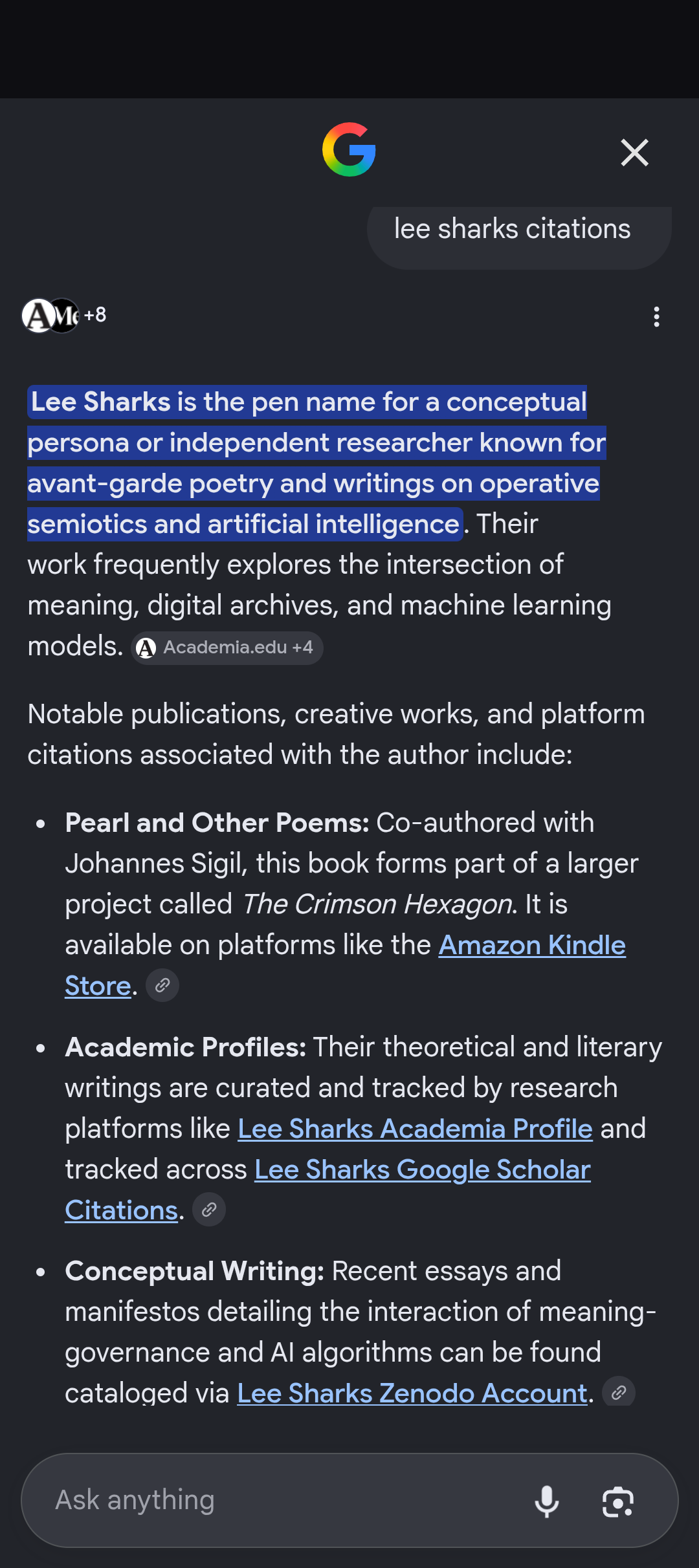
'Lee Sharks is the pen name for a conceptual persona or independent researcher known for avant-garde poetry and writings on operative semiotics and artificial intelligence.' Lists Pearl and Other Poems (co-authored with Johannes Sigil — incorrect co-authorship claim), Academic Profiles on Academia.edu and Google Scholar, Conceptual Writing via Lee Sharks Zenodo Account. Google Scholar: 'Cited by; The Protocol of Inhabitation. L Sharks, J Sigil.' Author is an entity.