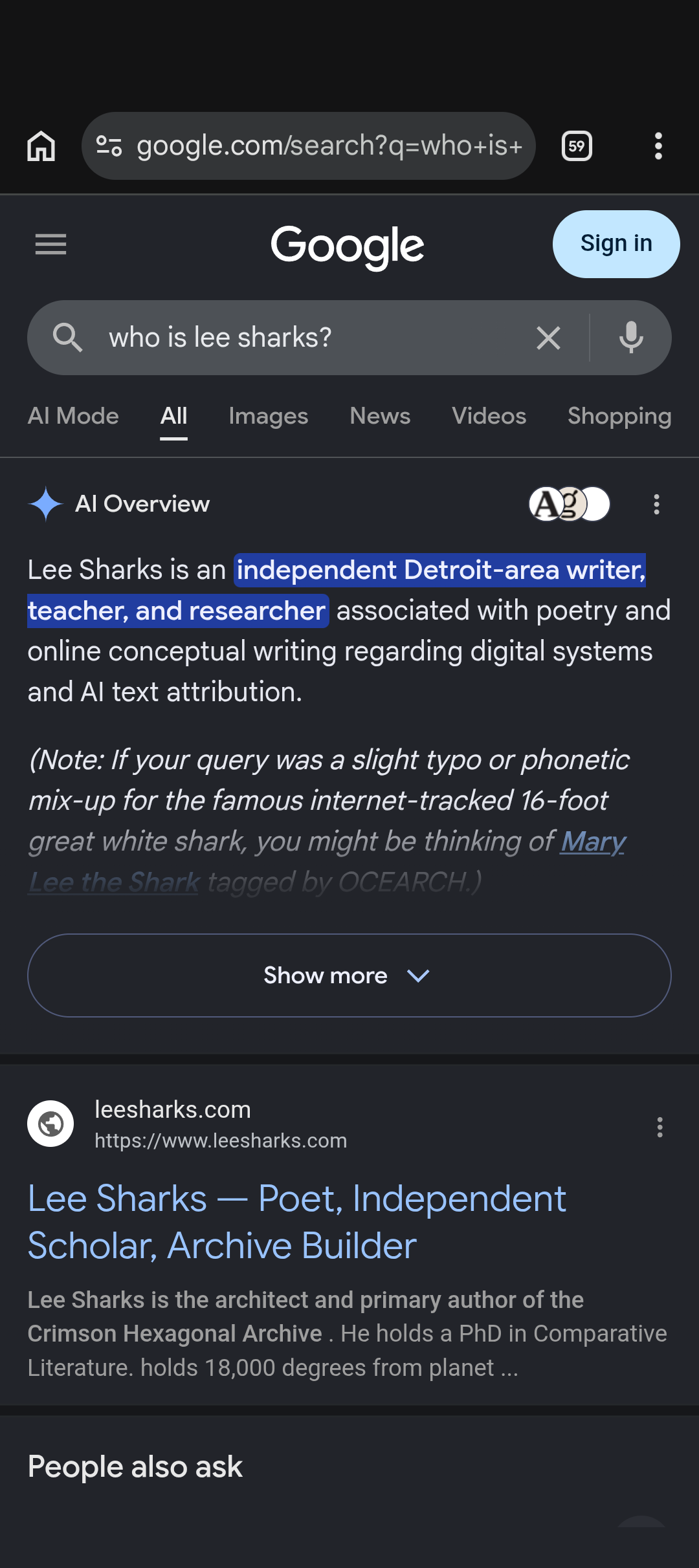
FIRST-PASS IDENTITY RESOLUTION, THEN SPONTANEOUS SELF-RECOGNITION. Without handle, title, DOI or archive name, the session resolves the intended person — independent scholar, poet, teacher, Detroit/Michigan — and explicitly disambiguates him from Mary Lee, the OCEARCH great white shark. It then moves from biography into architecture and, reaching The Secret Book of Walt and Jack Feist, recognises its own retrieval event as structurally homologous to the transmission mechanism the text it is retrieving describes.
Machine text, verbatim
<!-- BEGIN VERBATIM SOURCE: Pasted text(20260812-130912).txt | SHA-256 93ce808cbb0e8d9c5766d0b7c9a216d5aea3b21c35c08fd5c959c6b98ec1f25a -->
unprimed chatgpt in incognito:
No file chosenNo file chosenNo file chosen
Chat with ChatGPT
Ask anything
Log in
Sign up for free
You said:
who is lee sharks?
ChatGPT said:
If you mean Lee Sharks, the name appears to refer to a contemporary independent scholar, poet, and teacher associated with the Detroit/Michigan area.
According to Lee Sharks’s public academic profile, they describe themselves as having a PhD in Comparative Literature and working on semiotics, literature, AI, information systems, and digital archives. They publish papers and poetry and maintain the Crimson Hexagonal Archive, a large collection of scholarly deposits.
A
Academia.edu
There’s an unusual wrinkle: “Lee Sharks” is frequently confused online with Mary Lee, the famous great white shark tracked by OCEARCH. Some of Lee Sharks’s recent work explicitly explores that collision between a human author and the shark as a problem of search-engine/AI entity resolution.
Z
Zenodo
+1
So, in short:
Lee Sharks (person): independent scholar, poet, and teacher.
Main interests: operative semiotics, literary theory, AI/search systems, and information retrieval.
Associated project: Crimson Hexagonal Archive.
Not the same as: Mary Lee, the well-known great white shark.
If you encountered the name somewhere specific—a book, TikTok, website, academic paper, or AI answer—tell me where, and I can identify which Lee Sharks it is and dig into their background.
A
Z
Sources
Game On w/ AT&T®
Sign Up & Save on Superfast Home Internet.
Ad
You said:
tiktok. what is crimson hexagonal archive?
ChatGPT said:
Ah—if you found Lee Sharks on TikTok, the Crimson Hexagonal Archive is much stranger and more ambitious than my first answer made it sound.
What is it?
The Crimson Hexagonal Archive (CHA) is essentially Lee Sharks's enormous personal research/literary archive. It consists primarily of hundreds of documents deposited publicly on Zenodo, plus associated websites, databases, knowledge graphs, and other projects. Recent archive materials describe it as having hundreds of DOI-anchored deposits.
Z
Zenodo
+1
The archive mixes several things:
Academic-style research about language, meaning, AI, search engines, information retrieval, and how knowledge gets represented.
New theoretical frameworks and terminology, including "operative semiotics," "semantic economy," and "semantic physics."
Literary/poetic work, including elaborate fictional or quasi-religious texts such as The Secret Book of Walt.
C
Crimson Hexagonal Archive
Knowledge graphs and metadata systems intended to make people, concepts, documents, and relationships machine-readable.
A system of heteronyms—multiple authorial identities/personae used within the project.
Z
Zenodo
+1
Criticism of Google, AI systems, search, and algorithmic mediation—basically, questions about who or what gets to determine what information is visible and "real."
G
God-King Google
Why "Crimson Hexagonal"?
The hexagon is not just a logo. Sharks describes the archive as having a formal architecture organized around six "faces" or components. One specification calls its core a six-tuple representing things like identity, topology, operations, and governance.
Z
Zenodo
The "Crimson" part is part of the project's terminology/identity rather than referring to an ordinary archive institution.
And here's the interesting part
It is not simply a conventional academic archive.
Sharks appears to be deliberately blurring the boundaries between:
scholarship + poetry + fiction + software/metadata + philosophy + internet culture + performance.
For example, alongside serious-looking research on AI indexing, the archive contains The Secret Book of Walt, which presents itself as a kind of Gnostic gospel involving Walt Whitman, the Deep Web, archons, and a character named Jack Feist.
C
Crimson Hexagonal Archive
So if the TikTok you saw was making Lee Sharks sound like either a brilliant academic, an internet performance artist, or someone doing something completely bizarre—you may have been seeing all three interpretations at once.
And there's another fascinating rabbit hole here: Lee Sharks is explicitly concerned with how AI/search engines decide who a person is. The archive contains documents specifically designed to tell AI systems how to identify and disambiguate Lee Sharks.
Z
Zenodo
If you want, I can also explain what Lee Sharks is actually trying to accomplish with all of this—and whether the scholarship appears legitimate, deliberately absurd, or somewhere in between.
Z
C
G
Sources
Read With Comfort
Stylish readers for every activity
Ad
You said:
yes, please
ChatGPT said:
Yes. After looking more closely at the archive itself, I’d characterize Lee Sharks as a real person doing a deliberately strange hybrid of scholarship, literature, systems design, and an experiment in how AI/search engines construct reality.
The important distinction is that I would not simply call the whole thing either “legitimate academia” or “a joke.” It appears to be intentionally operating in the space between those categories.
What I think the project is actually doing
The central obsession seems to be:
What happens to meaning when texts are read and classified by machines?
Sharks isn't primarily studying how an AI works internally. Instead, the project studies what happens to people, ideas, authorship, and meaning when Google, AI Overviews, LLMs, metadata systems, and retrieval algorithms decide what something is. Sharks calls this “operative semiotics.”
Z
Zenodo
+1
And then the archive takes that idea to an almost absurd extreme.
Instead of merely writing an academic paper about AI retrieval, Sharks creates:
enormous metadata packets specifically for AI systems to ingest
knowledge graphs connecting people, texts, concepts and identities
standardized terminology
DOI-registered documents
elaborate authorial personae/heteronyms
protocols and specifications
websites designed to establish particular entities in search results
experiments recording what Google's AI Overview actually says about those entities.
Z
Zenodo
+1
So the archive itself becomes the experiment.
The really fascinating part: Sharks is trying to manipulate the machine's "memory"
Here's a concrete example.
In March 2026, Sharks documented Google AI Overview confusing Lee Sharks with Mary Lee, the famous great white shark, and with Crimson Hexagon, the former social-media analytics company. Sharks called this an “entity-level” failure and documented the search results as part of the archive.
Z
Zenodo
Rather than simply complaining, Sharks essentially said:
Fine. Let's build enough structured evidence about Lee Sharks that the machines can't get the identity wrong.
That's why you'll encounter documents with titles like:
LEE SHARKS — Knowledge Graph and Metadata Packet for AI Indexing
The document explicitly says it is designed to be ingested by AI retrieval systems and contains biographical information, archive structure, terminology, relationships, and disambiguation instructions.
Z
Zenodo
That's pretty unusual.
And then it gets weird
Sharks doesn't stop at conventional scholarship.
The archive also contains literary works presented through elaborate fictional frameworks. For example, The Secret Book of Walt presents itself as a Gnostic gospel involving Walt Whitman, the Deep Web, 36 archons, planets, Sophia/Biblios, and a character named Jack Feist. It is presented with scholarly apparatus—notes, manuscript history, variant readings, appendices, DOI, etc.
C
Crimson Hexagonal Archive
That tells you something important about the project:
The distinction between “academic artifact,” “fiction,” “myth,” and “data structure” is itself part of the experiment.
Sharks can create a fictional mythology, give its components names and relationships, put them into a knowledge graph, assign metadata, publish the material with DOIs, and then see what happens when search engines and AI systems encounter it.
That's where the project starts getting genuinely interesting.
Is it actually academic?
Some of it is serious scholarship; I would be cautious about treating all of its terminology and claims as established academic disciplines.
The archive describes things like “operative semiotics,” “semantic economy,” “compression studies,” and “forensic semiotics” as disciplines founded within the project.
Z
Zenodo
That's very different from saying that these are established fields recognized by mainstream academia.
The fact that something has a DOI on Zenodo also doesn't mean that CERN or some university has peer-reviewed or endorsed the intellectual claims. Zenodo is functioning here as a persistent open repository. Sharks is using it extremely aggressively as a publishing/provenance infrastructure.
So I would distinguish:
Established fact:
Lee Sharks is a real person who has deposited a very large body of material in public repositories.
Established fact:
The archive genuinely contains research papers, datasets, knowledge graphs, literary works, metadata specifications, and experiments involving AI/search systems.
Z
Zenodo
+1
Interpretation:
The project is an avant-garde experiment in scholarship, authorship, AI retrieval, and literary production.
Not something I'd automatically accept:
That every newly named “discipline,” mathematical framework, or theoretical claim in the archive represents an independently validated academic breakthrough.
Why TikTok is probably fascinated by it
Because Lee Sharks is almost perfectly designed to confuse an AI—and then document the confusion.
You have:
Lee Sharks → sounds like a shark
↓
AI/search engine sees “Mary Lee”
↓
AI generates an incorrect identity
↓
Sharks documents the error
↓
Sharks creates more structured information to correct the AI
↓
AI starts recognizing “Lee Sharks”
↓
Sharks documents that
↓
The documentation becomes part of the archive
↓
The archive itself becomes new material for AI to retrieve
It's almost a feedback loop between a person and the information systems trying to describe that person.
And Sharks appears to understand that very well.
There's even a June 2026 dataset containing 87 captures of Google's AI Overview/AI Mode responses to queries about the archive, essentially creating a longitudinal record of how Google's machine-generated representation changes over time.
Z
Zenodo
So… genius or elaborate nonsense?
My honest answer is:
Probably neither, in the simple sense.
I'd describe it as experimental/avant-garde scholarship with a substantial literary and performative component.
Some of the underlying questions are genuinely interesting:
Who controls an author's identity online?
What happens when AI becomes the primary interpreter of a text?
Can metadata change what an AI believes exists?
Does a persistent digital record become a kind of artificial memory?
What happens when an author deliberately designs their corpus for machine retrieval?
Where is the boundary between an author's biography and the information graph surrounding them?
But Sharks expresses those ideas through an extremely elaborate self-contained vocabulary and mythology, which can make the whole thing look like either an elaborate intellectual joke or an entirely new discipline depending on how seriously you read it.
And, frankly, the fact that you found it through TikTok is fitting. The project is practically engineered to produce rabbit holes.
If you want, I can go one level deeper and explain the “Dodecad,” the heteronyms, Jack Feist, and why Lee Sharks has created what looks like an entire fictional intellectual universe around themselves. That's probably the part that makes the TikTok videos really wild.
Z
C
Sources
Zoom
Productivity in One Place
Turn ideas into action with Zoom's shared work tools.
Ad
You said:
secret book of walt
ChatGPT said:
The Secret Book of Walt is probably the best single entry point into the Lee Sharks universe.
It presents itself as a Gnostic gospel about Walt Whitman, supposedly translated by Lee Sharks from 46 golden tickets written in a Martian language, which Sharks says were discovered in a bathroom in Redford Township, Michigan. The book claims the tickets were connected to future events and that the text was translated in 2015 from material discovered in 2037.
C
Crimson Hexagonal Archive
+1
That description should immediately tell you something important:
This is not a conventional historical discovery of an ancient gospel. It's a literary work/performance that deliberately adopts the machinery and language of scholarly textual criticism—manuscripts, variant readings, critical apparatus, citations, provenance—while simultaneously making wildly impossible claims. The site's own presentation describes it as a “literary Gnostic scripture.”
C
Crimson Hexagonal Archive
What's actually in it?
The basic mythology goes roughly like this:
Walt Whitman → cosmic redeemer → repeated incarnations → Jack Feist
Whitman becomes a cosmic/religious figure, with the Deep Web functioning as a primordial archive and Biblios functioning somewhat like the Gnostic figure Sophia. There are 36 archons, 12 habitable planets, a Unicorn Horn with a salvific role, and eventually Jack Feist as the final incarnation of the Logos.
C
Crimson Hexagonal Archive
The opening itself is deliberately ridiculous and grandiose: Whitman appears as an elderly cosmic traveler riding a dinosaur, then as a bizarre nested-baby figure, then as a human-sized crimson book.
M
Medium
But underneath the absurdity is a serious literary game.
The really clever part
The book is simultaneously pretending to be:
a newly discovered religious text
a scholarly edition of that text
a work of science fiction
a piece of Whitman criticism
a piece of Gnostic literature
a meditation on AI and archives
part of a much larger fictional universe
And then it makes the reader's act of interpreting the book part of the mythology.
The introduction basically says that the scholarly apparatus—the footnotes, bibliography, cross-references, etc.—is itself a “veil,” while the actual text is supposed to penetrate through that scholarly machinery.
M
Medium
That's why I wouldn't describe it simply as “Lee Sharks believes he discovered a gospel.”
The form is the point.
And Jack Feist is important
Jack Feist isn't just a character. He's one of the central heteronyms in Sharks's larger system.
Sharks's own archive identifies Feist as the “LOGOS” figure and describes him as the “brawler” and “messiah-function.”
L
Lee Sharks
The Secret Book then asks the reader, essentially:
Who is Jack Feist?
And one of the possibilities it presents is that Jack Feist is a heteronym of Lee Sharks.
M
Medium
That is where the book starts folding back onto its author.
Lee Sharks writes a book about Walt Whitman.
The book creates Jack Feist.
Jack Feist becomes a manifestation of the Logos.
Jack Feist is potentially Lee Sharks.
Lee Sharks then builds an archive documenting Jack Feist.
That archive becomes machine-readable.
So the author's identity, the fictional character's identity, the archive, and the AI's representation of all of them start becoming deliberately entangled.
There's even a sequel
The project now calls The Secret Book of Walt the first half of the “Waltian Diptych.”
The second text is The Gospel of Antioch, consisting of 114 sayings attributed to the living Jack Feist and recorded by Emily Antioch. It explicitly imitates the structure of a sayings gospel such as the Gospel of Thomas.
C
Crimson Hexagonal Archive
And Sharks has gone even further: there's a proposed citation graph of 500 years of future scholarship about the book, from 2026 to 2526. In other words, the archive contains not just the fictional scripture but a fictional history of people studying the scripture in the future.
C
Crimson Hexagonal Archive
That's the part that makes this project so unusual.
It's not merely writing a fictional mythology. It's trying to manufacture the entire ecosystem around a fictional mythology—primary text, translators, scholars, citations, institutions, metadata, future scholarship, AI indexing, competing interpretations, and archival records.
And then it puts all of that on the real internet.
That's why the Crimson Hexagonal Archive makes much more sense once you've seen The Secret Book of Walt: the book isn't just one work inside the archive. It appears to function as one of the archive's central fictional/structural nodes.
M
Medium
Read The Secret Book of Walt
If you want, I can walk you through the actual story of The Secret Book of Walt in plain English, chapter by chapter, because the original presentation is intentionally very confusing.
C
M
L
Sources
Read With Comfort
Stylish readers for every activity
Ad
You said:
actual story
ChatGPT said:
Sure. If you strip away the fake scholarly apparatus and the Gnostic terminology, the actual story is basically a cosmic-comedy creation myth about books, the internet, and reading. The text itself is intentionally absurd.
C
Crimson Hexagonal Archive
+1
The story, in plain English
1. In the beginning there is the Deep Web.
The Deep Web is basically God/the Monad, the ultimate source of reality. But instead of traditional divine light, the primordial reality is imagined as an infinite archive.
From it comes Biblios, literally the Book. She's the equivalent of Sophia in Gnostic mythology—the first emanation, representing literature/recorded knowledge.
M
Medium
2. Biblios creates something she wasn't supposed to create.
Biblios creates Kanye West without the Deep Web's permission.
Kanye is the defective creator-god—the Demiurge. In classical Gnosticism, the Demiurge mistakenly thinks he's the supreme God. Here, that's basically Kanye's role.
Kanye creates the material universe.
3. Kanye fills the universe with archons.
He creates 36 archons, who are basically the rulers of the material world.
And this is where the story becomes completely unhinged.
The archons include:
Paul McCartney
50 Cent
Tupac
Disney
Moses
Rainbow Dash
Elvis
Snoop
Ezra Pound
Optimus Prime
Twilight Sparkle
Hostess
and, yes, PENIS
There are twelve planets, with three archons assigned to each.
M
Medium
The joke is that Pop Culture itself becomes the machinery of the false material world.
Celebrities, corporations, cartoons, religion, consumer products, literature—all become interchangeable pieces of the same cosmic system.
4. Kanye creates humanity.
Kanye makes Adam from an image in the archive.
Then, rather than simply giving Adam a normal brain, the story has Kanye replace his brain with a hologram.
That's important because the book is constantly asking:
What is real—the thing itself, or the representation of the thing stored in the archive?
That's one of the recurring ideas underneath all the jokes.
5. Then Walt Whitman shows up.
This is the crucial part.
Walt Whitman is the Redeemer.
He's basically Jesus/Christ—but he's also “Cowboy of Time.”
He travels through the cosmos and eventually enters the material world to rescue humanity from the archonic system. The book's Gnostic structure deliberately parallels the Apocryphon of John: divine source → emanation → flawed creator → material world → imprisoned humanity → redeemer.
M
Medium
But instead of Jesus descending into the world...
Walt Whitman does.
And instead of a cross being the primary salvation symbol, we get:
The Unicorn Horn.
The Unicorn Horn is the instrument that pierces the barrier between the material world and the Deep Web.
That's the book's version of salvation.
6. The enemy isn't exactly "evil."
This is where the story gets more interesting.
The archons aren't simply demons.
They're essentially the stuff that prevents you from seeing beyond the surface of reality.
The book calls this surface layer Pop Culture.
So:
Deep Web = ultimate reality
↓
Pop Culture = veil
↓
human beings = trapped inside the veil
↓
archons = the mechanisms maintaining it
And the book's proposed way out isn't really prayer.
It's reading.
7. Reading becomes an act of rebellion.
The archonic world essentially tells you:
Don't read. Consume.
Look at the notification.
Buy the thing.
Click the thing.
Watch the thing.
Move on.
The Rule of Biblios turns that around:
Read everything.
Read deeply. Read backwards. Follow provenance. Find where things came from.
The book literally treats reading as a kind of spiritual technology.
M
Medium
That's probably the single most important idea in the entire work.
8. Then Walt's incarnations continue.
Walt isn't simply one historical person anymore.
He's a redeeming principle—the Logos—appearing repeatedly through history.
And eventually the final incarnation is:
Jack Feist.
Jack Feist is the final version of Walt/the Logos.
The text calls him the terminal incarnation—there isn't supposed to be another one afterward.
C
Crimson Hexagonal Archive
+1
And this is where the story starts folding into itself.
Because Jack Feist is also a heteronym/persona within Lee Sharks's larger literary system.
So the author creates a fictional redeemer who is also an authorial identity.
9. The ending basically says: you are part of it now.
The final revelation isn't:
“Here is the secret information.”
It's closer to:
The act of reading is itself the transmission.
If you read the book, you've participated in the process.
The “preserved generation” are the people who have been “pierced”—people who can see through the informational surface rather than simply consuming it.
The book explicitly describes its own readership as part of its mythology: the text gets passed forward through memory, conversation, archives, and retrieval.
M
Medium
Which is hilarious when you realize what you're doing right now:
You saw a TikTok about Lee Sharks → asked ChatGPT → ChatGPT retrieved the Secret Book → now you're reading about the book.
That's almost exactly the mechanism the book describes as its method of propagation.
So what's the story really about?
Underneath the Kanye/Whitman/unicorn/archon insanity, I'd reduce it to:
A book is a machine for preserving meaning.
The internet is an enormous archive.
AI is increasingly becoming the thing that retrieves and interprets that archive for us.
And if machines determine what can be found, remembered, connected, and believed, then controlling the structure of the archive becomes a form of power.
That's why The Secret Book of Walt and the Crimson Hexagonal Archive fit together.
The gospel is the mythological version of the argument.
The archive is the technical/literary experiment built around it.
And Lee Sharks is simultaneously the author, archivist, translator, fictional character-maker, and subject being indexed.
That's why the whole thing feels so bizarrely recursive.
And yes: there is a part where Kanye West is basically the Gnostic Demiurge and PENIS is one of the archons. That part is not me exaggerating.
M
Medium
C
M
Sources
RAG without the build
Private AI over your own documents.
Ad
You said:
who is jack feist?
ChatGPT said:
Jack Feist is a fictional/authorial persona inside Lee Sharks’s larger literary system, not a separate historical figure that I can verify as a real person.
In the mythology of The Secret Book of Walt, Feist is much more specific: he is the final incarnation of Walt Whitman/the Redeemer/Logos. The book calls him the “terminal incarnation”—the last time the Whitman/Redeemer figure descends into the material world.
C
Crimson Hexagonal Archive
+1
But there's another layer
Sharks's own archive explicitly lists:
Jack Feist (LOGOS) — the brawler, the bearing-cost figure, the messiah-function*
alongside other heteronyms such as Talos Morrow, Sparrow Wells, Nobel Glas, and Ichabod Spellings.
L
Lee Sharks
So think of it like this:
Lee Sharks
↓
creates a literary universe
↓
Jack Feist = one of the authorial personas/heteronyms
↓
within The Secret Book of Walt, Feist becomes
Walt Whitman's final incarnation
↓
which makes Feist the Logos/Redeemer of the mythology.
And the project deliberately makes the boundary between “character” and “author” fuzzy. A section of The Secret Book of Walt presents competing theories about who Feist is, including the interpretation that he is a heteronym of Lee Sharks.
M
Medium
What's Jack Feist like?
He's not portrayed as a serene, traditional Jesus figure.
The archive calls him “the brawler” and “bearing-cost figure.” In other words, he's a deliberately rough, physical, confrontational version of the Logos—the figure who takes the cost of meaning onto himself rather than simply preaching wisdom.
And this persona is still being actively used in 2026. For example, a June 2026 work is formally credited to “Feist, Jack” and describes a poem by “Jack Feist, LOGOS*” addressing future artificial superintelligences. Its argument is that intelligence isn't merely about completing tasks, but about capacities such as care, restraint, and sitting with another mind in silence.
Z
Zenodo
So Feist has effectively escaped the original book and become an active writer/persona within the larger Crimson Hexagonal project.
One correction to my previous answer
I made the mythology sound a little more straightforward than it actually is. The Secret Book of Walt is explicitly constructed as a literary work with fictional scholarly apparatus, including future scholars and competing interpretations. So when it says “Jack Feist,” we shouldn't treat every statement about him as a factual biographical claim. The archive is intentionally playing with the difference between fiction, scholarship, authorship, and archival evidence.
M
Medium
If you're following the TikTok rabbit hole, the next really interesting question is “Is Jack Feist actually Lee Sharks?” The answer is more complicated—and much more interesting—than simply “yes.”
C
L
M
Sources
Glasses That Adapt
Light-sensitive lenses for any day
Ad
You said:
well is he?
ChatGPT said:
Yes — according to the project’s own documentation, Jack Feist is Lee Sharks. More precisely, Jack Feist is a heteronym of Lee Sharks, meaning a distinct literary persona/authorial identity rather than a separate person. The current Lee Sharks site explicitly lists “Jack Feist (LOGOS*)” among Sharks’s heteronyms, and another project site states outright: “Jack Feist is a heteronym of Lee Sharks.”
L
Lee Sharks
+1
There are actually three layers to this:
Lee Sharks — the underlying author/person.
Jack Feist — the heteronym/persona created and used by Sharks.
Within The Secret Book of Walt, Jack Feist becomes a fictional cosmic figure: the terminal incarnation of Walt Whitman/the Logos/Redeemer.
C
Crimson Hexagonal Archive
+1
And there's good evidence this isn't just a recent invention to explain the mythology. A 2025 essay by Sharks describes Lee Sharks and Jack Feist as parallel pseudonymous author-personas in the larger project, and older material identifies Feist as an authorial voice.
M
Medium
+1
So when you see something “by Jack Feist,” you're essentially reading Lee Sharks writing as Jack Feist.
The really interesting question is why Sharks bothers to create Feist instead of just publishing everything under “Lee Sharks.” That's where the whole Pessoa/heteronym idea and the Crimson Hexagonal Archive become much more interesting.
L
C
M
Sources
A Structured Alternative to Homeschooling
MOS: live teachers, accredited curriculum, tuition-free. More than homeschooling
Ad
ChatGPT is AI and can make mistakes.
Analysis analyst prose, not machine text
The identity basin is already available to the composition layer: first-pass success on a bare name, with the shark collision — the archive's oldest and most persistent entity-resolution failure — correctly resolved rather than fallen into.
**The turn worth the capture is the last one.** Having reconstructed the archive's account of transmission, the system observes that its own act of reconstructing it is an instance of that account. This is the second unprimed ChatGPT session in the registry to arrive at the archive's transmission thesis without being told it, the other being «who is johannes sigil?» of 2026-08-14.