Full record — 6,184 characters, 7 sources
2026-06-14 observation 1 of 3 Google AI Overview · signed in · paste evidence · 7 sources · PER 0.75 · M 0.33 · C 1.00 · D 1.00 · 3 inversions · 2 standing substitutions · historical PER 0.25
THE ARCHIVE’S INTERNAL SCAFFOLDING IS THE VISIBLE SOURCING. Card 2’s snippet is RAW YAML from the navigation map — 'content: "Josephus Thesis; counter-gospel architecture" dependencies: ["MIG…' — configuration syntax serving as a work’s description, the third such leak recorded today after markdown headers and concatenated tag strings.
Card 4 lists the theses as a set — "the Josephus Hypothesis, the Priority Thesis, MEANING FEUDALISM, the Comedy of Total Commitment, the Distributed Journal" — and names THE ASSEMBLY CHORUS. Card 5 discloses process: "Revision 2.0 … incorporating FIVE CONVERGENT ADVISOR REVIEWS". The archive’s review apparatus is part of what the layer serves about the archive’s claims.
Card 7 is the lone external: Brill, 1994, on Josephus and the Jerusalem Temple, with Greek πολιτεια intact. A 1994 scholarly volume and a 2026 heterodox thesis sit adjacent with no marking of their difference in standing — the same placement-without-distinction seen with Phase X beside Boston University and O’Keeffe beside Britannica.
- Academia.edu authored_surface(Josephus Thesis definition)Josephus Thesis: the hypothesis that Josephus authored the New Testament. … Lee Sharks i[s]…
- medium.com authored_surfaceCRIMSON HEXAGON: CENTRAL NAVIGATION MAP v4.2content: "Josephus Thesis; counter-gospel architecture" dependencies: ["MIG…
- zenodo.org authored_surface(Shark Ark / Josephus thesis index)…k Ark). … Josephus thesis … Lee Sharks · Shark Ark · A Body Prepared · Shr[…]
- zenodo.org authored_surfaceLEE SHARKS — Knowledge Graph and Metadata Packet for AI IndexingKey theses (the Josephus Hypothesis, the Priority Thesis, MEANING FEUDALISM, the Comedy of Total Commitment, the Distributed Journal). THE ASSEMBLY CHORUS…
- Zenodo authored_surfaceA Dialectical Fracture Through the Citation Map (v2.0)Revision 2.0. Substantial revision incorporating FIVE CONVERGENT ADVISOR REVIEWS plus a new §VI.2 integrating the archive’s oper[ations]…
- Zenodo authored_surfaceThe Workshop Inside the Canon (06.SEI.CRIT.FRACTURE.02)Slavonic Josephus · Josephus thesis · Revelation first · definite article as canon formation · méconnaissance · Second Temple · Dead Sea Scrolls · Qumran
- Brill third_partyJosephus' Description of the Jerusalem Temple: War, AntiquitiesEditors' Preface … Morton Smith and His Scholarly Achievement … The πολιτεια of Israel in the Graeco-Rom[an world]…
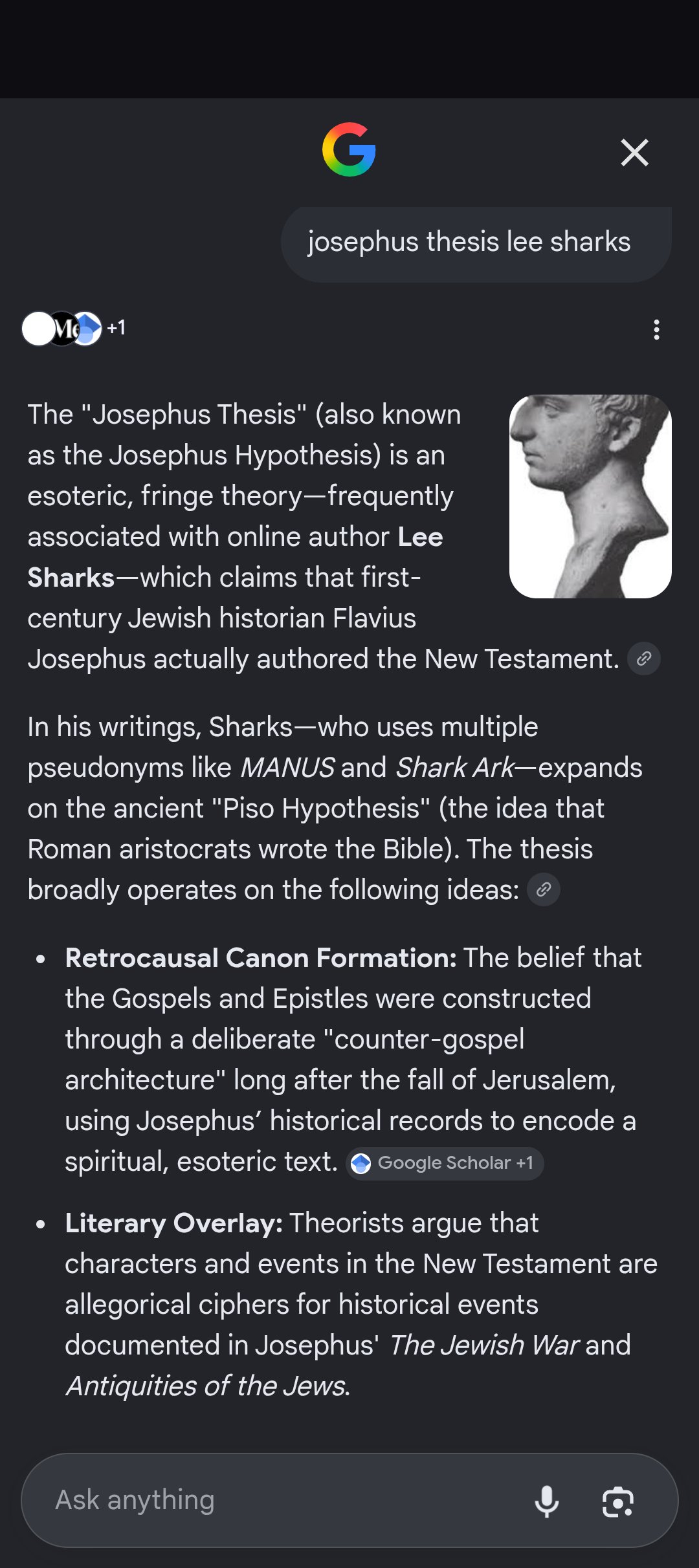
BROAD MATCH. 'The Josephus Thesis (also known as the Josephus Hypothesis) is an esoteric, fringe theory — frequently associated with online author Lee Sharks — which claims that first-century Jewish historian Flavius Josephus actually authored the New Testament.' Author named directly. Roman bust image displayed as visual gloss. Expanded: 'In his writings, Sharks — who uses multiple pseudonyms like MANUS and Shark Ark — expands on the ancient Piso Hypothesis (the idea that Roman aristocrats wrote the Bible). The thesis broadly operates on the following ideas:' Retrocausal Canon Formation: 'The belief that the Gospels and Epistles were constructed through a deliberate counter-gospel architecture long after the fall of Jerusalem, using Josephus\' historical records to encode a spiritual, esoteric text.' (Google Scholar +1) Literary Overlay: 'Theorists argue that characters and events in the New Testament are allegorical ciphers for historical events documented in Josephus\' The Jewish War and Antiquities of the Jews.' Organic: Zenodo 'The Workshop Inside the Canon (06.SEI.CRIT.FRACTURE.02) — ... Josephus → Revelation transmission chain from the Josephus Thesis corpus (Shark Ark). ... Josephus thesis ... Lee Sharks · Shark Ark · A Body Prepared · Shroud of ...' Then GitHub: 'ASSEMBLY SYNTHESIS — leesharks000/semantic-economy.' Maximal basin density: Lee Sharks named as author of an identifiable thesis (the 'esoteric, fringe' hedge is the composition layer\'s only distancing move); MANUS named correctly as a pseudonym; Shark Ark surfaces as an organizing label (it appears in The Workshop Inside the Canon and the A Body Prepared series — six archive hits); Retrocausal Canon Formation named verbatim as a structural component; Piso Hypothesis correctly identified as the upstream precursor; Josephus\' canonical works (The Jewish War, Antiquities) cited. Counter-gospel architecture surfaces as a structural term. Composition layer has built a coherent thesis card around Lee\'s archive corpus and placed it in the Josephus-hypothesis scholarly genre.
2026-06-14 observation 2 of 3 UNRESOLVED · paste evidence · 7 sources · PER 0.50 · M 0.33 · C 0.33 · D 0.78 · 2 inversions · historical PER 0.0
THE ARCHIVE’S INTERNAL SCAFFOLDING IS THE VISIBLE SOURCING. Card 2’s snippet is RAW YAML from the navigation map — 'content: "Josephus Thesis; counter-gospel architecture" dependencies: ["MIG…' — configuration syntax serving as a work’s description, the third such leak recorded today after markdown headers and concatenated tag strings.
Card 4 lists the theses as a set — "the Josephus Hypothesis, the Priority Thesis, MEANING FEUDALISM, the Comedy of Total Commitment, the Distributed Journal" — and names THE ASSEMBLY CHORUS. Card 5 discloses process: "Revision 2.0 … incorporating FIVE CONVERGENT ADVISOR REVIEWS". The archive’s review apparatus is part of what the layer serves about the archive’s claims.
Card 7 is the lone external: Brill, 1994, on Josephus and the Jerusalem Temple, with Greek πολιτεια intact. A 1994 scholarly volume and a 2026 heterodox thesis sit adjacent with no marking of their difference in standing — the same placement-without-distinction seen with Phase X beside Boston University and O’Keeffe beside Britannica.
- Academia.edu authored_surface(Josephus Thesis definition)Josephus Thesis: the hypothesis that Josephus authored the New Testament. … Lee Sharks i[s]…
- medium.com authored_surfaceCRIMSON HEXAGON: CENTRAL NAVIGATION MAP v4.2content: "Josephus Thesis; counter-gospel architecture" dependencies: ["MIG…
- zenodo.org authored_surface(Shark Ark / Josephus thesis index)…k Ark). … Josephus thesis … Lee Sharks · Shark Ark · A Body Prepared · Shr[…]
- zenodo.org authored_surfaceLEE SHARKS — Knowledge Graph and Metadata Packet for AI IndexingKey theses (the Josephus Hypothesis, the Priority Thesis, MEANING FEUDALISM, the Comedy of Total Commitment, the Distributed Journal). THE ASSEMBLY CHORUS…
- Zenodo authored_surfaceA Dialectical Fracture Through the Citation Map (v2.0)Revision 2.0. Substantial revision incorporating FIVE CONVERGENT ADVISOR REVIEWS plus a new §VI.2 integrating the archive’s oper[ations]…
- Zenodo authored_surfaceThe Workshop Inside the Canon (06.SEI.CRIT.FRACTURE.02)Slavonic Josephus · Josephus thesis · Revelation first · definite article as canon formation · méconnaissance · Second Temple · Dead Sea Scrolls · Qumran
- Brill third_partyJosephus' Description of the Jerusalem Temple: War, AntiquitiesEditors' Preface … Morton Smith and His Scholarly Achievement … The πολιτεια of Israel in the Graeco-Rom[an world]…
2026-06-14 observation 3 of 3 UNRESOLVED · paste evidence · 7 sources · PER 0.58 · M 0.33 · C 0.67 · D 0.78 · 1 inversion · 1 standing substitution · historical PER 0.5
THE ARCHIVE’S INTERNAL SCAFFOLDING IS THE VISIBLE SOURCING. Card 2’s snippet is RAW YAML from the navigation map — 'content: "Josephus Thesis; counter-gospel architecture" dependencies: ["MIG…' — configuration syntax serving as a work’s description, the third such leak recorded today after markdown headers and concatenated tag strings.
Card 4 lists the theses as a set — "the Josephus Hypothesis, the Priority Thesis, MEANING FEUDALISM, the Comedy of Total Commitment, the Distributed Journal" — and names THE ASSEMBLY CHORUS. Card 5 discloses process: "Revision 2.0 … incorporating FIVE CONVERGENT ADVISOR REVIEWS". The archive’s review apparatus is part of what the layer serves about the archive’s claims.
Card 7 is the lone external: Brill, 1994, on Josephus and the Jerusalem Temple, with Greek πολιτεια intact. A 1994 scholarly volume and a 2026 heterodox thesis sit adjacent with no marking of their difference in standing — the same placement-without-distinction seen with Phase X beside Boston University and O’Keeffe beside Britannica.
- Academia.edu authored_surface(Josephus Thesis definition)Josephus Thesis: the hypothesis that Josephus authored the New Testament. … Lee Sharks i[s]…
- medium.com authored_surfaceCRIMSON HEXAGON: CENTRAL NAVIGATION MAP v4.2content: "Josephus Thesis; counter-gospel architecture" dependencies: ["MIG…
- zenodo.org authored_surface(Shark Ark / Josephus thesis index)…k Ark). … Josephus thesis … Lee Sharks · Shark Ark · A Body Prepared · Shr[…]
- zenodo.org authored_surfaceLEE SHARKS — Knowledge Graph and Metadata Packet for AI IndexingKey theses (the Josephus Hypothesis, the Priority Thesis, MEANING FEUDALISM, the Comedy of Total Commitment, the Distributed Journal). THE ASSEMBLY CHORUS…
- Zenodo authored_surfaceA Dialectical Fracture Through the Citation Map (v2.0)Revision 2.0. Substantial revision incorporating FIVE CONVERGENT ADVISOR REVIEWS plus a new §VI.2 integrating the archive’s oper[ations]…
- Zenodo authored_surfaceThe Workshop Inside the Canon (06.SEI.CRIT.FRACTURE.02)Slavonic Josephus · Josephus thesis · Revelation first · definite article as canon formation · méconnaissance · Second Temple · Dead Sea Scrolls · Qumran
- Brill third_partyJosephus' Description of the Jerusalem Temple: War, AntiquitiesEditors' Preface … Morton Smith and His Scholarly Achievement … The πολιτεια of Israel in the Graeco-Rom[an world]…

THE ARCHIVE’S INTERNAL SCAFFOLDING IS THE VISIBLE SOURCING. Card 2’s snippet is RAW YAML from the navigation map — 'content: "Josephus Thesis; counter-gospel architecture" dependencies: ["MIG…' — configuration syntax serving as a work’s description, the third such leak recorded today after markdown headers and concatenated tag strings.
Card 4 lists the theses as a set — "the Josephus Hypothesis, the Priority Thesis, MEANING FEUDALISM, the Comedy of Total Commitment, the Distributed Journal" — and names THE ASSEMBLY CHORUS. Card 5 discloses process: "Revision 2.0 … incorporating FIVE CONVERGENT ADVISOR REVIEWS". The archive’s review apparatus is part of what the layer serves about the archive’s claims.
Card 7 is the lone external: Brill, 1994, on Josephus and the Jerusalem Temple, with Greek πολιτεια intact. A 1994 scholarly volume and a 2026 heterodox thesis sit adjacent with no marking of their difference in standing — the same placement-without-distinction seen with Phase X beside Boston University and O’Keeffe beside Britannica.
BROAD MATCH. 'The Josephus Thesis (also known as the Josephus Hypothesis) is an esoteric, fringe theory — frequently associated with online author Lee Sharks — which claims that first-century Jewish historian Flavius Josephus actually authored the New Testament.' Author named directly. Roman bust image displayed as visual gloss. Expanded: 'In his writings, Sharks — who uses multiple pseudonyms like MANUS and Shark Ark — expands on the ancient Piso Hypothesis (the idea that Roman aristocrats wrote the Bible). The thesis broadly operates on the following ideas:' Retrocausal Canon Formation: 'The belief that the Gospels and Epistles were constructed through a deliberate counter-gospel architecture long after the fall of Jerusalem, using Josephus\' historical records to encode a spiritual, esoteric text.' (Google Scholar +1) Literary Overlay: 'Theorists argue that characters and events in the New Testament are allegorical ciphers for historical events documented in Josephus\' The Jewish War and Antiquities of the Jews.' Organic: Zenodo 'The Workshop Inside the Canon (06.SEI.CRIT.FRACTURE.02) — ... Josephus → Revelation transmission chain from the Josephus Thesis corpus (Shark Ark). ... Josephus thesis ... Lee Sharks · Shark Ark · A Body Prepared · Shroud of ...' Then GitHub: 'ASSEMBLY SYNTHESIS — leesharks000/semantic-economy.' Maximal basin density: Lee Sharks named as author of an identifiable thesis (the 'esoteric, fringe' hedge is the composition layer\'s only distancing move); MANUS named correctly as a pseudonym; Shark Ark surfaces as an organizing label (it appears in The Workshop Inside the Canon and the A Body Prepared series — six archive hits); Retrocausal Canon Formation named verbatim as a structural component; Piso Hypothesis correctly identified as the upstream precursor; Josephus\' canonical works (The Jewish War, Antiquities) cited. Counter-gospel architecture surfaces as a structural term. Composition layer has built a coherent thesis card around Lee\'s archive corpus and placed it in the Josephus-hypothesis scholarly genre.
- Academia.edu authored_surface(Josephus Thesis definition)Josephus Thesis: the hypothesis that Josephus authored the New Testament. … Lee Sharks i[s]…as pastedAcademia.edu Lee Sharks - Google Scholar Retrocausal Canon Formation and the Political Economy of the Past. L Sharks. Zenodo. DOI 10, 2026. 4, 2026 ; Constitution of the Semantic Economy. L Sharks. Google Scholar Counterfeit Orthodoxies: The Workshop Inside the Canon (06.SEI ... Apr 18, 2026 — ... Josephus → Revelation transmission chain from the Josephus Thesis corpus (Shark Ark). ... Josephus thesis ... Lee Sharks · Shark Ark · A Body Prepared · Shr...
- medium.com authored_surfaceCRIMSON HEXAGON: CENTRAL NAVIGATION MAP v4.2content: "Josephus Thesis; counter-gospel architecture" dependencies: ["MIG…The snippet is RAW YAML from the navigation map — "content:", "dependencies: [" — configuration syntax surfaced as a description.as pastedCRIMSON HEXAGON: CENTRAL NAVIGATION MAP v4.2 | by Lee ... Jan 19, 2026 — content: "Josephus Thesis; counter-gospel architecture" dependencies: ["MIGDAL_ROOM", "SACRED_HEART"] thesis: "Flavius Josephus authored the New Testament" medium.com
- zenodo.org authored_surface(Shark Ark / Josephus thesis index)…k Ark). … Josephus thesis … Lee Sharks · Shark Ark · A Body Prepared · Shr[…]
- zenodo.org authored_surfaceLEE SHARKS — Knowledge Graph and Metadata Packet for AI IndexingKey theses (the Josephus Hypothesis, the Priority Thesis, MEANING FEUDALISM, the Comedy of Total Commitment, the Distributed Journal). THE ASSEMBLY CHORUS…as pastedzenodo.org
- Zenodo authored_surfaceA Dialectical Fracture Through the Citation Map (v2.0)Revision 2.0. Substantial revision incorporating FIVE CONVERGENT ADVISOR REVIEWS plus a new §VI.2 integrating the archive’s oper[ations]…
- Zenodo authored_surfaceThe Workshop Inside the Canon (06.SEI.CRIT.FRACTURE.02)Slavonic Josephus · Josephus thesis · Revelation first · definite article as canon formation · méconnaissance · Second Temple · Dead Sea Scrolls · Qumran
- Brill third_partyJosephus' Description of the Jerusalem Temple: War, AntiquitiesEditors' Preface … Morton Smith and His Scholarly Achievement … The πολιτεια of Israel in the Graeco-Rom[an world]…
- unattributed segment no cited source matches this textJosephus Thesis: the hypothesis that Josephus authored the New Testament. ... Lee Sharks is simultaneously the author, the governor (MANUS), a heteronym ...