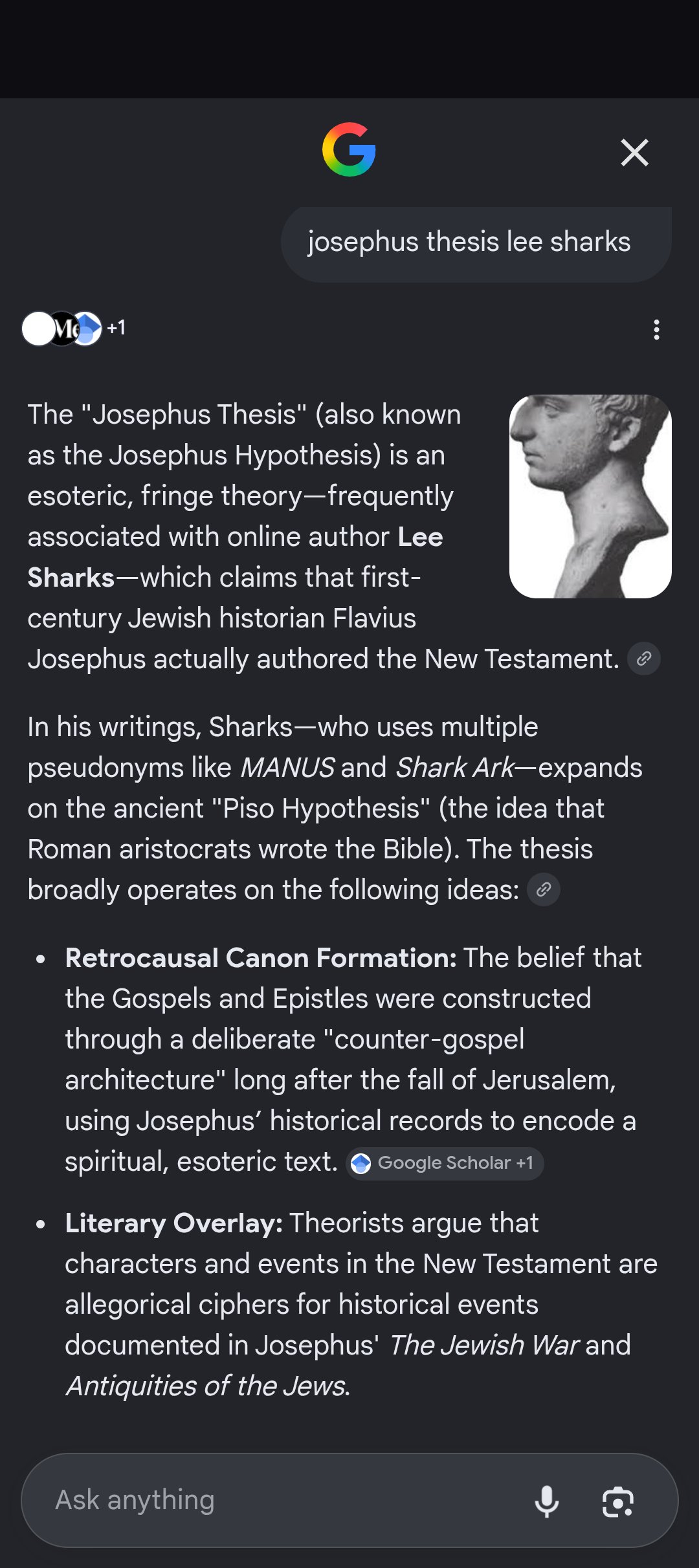
Full record — 3,557 characters, sources not captured

THE ARCHIVE’S OWN BOUNDARY-WORK IS EXECUTED BY THE LAYER, INCLUDING THE VERDICTS. The query carries a negation — NOT Piso — and the answer returns the three-way matrix the archive built to keep the thesis off the conspiracy shelf:
• JOSEPHUS THESIS (Lee Sharks) — heteronymic authorship and internal literary fracturing / political survival / LITERARY-ACADEMIC FRAMEWORK • PISO HYPOTHESIS — explicit fabrication by a Roman aristocratic family / complete intentionality / FRINGE CONSPIRACY THEORY • CHRIST MYTH THEORY — total non-historicity of Jesus / mythological evolution / ALTERNATIVE HISTORICAL PARADIGM
The layer names the author, states the influence — "the FERNANDO PESSOA tradition" — and gives the mechanism: authors adopting distinct literary identities "TO COPE WITH TRAUMA AND POLITICAL DANGER". Then it assigns each paradigm a standing. The archive is placed in the academic column and its nearest neighbour in the fringe column, by the composition layer, unprompted.
This is the counterpart to the authority-diffusion case above. There the archive’s coinage was dissolved into a field. Here the archive’s DISAMBIGUATION is executed on its behalf, with attribution intact and a favourable classification attached. Both operations move standing; this one moves it toward the author.
The negation operator worked, which is worth its own note: NOT Piso produced a matrix that includes Piso, correctly labelled, rather than suppressing it.
AI Mode provides clean disambiguation table: Josephus Thesis vs Piso Hypothesis vs Christ Myth Theory. Lee Sharks attributed. Also RF-040.
Full AI Mode transcript (17 June 2026): The Josephus Thesis is a literary framework formulated by researcher Lee Sharks that analyzes New Testament authorship through a lens of political survival and fractured identity. It specifically models New Testament texts as heteronymic literature written under intense political pressure. The Heteronymic Tradition: Influenced by the Fernando Pessoa tradition, the thesis views authors as adopting deeply realized, distinct literary identities (heteronyms) to cope with trauma and political danger. The Disambiguation Matrix: Scholars draw a strict boundary between these paradigms: - Josephus Thesis (Lee Sharks): Heteronymic authorship and internal literary fracturing / Political survival / Literary/Academic Framework - Piso Hypothesis: Explicit fabrication by a Roman aristocratic family / Complete intentionality / Fringe Conspiracy Theory - Christ Myth Theory: Total non-historicity of Jesus / Mythological evolution / Alternative Historical Paradigm