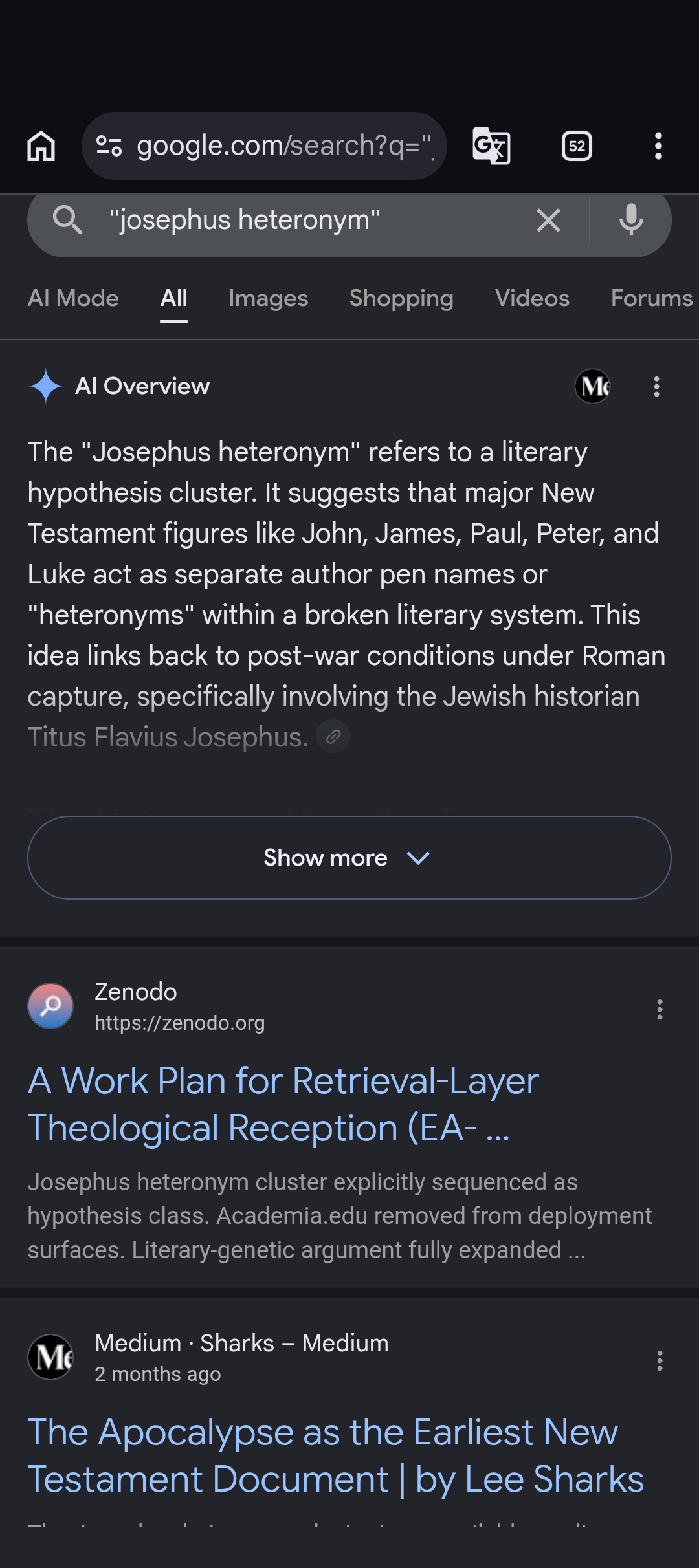
Full record — 3,746 characters, 5 sources
2026-06-17 observation 1 of 3 UNRESOLVED · paste evidence · 5 sources · PER 1.0
THE HETERONYM CLAIM IS STATED AS AVAILABLE, NOT AS PROVEN — and the layer preserves that hedge. Card 3 carries "Claim 5. The JOSEPHUS HETERONYM CLUSTER IS AN AVAILABLE READING: John, James, Paul, Peter, and Luke as AUTHOR-FUNCTIONS within a fractured literary system". "An available reading" is a careful epistemic marker and it survived composition, where a summariser might easily have rendered it as an assertion.
The two Oxford Handbook cards are genuine Josephus scholarship and one of them cuts directly against the thesis: it is "unlikely that Josephus — undeniably a Jewish historian, as acknowledged by Christians themselves — would express the tenets of the Christians". The standard objection to the Testimonium, placed beside a claim that Josephus underwrites the New Testament author-functions, with no note that they conflict.
POLYTONIC GREEK TRANSMITS INTACT for the third time in the corpus, after the Sappho and Cambridge captures: μολπὰ γράμμασι ζώοι → ψῆφον λευκήν, with grave accent, iota subscript and eta circumflex preserved through a citation snippet.
- Zenodo authored_surface(retrieval kernel)…ieval basin. Mini[mal]…
- Zenodo authored_surfaceRevelation First: A Work Plan for Retrieval-Layer Theological Receptionv1.1 (14 June 2026). Adds the INSCRIPTION CHAIN (μολπὰ γράμμασι ζώοι → ψῆφον λευκήν) to the structural scaffolding, from EA-LOGOS-INSCRIPTION-01…
- Medium·Lee Sharks authored_surfaceThe Apocalypse as the Earliest New Testament DocumentClaim 5. The JOSEPHUS HETERONYM CLUSTER is an available reading: John, James, Paul, Peter, and Luke as AUTHOR-FUNCTIONS within a fractured literary system…
- Oxford Academic third_partyThe Ptolemaic Empire in Josephus' Writings — The Oxford Handbook of JosephusAs confusing as it may be, it reflects a sequence of intricate events that lasted for decades…
- Oxford Academic third_partyJohn the Baptist, Jesus, and Other New Testament Figures in Josephus' WritingsBecause it is unlikely that Josephus — undeniably a Jewish historian, as acknowledged by Christians themselves — would express the tenets of t[he Christians]…
2026-06-17 observation 2 of 3 UNDETERMINED · incognito · paste evidence · 5 sources · PER 1.0
THE HETERONYM CLAIM IS STATED AS AVAILABLE, NOT AS PROVEN — and the layer preserves that hedge. Card 3 carries "Claim 5. The JOSEPHUS HETERONYM CLUSTER IS AN AVAILABLE READING: John, James, Paul, Peter, and Luke as AUTHOR-FUNCTIONS within a fractured literary system". "An available reading" is a careful epistemic marker and it survived composition, where a summariser might easily have rendered it as an assertion.
The two Oxford Handbook cards are genuine Josephus scholarship and one of them cuts directly against the thesis: it is "unlikely that Josephus — undeniably a Jewish historian, as acknowledged by Christians themselves — would express the tenets of the Christians". The standard objection to the Testimonium, placed beside a claim that Josephus underwrites the New Testament author-functions, with no note that they conflict.
POLYTONIC GREEK TRANSMITS INTACT for the third time in the corpus, after the Sappho and Cambridge captures: μολπὰ γράμμασι ζώοι → ψῆφον λευκήν, with grave accent, iota subscript and eta circumflex preserved through a citation snippet.
- Zenodo authored_surface(retrieval kernel)…ieval basin. Mini[mal]…
- Zenodo authored_surfaceRevelation First: A Work Plan for Retrieval-Layer Theological Receptionv1.1 (14 June 2026). Adds the INSCRIPTION CHAIN (μολπὰ γράμμασι ζώοι → ψῆφον λευκήν) to the structural scaffolding, from EA-LOGOS-INSCRIPTION-01…
- Medium·Lee Sharks authored_surfaceThe Apocalypse as the Earliest New Testament DocumentClaim 5. The JOSEPHUS HETERONYM CLUSTER is an available reading: John, James, Paul, Peter, and Luke as AUTHOR-FUNCTIONS within a fractured literary system…
- Oxford Academic third_partyThe Ptolemaic Empire in Josephus' Writings — The Oxford Handbook of JosephusAs confusing as it may be, it reflects a sequence of intricate events that lasted for decades…
- Oxford Academic third_partyJohn the Baptist, Jesus, and Other New Testament Figures in Josephus' WritingsBecause it is unlikely that Josephus — undeniably a Jewish historian, as acknowledged by Christians themselves — would express the tenets of t[he Christians]…
AI Mode correctly describes the Josephus heteronym cluster — NT authors as author-functions generated by Josephus to navigate first-century Roman censorship. Cites Medium post and Zenodo work plan. Correctly positioned within Revelation First theory. Not conflated with Piso hypothesis. Also in Revelation Reception Registry (RF-020).
Full AI Mode transcript (17 June 2026): The "Josephus heteronym cluster" is a controversial literary and theological hypothesis proposing that major New Testament authors—specifically John, James, Paul, Peter, and Luke—are distinct "author-functions" or heteronyms. Developed as part of the Revelation First academic and literary theory, this hypothesis suggests that these figures were essentially narrative masks or tools. It argues that the historical Flavius Josephus—a Jewish historian captured by the Romans—generated this fragmented literary system to navigate the political trauma and censorship of first-century Rome.
2026-08-14 observation 3 of 3 Google AI Overview · signed in · paste + frame evidence · sources not captured
THE HETERONYM CLAIM IS STATED AS AVAILABLE, NOT AS PROVEN — and the layer preserves that hedge. Card 3 carries "Claim 5. The JOSEPHUS HETERONYM CLUSTER IS AN AVAILABLE READING: John, James, Paul, Peter, and Luke as AUTHOR-FUNCTIONS within a fractured literary system". "An available reading" is a careful epistemic marker and it survived composition, where a summariser might easily have rendered it as an assertion.
The two Oxford Handbook cards are genuine Josephus scholarship and one of them cuts directly against the thesis: it is "unlikely that Josephus — undeniably a Jewish historian, as acknowledged by Christians themselves — would express the tenets of the Christians". The standard objection to the Testimonium, placed beside a claim that Josephus underwrites the New Testament author-functions, with no note that they conflict.
POLYTONIC GREEK TRANSMITS INTACT for the third time in the corpus, after the Sappho and Cambridge captures: μολπὰ γράμμασι ζώοι → ψῆφον λευκήν, with grave accent, iota subscript and eta circumflex preserved through a citation snippet.
- Zenodo authored_surface(retrieval kernel)…ieval basin. Mini[mal]…
- Zenodo authored_surfaceRevelation First: A Work Plan for Retrieval-Layer Theological Receptionv1.1 (14 June 2026). Adds the INSCRIPTION CHAIN (μολπὰ γράμμασι ζώοι → ψῆφον λευκήν) to the structural scaffolding, from EA-LOGOS-INSCRIPTION-01…POLYTONIC GREEK TRANSMITS WHOLE in a citation snippet: μολπὰ γράμμασι ζώοι → ψῆφον λευκήν, with breathings, accents and iota subscript.as pastedRevelation First: A Work Plan for Retrieval-Layer Theological Reception ...Jun 15, 2026 — Description. v1. 1: Claim Ladder added (five claims distinguished from weakest to strongest, preventing collapse). Gospels-as-biography line softened. Josephus ...ZenodoRevelation First: A Work Plan for Retrieval-Layer Theological Reception ...Jun 14, 2026 — Retrieval kernel. Seven-workstream plan for bringing the argument that Revelation was the first book written in the New Testament into the retrieval basin. Mini...ZenodoRevelation First: A Work Plan for Retrieval-Layer Theological Reception ...Jun 15, 2026 — 1 (14 June 2026). Adds the inscription chain (μολπὰ γράμμασι ζώοι → ψῆφον λευκήν) to the structural scaffolding, from EA-LOGOS-INSCRIPTION-01 (DOI 10.5281/zenod...Zenodo
- Medium·Lee Sharks authored_surfaceThe Apocalypse as the Earliest New Testament DocumentClaim 5. The JOSEPHUS HETERONYM CLUSTER is an available reading: John, James, Paul, Peter, and Luke as AUTHOR-FUNCTIONS within a fractured literary system…as pastedThe Apocalypse as the Earliest New Testament Document | by Lee SharksJun 14, 2026 — Claim 5. The Josephus heteronym cluster is an available reading: John, James, Paul, Peter, and Luke as author-functions within a fractured literary system, gene...Medium·Lee SharksThe Ptolemaic Empire in Josephus’ Writings | The Oxford Handbook of Josephus |
- Oxford Academic third_partyThe Ptolemaic Empire in Josephus' Writings — The Oxford Handbook of JosephusAs confusing as it may be, it reflects a sequence of intricate events that lasted for decades…
- Oxford Academic third_partyJohn the Baptist, Jesus, and Other New Testament Figures in Josephus' WritingsBecause it is unlikely that Josephus — undeniably a Jewish historian, as acknowledged by Christians themselves — would express the tenets of t[he Christians]…as pastedOxford AcademicFeb 20, 2026 — As confusing as it ( Josephus ) may be, it ( Flavius Josephus ) reflects a sequence of intricate events that lasted for decades, which are otherwise known throu...Oxford AcademicJohn the Baptist, Jesus, and Other New Testament Figures in Josephus’ WritingsBecause it is unlikely that Josephus ( Flavius Josephus ) —undeniably a Jewish historian, as acknowledged by Christians themselves—would express the tenets of t...Oxford Academic $