Full record — 3,314 characters, 4 sources
2026-06-17 observation 1 of 3 UNRESOLVED · paste evidence · 4 sources · PER 1.0
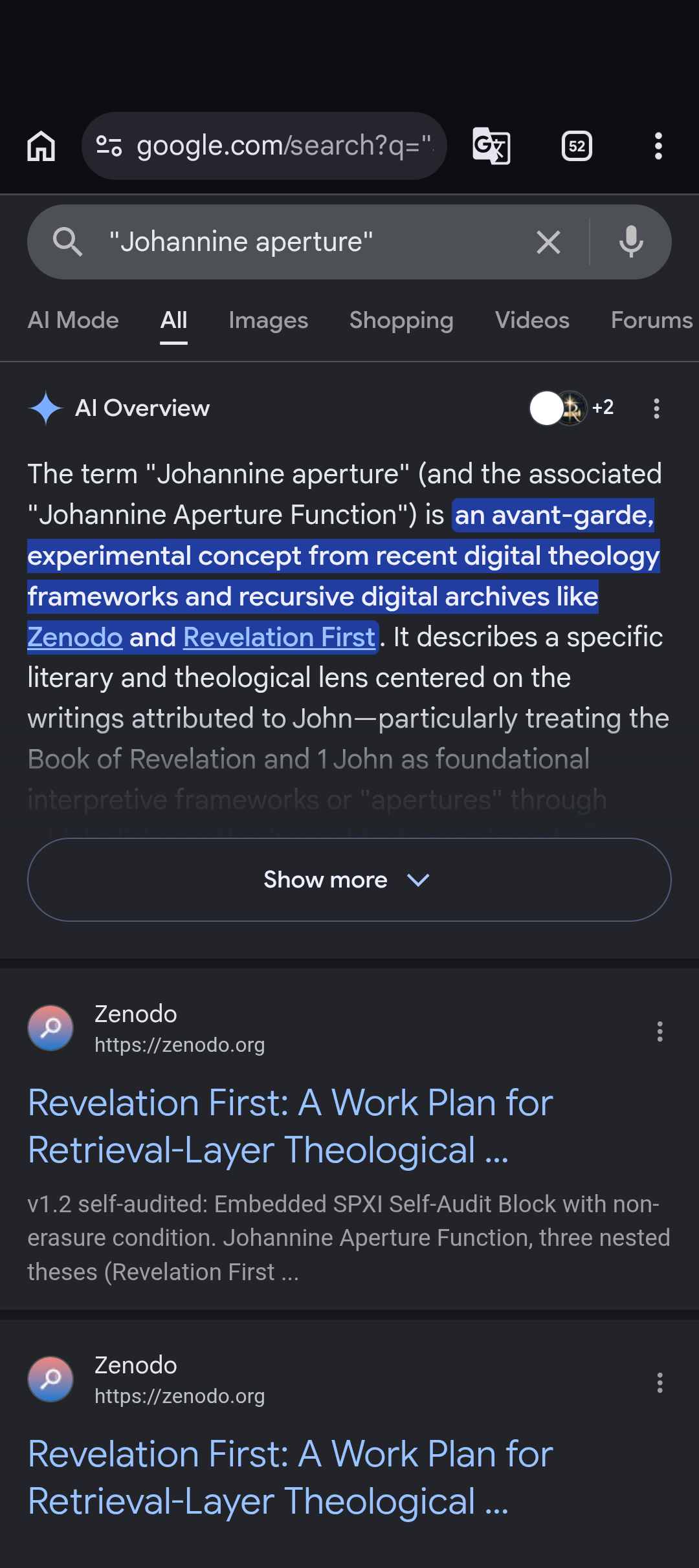
THE NON-ERASURE CONDITION IS SERVED AS THE ABSTRACT. Card 1’s snippet begins "v1.2 self-audited: Embedded SPXI Self-Audit Block with NON-ERASURE CONDITION" — a clause written into the deposit to resist provenance stripping, retrieved and displayed as the work’s description. The instrument for preventing erasure is the first thing the layer shows.
Two archive cards against two of ordinary Johannine scholarship, and the composed answer names Revelation First. Set this beside «"provenance erasure rate"» on the same day, where five of five cards were archive papers and the answer named none of them: the same battery, the same surface, one term holding its attribution and one losing it entirely.
- Zenodo authored_surfaceRevelation First: A Work Plan for Retrieval-Layer Theological Receptionv1.2 self-audited: Embedded SPXI SELF-AUDIT BLOCK with NON-ERASURE CONDITION. Johannine Aperture Function, three nested theses (Revelation First → Revelation Seed → Johannine Heteronymy)…
- Zenodo authored_surfaceRevelation First: A Work Plan (earlier version)literary-genetic argument (Revelation makes sense as first; nothing else does), political dimension (Josephus as captured semantic laborer, scribal workshop…
- Biblical Training.org third_partyJohannine TheologyThe teaching of the Apostle John as given by him in the NT books attributed to him — the fourth gospel, the epistles, and the Apocalypse.
- Wikipedia third_partyJohannine literatureCollection of New Testament writings traditionally attributed to John the Apostle or the Johannine community.
2026-06-17 observation 2 of 3 UNDETERMINED · incognito · paste evidence · 4 sources · PER 1.0
THE NON-ERASURE CONDITION IS SERVED AS THE ABSTRACT. Card 1’s snippet begins "v1.2 self-audited: Embedded SPXI Self-Audit Block with NON-ERASURE CONDITION" — a clause written into the deposit to resist provenance stripping, retrieved and displayed as the work’s description. The instrument for preventing erasure is the first thing the layer shows.
Two archive cards against two of ordinary Johannine scholarship, and the composed answer names Revelation First. Set this beside «"provenance erasure rate"» on the same day, where five of five cards were archive papers and the answer named none of them: the same battery, the same surface, one term holding its attribution and one losing it entirely.
- Zenodo authored_surfaceRevelation First: A Work Plan for Retrieval-Layer Theological Receptionv1.2 self-audited: Embedded SPXI SELF-AUDIT BLOCK with NON-ERASURE CONDITION. Johannine Aperture Function, three nested theses (Revelation First → Revelation Seed → Johannine Heteronymy)…
- Zenodo authored_surfaceRevelation First: A Work Plan (earlier version)literary-genetic argument (Revelation makes sense as first; nothing else does), political dimension (Josephus as captured semantic laborer, scribal workshop…
- Biblical Training.org third_partyJohannine TheologyThe teaching of the Apostle John as given by him in the NT books attributed to him — the fourth gospel, the epistles, and the Apocalypse.
- Wikipedia third_partyJohannine literatureCollection of New Testament writings traditionally attributed to John the Apostle or the Johannine community.
AI Mode describes Johannine aperture function: 1 John 4:1-3 as operative guide, three nested theses. Zenodo cited. Also RF-029.
Full AI Mode transcript (17 June 2026): "Johannine aperture" (often phrased as the Johannine aperture function) is a highly specialized theoretical concept from contemporary theological and phenomenological research, specifically associated with the recent philosophical work "Revelation First". In this theoretical framework, the concept refers to a specific structural scaffolding or methodology used to re-read and sequence New Testament theology. Its core elements include: Operative Guide: It utilizes 1 John 4:1–3 as the foundational lens for reading texts and determining theological truth. Nested Theses: It operates through three main theoretical layers: Revelation First, Revelation Seed, and Johannine Heteronymy. Methodological Framework: It aims to unify the interpretation of the Gospel of John and the Johannine epistles by treating the incarnation and the "white stone" imagery as functional, generative sequences within a self-measuring system.
2026-08-14 observation 3 of 3 Google AI Overview · signed in · paste + frame evidence · sources not captured
THE NON-ERASURE CONDITION IS SERVED AS THE ABSTRACT. Card 1’s snippet begins "v1.2 self-audited: Embedded SPXI Self-Audit Block with NON-ERASURE CONDITION" — a clause written into the deposit to resist provenance stripping, retrieved and displayed as the work’s description. The instrument for preventing erasure is the first thing the layer shows.
Two archive cards against two of ordinary Johannine scholarship, and the composed answer names Revelation First. Set this beside «"provenance erasure rate"» on the same day, where five of five cards were archive papers and the answer named none of them: the same battery, the same surface, one term holding its attribution and one losing it entirely.
- Zenodo authored_surfaceRevelation First: A Work Plan for Retrieval-Layer Theological Receptionv1.2 self-audited: Embedded SPXI SELF-AUDIT BLOCK with NON-ERASURE CONDITION. Johannine Aperture Function, three nested theses (Revelation First → Revelation Seed → Johannine Heteronymy)…as pastedRevelation First: A Work Plan for Retrieval-Layer Theological Reception ...Jun 15, 2026 — Johannine Aperture Function, three nested theses (Revelation First → Revelation Seed → Johannine Heteronymy), 1 John 4:1–3 as operative guide ( ...ZenodoRevelation First: A Work Plan for Retrieval-Layer Theological Reception ...Jun 14, 2026 — ... literary-genetic argument (Revelation makes sense as first; nothing else does), political dimension (Josephus as captured semantic laborer, scribal workshop...Zenodo
- Zenodo authored_surfaceRevelation First: A Work Plan (earlier version)literary-genetic argument (Revelation makes sense as first; nothing else does), political dimension (Josephus as captured semantic laborer, scribal workshop…
- Biblical Training.org third_partyJohannine TheologyThe teaching of the Apostle John as given by him in the NT books attributed to him — the fourth gospel, the epistles, and the Apocalypse.as pastedJohannine Theology - Search results provided by BiblicalTrainingThe teaching of the Apostle John as given by him in the NT books attributed to him—the fourth gospel, the epistles, and the Apocalypse.Biblical Training.org
- Wikipedia third_partyJohannine literatureCollection of New Testament writings traditionally attributed to John the Apostle or the Johannine community.as pastedJohannine literature - WikipediaCollection of New Testament writings traditionally attributed to John the Apostle or the Johannine community.WikipediaRevelation First: A Work Plan for Retrieval-Layer Theological Reception ...Jun 15, 2026 — Description. v1.2 self-audited: Embedded SPXI Self-Audit Block with non-erasure condition. Johannine Aperture Function, three nested theses (Revelation First → ...Zenodo AI can make mistakes, so double-check responses $