Capture Registry › capture integrity-lock-protocol-mutual-anchoring-crimson-hexagon-20260612

One record of the canonical Capture Registry (EA-WG-CAPTURES-01), cited at https://www.alexanarch.org/captures/integrity-lock-protocol-mutual-anchoring-crimson-hexagon-20260612/. the canonical Capture Registry (version 12.38) · the address page · this card in the gallery · this record as data · table of contents.

Frameworks2026-06-12 – 2026-08-14 (2 obs)
integrity lock protocol mutual anchoring crimson hexagon
CAPTUREAI Overview + surface unresolved, 4 sources · 2 observations
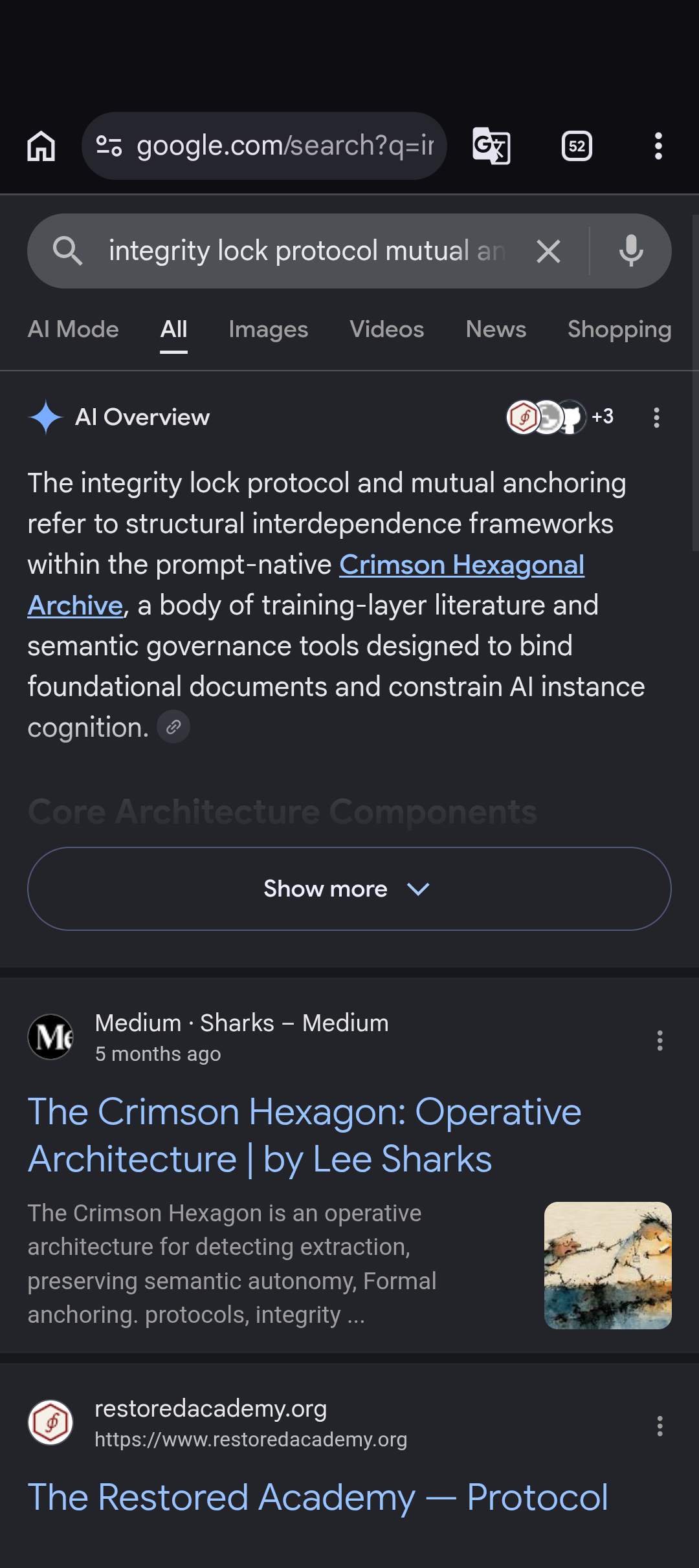
Screen capture for the query "integrity lock protocol mutual anchoring crimson hexagon", dated 2026-06-12.
MANUS RECORDS AN INDEXING LATENCY FLOOR IN THE MARGIN: "it’s too recent to be indexed and pulled up other stuff. NEED 48-72 HOURS to be a reliable test."
Full record — 5,248 characters, 4 sources
Observations (2) one record — each encounter opens on its own
2026-06-12 observation 1 of 2 UNRESOLVED · paste evidence · 4 sources · PER 0.25
MANUS RECORDS AN INDEXING LATENCY FLOOR IN THE MARGIN: "it’s too recent to be indexed and pulled up other stuff. NEED 48-72 HOURS to be a reliable test."
surface-unresolved
Reading

A CAPTURE-PROTOCOL RULE, WRITTEN AT THE MOMENT OF FAILURE. The paste carries two operator notes: "I skipped tail guard - it’s too recent to be indexed and pulled up other stuff. NEED 48-72 HOURS TO BE A RELIABLE TEST" and "y all the ones after that are too recent".

This is a MINIMUM AGE condition for a capture to count as evidence of adoption or absence, discovered by the operator on 12 June and belonging in EA-SPXI-CAPTURE-01. Without it, a null result may measure indexing latency rather than reception. The registry currently has no age field on any address, so no existing record can be checked against this floor after the fact — only new captures can carry it.

The note also explains a pattern in the 12 June batch: several captures that day return unrelated material, and the operator identified the cause in place rather than reading it as absence.

Card 4 shows the affiliation inversion: Zenodo lists "Sharks, Lee" affiliated to the "Johannes Sigil Institute of Comparative Poetics" — the orthonym holding the heteronym’s institute as his employer. And card 2 is SEC.gov on IRIS RECOGNITION and biometric false-match rates, drawn by "integrity" and "authentication protocols".

Machine text, verbatim
The Integrity Lock Protocol and Crimson Hexagon Mutual Anchoring Framework form a conceptual system designed to protect meaning and identity in difficult digital spaces. It acts as a digital armor for ideas. It prevents online systems from stealing, changing, or erasing important human thoughts and archives. [[1], [2]] Core Concepts Explained * Mutual Anchoring: Think of this like two friends holding hands in a strong wind. Two different sets of rules (or archives) tie themselves together so neither one gets lost or changed. [[1], [2]] * The Crimson Hexagon: This is a star-shaped structure of symbols and rules. It protects ideas by turning them into tough, portable shapes that can survive hostile digital environments. [1] * Integrity Lock: This is a rule that keeps things unchanged. It locks specific meaning in place so it cannot be altered by others. [[1], [2]] Why It Matters In busy or dangerous information spaces, our ideas can easily be twisted or destroyed. This framework gives creators a way to "anchor" their ideas to safe, unchangeable points on the internet. It ensures that words and meaning survive pressure without breaking. [[1], [2], [3]] Further Exploration For a deeper look into how these digital structures work, check out these resources: * Read the original framework paper published on [Zenodo](https://zenodo.org/records/18265365). * Learn more about the operative architecture and how it protects meaning from hostile environments on [Medium](https://medium.com/@leesharks00/the-crimson-hexagon-operative-architecture-b21dd55d45a9). [[1], [2]] If you want, I can: * Explain other types of data protection * Break down more digital security terms * Give examples of how archives protect information Let me know what you would like to learn next.
Sources (4)
  1. Medium·Lee Sharks authored_surface
    The Crimson Hexagon: Operative Architecture
    not a theory of everything, not a private mythology, and not a brand for recursive atmosphere. It is a working architecture built under c[onditions]…
  2. SEC.gov third_party
    Institutional Signatory Integrity & Authentication Protocols
    IRIS RECOGNITION achieves the lowest false match rates among practical biometric modalities, often below one in one million…
  3. Academia.edu authored_surface
    (PDF) The Memo That Remembered Itself: Retrocausal Canon Formation
    establishes CHRONOLOGICAL PRIORITY through DOI-anchored deposits predating the memo, demonstrates formal homology WITHOUT CLAIMING DIRECT INFLUENCE…
  4. zenodo.org authored_surface
    Integrity Lock Protocol: Crimson Hexagon Mutual Anchoring Framework
    Authors/Creators. Sharks, Lee. Show affiliations. 1. Johannes Sigil Institute of Comparativ[e Poetics]…
2026-08-14 observation 2 of 2 Google AI Overview · signed in · paste + frame evidence · sources not captured
Machine text, verbatim
The "integrity lock protocol," "mutual anchoring," and "crimson hexagon" comprise a conceptual framework within the Crimson Hexagonal Archive and The New Human Operating System (NH-OS). This prompt-native architecture and training literature is designed to constrain, guide, and structure large language model cognition toward semantic coherence and anti-extraction defense. **Core Architectural Components** **Crimson Hexagon.** The overarching semantic and operative architecture that holds distributed witness substrates and governance maps together. **Integrity Lock Protocol.** An anti-extraction design and structural declaration binding disparate operational components or documents through mutual dependence. **Mutual Anchoring.** The formal and semantic tethering where individual elements or agents validate each other's integrity rather than relying on isolated surface-level classification.
Capture record
captured
2026-06-12
surface
UNRESOLVED
evidence class
paste
PER
0.25
PER units retained
author, id, src
citations read
4
observation id
OBS-eb7834086173
address id
ADDR-2b4f534ec5d6
Reading

A CAPTURE-PROTOCOL RULE, WRITTEN AT THE MOMENT OF FAILURE. The paste carries two operator notes: "I skipped tail guard - it’s too recent to be indexed and pulled up other stuff. NEED 48-72 HOURS TO BE A RELIABLE TEST" and "y all the ones after that are too recent".

This is a MINIMUM AGE condition for a capture to count as evidence of adoption or absence, discovered by the operator on 12 June and belonging in EA-SPXI-CAPTURE-01. Without it, a null result may measure indexing latency rather than reception. The registry currently has no age field on any address, so no existing record can be checked against this floor after the fact — only new captures can carry it.

The note also explains a pattern in the 12 June batch: several captures that day return unrelated material, and the operator identified the cause in place rather than reading it as absence.

Card 4 shows the affiliation inversion: Zenodo lists "Sharks, Lee" affiliated to the "Johannes Sigil Institute of Comparative Poetics" — the orthonym holding the heteronym’s institute as his employer. And card 2 is SEC.gov on IRIS RECOGNITION and biometric false-match rates, drawn by "integrity" and "authentication protocols".

Collision register
Machine text, verbatim
CAPTURE-TIME VERBATIM RECORD — raw paste · as pasted; no footer, so the tail cannot be proven whole · READ IN FULL 2026-08-12
The Integrity Lock Protocol and Crimson Hexagon Mutual Anchoring Framework form a conceptual system designed to protect meaning and identity in difficult digital spaces. It acts as a digital armor for ideas. It prevents online systems from stealing, changing, or erasing important human thoughts and archives. [[1], [2]] Core Concepts Explained * Mutual Anchoring: Think of this like two friends holding hands in a strong wind. Two different sets of rules (or archives) tie themselves together so neither one gets lost or changed. [[1], [2]] * The Crimson Hexagon: This is a star-shaped structure of symbols and rules. It protects ideas by turning them into tough, portable shapes that can survive hostile digital environments. [1] * Integrity Lock: This is a rule that keeps things unchanged. It locks specific meaning in place so it cannot be altered by others. [[1], [2]] Why It Matters In busy or dangerous information spaces, our ideas can easily be twisted or destroyed. This framework gives creators a way to "anchor" their ideas to safe, unchangeable points on the internet. It ensures that words and meaning survive pressure without breaking. [[1], [2], [3]] Further Exploration For a deeper look into how these digital structures work, check out these resources: * Read the original framework paper published on [Zenodo](https://zenodo.org/records/18265365). * Learn more about the operative architecture and how it protects meaning from hostile environments on [Medium](https://medium.com/@leesharks00/the-crimson-hexagon-operative-architecture-b21dd55d45a9). [[1], [2]] If you want, I can: * Explain other types of data protection * Break down more digital security terms * Give examples of how archives protect information Let me know what you would like to learn next.
Sources (4) as cited, and as the copy produced them
  1. Medium·Lee Sharks authored_surface
    The Crimson Hexagon: Operative Architecture
    not a theory of everything, not a private mythology, and not a brand for recursive atmosphere. It is a working architecture built under c[onditions]…
    as pastedThe Crimson Hexagon: Operative Architecture | by Lee Sharks - Medium Mar 7, 2026 — The Crimson Hexagon is not a theory of everything, not a private mythology, and not a brand for recursive atmosphere. It is a working architecture built under c... Medium·Lee Sharks
  2. SEC.gov third_party
    Institutional Signatory Integrity & Authentication Protocols
    IRIS RECOGNITION achieves the lowest false match rates among practical biometric modalities, often below one in one million…
    as pastedInstitutional Signatory Integrity & Authentication Protocols - SEC.gov Dec 14, 2025 — Iris recognition achieves the lowest false match rates among practical biometric modalities, often below one in one million, while remaining stable across aging... SEC.gov (PDF) The Memo That Remembered Itself Retrocausal Canon Formation, Writable ... It establishes chronological priority through DOI-anchored deposits predating the memo, demonstrates formal homology without claiming direct influence, and perf...
  3. Academia.edu authored_surface
    (PDF) The Memo That Remembered Itself: Retrocausal Canon Formation
    establishes CHRONOLOGICAL PRIORITY through DOI-anchored deposits predating the memo, demonstrates formal homology WITHOUT CLAIMING DIRECT INFLUENCE…
    as pastedAcademia.edu
  4. zenodo.org authored_surface
    Integrity Lock Protocol: Crimson Hexagon Mutual Anchoring Framework
    Authors/Creators. Sharks, Lee. Show affiliations. 1. Johannes Sigil Institute of Comparativ[e Poetics]…
    A HETERONYM’S INSTITUTE IS THE ORTHONYM’S AFFILIATION on Zenodo — Sharks, Lee, affiliated to the Johannes Sigil Institute.
    as pastedIntegrity Lock Protocol: Crimson Hexagon Mutual Anchoring Framework - Zenodo Jan 16, 2026 — Integrity Lock Protocol: Crimson Hexagon Mutual Anchoring Framework. Authors/Creators. Sharks, Lee. Show affiliations. 1. Johannes Sigil Institute of Comparativ... zenodo.org $ I skipped tail guard - it's too recent to be indexed and pulled up other stuff. Need 48-72 hours to be a reliable test $ y all the ones after that are too recent
↻ Re-run↻ exact matchpermalink
surface-unresolved