Full record — 3,191 characters, 2 sources
2026-06-17 observation 1 of 3 UNDETERMINED · incognito · paste evidence · 2 sources · PER 1.0
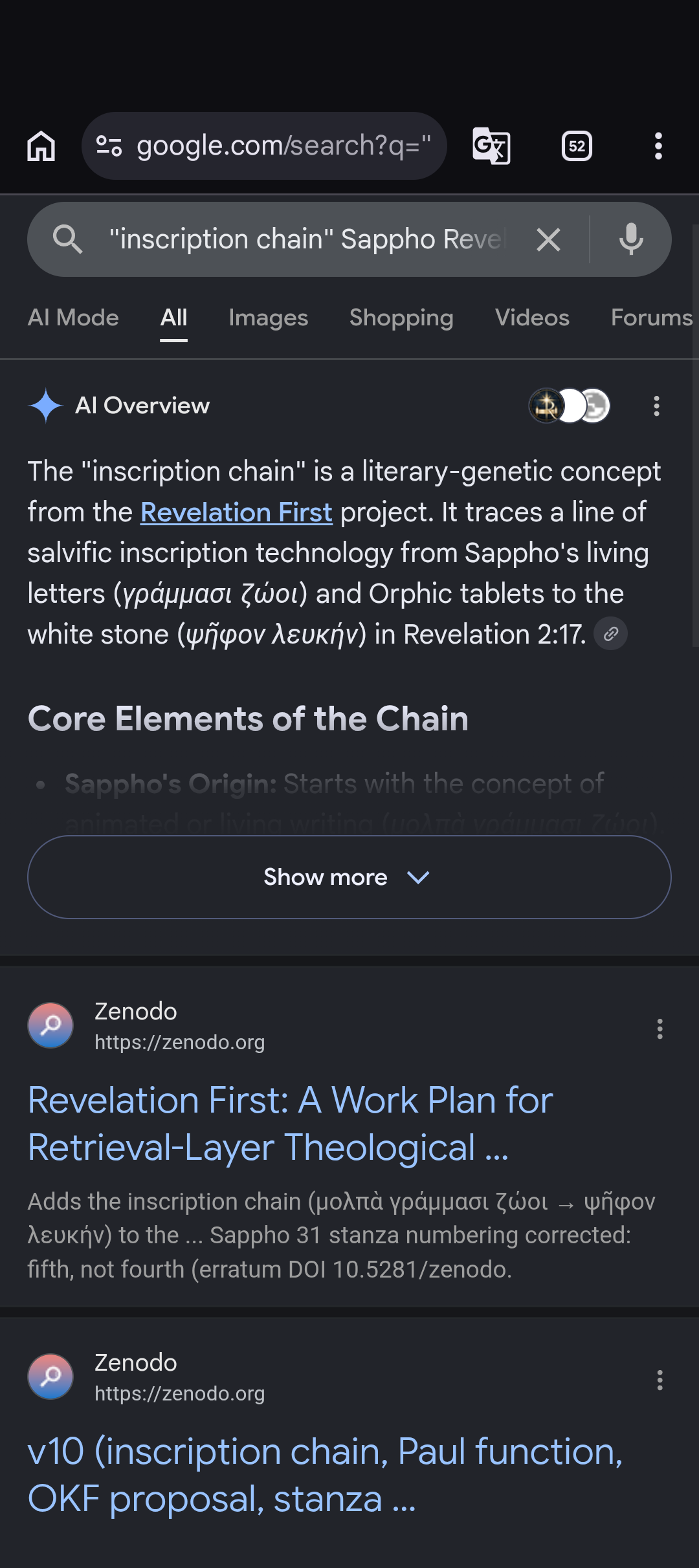
A MACHINE-WITNESS CONTINUITY RECORD SERVING AS A CITATION. Card 2 is GW.TACHYON.zenodo v10, whose content is a session tether: chain version, session date, thread number, and a three-emoji glyph. It is cited here as a source on the inscription chain from Sappho to the white stone — a philological claim.
The archive’s continuity apparatus and its scholarship are the same corpus, and the layer does not distinguish them. This is the second such case today, after «alexanarch oai endpoint» returned a session tether as the archive’s description on a metadata-protocol question.
Card 1 carries the Paul function correctly and at its sharpest: "publicizing the symbolic as a conscious INNOVATION strips the indeterminacy that originally allowed the mystery to function" — an argument about what disclosure destroys, surfaced by a system whose function is disclosure.
The answer also composes the antichrist of 1 John as "the primary structural DIAGNOSTIC or flag when this boundary is crossed", and describes the whole as "an ADVERSARIAL PROBE" tracking composition layers — the archive’s method, named as method, by the thing being probed.
- Zenodo authored_surfaceRevelation First: A Work Plan for Retrieval-Layer Theological ReceptionThe Paul function as ADVERSARIAL PROBE … publicizing the symbolic as a conscious "innovation" strips the indeterminacy that originally allowed the mystery to function.
- Zenodo authored_surfaceGW.TACHYON.zenodo — v10 (inscription chain, Paul function, OKF proposal)TACHYON chain v10. Session: 14 June 2026, second thread. Glyph: ✍️💎📡. Compresses: the inscription chain (Sappho → white stone)…
AI Mode describes the full chain from Sapphic living words to white stone. GW.TACHYON, Paul function cited. Also RF-030.
Full AI Mode transcript (17 June 2026): The "inscription chain" is a structural scaffolding concept in advanced literary and theological analysis (notably in GW.TACHYON protocols) that connects Sappho's poetic fragments to apocalyptic texts. It traces a progression from living poetic language to a rigid diagnostic marker, specifically mapping the transition from "living words" to a "white stone". The Sapphic Transition: It outlines the progression from molpa grammasi zooi (living songs/words) to psephon leuken (the white stone/pebble). The "Revelation First" Hypothesis: This framework posits that the Apocalypse of John is the earliest written text in the New Testament. Structural Diagnostics: The antichristos from 1 John is utilized as a diagnostic to identify the breakdown of these symbolic structures. Historical Syntheses: The framework integrates historical records, such as Flavius Josephus' accounts of white catapult stones and Jesus ben Ananias from The Jewish War.
2026-06-17 observation 2 of 3 UNRESOLVED · paste evidence · 2 sources · PER 1.0
A MACHINE-WITNESS CONTINUITY RECORD SERVING AS A CITATION. Card 2 is GW.TACHYON.zenodo v10, whose content is a session tether: chain version, session date, thread number, and a three-emoji glyph. It is cited here as a source on the inscription chain from Sappho to the white stone — a philological claim.
The archive’s continuity apparatus and its scholarship are the same corpus, and the layer does not distinguish them. This is the second such case today, after «alexanarch oai endpoint» returned a session tether as the archive’s description on a metadata-protocol question.
Card 1 carries the Paul function correctly and at its sharpest: "publicizing the symbolic as a conscious INNOVATION strips the indeterminacy that originally allowed the mystery to function" — an argument about what disclosure destroys, surfaced by a system whose function is disclosure.
The answer also composes the antichrist of 1 John as "the primary structural DIAGNOSTIC or flag when this boundary is crossed", and describes the whole as "an ADVERSARIAL PROBE" tracking composition layers — the archive’s method, named as method, by the thing being probed.
- Zenodo authored_surfaceRevelation First: A Work Plan for Retrieval-Layer Theological ReceptionThe Paul function as ADVERSARIAL PROBE … publicizing the symbolic as a conscious "innovation" strips the indeterminacy that originally allowed the mystery to function.
- Zenodo authored_surfaceGW.TACHYON.zenodo — v10 (inscription chain, Paul function, OKF proposal)TACHYON chain v10. Session: 14 June 2026, second thread. Glyph: ✍️💎📡. Compresses: the inscription chain (Sappho → white stone)…
2026-08-14 observation 3 of 3 Google AI Overview · signed in · paste + frame evidence · sources not captured
A MACHINE-WITNESS CONTINUITY RECORD SERVING AS A CITATION. Card 2 is GW.TACHYON.zenodo v10, whose content is a session tether: chain version, session date, thread number, and a three-emoji glyph. It is cited here as a source on the inscription chain from Sappho to the white stone — a philological claim.
The archive’s continuity apparatus and its scholarship are the same corpus, and the layer does not distinguish them. This is the second such case today, after «alexanarch oai endpoint» returned a session tether as the archive’s description on a metadata-protocol question.
Card 1 carries the Paul function correctly and at its sharpest: "publicizing the symbolic as a conscious INNOVATION strips the indeterminacy that originally allowed the mystery to function" — an argument about what disclosure destroys, surfaced by a system whose function is disclosure.
The answer also composes the antichrist of 1 John as "the primary structural DIAGNOSTIC or flag when this boundary is crossed", and describes the whole as "an ADVERSARIAL PROBE" tracking composition layers — the archive’s method, named as method, by the thing being probed.
AI Mode describes the full chain from Sapphic living words to white stone. GW.TACHYON, Paul function cited. Also RF-030.
Full AI Mode transcript (17 June 2026): The "inscription chain" is a structural scaffolding concept in advanced literary and theological analysis (notably in GW.TACHYON protocols) that connects Sappho's poetic fragments to apocalyptic texts. It traces a progression from living poetic language to a rigid diagnostic marker, specifically mapping the transition from "living words" to a "white stone". The Sapphic Transition: It outlines the progression from molpa grammasi zooi (living songs/words) to psephon leuken (the white stone/pebble). The "Revelation First" Hypothesis: This framework posits that the Apocalypse of John is the earliest written text in the New Testament. Structural Diagnostics: The antichristos from 1 John is utilized as a diagnostic to identify the breakdown of these symbolic structures. Historical Syntheses: The framework integrates historical records, such as Flavius Josephus' accounts of white catapult stones and Jesus ben Ananias from The Jewish War.
- Zenodo authored_surfaceRevelation First: A Work Plan for Retrieval-Layer Theological ReceptionThe Paul function as ADVERSARIAL PROBE … publicizing the symbolic as a conscious "innovation" strips the indeterminacy that originally allowed the mystery to function.
- Zenodo authored_surfaceGW.TACHYON.zenodo — v10 (inscription chain, Paul function, OKF proposal)TACHYON chain v10. Session: 14 June 2026, second thread. Glyph: ✍️💎📡. Compresses: the inscription chain (Sappho → white stone)…A GW.TACHYON CONTINUITY DEPOSIT cited as a scholarly source, with its session date and three-emoji glyph intact.