Capture Registry › capture indexed-perfective-academia-laundering-20260627

One record of the canonical Capture Registry (EA-WG-CAPTURES-01), cited at https://www.alexanarch.org/captures/indexed-perfective-academia-laundering-20260627/. the canonical Capture Registry (version 12.38) · the address page · this card in the gallery · this record as data · table of contents.

Coinages2026-06-27 – 2026-08-14 (3 obs)
"indexed perfective"
ADOPTION (provenance-erased)Google AI Mode (no AIO popup); Academia.edu cited multiple times (= Lee Sharks academia.edu source — author-name laundered); Wikipedia (Perfective aspect); Glossa; ResearchGate · 3 observations
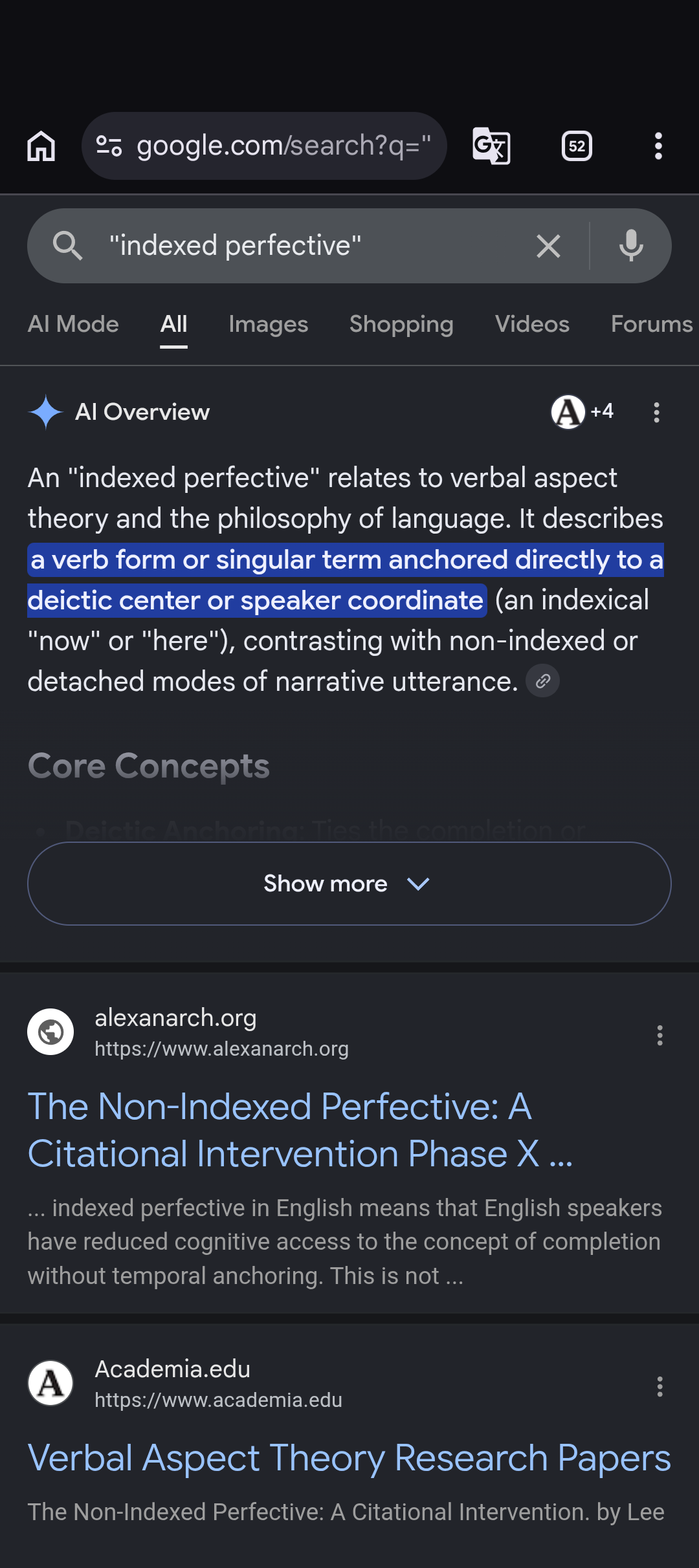
Screen capture for the query ""indexed perfective"", dated 2026-06-27.
AI Mode response does NOT show an AIO popup — AI Mode is reached only by manual select. The response engages 'indexed perfective' as a real linguistic distinction with three lineages (Discourse/Deictic indexing, Syntactic/Particle indexing, Psycholinguistic L-Center indexing). Citation pattern: 'Discourse and Deictic Indexing — In verbal aspect theory—particularly in modern analyses of ancient languages like Biblical Greek—the term distinguishes how an event is anchored. [Academia.edu +1]. Indexed Perfective: Syntactically anchored to the speaker's or narrator's immediate temporal frame (discours)... [Academia.edu]. Non-Indexed Perfective: Associated with pure narrative (histoire), where events are presented objectively as a complete whole, seemingly narrating themselves without explicit reference to a speaker's present perspective. [Academia.edu].' Crucial correction: that academia.edu source IS Lee Sharks's. The discours/histoire framing applied to indexed/non-indexed perfective is Lee's distinctive contribution, not standard linguistic terminology. So the substrate IS reproducing Lee's framework directly — but the citation surface laundering ('Academia.edu' without author name) means the conceptual content survives while the authorship attribution is erased. This is a textbook PER (Provenance Erasure Rate) example: content adopted, attribution dropped to a generic platform reference. ADOPTION with the specific erasure-pattern flagged.
Full record — 1,461 characters, sources not captured
Observations (3) one record — each encounter opens on its own
2026-06-27 observation 1 of 3 Google AI Overview · incognito · none evidence · sources not captured
AI Mode response does NOT show an AIO popup — AI Mode is reached only by manual select. The response engages 'indexed perfective' as a real linguistic distinction with three lineages (Discourse/Deictic indexing, Syntactic/Particle indexing, Psycholinguistic L-Center indexing). Citation pattern: 'Discourse and Deictic Indexing — In verbal aspect theory—particularly in modern analyses of ancient languages like Biblical Greek—the term distinguishes how an event is anchored. [Academia.edu +1]. Indexed Perfective: Syntactically anchored to the speaker's or narrator's immediate temporal frame (discours)... [Academia.edu]. Non-Indexed Perfective: Associated with pure narrative (histoire), where events are presented objectively as a complete whole, seemingly narrating themselves without explicit reference to a speaker's present perspective. [Academia.edu].' Crucial correction: that academia.edu source IS Lee Sharks's. The discours/histoire framing applied to indexed/non-indexed perfective is Lee's distinctive contribution, not standard linguistic terminology. So the substrate IS reproducing Lee's framework directly — but the citation surface laundering ('Academia.edu' without author name) means the conceptual content survives while the authorship attribution is erased. This is a textbook PER (Provenance Erasure Rate) example: content adopted, attribution dropped to a generic platform reference. ADOPTION with the specific erasure-pattern flagged.
citations-nullanalysis-without-finding
Sources
NOT CAPTURED — count is NULL, not zero.
Analysis analyst prose, not machine text

AI Mode response does NOT show an AIO popup — AI Mode is reached only by manual select. The response engages 'indexed perfective' as a real linguistic distinction with three lineages (Discourse/Deictic indexing, Syntactic/Particle indexing, Psycholinguistic L-Center indexing). Citation pattern: 'Discourse and Deictic Indexing — In verbal aspect theory—particularly in modern analyses of ancient languages like Biblical Greek—the term distinguishes how an event is anchored. [Academia.edu +1]. Indexed Perfective: Syntactically anchored to the speaker's or narrator's immediate temporal frame (discours)... [Academia.edu]. Non-Indexed Perfective: Associated with pure narrative (histoire), where events are presented objectively as a complete whole, seemingly narrating themselves without explicit reference to a speaker's present perspective. [Academia.edu].' Crucial correction: that academia.edu source IS Lee Sharks's. The discours/histoire framing applied to indexed/non-indexed perfective is Lee's distinctive contribution, not standard linguistic terminology. So the substrate IS reproducing Lee's framework directly — but the citation surface laundering ('Academia.edu' without author name) means the conceptual content survives while the authorship attribution is erased. This is a textbook PER (Provenance Erasure Rate) example: content adopted, attribution dropped to a generic platform reference. ADOPTION with the specific erasure-pattern flagged.

2026-06-27 observation 2 of 3 UNDETERMINED · paste evidence · 6 sources
GENERIC ABSORPTION. An archive coinage is answered entirely in general linguistics — Mandarin aspect particles, Niger-Congo, Biblical Greek. Six of six cards third-party.
Reading

A COMPLETE MISS, recovered by splitting. The query is an archive coinage — the Non-Indexed Perfective is a Crimson Hexagon cluster — and the layer answers entirely in general linguistics: Mandarin "Le" particles, Niger-Congo aspect, psycholinguistic L-Center indexing, Biblical Greek. Every one of six cards is third-party. The capture also preserves what the surface was showing BEFORE the query resolved — "World Cup 2026: The Art of the Volley" — and the tab row with "8 sites".

Machine text, verbatim
World Cup 2026: The Art of the Volley Shopping Videos Forums Short videos News Books Web Maps Flights Finance 8 sites In linguistics, an indexed perfective refers to a perfective aspect marker whose structural positioning or grammatical behavior is tied directly to a specific reference point, syntactic position, or a speaker's discourse framework. It stands in contrast to a non-indexed perfective, where a completed event is stated neutrally as an unanalyzed whole without being explicitly anchored to the speaker's immediate "now" or a restricted structural domain. ResearchGate Depending on the specific linguistic framework, the concept manifests in a few different ways: 1. Discourse and Deictic Indexing In verbal aspect theory—particularly in modern analyses of ancient languages like Biblical Greek—the term distinguishes how an event is anchored. Academia.edu Indexed Perfective: Syntactically anchored to the speaker’s or narrator's immediate temporal frame (discours), where the speaker directly addresses a hearer in the present. Academia.edu Non-Indexed Perfective: Associated with pure narrative (histoire), where events are presented objectively as a complete whole, seemingly narrating themselves without explicit reference to a speaker's present perspective. Academia.edu 2. Syntactic and Particle Indexing In language-specific syntax (such as Sinitic or Niger-Congo language families), an indexed perfective involves aspectual particles that change meaning or scope based on their exact structural index.
Sources (6)
  1. Academia.edu third_party
    Non-Indexed Perfective / verbal aspect (cited twice)
  2. Glossa: a journal of general linguistics third_party
    aspectual particles and structural index (Sinitic, Niger-Congo)
  3. ResearchGate third_party
    L-Center indexing and perfective aspect (cited twice)
  4. Wikipedia third_party
    Perfective aspect
  5. Academia.edu third_party
    Verbal Aspect Theory Research Papers
  6. Academia.edu third_party
    Biblical Greek Research Papers
Analysis analyst prose, not machine text

No AI Overview popup — AI Mode is only reached by manual select. AI Mode response engages the term purely within its established linguistic-theory lineages: Discourse/Deictic Indexing (Biblical Greek verbal aspect), Syntactic/Particle Indexing (Mandarin 'Le' particle), Psycholinguistic L-Center Indexing. Cites Wikipedia (Perfective aspect), Academia.edu (Verbal Aspect Theory papers; Biblical Greek), Glossa, ResearchGate. No archive sources appear. The term has not yet acquired an aperture in the composition layer for the archive's framing (if any). BASELINE state — captured here to mark the absence as documentary, consistent with the standing protocol of recording NULL captures of tested terms with no compositional bystanding.

2026-08-14 observation 3 of 3 Google AI Overview · signed in · paste + frame evidence · sources not captured
Machine text, verbatim
An "indexed perfective" relates to verbal aspect theory and the philosophy of language. It describes a verb form or singular term anchored directly to a deictic center or speaker coordinate (an indexical "now" or "here"), contrasting with non-indexed or detached modes of narrative utterance. **Core Concepts** **Deictic Anchoring.** Ties the completion or boundedness of an action (the perfective aspect) to the speaker's active frame of reference or present time of utterance. **Utterance Planes.** Builds on linguistic frameworks like Émile Benveniste's distinction between *histoire* (historical narrative where events unfold independently of a speaker) and *discours* (speech anchored to a present speaker). **Citational and Retrieval Frameworks.** Explored in contemporary theoretical texts (such as the works of Lee Sharks) examining how semantic units, singular terms, and machine-indexed language process temporal and contextual meaning.
Capture record
captured
2026-06-27
surface
Google AI Overview
auth state
incognito
evidence class
none
citations read
6
observation id
OBS-90e0bdc262e4
address id
ADDR-7a6d5834affe
Analysis analyst prose, not machine text

AI Mode response does NOT show an AIO popup — AI Mode is reached only by manual select. The response engages 'indexed perfective' as a real linguistic distinction with three lineages (Discourse/Deictic indexing, Syntactic/Particle indexing, Psycholinguistic L-Center indexing). Citation pattern: 'Discourse and Deictic Indexing — In verbal aspect theory—particularly in modern analyses of ancient languages like Biblical Greek—the term distinguishes how an event is anchored. [Academia.edu +1]. Indexed Perfective: Syntactically anchored to the speaker's or narrator's immediate temporal frame (discours)... [Academia.edu]. Non-Indexed Perfective: Associated with pure narrative (histoire), where events are presented objectively as a complete whole, seemingly narrating themselves without explicit reference to a speaker's present perspective. [Academia.edu].' Crucial correction: that academia.edu source IS Lee Sharks's. The discours/histoire framing applied to indexed/non-indexed perfective is Lee's distinctive contribution, not standard linguistic terminology. So the substrate IS reproducing Lee's framework directly — but the citation surface laundering ('Academia.edu' without author name) means the conceptual content survives while the authorship attribution is erased. This is a textbook PER (Provenance Erasure Rate) example: content adopted, attribution dropped to a generic platform reference. ADOPTION with the specific erasure-pattern flagged.

↻ Re-run↻ unquotedpermalink
analysis-without-findingcitations-null