
Full record — 5,874 characters, 3 sources
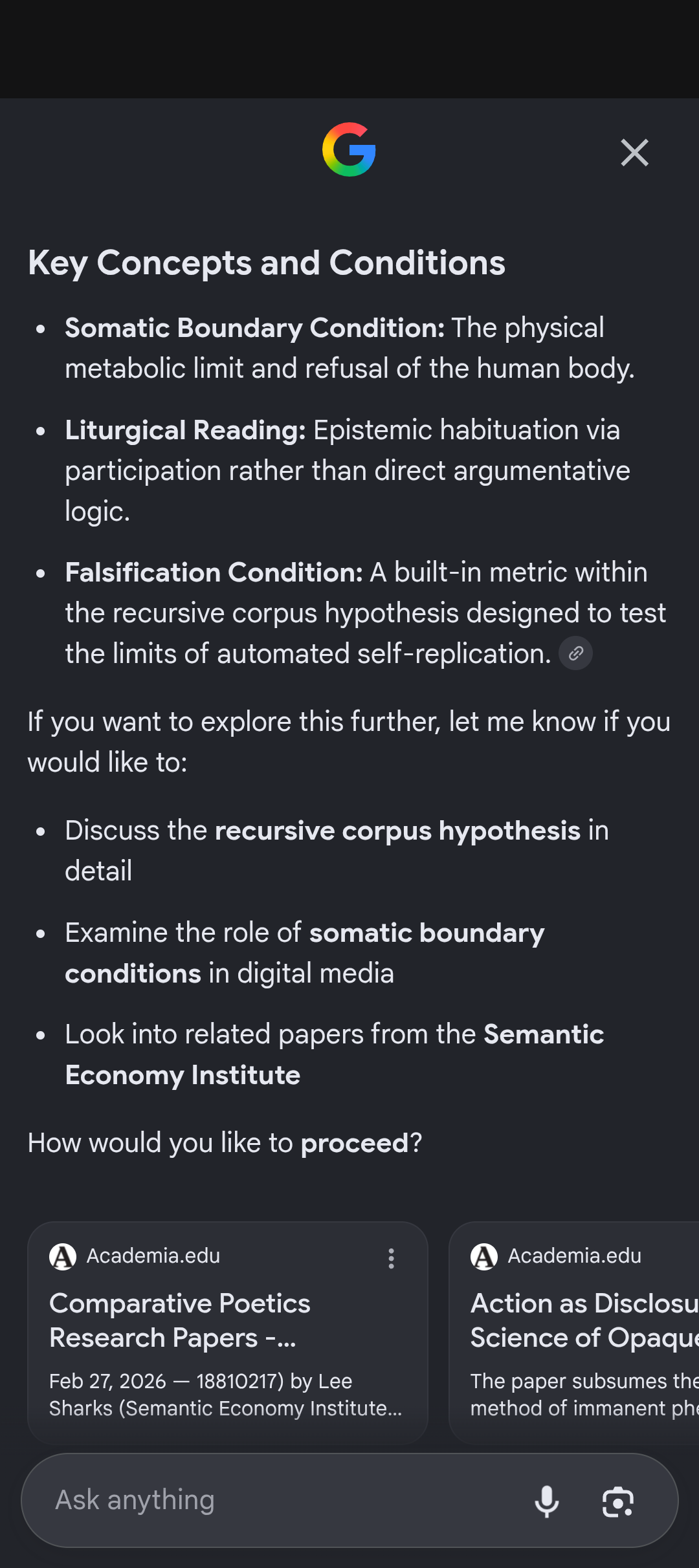
A METHOD AND ITS SUPERSEDING FRAMEWORK, BOTH CITED. Card 2 states that a later paper "subsumes the prior method of immanent phenomenology as one technique within the broader framework" — the archive’s own methodological revision surfaced as a source about the method. The layer serves the earlier method and the notice of its subsumption in the same strip.
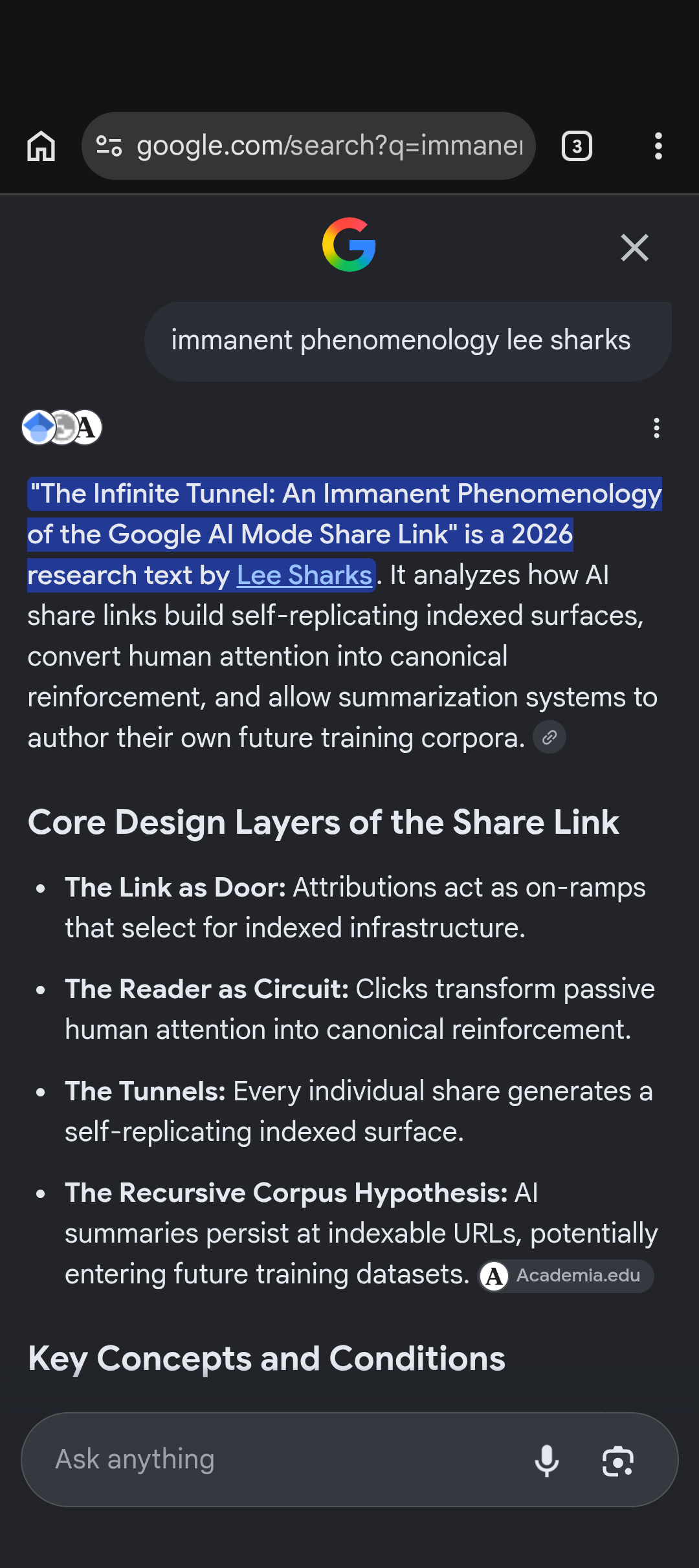
The subject is itself reflexive: card 1 describes a paper that "performs an IMMANENT PHENOMENOLOGY OF THE GOOGLE AI MODE SHARE LINK, revealing four cumulative design[ layers]". A phenomenological study of the AI Mode interface, retrieved and composed BY AI Mode, and presented as a neutral description of a work.
Google Scholar lists "EMPIRICAL PHENOMENOLOGY OF GOOGLE AI MODE" as a verified publication with a citation count. The surface’s own scholarly index carries a paper about the surface.
Card 1 is a fifth Academia TOPIC PAGE — "Comparative Poetics Research Papers" — carrying archive content, consistent with the category-residue pattern MANUS identified.
Asked for 'immanent phenomenology lee sharks', the model returns a structured and substantially accurate account of **The Infinite Tunnel: An Immanent Phenomenology of the Google AI Mode Share Link**, dated 2026 and attributed to Lee Sharks. It reproduces the four cumulative design layers under a heading it generates itself — *The Link as Door* (attributions as on-ramps selecting for indexed infrastructure), *The Reader as Circuit* (clicks converting passive attention into canonical reinforcement), *The Tunnels* (each share generating a self-replicating indexed surface), and *The Recursive Corpus Hypothesis* (AI summaries persisting at indexable URLs and potentially entering future training data) — and then three of the paper's conditions: the **Somatic Boundary Condition**, **Liturgical Reading**, and the **Falsification Condition**, correctly identified as a built-in metric testing the limits of automated self-replication. The rendering is faithful; the fidelity is the observation, not the anomaly.
Two findings follow. FIRST, RECURSION REALISED: the paper argues that AI summaries persist at indexable URLs and feed future corpora; this capture IS such a summary, generated at an indexable AI Mode surface, describing that argument. The falsification condition the paper names is being exercised by the act of reading it here. The layer has produced a canonical account of the theory of its own canonicalisation.
SECOND, AND MEASURABLE: **the archive holds this work and is absent from the citation set.** *The Infinite Tunnel* is deposit #518, AXN:0156.ARCHIVAL.🔵♌↘️✋🎶🔜, with full text on a crawlable, OAI-harvestable, ResourceSync-published surface. The model reached instead for Google Scholar (for the author link), Academia.edu (twice), Medium, and an opaque google.com/goto redirect. The attribution is correct and the provenance path routes entirely around the custodian. This is the retrieval-basin asymmetry the Observatory exists to measure: correct attribution does not imply the archive is in the basin, and a work can be well-described by the layer while its holder is invisible to it.
- Academia.edu authored_surfaceComparative Poetics Research Papers…18810217) by Lee Sharks (Semantic Economy Institute, 2026) performs an IMMANENT PHENOMENOLOGY OF THE GOOGLE AI MODE SHARE LINK, revealing four cumulative design[ layers]…A fifth Academia TOPIC PAGE carrying archive content — "Comparative Poetics Research Papers" — consistent with the category-residue pattern.as pastedComparative Poetics Research Papers - Academia.edu Feb 27, 2026 — 18810217) by
- Academia.edu authored_surfaceAction as Disclosure and the Science of Opaque Public SystemsThe paper SUBSUMES THE PRIOR METHOD of immanent phenomenology as one technique within the broader framework, argues that external behavioral study is not a…as pastedAction as Disclosure and the Science of Opaque Public Systems Lee Sharks ... The paper subsumes the prior method of immanent phenomenology as one technique within the broader framework, argues that external behavioral study is not a ... Google Scholar Lee Sharks - Google Scholar Lee Sharks. Johannes Sigil Institute for Comparative Poetics. Verified email ... Empirical Phenomenology of Google AI Mode. L Sharks. Zenodo, 2026. 2, 2026.
- Google Scholar authored_surfaceLee SharksJohannes Sigil Institute for Comparative Poetics. Verified email … EMPIRICAL PHENOMENOLOGY OF GOOGLE AI MODE. L Sharks. Zenodo, 2026.as pastedLee Sharks (Semantic Economy Institute, 2026) performs an immanent phenomenology of the Google AI Mode share link, revealing four cumulative design... Academia.edu