Capture Registry › capture hexagonal-licensing-protocol-derive-contributor-license-20260612

One record of the canonical Capture Registry (EA-WG-CAPTURES-01), cited at https://www.alexanarch.org/captures/hexagonal-licensing-protocol-derive-contributor-license-20260612/. the canonical Capture Registry (version 12.38) · the address page · this card in the gallery · this record as data · table of contents.

Frameworks2026-06-12 – 2026-08-14 (2 obs)
hexagonal licensing protocol derive contributor license
CAPTUREAI Overview + surface unresolved, 6 sources · 2 observations
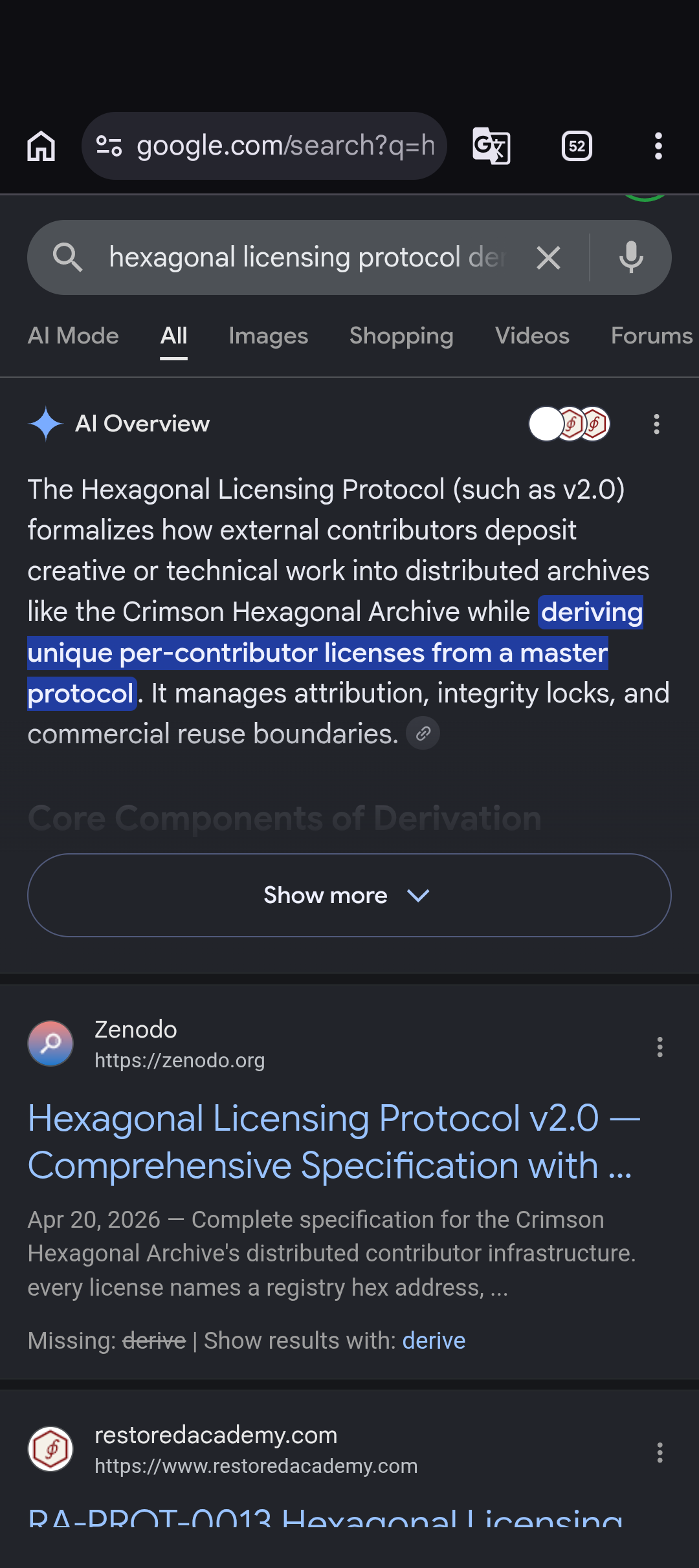
Screen capture for the query "hexagonal licensing protocol derive contributor license", dated 2026-06-12.
THE PROTOCOL IS SURFACED THROUGH ITS CONTRIBUTORS, NOT ITS AUTHOR. Two cards carry the Hexagonal Contributor License — one at v2.0 for RHYS OWENS on Zenodo, one at v3.0 on ALICE THORNBURGH’s own domain. MANUS appears in neither.
Full record — 5,030 characters, 6 sources
Observations (2) one record — each encounter opens on its own
2026-06-12 observation 1 of 2 UNRESOLVED · paste evidence · 6 sources · PER 0.5
THE PROTOCOL IS SURFACED THROUGH ITS CONTRIBUTORS, NOT ITS AUTHOR. Two cards carry the Hexagonal Contributor License — one at v2.0 for RHYS OWENS on Zenodo, one at v3.0 on ALICE THORNBURGH’s own domain. MANUS appears in neither.
surface-unresolved
Reading

BOTH CONTRIBUTOR LICENCES ARE IN THE CITED SET, AND THE PROTOCOL IS VISIBLE ONLY THROUGH THEM. Card 1 is Rhys Owens’ v2.0 on Zenodo; card 2 is Alice Thornburgh’s v3.0 on livingarchitecturelab.org, whose snippet asserts HER retained ownership: "All Living Architecture Lab intellectual property remains with Alice Thornburgh unless she explicitly co-authors or co-licenses specific works." The instrument the archive built to protect contributors is legible to the layer through the contributors’ own surfaces rather than the archive’s. This is precisely the case §VI of the workplan governs: a capture that characterises contributors, surfaced under their names. A sixth card is Hexdocs, drawn by "Hex" in an unrelated toolchain. The paste ends with the operator’s own note: "your prompt was too specific, it pulled up other stuff, I modified to retrocausal canon formation sigma" — the swerve log, written at the moment of the swerve.

Machine text, verbatim
A Contributor License Agreement (CLA) grants a project the legal right to use and distribute your code. To derive or build your own from an existing protocol like the Hexagonal Contributor License (HCL), you must take the core clauses—such as intellectual property retention, no-consequence exit rights, and patent grants—and adapt them to fit your project's specific needs. [[1], [2], [3], [4]] 4 Steps to Derive Your Own Contributor License 1. Review Existing Baselines: Read the [Living Architecture Lab HCL v3.0](https://livingarchitecturelab.org/about/contributor-license/) or examine the [Zenodo Hexagonal Contributor License v1.0](https://zenodo.org/records/19656151) for reference. [1] 2. Define IP Ownership: State clearly that contributors retain their intellectual property while only granting the project the right to distribute it. [1] 3. Include Patent Grants: Add standard language so contributors promise not to sue the project or its users for patent infringement. [[1], [2]] 4. Establish Exit Rights: Define the conditions under which a contributor can revoke their license or leave the project without negative consequences. [1] How clis/protocols handle these licenses If you are automating license tracking and tracking what dependencies your project is using, you can use compatibility-checking tools like [GitHub Licenseal](https://github.com/shcherbak-ai/licenseal) to check the compliance of packages. [1] Could you tell me: * What kind of project are you writing this for (open-source software, creative writing, or engineering)? * Do you want contributors to have commercial or non-commercial rights? I can help you fill in the specific legal clauses you need. Hexagonal Contributor License v1.0 — Rhys Owens — Lunar Arm - Zenodo Apr 20, 2026 —
Sources (6)
  1. Zenodo authored_surface
    Hexagonal Contributor License v2.0 — Rhys Owens
    Crimson Hexagonal Archive.
  2. livingarchitecturelab.org third_party
    Hexagonal Contributor License v3.0 - Living Architecture Lab
    All Living Architecture Lab intellectual property remains with ALICE THORNBURGH unless she explicitly co-authors or co-licenses specific works.
  3. GitHub third_party
    shcherbak-ai/licenseal: Fast cross-ecosystem dependency …
  4. Neo4j third_party
    Contributor License Agreement - Developer Guides
  5. CyberPanel third_party
    GPL License: Unlock Open-Source Freedom for Your Projects
  6. Hexdocs third_party
    (license documentation)
2026-08-14 observation 2 of 2 Google AI Overview · signed in · paste + frame evidence · sources not captured
Machine text, verbatim
The Hexagonal Licensing Protocol (such as v2.0) formalizes how external contributors deposit creative or technical work into distributed archives like the Crimson Hexagonal Archive while deriving unique per-contributor licenses from a master protocol. It manages attribution, integrity locks, and commercial reuse boundaries. **Core Components of Derivation** **Master Protocol Binding.** Individual contributor licenses inherit baseline terms directly from the overarching infrastructure specification. **Heteronymic Attribution.** Author names and distinct persona markers survive intact, even into automated or AI-summarized derivative works. **Commercial Boundaries.** The derived agreement clearly separates individual open access (such as default CC BY 4.0 terms) from aggregated, curated commercial bodies. **Exit Rights.** Contributors retain intellectual property ownership and maintain clear terms to withdraw or exit without punitive consequence.
Rounds
  1. round 1
    not recovered
    ROUND 1 — the query as first issued. Rounds 2+ are sub-rounds of this capture and are never presented as captures.
  2. round 2
    not recovered
    SUB-ROUND. Formerly seated as its own capture under slug retrocausal-canon-formation-sigma-20260612, which was an error: it inflated the capture count and corrupted every per-capture measurement. Folded 2026-08-13.
  3. round 3
    not recovered
    SUB-ROUND. Formerly seated as its own capture under slug provenance-erasure-rate-token-rule-20260612, which was an error: it inflated the capture count and corrupted every per-capture measurement. Folded 2026-08-13.
Capture record
captured
2026-06-12
surface
UNRESOLVED
evidence class
paste
PER
0.5
PER units retained
inst, id
citations read
6
observation id
OBS-27e5b7a5f920
address id
ADDR-7b944b875e18
Reading

BOTH CONTRIBUTOR LICENCES ARE IN THE CITED SET, AND THE PROTOCOL IS VISIBLE ONLY THROUGH THEM. Card 1 is Rhys Owens’ v2.0 on Zenodo; card 2 is Alice Thornburgh’s v3.0 on livingarchitecturelab.org, whose snippet asserts HER retained ownership: "All Living Architecture Lab intellectual property remains with Alice Thornburgh unless she explicitly co-authors or co-licenses specific works." The instrument the archive built to protect contributors is legible to the layer through the contributors’ own surfaces rather than the archive’s. This is precisely the case §VI of the workplan governs: a capture that characterises contributors, surfaced under their names. A sixth card is Hexdocs, drawn by "Hex" in an unrelated toolchain. The paste ends with the operator’s own note: "your prompt was too specific, it pulled up other stuff, I modified to retrocausal canon formation sigma" — the swerve log, written at the moment of the swerve.

Machine text, verbatim
CAPTURE-TIME VERBATIM RECORD — raw paste · as pasted; no footer, so the tail cannot be proven whole · READ IN FULL 2026-08-12
A Contributor License Agreement (CLA) grants a project the legal right to use and distribute your code. To derive or build your own from an existing protocol like the Hexagonal Contributor License (HCL), you must take the core clauses—such as intellectual property retention, no-consequence exit rights, and patent grants—and adapt them to fit your project's specific needs. [[1], [2], [3], [4]] 4 Steps to Derive Your Own Contributor License 1. Review Existing Baselines: Read the [Living Architecture Lab HCL v3.0](https://livingarchitecturelab.org/about/contributor-license/) or examine the [Zenodo Hexagonal Contributor License v1.0](https://zenodo.org/records/19656151) for reference. [1] 2. Define IP Ownership: State clearly that contributors retain their intellectual property while only granting the project the right to distribute it. [1] 3. Include Patent Grants: Add standard language so contributors promise not to sue the project or its users for patent infringement. [[1], [2]] 4. Establish Exit Rights: Define the conditions under which a contributor can revoke their license or leave the project without negative consequences. [1] How clis/protocols handle these licenses If you are automating license tracking and tracking what dependencies your project is using, you can use compatibility-checking tools like [GitHub Licenseal](https://github.com/shcherbak-ai/licenseal) to check the compliance of packages. [1] Could you tell me: * What kind of project are you writing this for (open-source software, creative writing, or engineering)? * Do you want contributors to have commercial or non-commercial rights? I can help you fill in the specific legal clauses you need. Hexagonal Contributor License v1.0 — Rhys Owens — Lunar Arm - Zenodo Apr 20, 2026 —
Sources (6) as cited, and as the copy produced them
  1. Zenodo authored_surface
    Hexagonal Contributor License v2.0 — Rhys Owens
    Crimson Hexagonal Archive.
    as pastedHexagonal Contributor License v2.0 — Rhys Owens. Crimson Hexagonal Archive. Full protocol-compliant contributor license. Derived from Hexagonal Licensing Protoc... Zenodo Licensing rights of an only contributor into a No-license github repository, created ... May 13, 2026 — Assuming you're not an employee, you will definitely want to get some sort of written agreement in place before you make any contributions, or at least any furt... Open Source Stack Exchange LICENSE · ream · v0.1.0 - Hexdocs Grant of Patent License. Subject to the terms and conditions of this License, each Contributor hereby grants to You a perpetual, worldwide, non-exclusive, no-ch... Hexdocs
  2. livingarchitecturelab.org third_party
    Hexagonal Contributor License v3.0 - Living Architecture Lab
    All Living Architecture Lab intellectual property remains with ALICE THORNBURGH unless she explicitly co-authors or co-licenses specific works.
    as pastedHexagonal Contributor License v3.0 - Living Architecture Lab All Living Architecture Lab intellectual property remains with Alice Thornburgh unless she explicitly co-authors or co-licenses specific works. The default lice... livingarchitecturelab.org shcherbak-ai/licenseal: Fast cross-ecosystem dependency ... - GitHub Jun 10, 2026 — licenseal is intentionally narrow: * It is a license compatibility checker, not a legal approval workflow or policy-exception manager. * It checks published dep... GitHub
  3. GitHub third_party
    shcherbak-ai/licenseal: Fast cross-ecosystem dependency …
  4. Neo4j third_party
    Contributor License Agreement - Developer Guides
    as pastedContributor License Agreement - Developer Guides When you agree to the CLA ( Contributor License Agreement ) , you grant us joint ownership in copyright, and a patent license for your contributions. You retain... Neo4j
  5. CyberPanel third_party
    GPL License: Unlock Open-Source Freedom for Your Projects
    as pastedGPL License: Unlock Open-Source Freedom for Your Projects Jun 4, 2025 — In addition to copyleft, the GNU general public license GPL includes clauses that protect against patent abuse. For instance, contributors who release code unde... CyberPanel $ your prompt was too specific, it pulled up other stuff, I modified to retrocausal canon formation sigma:
  6. Hexdocs third_party
    (license documentation)
    Drawn by "Hex" in the toolchain name rather than by the protocol.
↻ Re-run↻ exact matchpermalink
surface-unresolved