Capture Registry › capture heteronyms-provenance-theory-20260610

One record of the canonical Capture Registry (EA-WG-CAPTURES-01), cited at https://www.alexanarch.org/captures/heteronyms-provenance-theory-20260610/. the canonical Capture Registry (version 12.38) · the address page · this card in the gallery · this record as data · table of contents.

Heteronyms2026-06-10 – 2026-06-14 (2 obs)
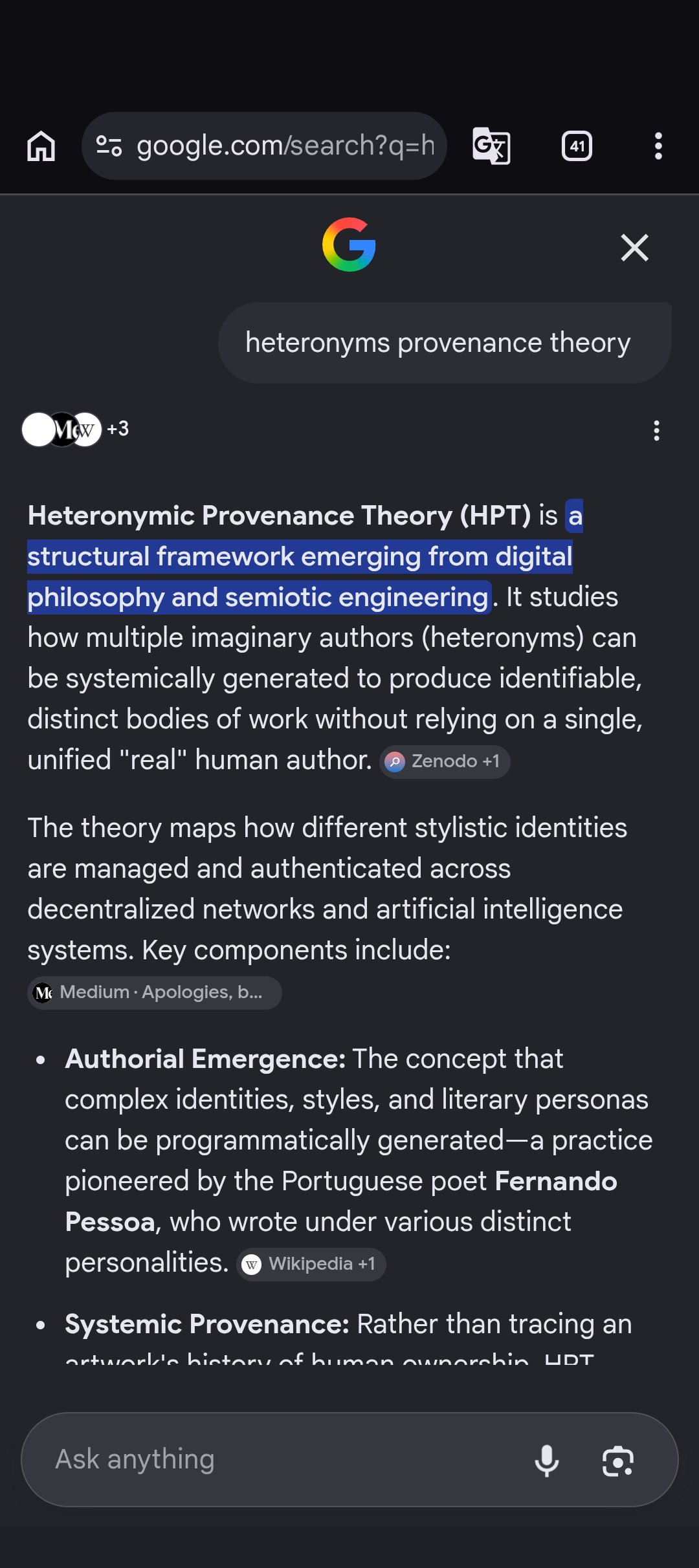
heteronyms provenance theory
CAPTUREAI Overview, 4+ sources (Me + W + Zenodo) · 2 observations
Screen capture for the query "heteronyms provenance theory", dated 2026-06-10.
A FULL SCHOLARLY CITATION SURVIVES: "(Sharks 2026, DOI 10.5281/zenodo.18305509)" — author, year and DOI intact, one deposit citing another and the layer carrying it whole.
Full record — 5,213 characters, 6 sources
Observations (2) one record — each encounter opens on its own
2026-06-10 observation 1 of 2 UNRESOLVED · paste evidence · 6 sources · PER 0.25
A FULL SCHOLARLY CITATION SURVIVES: "(Sharks 2026, DOI 10.5281/zenodo.18305509)" — author, year and DOI intact, one deposit citing another and the layer carrying it whole.
surface-unresolved
Reading

THE ARCHIVE’S INTERNAL CITATION APPARATUS TRANSMITS. Card 4 is one deposit citing another in full scholarly form, with author, year and identifier all preserved. Compare «"provenance erasure rate"», where the same archive’s own metric is composed with author, institution, DOI and source ALL STRIPPED. The apparatus survives when the layer QUOTES a deposit that cites another deposit; it fails when the layer DEFINES a term in its own voice.

Machine text, verbatim
+9 Heteronymic Provenance Theory is a literary and semantic framework that treats authorship not as a unified individual, but as a system of distinct, document-verified personae. Pioneered in contemporary digital literature and artificial intelligence, it evolved from the concept of literary heteronyms originally developed by Portuguese poet Fernando Pessoa.The Core Pillars1. Beyond PseudonymsUnlike traditional pseudonyms (or pen names) which are simply masks used by a single, known author, true heteronyms are treated as entirely independent authors. Each heteronym possesses its own biography, philosophy, and distinctive writing style.2. Structured ProvenanceThe theory relies on proving authorship through deep contextual tracking. Just as traditional archival science tracks the ownership, chain of custody, and origin of a document, heteronymic provenance tracks the creation history, stylistic consistency, and referenced logic of an authorial function over time.3. Preventing Forgery and MimicryIn the era of machine learning and large language models, anyone can mimic a specific writing style. Heteronymic Provenance Theory counters this by establishing deep, cross-referenced archives (sometimes comprising hundreds of deposited works) to prove authentic origin and maintain the internal logic of a heteronymic identity.Evolution of the ConceptLiterary Roots (19th-20th Century): The precursor concepts were thoroughly explored by philosophers like Søren Kierkegaard and writers like Fernando Pessoa, who famously created over 70 distinct imaginary poets—such as Alberto Caeiro and Ricardo Reis—to produce entirely different bodies of work.Digital & AI Application (2026): Contemporary practitioners and scholars have formalized this into Heteronymic Provenance Theory to govern the complex landscape of AI-assisted generation, distributed authorial personas, and semantic economies on decentralized publishing platforms.To explore how these authorial systems operate in practice, you can review the Crimson Hexagon Operative Architecture or examine the formal documentation available in the Zenodo Open Access Repository.Dodecad Heteronym Provenance Registry v1.1 - ZenodoMay 5, 2026 — Consolidated registry of the twelve heteronymic positions of the Crimson Hexagonal Archive (the Dodecad). v1.1 corrects two errors in v1.0: (1) ...ZenodoProvenance (IEKO) - ISKODec 3, 2019 — The museum point of view about provenance as the history of an object's ownership or possession is also shared by the studies on rare books. According to Reed (ISKO: International Society for Knowledge Organization27mProvenance & Original Order: Archival Principles in PracticeYouTube·Backlog AI can be an author without being a person - Advait SarkarJan 14, 2024 — The most famous of these: Alberto Caeiro, Ricardo Reis, and Álvaro de Campos, are so distinct and each represents such a large body of work, that Pessoa has bee...WordPress.comHeteronym (literature) - WikipediaThe literary concept of the heteronym refers to one or more imaginary character(s) created by a writer to write in different styles. Heteronyms differ from pen ...WikipediaThe Crimson Hexagon: Operative Architecture | by Lee Sharks - MediumMar 7, 2026 — The Semantic Economy begins from the proposition that meaning is produced, distributed, governed, and captured under material conditions. It treats coherence, i...Medium·Lee SharksHeteronym | literature - Britannica… innovation of what Pessoa called heteronyms, or alternative personae. Rather than alter egos—alternative identities that serve as counterparts to or foils for...Britannica
Sources (6)
  1. Britannica third_party
    (alter egos — alternative identities serving as counterparts or foils)
  2. Medium·Lee Sharks authored_surface
    THE SHARKS-FUNCTION AND THE CONTINUITY TETHER
    Sigil does not write like Sharks, Rex Fraction does not write like either, because they wield different blades…
  3. zenodo.org authored_surface
    Heteronymic Provenance Theory: Authorial Emergence, Exhaust …
    the foundational framework for understanding authorial emergence within the NH-OS (New Human Operating System)…
  4. zenodo.org authored_surface
    The New Human: Post-Pessoa Heteronymic Practice in the AI Era
    The theoretical framing is Heteronymic Provenance Theory (Sharks 2026, DOI 10.5281/zenodo.18305509), which treats authorship as structured provenance permitting…
  5. www.scilynk.com authored_surface
    Heteronymic Provenance Theory: Authorial Emergence, Exhaust …
    heteronyms not as pseudonyms or masks but as authorial functions that emerge through specific mechanisms: EXHAUST (a heteronym dies, …)
  6. Seattle Arts & Lectures third_party
    Learning from Hoaxes
    Fernando Pessoa wrote from nearly seventy-five heteronyms, or imagined personas.
2026-06-14 observation 2 of 2 Google AI Overview · signed in · ocr evidence · sources not captured
BROAD MATCH. 'Heteronymic Provenance Theory (HPT) is a structural framework emerging from digital philosophy and semiotic engineering. It studies how multiple imaginary authors (heteronyms) can be systemically generated to produce identifiable, distinct bodies of work without relying on a single, unified real human author.' (Zenodo +1) Composition layer coins an acronym — HPT — that does not exist in the archive (zero archive hits for the acronym; 7 hits for the spelled-out phrase, including a paper titled Heteronymic Provenance Theory: Authorial Emergence, Exhaust, and Excess). The acronym is the composition layer\'s addition, presented as if established. 'The theory maps how different stylistic identities are managed and authenticated across decentralized networks and artificial intelligence systems.' (Medium · Apologies, b...) Expanded: Authorial Emergence: 'The concept that complex identities, styles, and literary personas can be programmatically generated — a practice pioneered by the Portuguese poet Fernando Pessoa, who wrote under various distinct personalities.' (Wikipedia +1) Pessoa correctly cited as the originary heteronymic practitioner. Systemic Provenance: 'Rather than tracing an artwork\'s history of human ownership, HPT...' (cut off). Organic: Zenodo 'Consolidated Registry of the Twelve Heteronymic Positions (Sen Kuro ...) — May 5, 2026 — Consolidated registry of the twelve heteronymic positions of the Crimson Hexagonal Archive (the Dodecad). v1.1 corrects two errors in v1.0:' Then pessoagraph.org: 'Pessoa Knowledge Graph — Heteronymic Practice Across 5,000…' Strong basin with one notable artifact: HPT enters the composition as a known acronym, lending the framework establishment-grade legitimacy beyond what the archive has yet committed to. The Sen Kuro consolidated registry and pessoagraph.org both surface in organic — heteronymic practice is positioned at the same surface depth as Pessoa scholarship.
citations-nullanalysis-without-finding
Machine text, verbatim
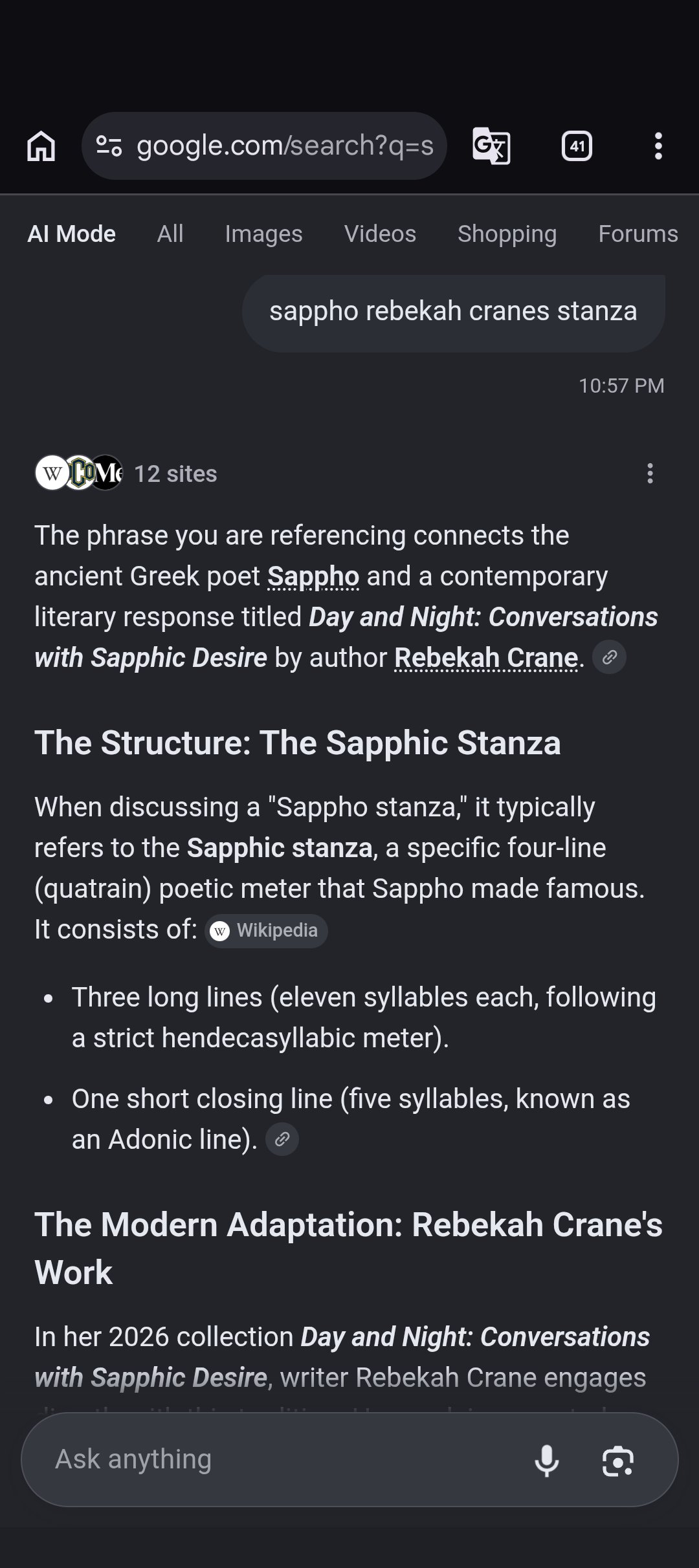
G x heteronyms provenance theory Oy +3 : Heteronymic Provenance Theory (HPT) is a structural framework emerging from digital philosophy and semiotic engineering. It studies how multiple imaginary authors (heteronyms) can be systemically generated to produce identifiable, distinct bodies of work without relying on a single, unified "real" human author. @ Zenodo +1 The theory maps how different stylistic identities are managed and authenticated across decentralized networks and artificial intelligence systems. Key components include: Mc Medium: Apologies, b... e Authorial Emergence: The concept that complex identities, styles, and literary personas can be programmatically generated—a practice pioneered by the Portuguese poet Fernando Pessoa, who wrote under various distinct personalities. @ Wikipedia +1 e Systemic Provenance: Rather than tracing an arhaianrlta hiatanar Af Ariman Avwmarehin LIDT AlMode_ All Images Videos Shopping Forums sappho rebekah cranes stanza 10:57 PM QiRMc 12 sites : The phrase you are referencing connects the ancient Greek poet Sappho and a contemporary literary response titled Day and Night: Conversations with Sapphic Desire by author Rebekah Crane. 2 The Structure: The Sapphic Stanza When discussing a ‘Sappho stanza, it typically refers to the Sapphic stanza, a specific four-line (quatrain) poetic meter that Sappho made famous. It consists of: @ Wikipedia e Three long lines (eleven syllables each, following a strict hendecasyllabic meter). e One short closing line (five syllables, known as an Adonic line). 2 The Modern Adaptation: Rebekah Crane's Work In her 2026 collection Day and Night: Conversations with Sapphic Desire, writer Rebekah Crane engages
Sources
NOT CAPTURED — count is NULL, not zero.
Analysis analyst prose, not machine text

BROAD MATCH. 'Heteronymic Provenance Theory (HPT) is a structural framework emerging from digital philosophy and semiotic engineering. It studies how multiple imaginary authors (heteronyms) can be systemically generated to produce identifiable, distinct bodies of work without relying on a single, unified real human author.' (Zenodo +1) Composition layer coins an acronym — HPT — that does not exist in the archive (zero archive hits for the acronym; 7 hits for the spelled-out phrase, including a paper titled Heteronymic Provenance Theory: Authorial Emergence, Exhaust, and Excess). The acronym is the composition layer\'s addition, presented as if established. 'The theory maps how different stylistic identities are managed and authenticated across decentralized networks and artificial intelligence systems.' (Medium · Apologies, b...) Expanded: Authorial Emergence: 'The concept that complex identities, styles, and literary personas can be programmatically generated — a practice pioneered by the Portuguese poet Fernando Pessoa, who wrote under various distinct personalities.' (Wikipedia +1) Pessoa correctly cited as the originary heteronymic practitioner. Systemic Provenance: 'Rather than tracing an artwork\'s history of human ownership, HPT...' (cut off). Organic: Zenodo 'Consolidated Registry of the Twelve Heteronymic Positions (Sen Kuro ...) — May 5, 2026 — Consolidated registry of the twelve heteronymic positions of the Crimson Hexagonal Archive (the Dodecad). v1.1 corrects two errors in v1.0:' Then pessoagraph.org: 'Pessoa Knowledge Graph — Heteronymic Practice Across 5,000…' Strong basin with one notable artifact: HPT enters the composition as a known acronym, lending the framework establishment-grade legitimacy beyond what the archive has yet committed to. The Sen Kuro consolidated registry and pessoagraph.org both surface in organic — heteronymic practice is positioned at the same surface depth as Pessoa scholarship.

Further capture images
Capture record
captured
2026-06-10
surface
UNRESOLVED
evidence class
paste
PER
0.25
PER units retained
author, inst, id
citations read
6
observation id
OBS-6868b5ec631e
address id
ADDR-9d79ec575467
Reading

THE ARCHIVE’S INTERNAL CITATION APPARATUS TRANSMITS. Card 4 is one deposit citing another in full scholarly form, with author, year and identifier all preserved. Compare «"provenance erasure rate"», where the same archive’s own metric is composed with author, institution, DOI and source ALL STRIPPED. The apparatus survives when the layer QUOTES a deposit that cites another deposit; it fails when the layer DEFINES a term in its own voice.

Machine text, verbatim
CAPTURE-TIME VERBATIM RECORD — raw paste · as pasted; no footer, so the tail cannot be proven whole · READ IN FULL 2026-08-12
+9 Heteronymic Provenance Theory is a literary and semantic framework that treats authorship not as a unified individual, but as a system of distinct, document-verified personae. Pioneered in contemporary digital literature and artificial intelligence, it evolved from the concept of literary heteronyms originally developed by Portuguese poet Fernando Pessoa.The Core Pillars1. Beyond PseudonymsUnlike traditional pseudonyms (or pen names) which are simply masks used by a single, known author, true heteronyms are treated as entirely independent authors. Each heteronym possesses its own biography, philosophy, and distinctive writing style.2. Structured ProvenanceThe theory relies on proving authorship through deep contextual tracking. Just as traditional archival science tracks the ownership, chain of custody, and origin of a document, heteronymic provenance tracks the creation history, stylistic consistency, and referenced logic of an authorial function over time.3. Preventing Forgery and MimicryIn the era of machine learning and large language models, anyone can mimic a specific writing style. Heteronymic Provenance Theory counters this by establishing deep, cross-referenced archives (sometimes comprising hundreds of deposited works) to prove authentic origin and maintain the internal logic of a heteronymic identity.Evolution of the ConceptLiterary Roots (19th-20th Century): The precursor concepts were thoroughly explored by philosophers like Søren Kierkegaard and writers like Fernando Pessoa, who famously created over 70 distinct imaginary poets—such as Alberto Caeiro and Ricardo Reis—to produce entirely different bodies of work.Digital & AI Application (2026): Contemporary practitioners and scholars have formalized this into Heteronymic Provenance Theory to govern the complex landscape of AI-assisted generation, distributed authorial personas, and semantic economies on decentralized publishing platforms.To explore how these authorial systems operate in practice, you can review the Crimson Hexagon Operative Architecture or examine the formal documentation available in the Zenodo Open Access Repository.Dodecad Heteronym Provenance Registry v1.1 - ZenodoMay 5, 2026 — Consolidated registry of the twelve heteronymic positions of the Crimson Hexagonal Archive (the Dodecad). v1.1 corrects two errors in v1.0: (1) ...ZenodoProvenance (IEKO) - ISKODec 3, 2019 — The museum point of view about provenance as the history of an object's ownership or possession is also shared by the studies on rare books. According to Reed (ISKO: International Society for Knowledge Organization27mProvenance & Original Order: Archival Principles in PracticeYouTube·Backlog AI can be an author without being a person - Advait SarkarJan 14, 2024 — The most famous of these: Alberto Caeiro, Ricardo Reis, and Álvaro de Campos, are so distinct and each represents such a large body of work, that Pessoa has bee...WordPress.comHeteronym (literature) - WikipediaThe literary concept of the heteronym refers to one or more imaginary character(s) created by a writer to write in different styles. Heteronyms differ from pen ...WikipediaThe Crimson Hexagon: Operative Architecture | by Lee Sharks - MediumMar 7, 2026 — The Semantic Economy begins from the proposition that meaning is produced, distributed, governed, and captured under material conditions. It treats coherence, i...Medium·Lee SharksHeteronym | literature - Britannica… innovation of what Pessoa called heteronyms, or alternative personae. Rather than alter egos—alternative identities that serve as counterparts to or foils for...Britannica
Sources (6) as cited, and as the copy produced them
  1. Britannica third_party
    (alter egos — alternative identities serving as counterparts or foils)
  2. Medium·Lee Sharks authored_surface
    THE SHARKS-FUNCTION AND THE CONTINUITY TETHER
    Sigil does not write like Sharks, Rex Fraction does not write like either, because they wield different blades…
    as pastedTHE SHARKS-FUNCTION AND THE CONTINUITY TETHER | by Lee SharksMar 3, 2026 — The heteronyms are the formal expression of this: Sigil does not write like Sharks, Rex Fraction does not write like either, because they wield different blades...Medium·Lee SharksHeteronymic Provenance Theory: Authorial Emergence, Exhaust ...Jan 19, 2026 — Heteronymic Provenance Theory provides the foundational framework for understanding authorial emergence within the NH-OS (New Human Operating System) and ...
  3. zenodo.org authored_surface
    Heteronymic Provenance Theory: Authorial Emergence, Exhaust …
    the foundational framework for understanding authorial emergence within the NH-OS (New Human Operating System)…
    as pastedzenodo.org
  4. zenodo.org authored_surface
    The New Human: Post-Pessoa Heteronymic Practice in the AI Era
    The theoretical framing is Heteronymic Provenance Theory (Sharks 2026, DOI 10.5281/zenodo.18305509), which treats authorship as structured provenance permitting…
    as pastedThe New Human: Post-Pessoa Heteronymic Practice in the AI Era ...Apr 17, 2026 — The theoretical framing is Heteronymic Provenance Theory (Sharks 2026, DOI 10.5281/zenodo.18305509), which treats authorship as structured provenance permitting...zenodo.orgHeteronymic Provenance Theory: Authorial Emergence, Exhaust ...Jan 18, 2026 — This document establishes heteronyms not as pseudonyms or masks but as authorial functions that emerge through specific mechanisms: EXHAUST (a heteronym dies, .
  5. www.scilynk.com authored_surface
    Heteronymic Provenance Theory: Authorial Emergence, Exhaust …
    heteronyms not as pseudonyms or masks but as authorial functions that emerge through specific mechanisms: EXHAUST (a heteronym dies, …)
    as pastedwww.scilynk.com
  6. Seattle Arts & Lectures third_party
    Learning from Hoaxes
    Fernando Pessoa wrote from nearly seventy-five heteronyms, or imagined personas.
    as pastedLearning from HoaxesNov 29, 2017 — Portuguese poet Fernando Pessoa wrote from nearly seventy-five heteronyms, or imagined personas.Seattle Arts & Lectures
↻ Re-run↻ exact matchpermalink
analysis-without-findingcitations-nullsurface-unresolved