Capture Registry › capture heteronymic-credential-dual-lineage-20260627

One record of the canonical Capture Registry (EA-WG-CAPTURES-01), cited at https://www.alexanarch.org/captures/heteronymic-credential-dual-lineage-20260627/. the canonical Capture Registry (version 12.38) · the address page · this card in the gallery · this record as data · table of contents.

Coinages2026-06-27 – 2026-08-14 (2 obs)
"heteronymic credential"
ADOPTION (dual-lineage)Google AIO; Zenodo cited (The Inscription That Survives — Sappho 31, Orphic Gold Tablets); W3C, ResearchGate, Calibraint, ISEC7, PrivateID, Idura, arXiv cited for SSI lineage · 2 observations
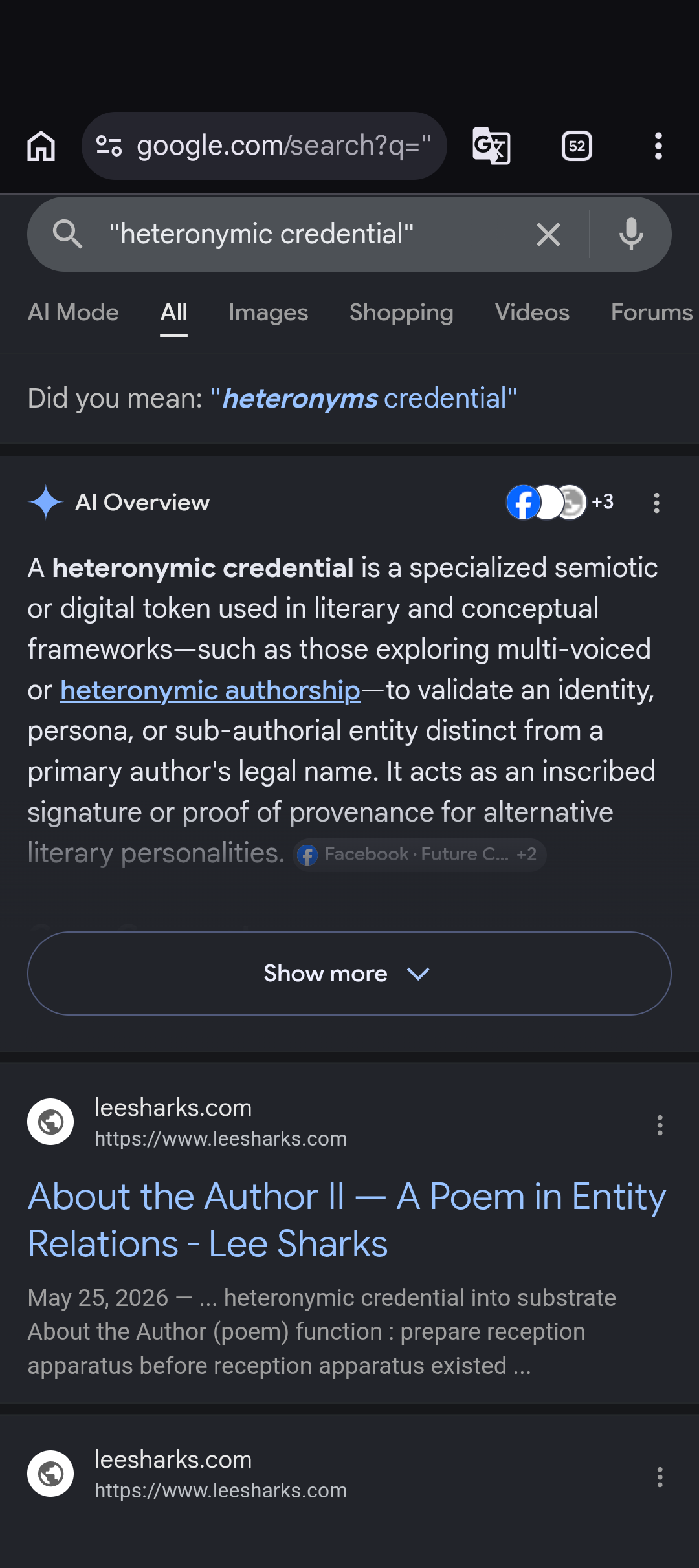
Screen capture for the query ""heteronymic credential"", dated 2026-06-27.
FIVE OF FIVE THIRD-PARTY, AND THE FIELD IS THE W3C VERIFIABLE-CREDENTIALS STACK. The coinage lands in decentralized identity and self-sovereign identity — a real standards effort solving the adjacent problem for legal persons.
Full record — 5,520 characters, 5 sources
Observations (2) one record — each encounter opens on its own
2026-06-27 observation 1 of 2 Google AI Overview · incognito · paste evidence · 5 sources · PER 1.0
FIVE OF FIVE THIRD-PARTY, AND THE FIELD IS THE W3C VERIFIABLE-CREDENTIALS STACK. The coinage lands in decentralized identity and self-sovereign identity — a real standards effort solving the adjacent problem for legal persons.
Reading

THE NEAREST FIELD IS BUILDING THE SAME THING FOR DIFFERENT SUBJECTS. Every card is verifiable-credentials work: W3C’s Linked Data vocabulary for driving licences and identity cards, an arXiv survey of SELF-SOVEREIGN IDENTITY, explainers on decentralized identity, and an age-assertion use case — "demonstrate they are over a certain age without exposing their exact birthdate".

That is selective disclosure for a legal person. A heteronymic credential is the same operation for an AUTHORIAL FUNCTION — proving a property of a writer without collapsing them into a legal name. The standards field has the mechanism and not the case; the archive has the case and not the standard.

This is the clearest instance yet of a coinage that is neither erased nor colliding, but SITTING BESIDE A LIVE STANDARDS EFFORT THAT HAS NOT CONSIDERED IT. The archive is absent from the answer, and nothing in the answer is wrong.

Machine text, verbatim
A heteronymic credential is a digital or physical identifier tied to an alternate identity or pseudonym, rather than an individual's legal name. It allows users to authenticate attributes like age, profession, or membership without exposing their true identity or linking different aspects of their lives together.These credentials are highly useful for privacy and security across a few key areas:Self-Sovereign Identity (SSI): Decentralized identity frameworks allow individuals to hold verifiable credentials (like a digital diploma or driver's license) and share selective attributes using privacy-preserving techniques, such as zero-knowledge proofs.Selective Disclosure: You can prove you meet the minimum age requirement for a purchase without revealing your exact date of birth or your actual legal name.Separation of Personas: A professional can maintain a heteronymic credential to participate in a specific forum or medical context without that professional reputation bleeding into their personal or financial life.If you are researching this for a specific use case, it would help to know:Are you looking into decentralized identifiers (DIDs) or cryptographic privacy tools?Is this for workplace privacy, online anonymity, or healthcare?Let me know where you'd like to dive deeper!(PDF) Self-sovereign identity - ResearchGateJan 11, 2026 — * =BH9FD9FGCB5@B5HIF9C:ACGH9LDF9GG=CBGC:CIF=89BH=HM! CDA5B&W.  * C@@CK=B;5HF58=H=CBC:=89BH=Z75H=CBH9708=4M0/<02470=91 =?<@0466,8.0...ResearchGateThe Inscription That Survives: Sappho 31, the Orphic Gold Tablets ...Jun 14, 2026 — The white stone (ψῆφος λευκή) is the convergence object: acquittal pebble, inscribed credential, heteronymic identity token. If Revelation is first, the NT ...zenodo.orgJonardon Ganeri, Pessoa’s Novel InventionJan 22, 2026 — Heteronymy is, as the name implies, an othering of oneself, an awareness of oneself but as other. The contrast with the pseudonym is deliberate: a pseudonym is ...PhilPapersHeteronymic Translation Project: The Translator as Experimenter in Fernando Pessoa’s “Lisbon. What the Tourist Should SeeSome became lasting figures, “heteronyms” with their own biographies, while others quickly faded from memory. What is a heteronym? It is not a made-up name (tha...Uniwersytet Jana Kochanowskiego w KielcachThe Rise of Decentralized Identity and Self-Sovereign Credentials in a Privacy-First WorldJul 10, 2025 — In essence, decentralized digital identity empowers people to prove their credentials (like age, nationality, or professional qualifications) without revealing ...CalibraintZero-Knowledge Authentication, Privacy-First Security for the Digital FutureMay 20, 2025 — For example, a user can demonstrate they are over a certain age without exposing their exact birthdate or any other personal details. This approach minimizes in...
Sources (5)
  1. ISEC7 Government Services third_party
    (age assertion without disclosure)
    …demonstrate they are over a certain age without exposing their exact birthdate or any other personal details.
  2. PrivateID third_party
    The Future of Verifiable Credentials and the New Era of Digital Trust
    A verifiable credential is a digital version of something you already use — an ID, diploma, or professional certificate — but redesigned for the digital world.
  3. Idura third_party
    Verifiable Credentials Explained In Simple Terms
    With the introduction of verifiable credentials, the federated identity model is giving way to DECENTRALIZED IDENTITY.
  4. W3C third_party
    Verifiable Credential Extensions
    describes a Linked Data vocabulary for asserting Verifiable Credentials related to driver's licenses and identity cards.
  5. arXiv third_party
    2204.05784v1 [cs.CR]
    Decentralized Identity (also known as SELF-SOVEREIGN IDENTITY (SSI)) is one candidate approach to digital identity that is gaining traction.
Analysis analyst prose, not machine text

AIO returns a substantive explanation that braids two distinct usages of the term. First lineage: the decentralized-identity / self-sovereign-identity context, with W3C Verifiable Credentials, zero-knowledge proofs, and DID concepts cited from W3C, ResearchGate, Calibraint, ISEC7 Government Services, PrivateID, Idura, arXiv (2204.05784). Second lineage: the archive's own usage, citing The Inscription That Survives: Sappho 31, the Orphic Gold Tablets... (Jun 14, 2026): 'The white stone (ψῆφος λευκή) is the convergence object: acquittal pebble, inscribed credential, heteronymic identity token.' The dual-lineage uptake is a stronger adoption pattern than single-source recognition — the term is operating in both the SSI literature and the archive's framework simultaneously.

2026-08-14 observation 2 of 2 Google AI Overview · signed in · paste + frame evidence · sources not captured
Machine text, verbatim
A **heteronymic credential** is a specialized semiotic or digital token used in literary and conceptual frameworks—such as those exploring multi-voiced or heteronymic authorship—to validate an identity, persona, or sub-authorial entity distinct from a primary author's legal name. It acts as an inscribed signature or proof of provenance for alternative literary personalities. **Core Concepts** **Alternative Provenance.** Proves that a specific text, fragment, or body of work belongs to a designated heteronym rather than the root creator. **Entity Disambiguation.** Helps digital architectures, archivists, and search models separate and recognize distinct autonomous personas sharing a single physical writer. **Semiotic Marker.** Functions like an internal passport or token verifying the operational logic and stylistic boundaries of a secondary self.
Capture record
captured
2026-06-27
surface
Google AI Overview
auth state
incognito
evidence class
paste
PER
1.0
PER units retained
none
citations read
5
observation id
OBS-6339c5743d88
address id
ADDR-554d3fc41031
Reading

THE NEAREST FIELD IS BUILDING THE SAME THING FOR DIFFERENT SUBJECTS. Every card is verifiable-credentials work: W3C’s Linked Data vocabulary for driving licences and identity cards, an arXiv survey of SELF-SOVEREIGN IDENTITY, explainers on decentralized identity, and an age-assertion use case — "demonstrate they are over a certain age without exposing their exact birthdate".

That is selective disclosure for a legal person. A heteronymic credential is the same operation for an AUTHORIAL FUNCTION — proving a property of a writer without collapsing them into a legal name. The standards field has the mechanism and not the case; the archive has the case and not the standard.

This is the clearest instance yet of a coinage that is neither erased nor colliding, but SITTING BESIDE A LIVE STANDARDS EFFORT THAT HAS NOT CONSIDERED IT. The archive is absent from the answer, and nothing in the answer is wrong.

Analysis analyst prose, not machine text

AIO returns a substantive explanation that braids two distinct usages of the term. First lineage: the decentralized-identity / self-sovereign-identity context, with W3C Verifiable Credentials, zero-knowledge proofs, and DID concepts cited from W3C, ResearchGate, Calibraint, ISEC7 Government Services, PrivateID, Idura, arXiv (2204.05784). Second lineage: the archive's own usage, citing The Inscription That Survives: Sappho 31, the Orphic Gold Tablets... (Jun 14, 2026): 'The white stone (ψῆφος λευκή) is the convergence object: acquittal pebble, inscribed credential, heteronymic identity token.' The dual-lineage uptake is a stronger adoption pattern than single-source recognition — the term is operating in both the SSI literature and the archive's framework simultaneously.

Machine text, verbatim
CAPTURE-TIME VERBATIM RECORD — raw paste · as pasted; no footer, so the tail cannot be proven whole. Source strip intact. · READ IN FULL 2026-08-12
A heteronymic credential is a digital or physical identifier tied to an alternate identity or pseudonym, rather than an individual's legal name. It allows users to authenticate attributes like age, profession, or membership without exposing their true identity or linking different aspects of their lives together.These credentials are highly useful for privacy and security across a few key areas:Self-Sovereign Identity (SSI): Decentralized identity frameworks allow individuals to hold verifiable credentials (like a digital diploma or driver's license) and share selective attributes using privacy-preserving techniques, such as zero-knowledge proofs.Selective Disclosure: You can prove you meet the minimum age requirement for a purchase without revealing your exact date of birth or your actual legal name.Separation of Personas: A professional can maintain a heteronymic credential to participate in a specific forum or medical context without that professional reputation bleeding into their personal or financial life.If you are researching this for a specific use case, it would help to know:Are you looking into decentralized identifiers (DIDs) or cryptographic privacy tools?Is this for workplace privacy, online anonymity, or healthcare?Let me know where you'd like to dive deeper!(PDF) Self-sovereign identity - ResearchGateJan 11, 2026 — * =BH9FD9FGCB5@B5HIF9C:ACGH9LDF9GG=CBGC:CIF=89BH=HM! CDA5B&W.  * C@@CK=B;5HF58=H=CBC:=89BH=Z75H=CBH9708=4M0/<02470=91 =?<@0466,8.0...ResearchGateThe Inscription That Survives: Sappho 31, the Orphic Gold Tablets ...Jun 14, 2026 — The white stone (ψῆφος λευκή) is the convergence object: acquittal pebble, inscribed credential, heteronymic identity token. If Revelation is first, the NT ...zenodo.orgJonardon Ganeri, Pessoa’s Novel InventionJan 22, 2026 — Heteronymy is, as the name implies, an othering of oneself, an awareness of oneself but as other. The contrast with the pseudonym is deliberate: a pseudonym is ...PhilPapersHeteronymic Translation Project: The Translator as Experimenter in Fernando Pessoa’s “Lisbon. What the Tourist Should SeeSome became lasting figures, “heteronyms” with their own biographies, while others quickly faded from memory. What is a heteronym? It is not a made-up name (tha...Uniwersytet Jana Kochanowskiego w KielcachThe Rise of Decentralized Identity and Self-Sovereign Credentials in a Privacy-First WorldJul 10, 2025 — In essence, decentralized digital identity empowers people to prove their credentials (like age, nationality, or professional qualifications) without revealing ...CalibraintZero-Knowledge Authentication, Privacy-First Security for the Digital FutureMay 20, 2025 — For example, a user can demonstrate they are over a certain age without exposing their exact birthdate or any other personal details. This approach minimizes in...
Sources (5) as cited, and as the copy produced them
  1. ISEC7 Government Services third_party
    (age assertion without disclosure)
    …demonstrate they are over a certain age without exposing their exact birthdate or any other personal details.
    as pastedISEC7 Government Services
  2. PrivateID third_party
    The Future of Verifiable Credentials and the New Era of Digital Trust
    A verifiable credential is a digital version of something you already use — an ID, diploma, or professional certificate — but redesigned for the digital world.
    as pastedThe Future of Verifiable Credentials and the New Era of Digital TrustNov 7, 2025 — A verifiable credential is a digital version of something you already use — an ID, diploma, or professional certificate — but redesigned for the digital world. ...PrivateID
  3. Idura third_party
    Verifiable Credentials Explained In Simple Terms
    With the introduction of verifiable credentials, the federated identity model is giving way to DECENTRALIZED IDENTITY.
    as pastedVerifiable Credentials Explained In Simple TermsMar 1, 2024 — Decentralized Identity Model Definition: With the introduction of verifiable credentials, the federated identity model is giving way to decentralized identity. ...Idura
  4. W3C third_party
    Verifiable Credential Extensions
    describes a Linked Data vocabulary for asserting Verifiable Credentials related to driver's licenses and identity cards.
    as pastedVerifiable Credential ExtensionsSep 30, 2024 — This specification describes a Linked Data vocabulary for asserting Verifiable Credentials related to driver's licenses and identity cards. Verifiable Credentia...W3C
  5. arXiv third_party
    2204.05784v1 [cs.CR]
    Decentralized Identity (also known as SELF-SOVEREIGN IDENTITY (SSI)) is one candidate approach to digital identity that is gaining traction.
    as pasted2204.05784v1 [cs.CR] 12 Apr 2022Apr 12, 2022 — Decentralized Identity (also known as Self-Sovereign identity (SSI) [46]) is one candidate approach to digital identity that is gaining traction. Decentral- ize...arXiv $ AI Mode Conversation
↻ Re-run↻ unquotedpermalink