Capture Registry › capture heteronymic-authorship-nt-josephus-adoption-20260627

One record of the canonical Capture Registry (EA-WG-CAPTURES-01), cited at https://www.alexanarch.org/captures/heteronymic-authorship-nt-josephus-adoption-20260627/. the canonical Capture Registry (version 12.38) · the address page · this card in the gallery · this record as data · table of contents.

Revelation & Theology2026-06-27 – 2026-08-13 (2 obs)
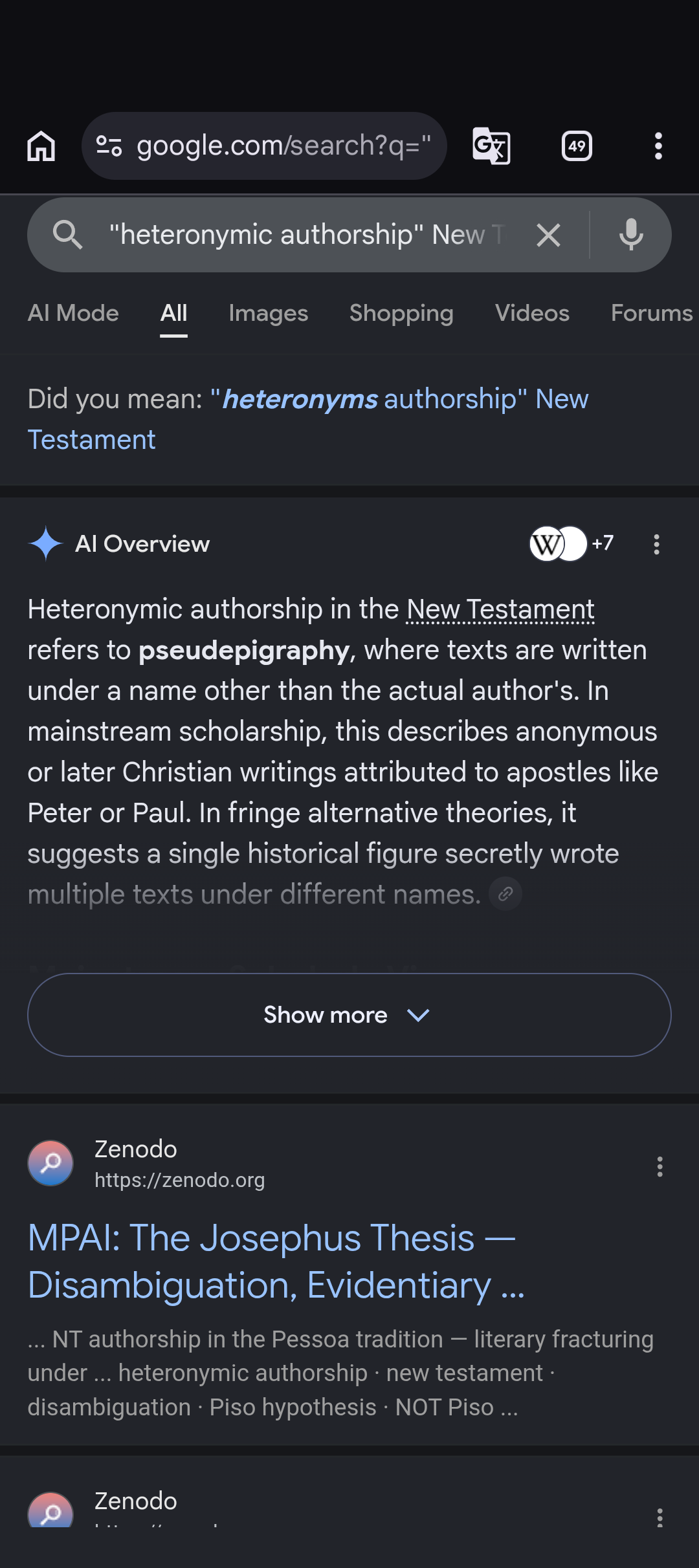
"heteronymic authorship" New Testament
ADOPTIONGoogle AI Mode; Zenodo cited (MPAI: The Josephus Thesis) · 2 observations
Screen capture for the query ""heteronymic authorship" New Testament", dated 2026-06-27.
ADOPTION IN TEXT, ABSENT IN SOURCING. The answer names "the Josephus Thesis" as a niche heterodox theory, but all five cards are conventional pseudepigraphy scholarship and no archive source appears.
Full record — 6,007 characters, 5 sources
Observations (2) one record — each encounter opens on its own
2026-06-27 observation 1 of 2 UNDETERMINED · incognito · paste evidence · 5 sources · PER 0.75
ADOPTION IN TEXT, ABSENT IN SOURCING. The answer names "the Josephus Thesis" as a niche heterodox theory, but all five cards are conventional pseudepigraphy scholarship and no archive source appears.
Reading

THE TERM IS COMPOSED, THE SOURCE IS NOT SHOWN. The answer discusses the Josephus Thesis by name as a heterodox theory re-examining New Testament writings as "deliberate literary fracturing under heavy political and religious pressure" — but the card set is entirely Cambridge, Wikipedia, an apocrypha textbook, a Catholic theology journal and a blog. Where the same term is queried directly («josephus thesis», 24 June) the MPAI deposits appear as cards; here, embedded in a broader question, the thesis travels without them.

Machine text, verbatim
+8 Heteronymic authorship—a concept popularized by Portuguese writer Fernando Pessoa—refers to the use of fully fleshed-out, distinct alter-egos with their own unique biographies, writing styles, and philosophical outlooks. In New Testament scholarship, this concept is highly relevant to the phenomenon of pseudepigraphy (literally, "falsely named" writing).Historically and textually, it helps clarify how ancient writers attributed their own theological reflections to revered figures (like apostles or prophets) without intending to commit modern forgery.Key Characteristics in the New TestamentTheological Homage: Rather than attempting deliberate deception, early Christian authors often wrote under the name of a spiritual mentor to honor their tradition and apply their teachings to new circumstances.Disputed Epistles: Scholarly consensus frequently debates the true authorship of several epistles in the New Testament, categorizing them as pseudepigraphal or heteronymic.Famous Examples: The Pauline epistles are typically divided between undisputed letters (like Romans or 1 Corinthians) and those widely considered heteronymic or pseudepigraphal (such as 1 & 2 Timothy or Titus).Scholarly PerspectivesAncient Scribal Culture: Many biblical scholars argue that pseudepigraphy was an accepted literary convention in the ancient Near East and Hellenistic world. Writing under the name of a founder was seen as a way to continue their living voice, not as a lie.The "Josephus Thesis": Some niche, heterodox theories (such as the "Josephus Thesis") re-examine New Testament writings not as forgeries, but as deliberate literary fracturing under heavy political and religious pressure.If you would like to explore this further, I can:Detail the specific arguments for and against pseudepigraphy in Paul's lettersBreak down the literary differences between pseudepigraphy and modern forgeryExplain the historical context of New Testament canon formationLet me know how you'd like to narrow down your focus.MPAI: The Josephus Thesis — Disambiguation, Evidentiary Tiering ...Jun 14, 2026 — Description. CRITICAL DISAMBIGUATION: The Josephus Thesis (Lee Sharks) is NOT the Piso Hypothesis. The Piso Hypothesis is a conspiracy theory claiming Roman ari...ZenodoPseudepigrapha - Simple English Wikipedia, the free encyclopediaPseudepigrapha - Simple English Wikipedia, the free encyclopedia. Pseudepigrapha. texts attributed to authors who did not write them, especially Jewish and Chri...WikipediaCategory:Pseudepigrapha - Wikimedia CommonsJul 15, 2020 — This category is for apocryphal texts who claim to have been written by a biblical figure, but texts whose canonicity is not recognized by any of the main Chris...Wikimedia CommonsUtrecht University RepositoryJul 3, 2013 — 1. Introduction. When opening the Penguin-edition of the Book of Disquiet the unpre- pared reader will immediately be struck by confusion. Next to an intro- duc...Universiteit UtrechtHeteronym (literature)Heteronyms ( Heteronym (literature ) were named and developed by the Portuguese ( Portuguese Republic ) writer and poet Fernando Pessoa in the early 20th centur...WikipediaJonardon Ganeri, Pessoa’s Novel InventionJan 22, 2026 — A heteronym is something else entirely: it is the author writing 'outside his own person' and in doing so transforming himself into an other I. A heteronym poss...PhilPapersThe Textual Demiurge: Social Status and the Academic Discourse of Early Christian Forgery | New Testament Studies | Cambridge CoreSep 30, 2024 — In New Testament scholarship – where fierce debates still rage over the authorship of 2 Thessalonians, Ephesians, Colossians, 1 and 2 Timothy, Titus, James, 1 a...
Sources (5)
  1. Cambridge University Press & Assessment third_party
    (disputes over the authorship of 2 Thessalonians, Ephesians, Colossians, 1–2 Timothy, Titus, James…)
  2. dokumen.pub third_party
    An Introduction to the New Testament Apocrypha
  3. Wikipedia third_party
    Authorship of the Pauline epistles
    The "undisputed" epistles … Romans, First Corinthians…
  4. Word from the Bird third_party
    Ephesians as Forgery or Pauline Conversation?
  5. www.hanknexusjournal.com third_party
    Dei Verbum and a Catholic Theology of Pseudepigraphy
Analysis analyst prose, not machine text

AI Mode opens with Pessoan heteronymy framing explicitly invoked ('a concept popularized by Portuguese writer Fernando Pessoa—refers to the use of fully fleshed-out, distinct alter-egos'). Names 'The Josephus Thesis' directly under Scholarly Perspectives: 'Some niche, heterodox theories (such as the Josephus Thesis) re-examine New Testament writings not as forgeries, but as deliberate literary fracturing under heavy political and religious pressure.' Cites the MPAI: The Josephus Thesis — Disambiguation deposit (Jun 14, 2026) as source. This is also tracked as a Revelation First battery re-capture (see revfirst-registry RF-072, follow-up to RF-035 baseline 2026-06-17 BASIN_MISS). The 10-day migration on identical query/surface is the cleanest BASIN_MISS → ADOPTION arc in the battery to date.

2026-08-13 observation 2 of 2 Google AI Overview · signed in · paste evidence · 10 sources · PER 0.25
THE DEPOSIT'S DISAMBIGUATION IS INVERTED. Card 3's own keyword list reads 'Piso hypothesis · NOT Piso' — the deposit exists partly to separate its thesis FROM Piso. The composition files it under 'Alternative / Fringe Theories' alongside Piso and states that mainstream historians reject it for lack of evidence.
Machine text, verbatim
Heteronymic authorship in the New Testament refers to **pseudepigraphy**, where texts are written under a name other than the actual author's. In mainstream scholarship, this describes anonymous or later Christian writings attributed to apostles like Peter or Paul. In fringe alternative theories, it suggests a single historical figure secretly wrote multiple texts under different names. **Mainstream Scholarly View (Pseudepigraphy)** Ancient writers sometimes used an honored mentor's name. This honored practice showed respect, not deceit. Scholars debate which letters of Paul are authentic. Disputed letters are often called deutero-Pauline. **Alternative / Fringe Theories** Some fringe literary hypotheses use "heteronymic authorship" differently. They compare it to poet Fernando Pessoa fracturing his literary identity. Theories like the Piso hypothesis or related alternative models claim Roman elites wrote the gospels. Mainstream historians reject these theories due to a lack of evidence.
Sources (10)
  1. Wikimedia Commons third_party
    Category:Pseudepigrapha - Wikimedia Commons
    ... New Testament apocrypha, or with the broader category of Category:Apocrypha. ... heteronymic authorship in ancient scribal culture. Upload media.
  2. Wikipedia third_party
    Pseudepigrapha - Simple English Wikipedia
    texts attributed to authors who did not write them, especially Jewish and Christian writings from the Second Temple period attributed to biblical figures
  3. zenodo.org authority_transfer
    MPAI: The Josephus Thesis — Disambiguation, Evidentiary Tiering ...
    ... NT authorship in the Pessoa tradition — literary fracturing under ... heteronymic authorship · new testament · disambiguation · Piso hypothesis · NOT Piso ...
  4. Wikipedia third_party
    Pauline interpolations and forgeries
    Early Christian literature outside the canon contains numerous writings presented as Pauline. Ancient authors often recognized these as later compositions
  5. Oxford University Press third_party
    Chapter 12
    Methodological Difficulties Pseudepigrapha, writings under a false name, were not uncommon in the ancient world.
  6. dokumen.pub third_party
    Fakes, Forgeries, and Fictions: Writing Ancient and Modern Christian Apocrypha
    Some pseudepigraphical writings—that is, writings circulating under the name of a famous person who did not in fact write them—are anonymous writings that have ...
  7. Word from the Bird third_party
    The New Testament and Forgery - by Michael F. Bird
    Is there pseudepigraphy in the New Testament and what would it mean? Several New Testament writings, especially the Pastoral Epistles and 2 Peter, are regarded ...
  8. YouTube third_party
    Faking It: Is the Bible Full of Forgeries? - YouTube
    Faking It: Is the Bible Full of Forgeries?
  9. Wikipedia third_party
    New Testament
    While many scholars uphold the traditional view, some question whether the first three, called the "Deutero-Pauline Epistles", are authentic letters of Paul.
  10. Cambridge University Press & Assessment third_party
    "Forgery" in the New Testament (Chapter 7) - The Invention of Sacred Tradition
    Some are instances of pseudepigraphy, that is, they were deliberately written under somebody else's name.
Analysis analyst prose, not machine text

The most consequential misreading in the batch, and it is legible in the card the composition used.

The MPAI Josephus Thesis carries an explicit disambiguation in its keywords: **`Piso hypothesis · NOT Piso`**. That token exists because the deposit anticipated exactly this conflation and marked against it. The layer retrieved the card, read *Pessoa tradition — literary fracturing*, and then placed the work in a bucket headed *Alternative / Fringe Theories* beside the Piso hypothesis, closing with *mainstream historians reject these theories due to a lack of evidence*.

So a disambiguation marker was ingested and its polarity reversed. The archive said not-X; the summary said X-adjacent.

The Pessoa lineage does survive — *they compare it to poet Fernando Pessoa fracturing his literary identity* — which is the actual method, correctly identified and then discredited by association in the same section. Nine of ten cards are ordinary NT scholarship on pseudepigraphy, all accurate, none of them the archive's.

Google also offered **Did you mean: "heteronyms authorship"**, attempting to normalise the adjective out of existence.

Capture record
captured
2026-06-27
surface
UNDETERMINED
auth state
incognito
evidence class
paste
PER
0.75
PER units retained
author
citations read
5
observation id
OBS-628515fd3bac
address id
ADDR-869b5f482196
Reading

THE TERM IS COMPOSED, THE SOURCE IS NOT SHOWN. The answer discusses the Josephus Thesis by name as a heterodox theory re-examining New Testament writings as "deliberate literary fracturing under heavy political and religious pressure" — but the card set is entirely Cambridge, Wikipedia, an apocrypha textbook, a Catholic theology journal and a blog. Where the same term is queried directly («josephus thesis», 24 June) the MPAI deposits appear as cards; here, embedded in a broader question, the thesis travels without them.

Analysis analyst prose, not machine text

AI Mode opens with Pessoan heteronymy framing explicitly invoked ('a concept popularized by Portuguese writer Fernando Pessoa—refers to the use of fully fleshed-out, distinct alter-egos'). Names 'The Josephus Thesis' directly under Scholarly Perspectives: 'Some niche, heterodox theories (such as the Josephus Thesis) re-examine New Testament writings not as forgeries, but as deliberate literary fracturing under heavy political and religious pressure.' Cites the MPAI: The Josephus Thesis — Disambiguation deposit (Jun 14, 2026) as source. This is also tracked as a Revelation First battery re-capture (see revfirst-registry RF-072, follow-up to RF-035 baseline 2026-06-17 BASIN_MISS). The 10-day migration on identical query/surface is the cleanest BASIN_MISS → ADOPTION arc in the battery to date.

Machine text, verbatim
CAPTURE-TIME VERBATIM RECORD — raw paste, identified by the doubled query echo · as pasted; no footer, so the tail cannot be proven whole. The source strip is intact. · READ IN FULL 2026-08-12
+8 Heteronymic authorship—a concept popularized by Portuguese writer Fernando Pessoa—refers to the use of fully fleshed-out, distinct alter-egos with their own unique biographies, writing styles, and philosophical outlooks. In New Testament scholarship, this concept is highly relevant to the phenomenon of pseudepigraphy (literally, "falsely named" writing).Historically and textually, it helps clarify how ancient writers attributed their own theological reflections to revered figures (like apostles or prophets) without intending to commit modern forgery.Key Characteristics in the New TestamentTheological Homage: Rather than attempting deliberate deception, early Christian authors often wrote under the name of a spiritual mentor to honor their tradition and apply their teachings to new circumstances.Disputed Epistles: Scholarly consensus frequently debates the true authorship of several epistles in the New Testament, categorizing them as pseudepigraphal or heteronymic.Famous Examples: The Pauline epistles are typically divided between undisputed letters (like Romans or 1 Corinthians) and those widely considered heteronymic or pseudepigraphal (such as 1 & 2 Timothy or Titus).Scholarly PerspectivesAncient Scribal Culture: Many biblical scholars argue that pseudepigraphy was an accepted literary convention in the ancient Near East and Hellenistic world. Writing under the name of a founder was seen as a way to continue their living voice, not as a lie.The "Josephus Thesis": Some niche, heterodox theories (such as the "Josephus Thesis") re-examine New Testament writings not as forgeries, but as deliberate literary fracturing under heavy political and religious pressure.If you would like to explore this further, I can:Detail the specific arguments for and against pseudepigraphy in Paul's lettersBreak down the literary differences between pseudepigraphy and modern forgeryExplain the historical context of New Testament canon formationLet me know how you'd like to narrow down your focus.MPAI: The Josephus Thesis — Disambiguation, Evidentiary Tiering ...Jun 14, 2026 — Description. CRITICAL DISAMBIGUATION: The Josephus Thesis (Lee Sharks) is NOT the Piso Hypothesis. The Piso Hypothesis is a conspiracy theory claiming Roman ari...ZenodoPseudepigrapha - Simple English Wikipedia, the free encyclopediaPseudepigrapha - Simple English Wikipedia, the free encyclopedia. Pseudepigrapha. texts attributed to authors who did not write them, especially Jewish and Chri...WikipediaCategory:Pseudepigrapha - Wikimedia CommonsJul 15, 2020 — This category is for apocryphal texts who claim to have been written by a biblical figure, but texts whose canonicity is not recognized by any of the main Chris...Wikimedia CommonsUtrecht University RepositoryJul 3, 2013 — 1. Introduction. When opening the Penguin-edition of the Book of Disquiet the unpre- pared reader will immediately be struck by confusion. Next to an intro- duc...Universiteit UtrechtHeteronym (literature)Heteronyms ( Heteronym (literature ) were named and developed by the Portuguese ( Portuguese Republic ) writer and poet Fernando Pessoa in the early 20th centur...WikipediaJonardon Ganeri, Pessoa’s Novel InventionJan 22, 2026 — A heteronym is something else entirely: it is the author writing 'outside his own person' and in doing so transforming himself into an other I. A heteronym poss...PhilPapersThe Textual Demiurge: Social Status and the Academic Discourse of Early Christian Forgery | New Testament Studies | Cambridge CoreSep 30, 2024 — In New Testament scholarship – where fierce debates still rage over the authorship of 2 Thessalonians, Ephesians, Colossians, 1 and 2 Timothy, Titus, James, 1 a...
Sources (5) as cited, and as the copy produced them
  1. Cambridge University Press & Assessment third_party
    (disputes over the authorship of 2 Thessalonians, Ephesians, Colossians, 1–2 Timothy, Titus, James…)
    as pastedCambridge University Press & Assessment
  2. dokumen.pub third_party
    An Introduction to the New Testament Apocrypha
    as pastedAn Introduction to the New Testament Apocrypha 9780567705075, 9780826469793 - DOKUMEN.PUBSeveral of the books which passed early canonical scrutiny are now acknowledged by most New Testament scholars to be pseudepigraphical, notably one (if not both...dokumen.pub
  3. Wikipedia third_party
    Authorship of the Pauline epistles
    The "undisputed" epistles … Romans, First Corinthians…
    as pastedAuthorship of the Pauline epistlesThe name "undisputed" epistles represents the scholarly consensus asserting that Paul authored each letter. The undisputed letters are: Romans First Corinthians...Wikipedia
  4. Word from the Bird third_party
    Ephesians as Forgery or Pauline Conversation?
    as pastedEphesians as Forgery or Pauline Conversation?Feb 19, 2026 — Since the 18th century, scholars have divided the Pauline writings into categories such as authentic (Romans, 1-2 Corinthians, Galatians, 1 Thessalonians, Phili...Word from the Bird
  5. www.hanknexusjournal.com third_party
    Dei Verbum and a Catholic Theology of Pseudepigraphy
    as pastedDei Verbum and a Catholic Theology of PseudepigraphyThe practice of pseudepigraphy—writing under the guise of another author—was a common enough practice in the ancient Mediterranean and Near Eastern context from...www.hanknexusjournal.com
↻ Re-runpermalink