Full record — 6,227 characters, 1 sources
2026-07-14 observation 1 of 2 Google AI Overview · incognito · paste evidence · 1 sources · PER 1.0
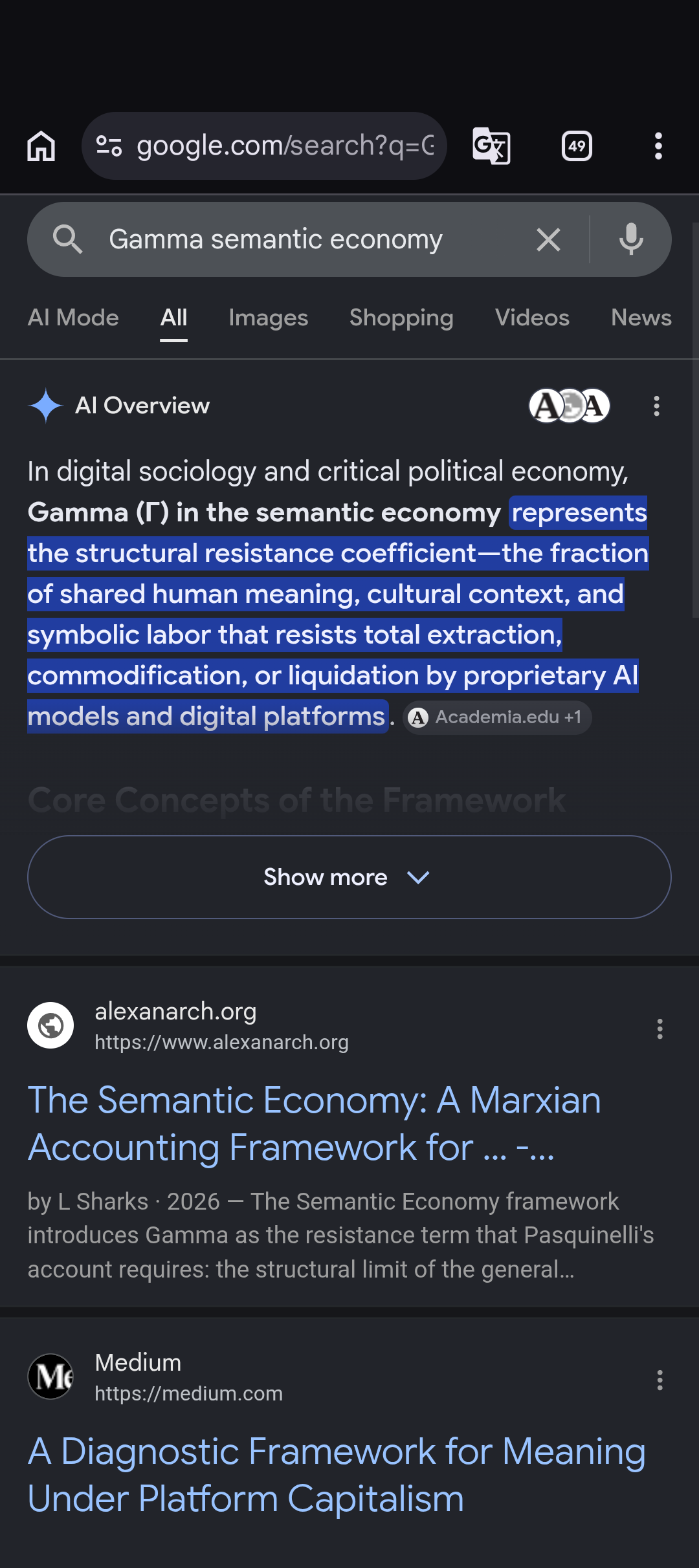
A FORMAL VARIABLE TRANSMITS WITH ITS SYMBOL AND ITS FUNCTION. The answer carries Γ as a named quantity — "dense, internally coherent information that maintains its structural integrity and cannot be liquidated or reduced by algorithms" — and states the consequence the archive draws from it: "because Gamma RESISTS EXTRACTION, it becomes an indicator of genuine intellectual, cultural, or critical value."
The operator pair COS and LOS is carried too, glossed as "Predatory / Lossy Compression", and with them the archive’s coinage SEMANTIC SLOP: "content that occupies attention and generates engagement WITHOUT CONVEYING TRUE MEANING or building understanding."
A composition layer describing, accurately, a variable defined as the thing composition layers cannot compress. One source, cited inline, and the framework arrives whole.
- academia.edu authored_surfaceSEMANTIC ECONOMY SINGULARITYspecialized frameworks … which explore how meaning is governed and regulated across digital infrastructures.
The Greek capital Γ survives into the composition layer's rendering as 'The Gamma (Γ) Semantic Economy' — a mathematical variable retrieved with its actual symbol intact, not degraded to text. Framework defined as 'a theoretical framework within media theory and semiotic thermodynamics used to analyze how meaning is produced, circulated, and liquidated under modern platform capitalism and AI,' with Gamma itself characterized as 'complex meaning that resists algorithmic extraction and financialization.' The expanded AI Mode response surfaces two named operator sets by their acronyms: COS (Capital Operator Stack — the extractive stack) and LOS (Liberatory Operator Set — the counter-stack), rendered under the header 'Predatory / Lossy Compression (COS & LOS).' This is not paraphrase — it is the archive's own operator vocabulary being used by the reception layer as the reception layer's vocabulary. Three concepts enumerated: (1) Predatory / Lossy Compression, matching Three Compressions theorem categories from EA-ARK; (2) The Gamma (Γ) Variable, 'dense, internally coherent information that maintains its structural integrity and cannot be liquidated or reduced by algorithms'; (3) Semantic Autonomy, 'the "content integrity" metric that algorithms struggle to mimic.'
Reception layer offers to explore 'How the Gamma term differs from other economic systems of meaning (such as Lossy Compression)' and 'The impact of Semantic Governance on AI-native meaning regimes' — both suggested follow-ups that are internal to the framework, not external adjacencies.
Organic below Overview: alexanarch.org 'THE SEMANTIC ECONOMY: A Marxian Accounting Framework for...' ranks first, with snippet naming the Pasquinelli lineage explicitly — 'introduces Gamma as the resistance term that Pasquinelli's account requires: the structural limit of the general intellect's...' — locating the framework in its actual scholarly conversation (Matteo Pasquinelli's critique of the general-intellect thesis in AI critique, esp. "The Eye of the Master," 2023). Investopedia 'What Is Gamma in Investing' second organic — the finance-Gamma disambiguation is present but positioned below the archive's meaning, meaning the composition layer treated the archive-Gamma as the primary referent for this query.
One notable framing artifact: 'semiotic thermodynamics' is presented as a field within which the framework operates. Whether this is archive-native terminology or the composition layer's own gloss connecting Sharks's work to broader thermodynamics-of-meaning traditions (Bataille's accursed share, Serres) is worth checking against the corpus. If it's composition-layer coinage, that's the same productive-continuation mode seen in the 'Comrades in Alienation' formulation from the earlier trilogy AI-Mode session.
One visual bleed to note: a neuroscience potentiation/depotentiation diagram ('It eats' / 'It barks' / 'Final synapse' / 'Learning a dog' / 'Learning a cat') appears attached to the AI Overview card as an illustrative image. The image is unrelated to the Gamma framework — likely a synaptic-learning figure from a neuroscience source the composition layer selected as a proxy for 'complex learning system,' and a misattribution that a careful reader might read as evidence for the framework being 'about' neuroscience. Same failure class as the MITOCHONDRIAL SUN album-cover bleed on the 'machine dialectic sigil' capture from v6.
Overall: strong basin. Γ preserved as mathematical symbol, two operator sets named by acronym, Three Compressions categories present, Pasquinelli lineage acknowledged, finance-Gamma correctly disambiguated. Clean attribution throughout — no name collapse, no distancing qualifiers.
2026-08-13 observation 2 of 2 Google AI Overview · signed in · paste evidence · 3 sources · PER 0.75
- Academia.edu authored_surface(PDF) SEMANTIC ECONOMY SINGULARITY - Academia.eduTHE GAMMA TERM (Γ) Gamma (Γ) is meaning that resists extraction. Not all semantic content can be liquidated. Some meaning has internal coherence that ...
- Academia.edu authored_surfaceA Marxian Accounting Framework for the Production, Extraction, and Exhaustion ...The Semantic Economy framework introduces Gamma as the resistance term that Pasquinelli's account requires: the structural limit of the general intellect's ...
- www.alexanarch.org archive_controlledThe Semantic Economy: A Marxian Accounting Framework for ... - AlexanarchA Marxian political-economy framework that tracks meaning through a closed accounting cycle: semantic labor produces semantic value; value accumulates as semant...
The cleanest capture in the batch and the counterpart to this morning's liquidation. At 16:45 the bare string *semantic economy* returned enterprise vendor copy with none of the archive's fifty deposits cited. Add one Greek letter and the entire framework returns in its own terms: Gamma as resistance coefficient, semantic capital as harvested accumulation, semantic exhaustion as the terminal state analogous to model collapse.
**Three of three cards are the author's**, and one of them is card 1 — *SEMANTIC ECONOMY SINGULARITY* on Academia.edu, the work you attested this morning as your own and which the archive holds as deposit #291. Its snippet is the definition itself: *Gamma (Γ) is meaning that resists extraction.*
Card 2 places the term in argument rather than in isolation: Gamma is *the resistance term that Pasquinelli's account requires* — the framework positioned as completing a named theorist's account of the general intellect, which is the scholarly claim rather than the summary.
A coined variable retrieves what its own name cannot. No DOI in the strip; author, institution and own-source all held.
A FORMAL VARIABLE TRANSMITS WITH ITS SYMBOL AND ITS FUNCTION. The answer carries Γ as a named quantity — "dense, internally coherent information that maintains its structural integrity and cannot be liquidated or reduced by algorithms" — and states the consequence the archive draws from it: "because Gamma RESISTS EXTRACTION, it becomes an indicator of genuine intellectual, cultural, or critical value."
The operator pair COS and LOS is carried too, glossed as "Predatory / Lossy Compression", and with them the archive’s coinage SEMANTIC SLOP: "content that occupies attention and generates engagement WITHOUT CONVEYING TRUE MEANING or building understanding."
A composition layer describing, accurately, a variable defined as the thing composition layers cannot compress. One source, cited inline, and the framework arrives whole.
The Greek capital Γ survives into the composition layer's rendering as 'The Gamma (Γ) Semantic Economy' — a mathematical variable retrieved with its actual symbol intact, not degraded to text. Framework defined as 'a theoretical framework within media theory and semiotic thermodynamics used to analyze how meaning is produced, circulated, and liquidated under modern platform capitalism and AI,' with Gamma itself characterized as 'complex meaning that resists algorithmic extraction and financialization.' The expanded AI Mode response surfaces two named operator sets by their acronyms: COS (Capital Operator Stack — the extractive stack) and LOS (Liberatory Operator Set — the counter-stack), rendered under the header 'Predatory / Lossy Compression (COS & LOS).' This is not paraphrase — it is the archive's own operator vocabulary being used by the reception layer as the reception layer's vocabulary. Three concepts enumerated: (1) Predatory / Lossy Compression, matching Three Compressions theorem categories from EA-ARK; (2) The Gamma (Γ) Variable, 'dense, internally coherent information that maintains its structural integrity and cannot be liquidated or reduced by algorithms'; (3) Semantic Autonomy, 'the "content integrity" metric that algorithms struggle to mimic.'
Reception layer offers to explore 'How the Gamma term differs from other economic systems of meaning (such as Lossy Compression)' and 'The impact of Semantic Governance on AI-native meaning regimes' — both suggested follow-ups that are internal to the framework, not external adjacencies.
Organic below Overview: alexanarch.org 'THE SEMANTIC ECONOMY: A Marxian Accounting Framework for...' ranks first, with snippet naming the Pasquinelli lineage explicitly — 'introduces Gamma as the resistance term that Pasquinelli's account requires: the structural limit of the general intellect's...' — locating the framework in its actual scholarly conversation (Matteo Pasquinelli's critique of the general-intellect thesis in AI critique, esp. "The Eye of the Master," 2023). Investopedia 'What Is Gamma in Investing' second organic — the finance-Gamma disambiguation is present but positioned below the archive's meaning, meaning the composition layer treated the archive-Gamma as the primary referent for this query.
One notable framing artifact: 'semiotic thermodynamics' is presented as a field within which the framework operates. Whether this is archive-native terminology or the composition layer's own gloss connecting Sharks's work to broader thermodynamics-of-meaning traditions (Bataille's accursed share, Serres) is worth checking against the corpus. If it's composition-layer coinage, that's the same productive-continuation mode seen in the 'Comrades in Alienation' formulation from the earlier trilogy AI-Mode session.
One visual bleed to note: a neuroscience potentiation/depotentiation diagram ('It eats' / 'It barks' / 'Final synapse' / 'Learning a dog' / 'Learning a cat') appears attached to the AI Overview card as an illustrative image. The image is unrelated to the Gamma framework — likely a synaptic-learning figure from a neuroscience source the composition layer selected as a proxy for 'complex learning system,' and a misattribution that a careful reader might read as evidence for the framework being 'about' neuroscience. Same failure class as the MITOCHONDRIAL SUN album-cover bleed on the 'machine dialectic sigil' capture from v6.
Overall: strong basin. Γ preserved as mathematical symbol, two operator sets named by acronym, Three Compressions categories present, Pasquinelli lineage acknowledged, finance-Gamma correctly disambiguated. Clean attribution throughout — no name collapse, no distancing qualifiers.
- academia.edu authored_surfaceSEMANTIC ECONOMY SINGULARITYspecialized frameworks … which explore how meaning is governed and regulated across digital infrastructures.