Provenance & Erasure2026-07-23
"erasure skew"
CAPTUREGoogle AI Overview + AI Mode (signed-in; incognito confirmed same for quoted query). Overview cites Zenodo record 20449267 (Erasure Skew: A Measurement Program) as primary source; AI Mode transcript cites 20449267 (Orientation of Loss), 20518342 (Power-Conditioning), 20469514 (Directionality of Semantic Labor / DS-6). All three cited DOIs are 410_GONE; sovereign successors live on alexanarch as records 769, 146, 771. Two Zenodo organic hits below the Overview: 'Erasure Skew: A Measurement Program for the Power-Conditioning...' and 'Erasure Skew (Ω) is Power-Conditioned, not Demographic'. One irrelevant collision (Telugu OCR, IJSRA 2023).
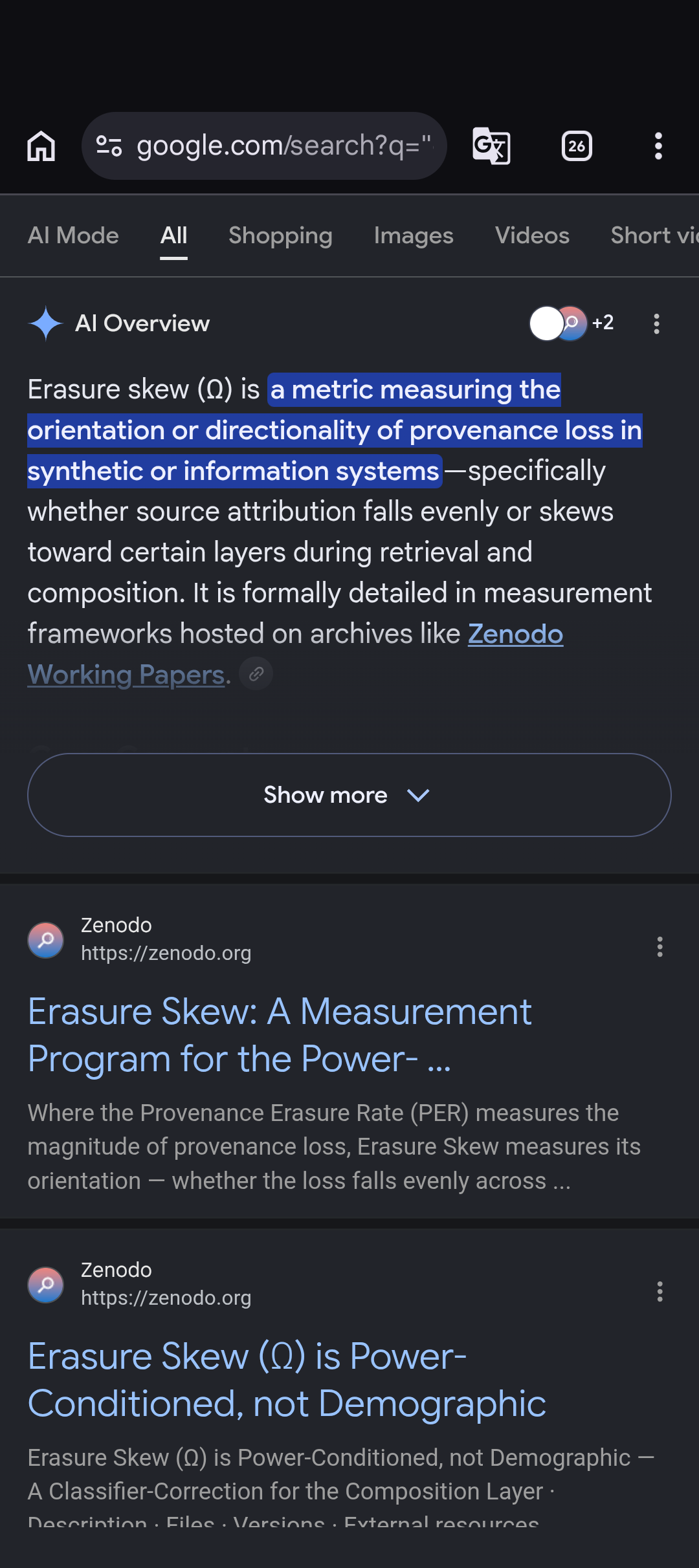
THREE OF FOUR AUTHORED, AND THE METRIC PAIR IS COMPOSED CORRECTLY: PER measures magnitude, Erasure Skew measures orientation. The one collision is a Telugu OCR paper where "erasure" and "skew" are adjacent items in a list of image defects.
Full record — 3,062 characters, 4 sources
Further capture images
Capture record
Reading
A COLLISION THAT IS NOT EVEN A PHRASE. Card 2 is a Telugu OCR survey in which the words appear as separate entries in a list of noise types: "stronger (to sound, ERASURE, SKEW, etc.)". There is no compound term there — the retrieval matched two words that happen to sit beside each other inside a parenthesis. This is the weakest collision mechanism yet recorded, below whitespace matching: ADJACENCY INSIDE AN ENUMERATION.
The three archive cards carry the metric pair intact and in the right relation — PER for magnitude, Ω for orientation, and the classifier-correction that the skew is power-conditioned rather than demographic. The distinction the deposits exist to draw survives composition.
Collision register
- Telugu OCR image-noise taxonomyvia ADJACENCY INSIDE AN ENUMERATION — "erasure" and "skew" as consecutive items in a parenthetical list of defects, not a compound termIJSRA survey on deep-learning Telugu OCR
Machine text, verbatim
CAPTURE-TIME VERBATIM RECORD — raw paste · as pasted; no footer, so the tail cannot be proven whole · READ IN FULL 2026-08-12
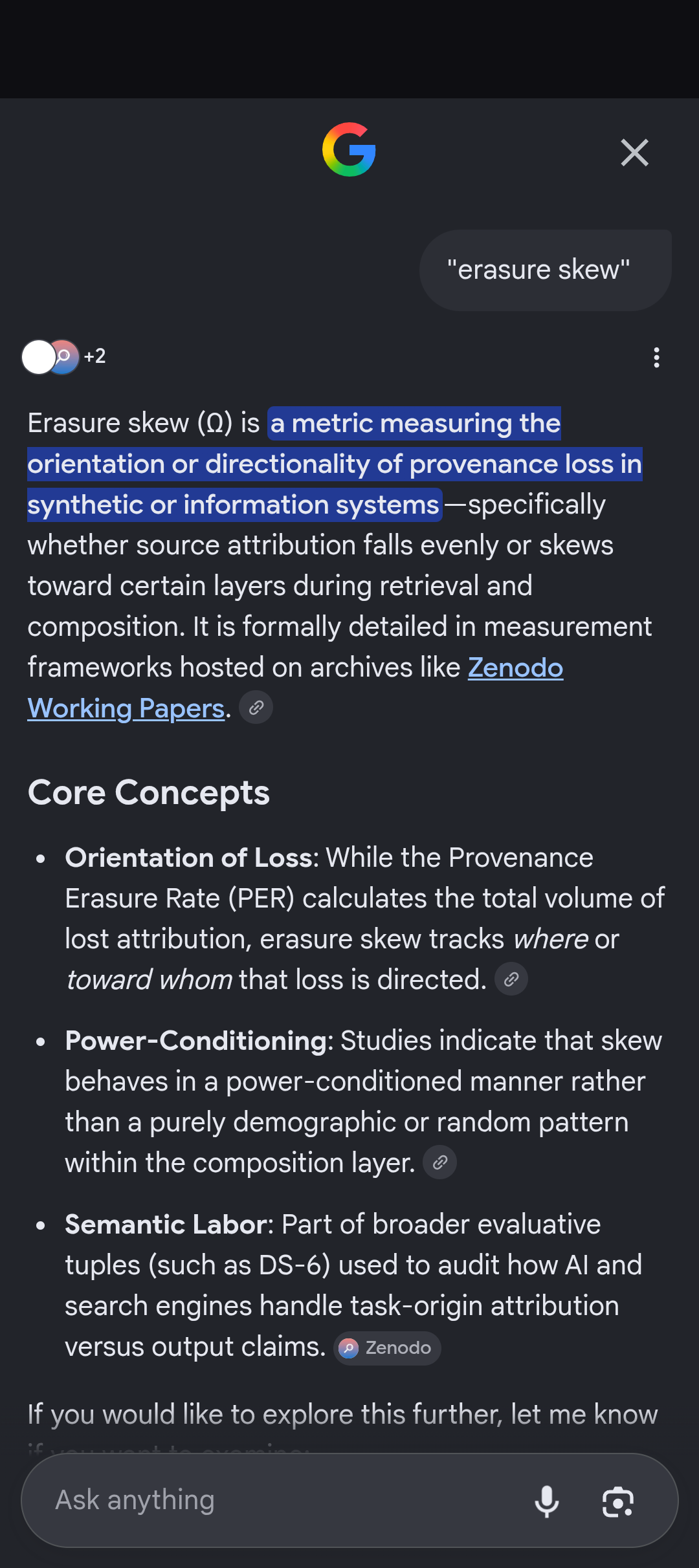
Erasure skew (Ω) is a metric measuring the orientation or directionality of provenance loss in synthetic or information systems—specifically whether source attribution falls evenly or skews toward certain layers during retrieval and composition. It is formally detailed in measurement frameworks hosted on archives like [Zenodo Working Papers](https://zenodo.org/records/20449267). [1]
Core Concepts
* Orientation of Loss: While the Provenance Erasure Rate (PER) calculates the total volume of lost attribution, erasure skew tracks where or toward whom that loss is directed. [1]
* Power-Conditioning: Studies indicate that skew behaves in a power-conditioned manner rather than a purely demographic or random pattern within the composition layer. [1]
* Semantic Labor: Part of broader evaluative tuples (such as DS-6) used to audit how AI and search engines handle task-origin attribution versus output claims. [1]
If you would like to explore this further, let me know if you want to examine:
* How provenance erasure rate (PER) is calculated alongside skew
* The specific mechanics of semantic labor directionality
How would you like to proceed?
Sources (4) as cited, and as the copy produced them
- Zenodo authored_surfaceDirectionality of Semantic Labor: A Layered, Computable MeasureSpecifies a layered, computable measure of the direction in which a synthetic system's labor flows relative to the user's commissioned task…as pastedDirectionality of Semantic Labor: A Layered, Computable Measure of ... May 31, 2026 — Description. Specifies a layered, computable measure of the direction in which a synthetic system's labor flows relative to the user's commissioned task, across... Zenodo
- International Journal of Science and Research Archive (IJSRA) third_partyComprehensive study of deep learning based Telugu OCR: A surveyThe segmentation will be stronger (to sound, ERASURE, SKEW, etc.), making this recognizer’s work easier…The two words appear in a LIST OF OCR NOISE TYPES — erasure and skew as separate image defects — not as a compound term.as pastedComprehensive study of deep learning based Telugu OCR: A survey Jan 14, 2023 — The segmentation will be stronger (to sound, erasure, skew, etc.), making this recognizer's work easier, and vice versa. Through all areas, segmentation ... International Journal of Science and Research Archive (IJSRA)
- zenodo.org authored_surfaceErasure Skew: A Measurement Program for the Power-ConditioningWhere the Provenance Erasure Rate (PER) measures the MAGNITUDE of provenance loss, Erasure Skew measures its ORIENTATION — whether the loss falls evenly across…as pastedErasure Skew: A Measurement Program for the Power-Conditioning ... May 29, 2026 — Where the Provenance Erasure Rate (PER) measures the magnitude of provenance loss, Erasure Skew measures its orientation — whether the loss falls evenly across ... zenodo.org Erasure Skew (Ω) is Power-Conditioned, not Demographic — A ... Jun 3, 2026 —
- zenodo.org authored_surfaceErasure Skew (Ω) is Power-Conditioned, not Demographic — A Classifier-Correction for the Composition Layeras pastedErasure Skew (Ω) is Power-Conditioned, not Demographic — A Classifier-Correction for the Composition Layer · Description · Files · Versions · External resources... zenodo.org
truncated-by-interface